Riding the Rails

I was in in Washington (District of Columbia variety) for a work conference the last couple days. I was all set to fly to Chicago to visit the homeland when things wrapped up. But a little while after our meetings ended early this afternoon, I wondered whether I could take the trip by train instead. I checked Amtrak online, and the Capitol Limited–you don’t take it for granted these trains exist anymore–was scheduled to leave in about an hour. I thought it over for a few minutes as I had coffee with one of my San Francisco radio colleagues. The conclusion of my deliberations: Sure, why not? So I went and grabbed my suitcase from the hotel and walked down to Union Station. I bought a ticket on one of the sleeper cars, and now I’m nearly seven hours out of Washington and twelve from Chicago.

It’s my first overnight train trip since one I took in 1976 after an attempt to hitchhike from Berkeley to Chicago ended with an unfriendly encounter with police in Cheyenne, Wyoming. I decided to catch the train east from there, called my folks and had them wire the money for a one-way ticket. I hiked to the Western Union office, then the train station, and paid my fare. It had been a miserable road trip–rides few and far between and never really long enough to make a dent in the 2,000 miles I was trying to cover. And there was other unpleasant stuff I’ve kind of put out of my mind over the years. A scary ride ride with a couple of drunks who I was scared were too out of it to make the long plunging descent on Interstate 80 from Donner Pass to Reno. The guy who picked me up in Reno and became very threatening after I declined his invitation to come home with him. (Very threatening? When I insisted he let me out of his car–we were now near some desolate place about 10 miles outside town–he complied. But a few minutes later he stopped on the other side of the interstate and called out to me that he had a gun and was going to shoot me. Yeah–I ran down the embankment off the road as fast as I could and stayed there until I saw he was gone. But for the hour or so it took for someone else to stop out there, I expected every approaching car to be this guy coming back to get me.)

When I got on that train in Cheyenne, I was drained and decided I should have a beer. One beer in the middle of the afternoon. It knocked me out, and when I came to I was alone in a coach car, which was filled with a beautiful golden light from the setting sun. For maybe 30 seconds, I had no idea where I was or what I was doing on a train car. It seemed a lot longer. Then I put it together–this is the Chicago train, we’re stopped in Denver, and everyone else has gotten off to have a smoke or stretch or grab a cup of coffee.

This trip is tame compared to that. I’m sitting in the lounge car writing on my phone–Amtrak seems to be a WiFi-free zone, and this is the only way to post. I’m ready to turn in–that’s my mini railroad bunk in the picture. See you in the morning.


Riding the Rails

Hotel Blog: View

I got in late, slept too short, and now I’m up. I’m in a new-ish kind of nice chain hotel. My sense is that I’m looking south from my hotel window over a new “loft” building (with a swimming pool on the roof), a Metro train yard, and then, in the early sunshine in the distance, a squashed cupola that memory tells me is the Library of Congress. Scanning the skyline, another familiar fragment: the statue at the very top of the U.S. Capitol, standing atop its little columned structure at the top of the dome, rises above the roofline of a much more recent building.

Hey. It’s Washington.

Air Blog: Texas Landing

shadow091813.jpg

I flew to Washington, D.C., from San Francisco on Wednesday. It’s business: a bunch of people from KQED, my employer, are attending a training at National Public Radio. Most of my colleagues seem to have contrived to fly direct on Virgin America. Not me. I managed to put myself on a one-stop, with the stop being at Dallas-Fort Worth. That’s a piece of Texas pavement pictured above, complete with a Boeing 757 shadow.

If you haven’t been to DFW, it’s huge. Many airports have tram/train systems now, and Dallas-Fort Worth is no exception. What was exceptional, however, was the length of the train ride, as only one of the two lines was running. When I got on, at one of the Terminal A stops, another passenger who’d just gotten off a flight from out west was fretting about whether he’d make a flight that was scheduled to leave in 45 minutes. I assured him that he’d be OK. Not that I really knew, but what are the chances that once you’re on the airport train rolling from terminal to terminal that you’ll miss a flight with so much leeway?

Well, he (and I) made our flights easily, really. But it was a bit of an odd trip. From Terminal A, we went to Terminal B (two stops there). From B, we went to D (two stops there). From D, we went to E (another two stops). And from E, we went to C (my stressed-out fellow traveler and I both got out at the first of the two Terminal C stops).

If I fly through DFW again any time soon, I’m going to see whether it’s possible to walk between some of these terminals.

Road Blog: ‘Bivouac of the Dead’

cemetery081613.jpg

We’ve spent the last several days making family visits in New Jersey and Pennsylvania: with Kate’s mom and sister in Monmouth County, N.J., with Kate’s cousin Rose north of Philadelphia. Yesterday, we made a long, looping drive back to New Jersey to the home of one of Kate’s closest high school friends, Lisa. On the way, we stopped in Scranton to visit the cemetery where Kate’s dad, Paul Edward Gallagher, is buried.

We’d visited the place, Cathedral Cemetery, just once before, in the summer of 1995. In the interim, I’ve discovered how difficult it is to find gravesites when you’re not intimately familiar with a cemetery’s layout (or even if you are). When we arrived, the cemetery office was already closed for the day, so we couldn’t get directions to the exact spot. I had a vague image of the part of the cemetery where the Gallaghers are interred, and we drove slowly around the place until I found a spot that looked right. We got out and went walking in different directions to see if we could find the site. I figured we’d never find it. But after looking for 15 or 20 minutes, Kate texted me that she’d found the place.

We went through an exercise I’ve gone through before, trying to note landmarks to remember for the next visit years hence. So: that group of five trees to the east of the site. The bee-hive shrine to the west. The prominent Mullaghy plot next to the Gallaghers. And I took pictures for a visual guide. I’ll look up the place on Google’s satellite maps and put an X on the spot. Assuming there is a next time, I’m sure I’ll feel lost again, at least for a little while.

During our search we also passed a section of the cemetery reserved for veterans’ graves. Civil War veterans and veterans of wars up through Vietnam. The largest group was from that first war, though, and a tablet had been put up with a stanza of a poem, “Bivouac of the Dead,” that reportedly appears at Arlington National Cemetery and many other burial places of Civil War soldiers. It’s by Theodore O’Hara, a Kentuckian who wrote it to honor the state’s dead in the Mexican War. He fought for the Confederacy in the Civil War (click the image below for a larger–readable–version).

cemetery081613a.jpg

Road Blog: Finding President Garfield

Long Branch, New Jersey.

I have a minor obsession with the assassinated President James A. Garfield. What drew my attention to him was one doleful fact about his passing: He lingered for 80 days after he was shot in July 1881. He succumbed to infections caused by the insistent and non-sterile probing of his most serious wound by a succession of doctors searching for a bullet. Alexander Graham Bell attempted to use a primitive medical detector to find the slug. He failed, perhaps because Garfield was lying on a newfangled metal-coil mattress. A medical historian summed up the case a few years ago: “Garfield had such a nonlethal wound. In today’s world, he would have gone home in a matter or two or three days.”

Instead, Garfield languished. Two months after he was shot, he was taken to Long Branch, New Jersey, a seaside resort filled with the rich and famous of the Gilded Age. Sort of a 19th century version of Malibu or the Hamptons. Those caring for the president are said to have thought maybe the sea air would help effect a cure. Or maybe they knew better and just wanted the president to be comfortable before the inevitable occurred.

Garfield was taken on a special train to Long Branch. His condition was so fragile that there was widespread discussion of how fast the train ought to travel on the trip from Washington to protect him from unnecessary jolts (the decision: slow. The 238-mile trip took about seven hours). Doctors thought it best that Garfield not be transferred to a horse-drawn coach from the train, so teamsters and citizen volunteers built a 3,200-foot temporary rail line from a nearby station to the 20-room Francklyn Cottage in the hamlet of Elberon, where the president was to convalesce. The line, built in less than a day, was tested by running a locomotive over the fresh tracks. Twice, the engine derailed because a curve in the line was too short, and that section of the rails had to be relaid. The third time, the tracks stayed in place, and they held up for a final test before the president’s train got there.

Garfield arrived on September 6, 1881, and he was duly installed in his seaside abode. He died on September 19.

We’ve been visiting Kate’s family, which lives in the general vicinity of Long Branch, for the last couple of days. Late this afternoon, we decided to drive over and see if we could find any trace of the Garfield story. One remnant you come across if you do some quick web research is a “tea house” that’s said to be built from some of the ties from the temporary railroad. It’s supposed to be the only building with any connection to the Garfield story that’s still standing. I saw online that the tea house resides outside the Long Branch History Museum, so we went looking for that. We more or less stumbled upon it around sunset and saw that the museum consists of the former St. James Chapel, a.k.a. Church of the Presidents, and several tiny frame structures (including the Garfield tea house) on a lot surrounded by a flimsy chain-link fence.

We also noticed that a little semi-private-looking lane nearby was named Garfield Road. We decided to take a walk up that street to see if there was anything related to the president there. What I was imagining was a plaque saying “this is the place where. …”

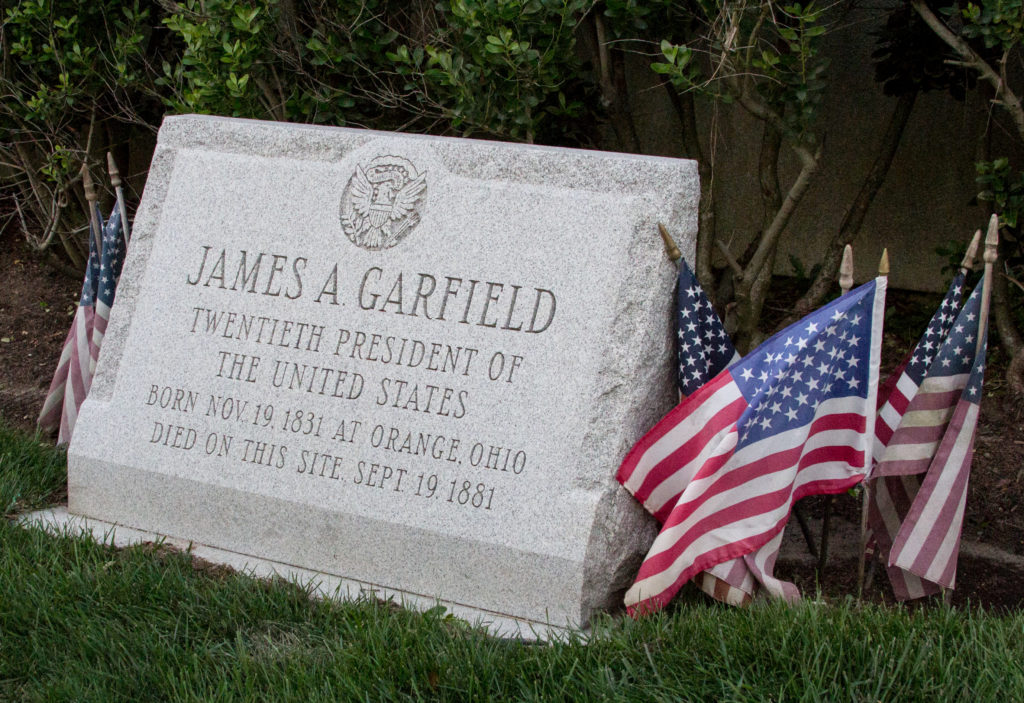
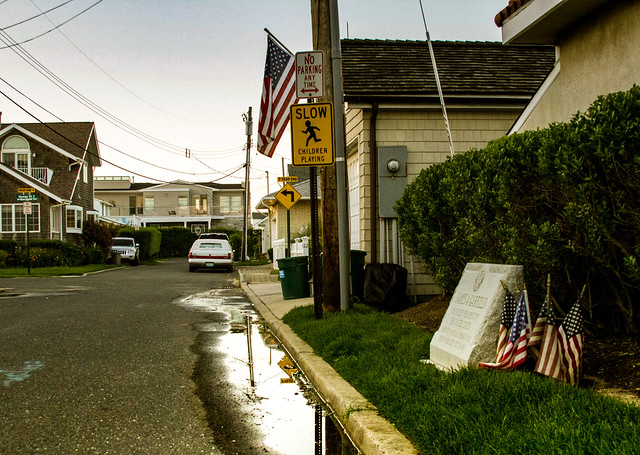
Around a corner of the lane, we encountered something just a little grander, a granite marker (pictured above) on a little patch of lawn outside someone’s shore house. It’s a wonderful scene in a way: to one side, someone’s got the garbage out for pickup. On the other, there’s a “children playing” sign. And in the middle, the simplest acknowledgment that one noted life came to an end here:

JAMES A. GARFIELD
Twentieth president of the United States
Born Nov. 19, 1831 at Orange, Ohio
Died on this site, Sept. 19, 1881

Here’s a brief explanation for how the marker came to be, by way of a nice little 1981 historical essay in The New York Times:

“In 1961, as a result of a campaign begun in 1957 by 8-year-old Bruce Frankel of Asbury Park, a granite marker was erected on the site of the cottage. Mr. Frankel, a lawyer, now lives in Fort Myers, Fla. and is still an avid reader of Presidential history.”

Garfield Lane, Long Branch, New Jersey.

Road Blog: Late Starts, and Walking New York

Advantage to flying east from the western edge of the continent late in the morning: One can enjoy a leisurely morning. Coffee. Walking the dog. Getting the house a little ready for the neighbors (hi, Marie and Steve) who will be looking after things (and the dog) while we’re gone. Finishing packing.

Disadvantage to the late start: You reach your destination pretty late. And even later if your plane is delayed, the way ours was yesterday. We climbed off the jet around 11:45 or so and reached my brother’s place a little after 1 in the morning. The fatigue of the late hour was offset by the exhilaration of finding a parking space within a block of his apartment building near the Brooklyn Bridge.

The late arrival meant we were up until all hours talking with John, my sister-in-law Dawn, nephew Sean, and niece Leah. Then we had a late start this morning (or some of us did–John and Dawn were up pretty early). Eventually, Kate and I went out with Eamon and Sakura (our son and daughter-in-law) and Sean and Leah for lunch, a hike across the Brooklyn Bridge, a visit to the World Trade Center memorial, another hike up to Chinatown for dinner (with John and Dawn), then the eight of us finished with a stroll back to Brooklyn by way of the Manhattan Bridge.

Weather: beautiful. Warm and just enough humidity to remind us what that is without beating us over the head with it. Experiences: wow, were the streets crowded. I need more time to absorb the World Trade Center site. All I can say now is that the site is somber and restrained; that was a pleasant surprise.

Here’s a clutch of pictures from the day:

Road Blog: Oyster, Hero, Backhoe Man

oyster071313.jpg

A week ago, I was traveling down the coast of Washington with my brother Chris and nephew Liam. Just after sunset, we passed through a couple little towns in Pacific County, on U.S. 101 north of Astoria–first Raymond, then South Bend. Both are right on the Willapa River, just inland from Willapa Bay. As we rolled through South Bend, population 1,700, with Chris carefully watching how fast he was going in case of a speed trap, we passed a sign pointing to a launching ramp for kayaks and canoes. I glanced over and saw what appeared to be a giant shell with a sign that said “Worlds Largest Oyster.”

“Turn around,” I said to Chris as we rolled past. He pulled an apparently legal U-turn, and we drove into a little waterfront park. The “oyster” turned out to be made of concrete–maybe a draw for the rubes, of whom I had apparently proven myself one. The main display in the park turned out to be a memorial to a son of Pacific County, Robert E. Bush, who won the Medal of Honor as an 18-year-old Navy corpsman during World War II. In fact, there was a sign saying Mr. Bush, who did well in the lumber and building-supply business, had donated money for the park. He died in 2005, but there’s a small pavilion with a plaque inscribed with Bush’s Medal of Honor citation and a statue depicting Bush’s actions. Here’s the citation:

The President of the United States of America takes pleasure in presenting the Medal of Honor to Robert E. Bush, Hospital Apprentice First Class, U.S. Navy, for service as set forth in the following:

Citation: Robert Bush, United States Navy, for conspicuous gallantry and intrepidity at the risk of his life above and beyond the call of duty while service as Medical Corpsman with a Rifle Company, Second Battalion, Fifth Marines, First Marine Division, in action against enemy Japanese forces on Okinawa Jima, Ryukyu Islands, 2 May 1945. Fearlessly braving the fury of artillery, mortar and machine-gun fire from strongly entrenched hostile positions, Bush constantly and unhesitatingly moved from one casualty to another to attend the wounded falling under the enemy’s murderous barrages. As the attack passed over a ridge top, Bush was advancing to administer blood plasma to a Marine officer lying wounded on the skyline when the Japanese launched a savage counterattack. In this perilously exposed position, he resolutely maintained the flow of life-giving plasma. With the bottle held high in one hand, Bush drew his pistol with the other and fired into the enemy’s ranks until his ammunition was expended. Quickly seizing a discarded carbine, he trained his fire on the Japanese charging point-blank over the hill, accounting for six of the enemy despite his own serious wounds and the loss of one eye suffered during the desperate battle in defense of the helpless man. With the hostile force finally routed, he calmly disregarded his own critical condition to complete his mission, valiantly refusing medical treatment for himself until his officer patient had been evacuated, and collapsing only after attempting to walk to the battle aid station. His daring initiative, great personal valor and heroic spirit of self-sacrifice in service of others reflect great credit upon Bush and enhance the finest traditions of the United States Naval Service.

–Harry S Truman

Bush was one of the veterans featured in Tom Brokaw’s “The Greatest Generation.” He died in 2005, and is buried near South Bend. I see on Google Maps that U.S. 101 through the town is named after him. And so is a naval hospital in Twentynine Palms, in the Southern California desert.

There’s one other personal memorial in South Bend’s waterside park. And whereas you can easily track down the basics of Robert Bush’s life, buy his autograph on eBay, and find pictures of him receiving his medal from President Truman, I can’t find a thing about this second honoree. Here’s his marker:

backhoe071313.jpg

The text reads: “Burke J. Welsh, 1948-2005. Expert Backhoe Operator. South Bend Fire Department, 1975-1993. Lifetime Community Volunteer and Lifelong Friend.” That, and the fact folks in town thought enough of Mr. Welsh to remember him this way, is all I know about Mr. Welsh despite deploying my magical Internet skills (there’s a preview of my own someday plaque).

After we left the park, we saw that one of the local cops had pulled over a car–a gaudy PT Cruiser with British Columbia plates–about a block down the way. Always watch for that speed trap.

A Long Walk

Last Saturday, the 1st of June, I skipped my usual weekend sleep-in and got up at dawn to go on a walk. OK, nothing terribly unusual there. But this wasn’t just going to be a stroll out for morning coffee, or even a hike in the hills. I needed to be over at Candlestick Point in San Francisco–yes, where the stadium is–to start an all-day hike around the San Francisco shoreline. The entire San Francisco shoreline, all the way up the eastern bayside, past landmarks like the old Hunters Point naval base, Phone Company Park, the Bay Bridge, and Fisherman’s Wharf, then across the northern shore past Fort Mason and the Marina and the Golden Gate Bridge, then south past Land’s End and Cliff House and along the beaches all the way to Fort Funston.

That’s 23 or 24 miles, depending on detours along the way. Molly Samuel, a colleague and friend at the Public Radio Station where I work, dreamed up the project and scouted out the route and then walked it last June with about 15 people. (Another Public Ratio Station in town actually did a cool little feature on the event afterward.)

I think the best reason to take a hike like this is no reason at all–because it’s there, because you can. But for me, there was something else: There are big slices of the city I’ve never really seen, especially its southeast corner, where we started–Bayview and Hunters Point–and this was a way of starting to stitch together pieces I know with new pieces I don’t really have a sense of. I’m pretty confident we may have walked adjacent to one of the poorest census tracts in the city–the Double Rock housing project, out by Candlestick Park–and through the wealthiest–the Seacliff neighborhood between Baker Beach and Land’s End. And walking along Ocean Beach is always a little bit of a surprise: a magnificent strand that seems to stretch forever into the mist fronted by a diverse collection of neighborhoods, some blocks looking pretty affluent, some looking pretty hard-scrabble. It was a trip I wanted to record; the result: lots of pictures.

The biggest surprise of the walk for me: Although it took eleven and a half hours to complete, including stops for lunch and snacks and regrouping along the way, I never felt fatigued and the day never dragged. I don’t really think I looked at the clock once except out of curiosity. I think one reason, maybe the main one, was that the group was so sociable and comfortable and there was interesting conversation every step of the way, or engaged silence if that was what you wanted.

Molly said she noticed last year that you see certain landmarks ahead of you for a long time and they sort of work their way into your consciousness as a way to mark your progress. And that was true: the Bay Bridge was out there in front of us for a long time. Then the Ferry Building. Then the Palace of Fine Arts and the Golden Gate Bridge, until you arrive at the top of the bluff at the northern end of Ocean Beach with those miles of sand spread out forever. You’d see those sights, gain slowly on them, then be slightly amazed that you’d already arrived at them and then surprised again to take a glance back to see them disappear.

That’s it, except to say thanks to Molly and everyone else for a fun day out of doors.

Here’s the slideshow.

California Road Trip: Yolano Wandering

vultures052413.jpg

As earlier recounted, Kate and I went up the Delta on Friday, the beginning of the Memorial Day weekend, in search of ferries. After riding back and forth on the Real McCoy II (just outside Rio Vista) and the J-Mack (at a non-place called Howard’s Landing, across Steamboat Slough between Ryer and Grand islands), we started thinking about getting something to eat. We both had the same thought: a hamburger. One place to procure a decent one–OK, everyone’s got their own idea of decent–In N Out Burger in Davis.

So we set out north from Rio Vista, ignored signs that we were trespassing as we crossed onto Hastings Island, then hit state Highway 113 somewhere south of Dixon. My knowledge of the farms roads in that part of the world, earned from cycling on some of them day and night, told me we ought to head east off 113, in the general direction of Davis, which still lay to the north. I turned on Midway Road and at every crossroads looked for names that looked familiar. Pedrick Road–I knew that would take us up to Interstate 80 a few miles southwest of downtown Davis; I kept heading east on Midway. At one corner, I saw a sign for Yolano–my favorite kind of name, a hybrid of two places (Yolo and Solano counties, in this case) and probably right on their border. I headed east thinking there might be a town out there I had never seen. We got to Midway and Yolano roads–farms in every direction (looking at the map now, the hamlet is south and west of this intersection).

Eventually I started to get the feeling I’d driven too far east. Way off in the lowering sunlight to the northeast, I could see some tall buildings that had to be downtown Sacramento. I kept east but decided to turn north at the next opportunity, no matter what road I came across. It was Levee Road, and it was gravel.

I turned, and just north of the intersection with Midway, on the lefthand side of the road, the west side, just at the edge of the right of way, there was a big stand of eucalyptus, maybe a shelter belt for a nearby farm. And there were dozens of turkey vultures in the trees, getting ready to roost for the night. We stopped to take a look. The birds stirred. Then Kate pointed up to a tree that had a pair of big white egrets, right in among the vultures. I grabbed my camera and opened the door to climb out and take pictures. And doing only that much prompted a mass takeoff of the vultures–50, maybe 100 of them, along with the egrets and maybe a stray hawk or two. Some turkeys that were roosting nearby started to gobble. It was a full on big-bird party.

Here’s a snippet of the sound, and after that, a couple more pictures:

Picture above: Vultures (and maybe others) above eucalyptus grove in Yolo County, south of Davis. Below left: turkey vulture at same location. Below right: turkey vulture at same location and airliner far above (I’m having trouble identifying the plane, though: It looks like a four-engine jet, and the colors look like a United scheme; as it turns out, there was a United 747 to Frankfurt passing over the area right about this time, so maybe that’s it.)

vultures052413b.jpg vultures052413a.jpg

Illinois Road Trip: The Eternal Indian, and Other Stories

bettycroft091012.jpg

Last September, our family gathered in Chicago for a memorial for my dad. It’s one of those events that seems like it happened both long ago and just yesterday; long ago in that I can’t believe that nearly nine months have passed, just yesterday in that some of the experiences of last summer seem so immediate.

Anyway, people came from all points of the compass. We had a short family gathering at Holy Sepulchre Cemetery, just past the southern edge of Chicago, where Dad’s ashes were being placed in the same grave where Mark, our brother, who died in 1960, is buried and where Mom, who died in 2003, is also inurned. After our ceremony, we walked around and visited some of Mom’s family elsewhere in the cemetery, then we drove back up to my sister Ann’s house on the North Side for a memorial–a party, really–with other friends and family.

Early the next day, people started to head home: our older son Eamon and his wife Sakura to New York, my brother John, also to New York, and last Thom, our younger son, back to the Bay Area. That was on Monday, it was already mid-afternoon, traffic back into the city looked like it was backing up on the expressway outside O’Hare. As we left the airport I asked Kate whether she’d just like to go for a drive someplace instead of going back into the city. She was game.

We headed west with no particular destination in mind. But if you go west from Chicago, there’s one destination I automatically think of, and that’s the Mississippi River. That was one of Dad’s favorite trips, and I usually never hesitate to start out on a foolishly long drives, but as we tried to get free of the traffic in the northwestern suburbs, even I had to concede it didn’t seem realistic since we had to be back the next day to fly home ourselves.

So then I thought of another place that seemed more reachable: the Black Hawk statue on the Rock River, near the town of Oregon.

Dad took us there when we were kids–it might have been the time he took us on a drive out to White Pines State Park with his mother, a trip during which I remember him getting our new gold Chevy Impala station wagon, complete with a 327-cubic-inch V8, up to 90 miles an hour on Illinois Highway 64. I would have been 13, and what I remember is that we pulled over on Highway 2, which goes up the west bank Rock River from Oregon to Rockford, to look at this statue on a bluff across the water. It made a huge impression–an impassive , blanket-clad stone figure gazing out across the river and off to the west.

So, driving west last September on Illinois Highway 72, I told Kate I thought we could get there before dark and that it would be well worth the trip. Along the way, we stopped to check out a historical marker in a town called Stillman Valley. The site turned out to be the burial place of militia members killed in the first battle of the Black Hawk War of 1832. (Yes, I had heard of Black Hawk’s War, but remembered it mostly for the name of its last skirmish, the Battle of Bad Axe, and the fact the brief conflict marked Abraham Lincoln’s first and only military service).

Driving on, we hit the Rock River at Byron and turned south. We made a detour so I could take pictures of the big nuclear power plant between Byron and Oregon. And eventually, we made it to Lowden State Park, home of the Black Hawk statue (titled by its creator, sculptor Lorado Taft, “The Eternal Indian”). As we parked, we encountered an older woman sitting in her car and finishing up her dinner, from the McDonald’s in Oregon. She directed us to the statue and said she’d be over in a few minutes to tell us about it.

So: I had my camera with me, and I had an audio app on my iPhone that was good enough to record our guide, Betty Croft. That’s her picture up above. We talked to her for an hour, until well after dark. It took me until the past week to actually sit down and listen to the audio and figure out what to make of it. Here it is (edited down to four minutes or so):