Friday Ferries: Delta Edition

ferry052413.jpg

I’ve known for a while about ferries in the Sacramento-San Joaquin Delta, barge-like little boats that run across the side channels to the main rivers and at a couple of points actually provide continuations for state highways (84, a rather long one, and 220, a very short one). But the Delta isn’t really next door. The closest gateway is Antioch, in eastern Contra Costa County, about 50 miles northeast of Berkeley. So the ferries up there were just little dotted lines on the map.

We both had the day off today, got up late, did a couple chores, and early in the afternoon headed up to the Delta by way of Antioch and Highway 160. We caught the Real McCoy II ferry, which crosses something called Cache Slough (apparently the outflow of Cache Creek, which flows out of Clear Lake, about 80 air miles and a lot more stream miles to the northwest) onto the west bank of Ryer Island. We drove around to the east bank of Ryer Island and took the J-Mack ferry across Steamboat Slough (so called, I’ve heard, because it was the favored route of early river boats that ran from the Bay Area up to Sacramento) to Grand Island. (That’s the picture above, looking east toward Grand Island.)

And then we noodled around a little, stopping in Walnut Grove, a little town on the Sacramento River, and puzzling over the map trying to see a way of getting north from where we were to Davis while avoiding the capital city and suburbs. The only way was to head back down across the ferries to Rio Vista, then double back north to the west of Cache Slough and the Yolo Bypass. We managed that and eventually came to a bridge shown on the map between Liberty Island and Hastings Island. There was a sign declaring the bridge was a private road. I walked across it and saw a couple big signs declaring the road and land beyond to be private. Back at the car, I decided to see if anyone who had come out this far–we were on a gravel road atop a levee, surrounded by fields full of hay, wheat and corn–had posted anything about whether the road ahead was really private. I came across a posting from a hunting club that told visitors to ignore the “no trespassing” signs and just head across the bridge. So, that’s what we did, and drove onto Hastings Island.

After crossing to the west side of the island, we were back up on a narrow levee road with a view of Mount Diablo maybe 30 or 40 miles to the south. We approached a farm, and right there on the side of the road, a horse looked like it was leaning against the side of a red barn. The sun was low and even though I just glanced over, the light and shadow were dramatic. I kept going, but decided to turn around to take another look. And that’s what you see below. I’ll add that the horse looked spent. Old, tired. Skin and bones. Someone’s good friend, I hope. Waiting on sundown.

horse052413.jpg

Roadside Find: Zedonk (or Is It a Donkra?)

zedonk032713.jpgzedonk032713a.jpg

Exotic fauna of Sutter County: a zebroid on the hoof (click for larger images).

We’re in the bittersweet last day or so of our joint spring break (Kate from the demanding world of public education, me from the somewhat less demanding world of public broadcasting). At the beginning of the week, we went on a mini road trip to see a relatively little-visited natural wonder I’d read about in the paper a few weeks ago (Feather Falls–more on that later). We wound up spending a day driving up to one of the state’s big reservoirs, Lake Oroville, a day hiking, then another day winding our way back down to the Bay Area.

There’s a certain part of the Sacramento Valley I’ve gotten to know from riding a bicycle through it–generally the area on the southern half or so of the valley, from the state capital up to about Chico. The most striking visual feature of that part of the state, almost everyone would agree, is the volcanic remnant rising up from the floor of the valley, known now as the Sutter Buttes. Someone sometime in the distant past–probably Ripley’s Believe-It-or-Not, probably in the 1940s–designated the buttes, which rise to a maximum elevation of just over 2,100 feet and cover about 75 square miles, “the smallest mountain range in the world.”

One thing about the buttes: though a piece of the central buttes is now public land, access is across private land and thus only possible by appointment–either on a pre-arranged tour or with researchers (a public-radio colleague, Molly Samuel, got in a while back with some biologists studying an animal I had never heard of before: the ringtail). So what the public gets to do, generally, is drive around the perimeter. Wednesday, that’s what we did, retracing a path I’ve ridden a few times in the past. West of Yuba City, just outside the little town of Sutter, we had our own exotic animal encounter.

Passing a farmyard, Kate called out, “Is that a zebra?” I missed whatever she had seen, but when I looked over, I saw a couple of llamas (more and more common on ranches here) and, very uncommon, a camel. A camel? A zebra? I turned around to take a look.

The “zebra” was pretty clearly a hybrid of some kind–probably a cross between a zebra and a donkey. She, or perhaps he, certainly looked like a donkey and had the docile, inquisitive nature of a donkey, coming right over to the fence to check out Scout (a.k.a The Dog). We checked out some of the other animals on the premises–some odd-looking goats, a pygmy donkey of some sort, the llamas, a few horses, the aforementioned camel, and a pack of furious dogs that seemed to contain at least one labradoodle.

Wikipedia says zebra/equine hybrids–known generally as zebroids–have a long history and even drew Darwin’s attention. The names for the crosses are many, including zonkey, donkra, zedonk, zebonkey, zebronkey, zebrinny, zebrula, zebrass, and zebadonk. I came up with my own term: variegated ass.

On the Road, 1973 Style

I’m trying to do a little project before the year gets too old: publish my dad’s 1930 diary, which his mom forced him to keep when the family traveled out to California, alongside my journal of my first trip out West, including California, in 1973. (When I say “publish,” I’m mostly talking about uploading scans to this here blog.)

Anyway, I started to look at what I was writing 40 years ago as I hitch-hiked down the coast in February from Vancouver. One thing I had kind of forgotten: I’d gotten it into my head that I ought to try to write down notable conversations I had with people along the way. And I see stuff in there now featuring rides and people I honestly don’t recall. There’s a good example near the beginning of my trip.

On January 31, I took the ferry from Vancouver to Victoria to Port Angeles, Washington. On February 1, I headed down the coast via U.S.101 West. Here’s part of the entry at the end of that day (and yes, this is just how I wrote it down):

“I met some interesting people today while hitch-hiking. A logging truck driver who picked me up in Port Angeles, a Washington State geology grad, a mother of two from Quinault who related the details of relatives’ mill accidents:

” ‘My husband got his hand caught in a chain, and it ground his fingers up good; he lost one, and has to hold his hand like this (she held her hand up in a clawed position)

” ‘And my brother in law, he was sawing shakers at a mill and cut right up the middle of his index finger–to the second joint–but his hand is perfectly all right.

” ‘He’s only 18, but last year, he crashed his car down a thousand foot embankment. The car, it was a brand new Super Bee, hit the embankment twenty times on the way. And he got a bruise on his forehead.’ “

“One of her little girls said: ‘Daddy’s finger is growing back.’

” ‘No, Shelley,’ the mother replied. ‘Once you lose a finger, it doesn’t grow back.’

” ‘But I don’t want daddy’s finger to look like that forever,’ Shelley said (she was about five).

” ‘But the bones in it were too smashed up honey, and they couldn’t fix it.’ “

Those folks dropped me off somewhere along the road. I can’t say where, exactly. What I do remember is how wet it was on the coast of the Olympic Peninsula and how dense the forests seemed. And banana slugs–I think I saw one that day for the first time. I remember ending up the day in a little state park in the southwestern corner of the state, how gray it seemed, how early darkness came, and how much I missed being at home with my family and friends close by.

So, here I am in 2013. What I’m wondering to myself is whether I listen as carefully now as I did for a few minutes back then.

Morning Rituals

watchtower112112.jpg

We got up early this morning in Brooklyn Heights to play a pursue a favorite neighborhood pastime: moving the car from one temporarily illegal parking spot (it’s a street-sweeping day) to a spot that will be temporarily illegal tomorrow (or maybe not, since it’s a holiday). We found a gorgeous new parking space on the north/east end of the Brooklyn Heights promenade. The view across the East River where it opens out into New York Harbor was dazzling. As I started to climb out of the car, I saw a procession of people walking up the promenade. Scores of them, all in business attire. My surmise: They were all headed to the Jehovah’s Witness headquarters, just down the street. The church is a major landowner in the neighborhood where the Brooklyn and Manhattan bridges touch down on the east side of the river, with several large buildings bearing the legend “Watchtower”–the name of the church’s publication.

We stayed and took in the view, watched the parade to The Watchtower, then walked through the stream of parents and kids and commuters to get our first coffee of the morning.

brooklynheights112112a.jpg

Journal of Airliner Seat Photography

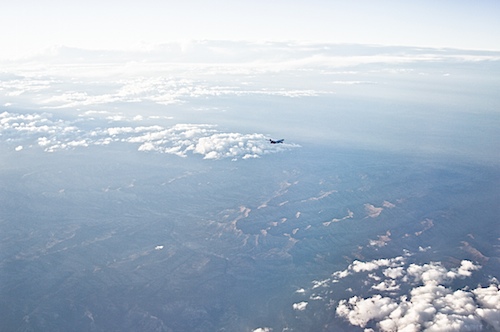
One thing you notice when you spend hours staring out an airliner window in flight is other airliners streaking past. Sometimes you’ll see them headed in the same direction, flying roughly parallel to your path. Mostly, you see them go flashing by in the opposite direction (last week, we saw four in the space of about 30 seconds).

In the shot above, taken July 26, I was on an American Airlines flight headed west from Chicago to San Francisco. The local time, somewhere over Utah, was about 8:20 p.m. Suddenly, I spotted a jet heading north/northeast that appeared to have crossed below and ahead of us. It was there and gone in a few seconds, but I had my camera in hand and shot several frames before it disappeared.

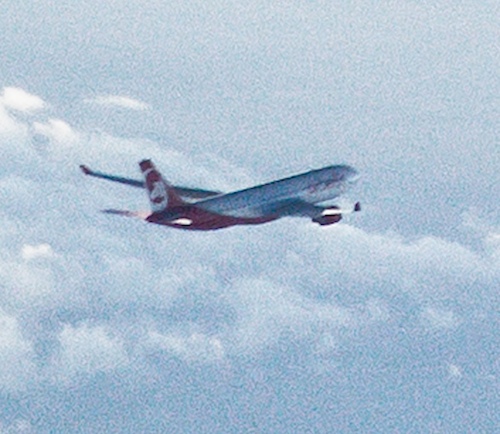
Looking at the pictures afterward, I tried to make out the words and logo pained on the aircraft. After searching for a few minutes, I came up with an answer: Air Berlin. My educated guess, thanks to the airline site and looking for records on FlightAware.com, is that this was Air Berlin Flight 7499, about 46 minutes into a direct from from Las Vegas to Duesseldorf, and that our position at this moment was about 50 miles northeast of Price, Utah.

Below is a cropped image of the airliner, an Airbus 330. And below that is the original image–which among other things makes it clear how late in the day it was–before I started fiddling with it digitally to identify the plane.

Friday Night (Chicago) Ferry

chicagoriver050412.jpg

I’m not in the Bay Area to do our Friday night ferry ritual. So the next best thing was to do a Friday evening boat trip in Chicago. Ann (my sister) and Ingrid (my niece) and I drove downtown and caught a Wendella cruise from a dock just beneath the Michigan Avenue bridge over the Chicago River. The first third of the 90-minute cruise heads west to the South Branch of the river, heads down a little way, and turns around when it’s just below Sears (Willis) Tower. Then it head back out to the lake, goes through the Chicago River lock out to the lake (there’s a two-foot elevation difference between the lake and engineered river), then a short spin north from the mouth of the river, then south toward the planetarium and aquarium, then back into the river.

Yesterday featured shockingly fine mid-spring weather. It was a not-overly-humid 85 with a what we in the Bay Area call an offshore wind–the breeze was coming from the southwest and blowing out over the water, meaning the cooling influence of Lake Michigan was felt (and then only slightly) immediately along the shore. That beautiful day ended in a long evening of lightning, thunder, and pounding rain, and by mid-morning today the wind had turned around and was coming from the northeast, off the lake. The high here today was about 60. And on the boat this evening, it was quite cool. But as long as we were on the river, well below street level, there was hardly any wind. But I noticed that as soon as we headed out toward the lake, the tour guide who had been filling us in on the architectural scene along the river grabbed her gear and headed for the downstairs cabin. “I’ll be back,” she told me. “But the wind is blowing so hard out here you won’t be able to hear me.” The U.S. and Army Corps of Engineers flags flying at the western end of the lock were standing straight out in the breeze as we approached. I saw in the paper today that the lake’s surface temperature is 43 degrees near shore, and as soon as we got out into that wind, it felt–well, pretty cold.

Then we turned around and came out of the tempest, back through the lock, back down the river. The scene above: the new Trump Building (second tallest in Chicago, a sign at its base boasts), with the Wrigley Building at right (decked in blue as part of a commemoration of fallen Chicago Police Department officers).

Air Blog: To Chicago

flight050212.jpg

I managed to miss my scheduled flight earlier today by attempting one too many last-minute tasks before I headed out the door to the airport (including the daily Last Task Before Leaving, walking The Dog). I took BART out to SFO and knew I was kind of cutting it close and got to the baggage counter to check my bag about five minutes after they’d stopped taking luggage for my flight. Since they want you to be on the same plane as your baggage (think about why that is), both I and my bag got moved onto the next flight about an hour later. That was fine by me (though I might have emoted more if the delay had been four or five hours). My substitute flight was late, and for some reason the trip seemed much longer than the three and a half hours it was.

But all that’s ancient history. I’m up on the North Side now, at my sister and bro-in-law’s place in West Rogers Park. It’s one of those perfect nights in Chicago, springtime or anytime: warm until well after midnight, but not humid enough that you feel like the warmth is hanging on you. It’s calm and a little hazy but clear enough to see the brightest stars.

California Salmon: Slideshow of the Day

Some pictures I’ve been sitting on for oh, the last year and a half. The September before last, Kate and The Dog and I took a Sunday field trip to the state fish hatchery just below Oroville Dam. It was a perfect day in the Sacramento Valley, clear and brilliantly sunny but not really hot — maybe 85 degrees. The first decent chinook salmon run in several years was under way, and in the three or four hours we hung around, several hundred people, almost all locals, showed up to take a look at the fish. A quick look at some of what we saw (captions to come): 

Superior Suds

A random Sunday morning find in my 2011 photos–an August street scene in Brooklyn. This was at 5th and Baltic, as Kate and I walked from Court and Warren streets down to Grand Army Plaza to meet our friends Jan and Christian at the Brooklyn Public Library. superiorsuds.jpg

‘A Ruin, Only in Reverse’

The Ziolkowski monument to Crazy Horse in South Dakota’s Black Hills.

Last June, I drove from Seattle to Omaha with my son Eamon and my daughter-in-law Sakura. Our first day took us into western Montana. The second day saw us get to western South Dakota after a stop at the Little Big Horn. And the third day we started out with a quick blast through the Black Hills. We stopped in Deadwood, then headed to the Crazy Horse monument. That’s the picture above. If you pay a little extra when you visit the memorial, you can take a bus ride right up close to where the work on the monument is going on.

I had been to Crazy Horse once before, back in 1988, with my dad, when we were on our way to the Little Big Horn. Back then, you had to take the artists’ word that something would emerge from the mountain they were blasting away. At the visitors center, we paid a dollar for a chunk of granite from the rubble, faced with mica and shot through with what look like nodules of pyrite. The rock’s here on the dining room table as I write this. Twenty-three years later, something dramatic has been brought out of the mountain, and the scene around the area has changed, too. The site is now approached on a route that’s turned into a major highway, and the turnoff is controlled by the kind of traffic signal you see on expressways in San Jose. There’s an entrance plaza with maybe six lanes, just like going into a stadium parking lot. After that, there’s plenty of parking, a museum, shops, and beyond that, the mountain. Lots of people were visiting the early June day we stopped, though I wouldn’t say the place was overrun.

A few days ago, I came across Ian Frazier’s account of his visit to Crazy Horse, probably within a year or so of when we were there. Here’s what he saw, as recounted in his book “Great Plains“:

“In the Black Hills, near the town of Custer, South Dakota, sculptors are carving a statue of Crazy Horse from a six-hundred-foot-high mountain of granite. The rock, called Thunderhead Mountain, is near Mt. Rushmore. The man who began the statue was a Boston-born sculptor named Korczak Ziolkowski, and he became inspired to the work after receiving a letter from Henry Standing Bear, a Sioux chief, in 1939. Standing Bear asked Ziolkowski if he would be interested in carving a memorial to Crazy Horse as a way of honoring heroes of the Indian people. The idea so appealed to Ziolkowski that he decided to make the largest statue in the world: Crazy Horse, on horseback, with his left arm outstretched and pointing. From Crazy Horse’s shoulder to the tip of his index finger would be 263 feet. A forty-four-foot stone feather would rise above his head. Ziolkowski worked on the statue from 1947 until his death in 1982. As the project progressed, he added an Indian museum and a university and medical school for Indians to his plans for the grounds around the statue. Since his death, his wife and children have carried on the work.

“The Black Hills, sacred to generations of Sioux and Cheyenne, are now filled with T-shirt stores, reptile gardens, talking wood carvings, wax museums, gravity mystery areas (‘See and feel COSMOS–the only gravity mystery area that is family approved’), etc. Before I went there, I thought the Crazy Horse monument would be just another attraction. But it is wonderful. In all his years of blasting, bulldozing, and chipping, Ziolkowski removed over eight million tons of rock. You can just begin to tell. There is an outline of the planned sculpture on the mountain, and parts of the arm and the rider’s head are beginning to emerge. The rest of the figure still waits within Thunderhead Mountain–Ziolkowski’s descendants will doubtless be working away in the year 2150. This makes the statue in its present state an unusual attraction, one which draws a million visitors annually: it is a ruin, only in reverse. Instead of looking at it and imagining what it used to be, people stand at the observation deck and say, ‘Boy, that’s really going to be great someday.’ The gift shop is extensive and prosperous, buses with ‘Crazy Horse’ in the destination window bring tourists from nearby Rapid City; Indian chants play on speakers in the Indian museum; Boy Scouts, Girl Scouts, local residents, and American Indians get in free. The Crazy Horse monument is the one place on the plains where I saw lots of Indians smiling.”

If you happen to go to the monument in the fall, there’s a walk to Korczak Ziokowski’s tomb every year on October 20, the anniversary of his death. Also interred there: his daughter Anne, who died last year just a few week’s before we visited. Her obituary, brief as it is, speaks volumes about the family’s commitment to the Black Hills.

Black Hills Crazy Horse monument in closeup.