Little Egypt, Cairo, and Cotton-Gin City

Other notes on our southward drive:

–Passed through Salem, Illinois. One claim to fame, according to venerable roadside marker: It’s the gateway to Little Egypt (that’s Southern Illinois, for Alan Keyes and other non-Prairie Staters). Another: It’s the birthplace of William Jennings Bryan, memorable losing presidential contender and opponent of evolutionary theory. Another: Oil was discovered near town in 1938; by ’42, they were pumping 259,000 barrels a day from there (we saw some scrapped oil pumps just outside Salem).

–Speaking of Keyes, we drove the entire length of the Land of Lincoln and saw not a single Keyes sign. Dad thinks maybe that’s because the Republicans haven’t made any. Saw maybe a dozen Bush-Cheney signs. A half-dozen for Barack Obama. One for Kerry — in the window of a United Mine Workers hall in Benton. Not a lot of interest in big-time national-type politics, sign-wise, in a 400-mile tour of the state. But there are tons of signs for everyone else who’s on a ballot: state legislative candidates, sheriffs, state’s attorneys, coroners, judges, you name it. The other impression: This is big yellow-ribbon “support our troops” country.

–We detoured slightly through Vienna, hometown of late legendary Illinois Secretary of State Paul Powell. Mom and Dad actually saw him speak once, on behalf of John Houlihan, a Park Forester and World War II Marine amputee (he lost a leg at Iwo Jima is the story I heard) who was running for the state House of Representatives in the late ’60s. Powell appeared at a dinner in Joliet and apparently was the most captivating (even lovable, Dad says) of all the politicos present. Mom’s comment at the end of the evening was, “He’s a charming old rascal, isn’t he?” Powell died a couple years later, I think, and became a legend when something like $800,000 in cash turned up in his Springfield hotel room, stuffed in shoe boxes. I was confident there’d be some sign of him in Vienna, which I remember being told is pronounced VYE-enna, and sure enough, on the main drag an official-looking sign pointed to the “Paul Powell Museum.” We turned up a pretty residential street and drove to its end on the northern edge of town. No museum. Made a couple other passes with no success. We’ll have to look again the next time we pass through Vienna.

–The country around Cairo is lush, levee-protected bottom land. Cairo itself, though, is a blasted-looking place that looks like it could be washed away with one more good flood. You get a hint of that driving through on the main road, Washington Street/U.S. 51. Dad spotted a building collapsing a block over toward the levee, on our left, and I turned that way to see whether we could get up on the embankment and see the Ohio River. We found a place to drive up on the levee as the sun went down. Even filled with barges and bordered by a semi-industrial landscape, the big spread of water flowing in its final mile to the Mississippi, visible just beyond a bend below town, is memorable. Then we retreated down into the heart of Cairo’s broken-down historic district. A line of battered old buildings line a wide street parallel to the levee. But it looks like it would take nothing to knock them down. The only signs of life were at a couple bars that have managed to stay open. The vintage-looking streetlights and wrought-iron benches along the deserted streets only added to the sense of twilight desolation.

–Staying the night in Charleston, Missouri. Comfort Inn. Cuisine: McDonald’s. Dad notices in perusing the local phone book that there are seven cotton gins listed in the area. Two K-marts and a bunch of Wal-Marts, too.
Road Blog: Tolono 09.11.04

Dad and I headed south from Chicago, leaving the North Side about 9:30 a.m., going down Lake Shore Drive and the Dan Ryan before peeling off to the southwest on Interstate 57 with a destination of Cairo, all the way at the southern tip of the state. We stayed on that all the way down to Tolono, a small town that’s the subject of a railroad song by Utah Phillips (I wrote briefly about the song earlier this year).

The old Illinois Central (now Illinois Central Gulf) and Wabash (now Norfolk Southern) lines come together in town. In his song, Phillips describes the place as a flag stop — a place too small to have regular service. That looks like it was probably true, though there are so few passenger trains now that I’m sure it’s been decades since even a flag stop was made.

We got off the interstate just northwest of Tolono and drove into town on U.S. 45. I noticed while we were heading through that there was a sign for a historical marker. But as we passed the spot indicated — the entrance to a gas station — I didn’t see a marker. We drove out the south end of town, turned around, and tried again. We turned in at the gravel entrance to the gas station, but still didn’t see anything historic looking. But we did see a local constable parked in his Tolono squad car, apparently waiting for speeders . He lowered his passenger-side window as we rolled up.

“We were looking for that historical marker,” I said.

“What?” he answered.

“Do you know anything about the historical marker that’s supposed to be here?”

“A drunk took it down last winter. State still hasn’t put it back up.”

“Do you know what it was for? What the marker was for?

“I don’t know. State’s supposed to put it back up again.”

I had my camera out, but I couldn’t bring myself to ask whether I could take the officer’s picture. I also didn’t ask how long he’d been living in the area that he had no idea what this marker was about. Inquiries like that could be a threat to homeland security and speed-zone enforcement. Instead, Dad and I drove off to see Tolono; I was hoping there’d been an old station or stop of some kind I could photograph so I can send a shot to my old friend Gerry, who used to play the song so well. But there’s not a whole lot happening in town, certainly no evidence of a rail-passenger platform anywhere. I shot a couple scenes along the Norfolk tracks anyway. Then we headed back to U.S. 45 to go south for a few miles and get back on I-57.

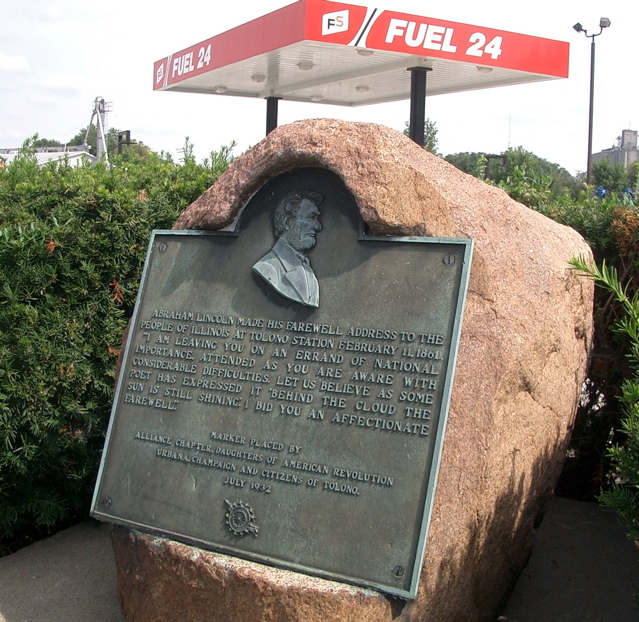
We passed the historical marker sign again, and going by the gas station I finally saw the monument. It was a tablet set into a boulder in among some sort of ever-greenery. The bushes kind of looked like landscaping for the gas station, and the boulder hadn’t been visible when we were consulting local law enforcement about markers of historical significance. The police officer had been parked no more than 100 feet from the spot.

We halted again, and it turned out to be worth it this time. The marker commemorates what is said to be Lincoln’s last speech in Illinois, on February 11, 1861, during a brief stop on his journey east to be inaugurated. One site notes that Lincoln stopped further east, too, in Danville, and spoke to a crowd there. A railroad-centric account of the journey mentions Tolono, but not Danville.)

Lincoln’s brief Tolono speech is on the marker:

“I am leaving you on an errand of national importance, attended as you are aware with considerable difficulties. Let us believe as some poet has expressed it, ‘Behind the cloud the sun is still shining.’ I bid you an affectionate farewell.”

Monument commemorating Lincoln’s stop in Tolono, Illinois, (just south of Champaign) in February 1861.

Chicago Dispatch 09.10.04

697

Slow Friday. Beautiful end-of-summer weather here. Sitting outside at a non-Starbucks wirelessly endowed cafe on North Sheridan Road. Just about to shut things down here and walk back west to my sister’s place for dinner with her kids. Then perhaps tomorrow, Dad and I will take a little drive someplace for the weekend. Details still unsettled.

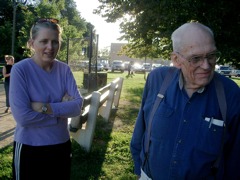
Yesterday, I went for a bike ride up along the north shore, then returned to my sister’s, then went out to the park to watch my nephew, Soren, at soccer practice. Here’s Dad and Ann, who are both taking in my niece Ingrid’s antics.

Reading While Flying

outsideSo, another thing about flying: I’m almost always glued to the window to watch the geography below. But I made an impulse newsstand buy before I got on the flight in Oakland that distracted me a good part of the flight: Outside Magazine’s September issue. The cover story is a first-person account by Aron Ralston of how he became trapped while scrambling through a Utah canyon last year when a boulder fell and pinned his right arm to a canyon wall. He freed himself after six days, but only after he managed to amputate his hand. Even sort of knowing how the story comes out, it was a gripping, extraordinarily well told story (just an excerpt from a book due out this month), and I found myself really admiring this guy not for his physical courage, which was considerable, but for his skill and quick-wittedness in assessing his situation and trying to resolve it. And no, he doesn’t shrink from his own responsibility for the event. The boulder falling was bad luck. But he had left no word of his whereabouts and certainly would have died if he hadn’t been able to finally extricate himself.

Blog East …

… or maybe Blog Midwest would be more like it. I’m headed back to Chicago this afternoon and then all over what used to be called the Northwest (and beyond) with my dad. That’s the plan, anyway; though we’ll be on the lookout for Alan Keyes trying to throw himself in front of our car to make a point about the sanctity of life. If I can figure out mobile technology, it’s possible that road reports and Keyes sightings will be logged.

Still East

We’re in my brother’s neighborhood in Brooklyn — Brooklyn, New York (a sign on the expressway coming in from Queens says “Brooklyn, Believe the Hype”).

Spent yesterday and last night with friends in Hastings-on-Hudson, just north of New York City (not sure if that “on Hudson” is a modern invention or not). A beautiful stretch of country, with the Palisades on the New Jersey shore and a series of old rich-guy estates stretching from the upper Bronx far up the eastern side of the river. We visited one: Wave Hill, maintained by the New York City park’s department. Then went up the road a way to Tarrytown, where Washington Irving concocted his “Sleepy Hollow” tale. We went to a church and graveyard that figure in the story and saw the Irving family plot (crowded).

Tomorrow, back south, eventually to Washington and our flight back west and a lot of work waiting for us in California.

Road notes: July 9

7/9/04

Breakfast with McCrohons in Washington

Drive up to New Jersey by way of the Lewes-Cape May Ferry

Needed to reserve ferry spot and arrive an hour ahead of departure for “security reasons.”

Got to terminal about 55 minutes before our scheduled departure at 4:15 p.m. But they put us on the 3:30 p.m. ferry. What security? They did check my ID when we drove up to the gate, but that’s it..

Clear on the ferry. Lewes beaches stretching west along shore of Delaware Bay.

from D.C. Crowded.

As we approached Cape May, passengers spotted about 20 dolphins off port side (one said she saw a whale, too). Occasionally one leaped from the water. But mostly we saw them arching and diving.

Cape May: Wild place? Was always taken by image of Cape May warbler, which I have only seen in a book.

New Jersey’s Ocean Route, the scenic way up the shore: Nonstop strip of beachtown development. Prettier once you turn away from shore, north of Wildwood, and cross wide stretch of marshes toward the Garden State parkway. All the Jersey bashing aisde, the freeway in that north-south stretch is much more “scenic” than the shore.

Yankees-Devil Rays on the radio. Rays up 2-0. Charlie somebody, whose voice I recognize from ESPN, is doing the play-by-play. In 3rd or 4th inning, introduces “the Yankees injury report. Brought to you by the Cochrane team. If you get hurt, call Johnny Cochrane and his team of laywers.” Or something to that effect. Thereafter follows the injury report, which is an extended discussion on the intestinal parasites that had been infesting Jason Giambi and Kevin Brown. Johnny Cochrane. Intestinal arasites. Awesome.

Ended the day at Exit 105 off the Garden State Parkway, Tinton Falls. No falls visible, though.

They’re Off!

A picture named eamonsakurasfo.JPG

Eamon and Sakura at the airport this morning, about an hour and a half before they took off for Tokyo. The clerk at the airline desk didn’t quite get it when Eamon said he didn’t have a return ticket: He’s going to Japan to stay (well, his initial spousal visa is good for a year and will be renewable for three years). Eamon and Sakura’s trip has been coming for such a long time that I think I took it kind of for granted and only thought briefly about how I’d feel when they were gone. But now that they are — it kind of hit me this evening when Kate said to Tom, “It’s just the three of us here now” — I miss them both

and feel like they’re very far away. But what a great adventure. And the next time we see each other, I hope, will be in

Tokyo.

Blog Break

As Scrooge once said, sort of, “It was a hiatus, nothing more.” The only remotely Dickensian pause was occasioned by a trip from one coast to another to visit friends in George W. Bush’s adopted hometown (Max and Nancy and Sean McCrohon. I flew to New York and drove down with my brother, John).

The Hitchhiking Lie

A story in the Washington Post, about a group of latter-day hitchhikers meeting in bleak southeastern California, got me thinking: From January 1973 through December 1979, I hitchhiked all over the country. It’s hard to believe now. Everyone then thought the country was dangerous and had lost its innocence, compared to the Kerouac era; but it was a great adventure, in its way, and my brothers started thumbing everywhere, too. I finally quit, in large part because I found myself in one too many stupid, nearly desperate situations (and heard similar stories from my brothers). But today seems so much worse somehow — people seem more isolated from each other than ever, much less willing to trust strangers and maybe wisely so. I hardly ever see hitchhikers anymore, and I haven’t picked one up since 1985. So here’s a guy with a hitch-hiking site , sponsoring gatherings and sort of promoting the culture the way hoboing used to be promoted (and romanticized) as a lifestyle/transportation mode.