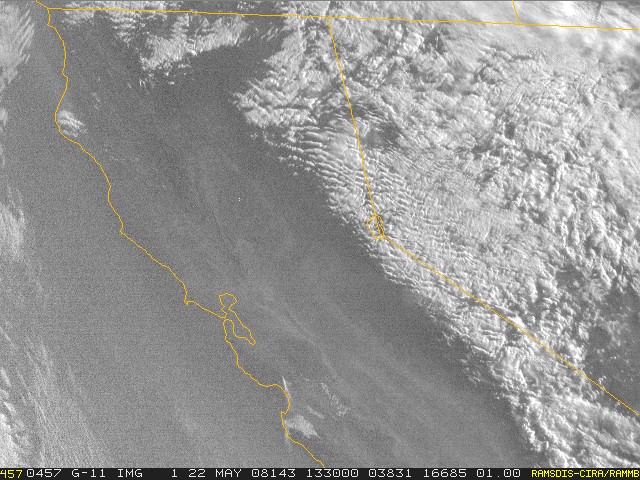
Today’s big Bay Area news: a wildfire in the Santa Cruz Mountains. The wind is blowing hard from the north, and the blaze is moving fast. The images below are from a NOAA weather. The top frame (click for larger image) shows a smoke erupting (near Monterey Bay, the big scalloped area in the bottom center of the picture) at 5:30 a.m. The next frame (8 a.m.) shows the smoke plume spreading south two and a half hours later. The bottom image, from 10 a.m., shows a wider view of the coast with the southern end of the smoke plume off the coast of Santa Barbara County (also see the NOAA satellite loop).
The Rules
[“Immigration raids terrify kids, House is told” — San Francisco Chronicle]
You know, it’s such a gift to have had ancestors who had the foresight to emigrate to the United States while the doors were wide open. I’m not saying that everyone involved in the melange of immigrants that led to me qualified as wretched refuse, but I’ve seen where most of them came from. There are a lot of rocks strewn across the fields they worked. There is plenty of wind. There are long winter nights to contemplate the season to come and how to keep the cold out. For the people who left there, nothing was in short supply but level ground, cash in hand, and a prospect that things might change for the better.
But they crossed, they did, and they were welcome to try what millions of others had tried. They farmed. They mined coal. They worked in the stockyards, taught school, ministered to parishes, and worked in banks. If any of them got rich, I never heard about it. They did something far more important: They made me and everything I know possible.
The country kept the door wide open back then, but that should not be mistaken for an act of warm-hearted generosity. The country needed willing hands to help realize its manifest greatness; those forebears of mine and the millions like them were more or less willing.
I have to wonder how they would fare today. The door is still open, but just the slightest crack. Yes, lots of people slip over, under, or around it. Once they do, they seem to embark on the same path those forebears of mine did–they are today’s willing hands, and in slaughterhouses and construction sites and farm fields far and wide they are building something that only their children and grandchildren will get to see.
Or maybe not. These new immigrants aren’t following the rules if they fail to wait their turn at the door (a door, it should be noted, that is unlikely to ever open for their ilk–poor, uneducated, unable to speak our language). The rules–that’s another thing I have to wonder about. In the debate over immigration today, descendants of yesterday’s immigrants’ are careful to point out what honorable, law-abiding rule followers their ancestors were. Without subjecting anyone to a historical treatise just now, let’s just say that the bar for entry for most of these huddled and rule-following masses was a lot lower than it is today–unless, of course, they were Chinese or Japanese or from some other group loathed by the rule writers.
So, many of our new immigrants aren’t waiting their turn. Today’s immigration rule writers have decided this behavior is a danger to the country and are taking steps to punish the rule breakers. What form does the punishment take? See the article linked above. It talks about immigration roundups. I know most of us know this is going on, have heard stories about workplace raids, and probably put the whole business out of our minds.
A couple of weeks ago, a friend who teaches nearby told me about a student, one of the brightest in the class, who had come to school with his mother that morning. The mother was weeping. Why? the teacher asked. Because immigration agents had pounded on her door at 7:30 p.m., swept through her small apartment, and taken away three relatives. It was a shattering experience.
So this is what we’ve created to safeguard our bastion of prosperity–thug tactics in which a certain sector of the population is freely targeted and virtually without legal recourse. Oh, yes, none of this would happen if the affected people had just followed the rules, and we are, above all, a nation of rules. But there is a human cost here in the dismantling of people’s lives, the destruction of their sense of security, and in sowing emotional trauma. And for those who have got ours already, the sons and daughters of past generations of rule followers, there’s a cost in building the kind of apparatus that treats people as if they’re so much garbage to be thrown out. I’m all for rules–I’m not a fan of anyone coming into my house and taking my stuff, and I hate people who cut in line–but the rules need to have a humane edge. At our best, that’s the kind of rules we’ve written.
(Oh, and my solution for the illegal immigration issue: Amnesty, education, and citizenship.)
Technorati Tags: immigration
Done and Neglected
Done: The semester at UC Berkeley. I await the results of the semester. Promising not to go into the details, I’m sure the outcome was mixed. That paper I mentioned recently? Got an A on it; but it was a tough A, and reading the comments — both the graduate student instructor and the professor who taught the class wrote a full page of single-spaced comments — made me realize how much I have to learn (and also, the research made me see how often historians have trod the same ground (the Irish, the Irish in America, slavery, abolition, racism); well, perhaps not exactly the same ground: I want to explore how the Roman Catholic Church fits into the mix. Maybe I’ll write some more about that later.
And my other class? Cognitive linguistics. An excellent class that I could have done better by. In the end, I got into a bind with a long, complex take-home final due at virtually the same time as my long, complex research paper. One lesson I learned: Ask for an extension (on something). In the end, I put nearly all my chips on the history paper. Glad that it paid off, though I feel like I missed something in the linguistics class. Like I said: more to learn.
Neglected: Nearly everything else, including this here blog, though I have been watering the plants and mowing the lawn.
That is all. For tonight. b
Technorati Tags: berkeley
From the Mailbox

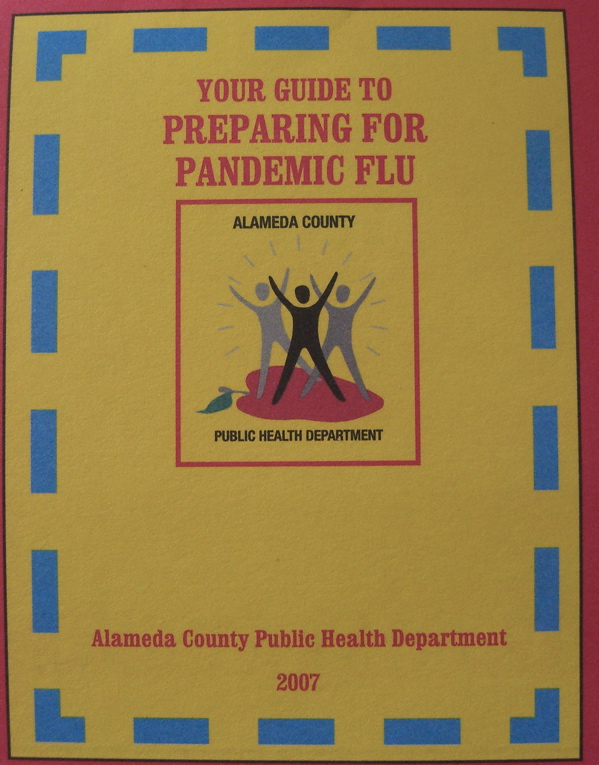
Here’s an odd recent arrival, thanks to our letter carrier (the one we used to have a cordial relationship with before we got a dog, but that’s another story). The county health department wants us to know how to fend off the avian flu epidemic (sorry–pandemic) that was coming last year. Thanks, county health department. Inside the pictured folder (with its weird “up, up with people” logo) is a fold-out sheet with helpful information like the frequencies of the local emergency broadcast stations, addresses of hospitals, and reminders to wash your hands.
On the long list of things I worry about, the avian flu is pretty low–way behind my concern over George W. Bush being able to launch a nuclear weapon, for instance.
Technorati Tags: berkeley
News of Note
That paper from yesterday? It’s done. It beat me up, too. If you like surprises and want to know what it’s about, just send a self-addressed stamped envelope.
Now just have to finish my take-home final for cognitive linguistics. Due tomorrow. It’s like one of those long, long multiday bike rides I’ve done: at a certain point, it’s just about managing to ride the thing in any old way you can. By the way, that’s the sound of me in a buoyant mood.
Tomorrow, not that anyone asked, is the 25th anniversary of my first date with someone I’m still going out with. That worked out well, I think.
More later.
Technorati Tags: berkeley
Paper

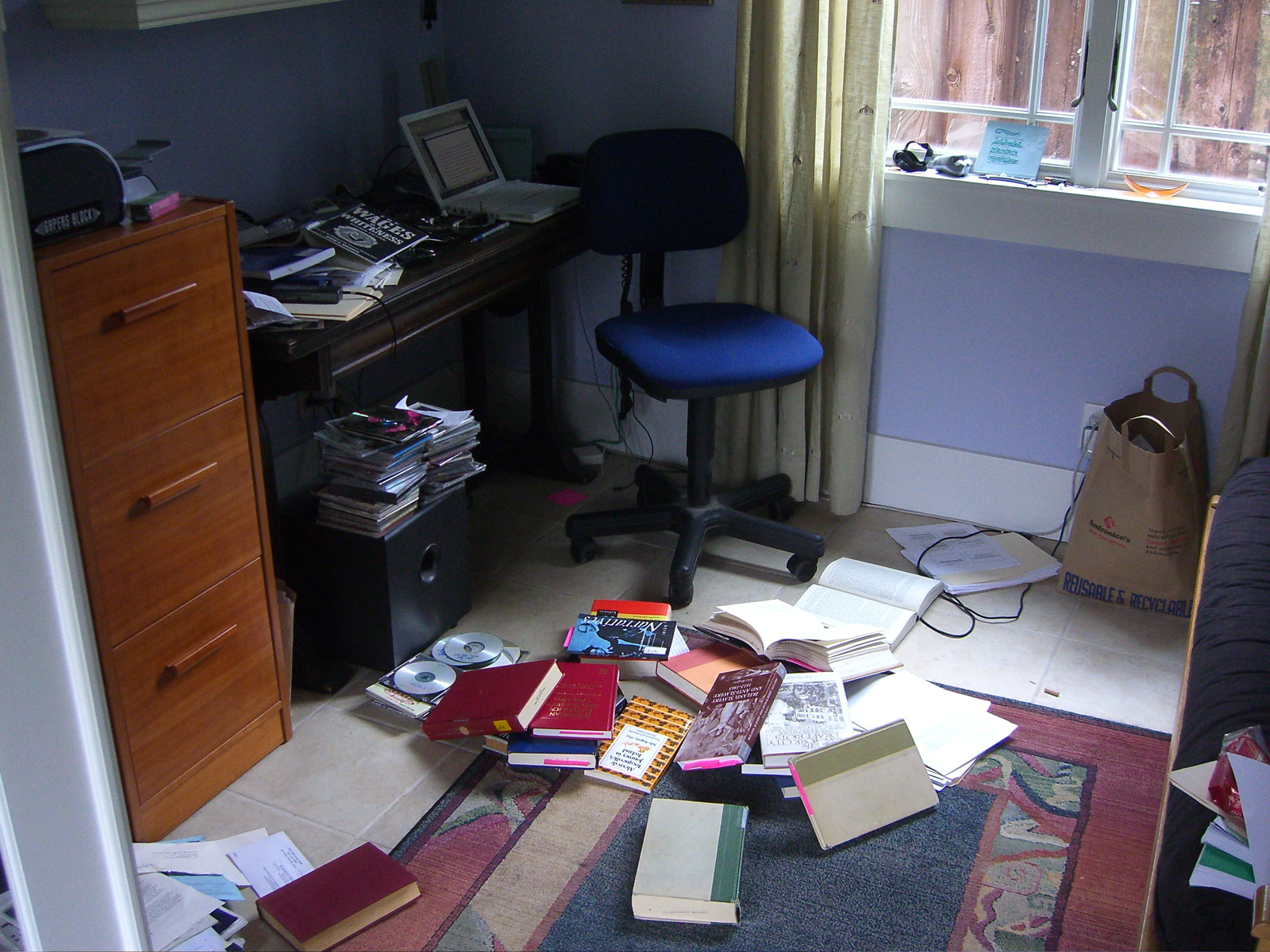
It’s finals time, sort of, at UC-Berkeley. I’m in the midst of trying to wrestle a history research paper to the ground. That struggle is signified by the mess around me chair. And after that’s done, I have a take-home final to finish for my cognitive linguistics class.
Technorati Tags: berkeley, uc berkeley, university of california
Still Life, with Rolodex

The dining room table as the sun went down this evening. Kate got the sunflowers earlier this week–or was it just yesterday?
Technorati Tags: berkeley
Vignettes 1 & 2
On BART, going from North Berkeley to downtown Berkeley on my way to class. I got on the last car of a three-car train and since I was going just one stop, I didn’t sit down. I stood next to a woman in a motorized wheelchair; she was facing away from me and toward a vacant seat. It’s about a two- or three-minute trip from one station to the next, and I was preoccupied. But gradually it dawned on me that the woman in the wheelchair was reading a newspaper that she had place on the vacant seat. She was turning the pages with one of her feet. A couple of days ago I was reading about Christy Brown, the Irish artist (subject of the movie “My Left Foot”) who taught himself to paint and write though he had control over just one of his feet. Watching the woman in front of me, I was reminded of that and I thought about the determination it would take to learn to do what she was doing and take it into the world–to be as “normal” as she can be, “normal” defined as what the rest of us are doing. Even in the short time I was watching, I became absorbed in what she was doing. If she had turned and looked at me, I would have said something vague like, “Hey, how’s it going?”
Across the aisle from the wheelchair woman sat an African-American woman with a striking straw hat and stylish sunglasses. She was nicely turned out. The straw-hat woman was looking at the wheelchair woman. She looked like she was going to say something. As we approached the Berkeley station, she spoke up. “Excuse me. … Excuse me,” she said, looking at the woman in the wheelchair. “It’s amazing … it’s amazing what you’re able to do. I really admire you.” I couldn’t see the wheelchair woman’s face. But I heard her say, “Well, that’s my life.” She sounded matter of fact–no impatience or crossness in her voice. “I admire that,” the straw-hat woman said, “the way you’ve learned to get along with what you have. …””
The train had stopped at the platform and the doors had opened. I got off and didn’t hear any more of the conversation. The straw-hat woman’s frankness was as striking to me as the wheelchair woman’s physical performance.
* * *
In Ohlone Park with the dog. As usual, he had spotted a squirrel and went into stalking and observation mode. I didn’t hurry him along, and we wound up under the canopy of an 80- or 100-foot tall redwood. There was a commotion overhead, a bird fluttering. I looked up and saw that it was a little hawk–a sharp-shinned or a Cooper’s. You see them around here; they hunt other birds. The one overhead was pretty well obscured by redwood boughs, but it moved twice into higher branches. It was only when it settled down that I saw it worrying something with its beak–a freshly killed bird, it turned out. A steady fall of downy feathers came down from the tree, and I caught a few. While looking for feathers around the base of the tree, I discovered a used syringe. More feathers fell, maybe from a mockingbird, which, per Harper Lee, would be a shame. Finally the hawk had worked its way to the main course, I guess, because the feathers stopped. I look at the birds around here and often think of the calories they need to survive; how many mockingbirds does a Cooper’s hawk need to kill and lunch on to enjoy a healthy, rewarding lifestyle (and raise a family)?
Technorati Tags: berkeley
Tonight’s Fund-Raising Call
The Democratic National Committee called tonight. After all the sterling work the party has done since the 2006 election, helped of course by my hefty donations (five figures if you go to the right of the decimal point), a very cheerful and polite and hopeful-sounding young woman wanted to ask me for another couple hundred bucks.
You know, I was on the verge earlier today of writing down the litany of the woes I read about and hear about and witness and the sense I have that we’ll be good and tangled up in these things for a good long while: The people blown to pieces day after day after day in Iraq and Afghanistan, the people losing their homes or walking away from them, the four-buck-a-gallon gasoline, and the president who says everything will be fine if we just do things his way. Then there’s the stuff we apparently just accept as part of the landscape now–our shambles of an education system (tell me, when’s the last time you heard the candidates slug it out over that?), our excellent but increasingly unaffordable system of health care, and the fact we’ve apparently decided that as a country we can’t or prefer not to pay our own way anymore.
Did I mention that domestic ferry passengers in Washington State are being accosted by border agents demanding proof of citizenship? Or the sudden and calamitous decline of the last big salmon runs in California over the last year? Declining dollar, anyone? The estimate of my state’s budget deficit for the next year increased from $8 billion to $10 billion to $20 billion in just the last four days (or maybe it didn’t).
And then I look at the parties and the trio from whom we’ll select our next president. While all of the above is transpiring, one of the Democrats has been reduced to talking about his minister’s loony views and apologizing for speaking frankly about the fear and frustration that drives the electorate. His principal opponent is capitalizing on the fear and frustration to sabotage him (and probably herself, too, in the fullness of time). The guy from the other party appears to be promising more of his predecessor’s worst policies along with a few gems of his own.
Plenty of tunnel. No light. I know this is not the glass-half-full view. I know I am not being “part of the solution.” I am not being the change I’ve been waiting for or that you’ve been waiting for either.
You know, tonight’s not a good night to ask for that two hundred bucks.
Advice from the Neighbors

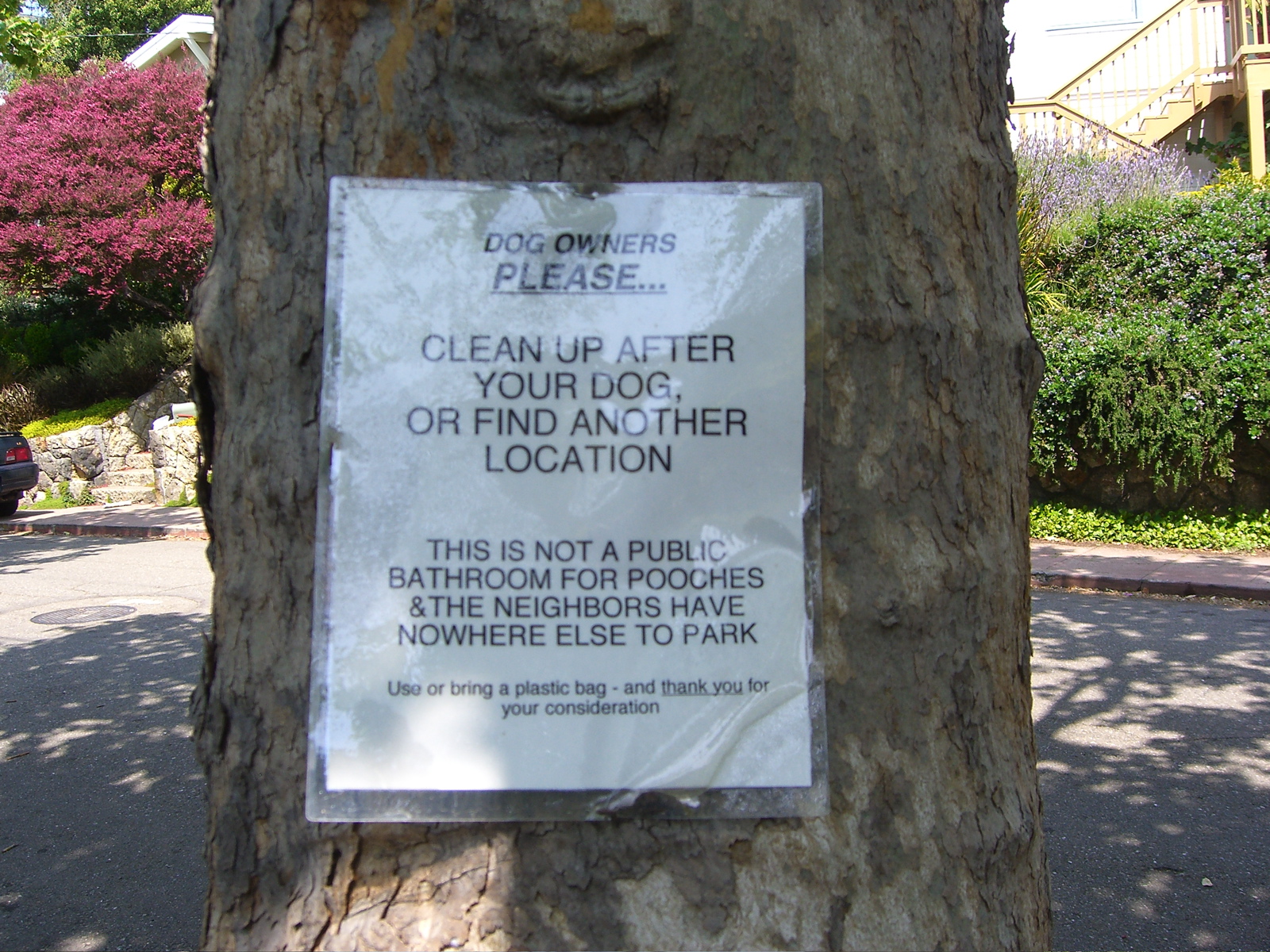
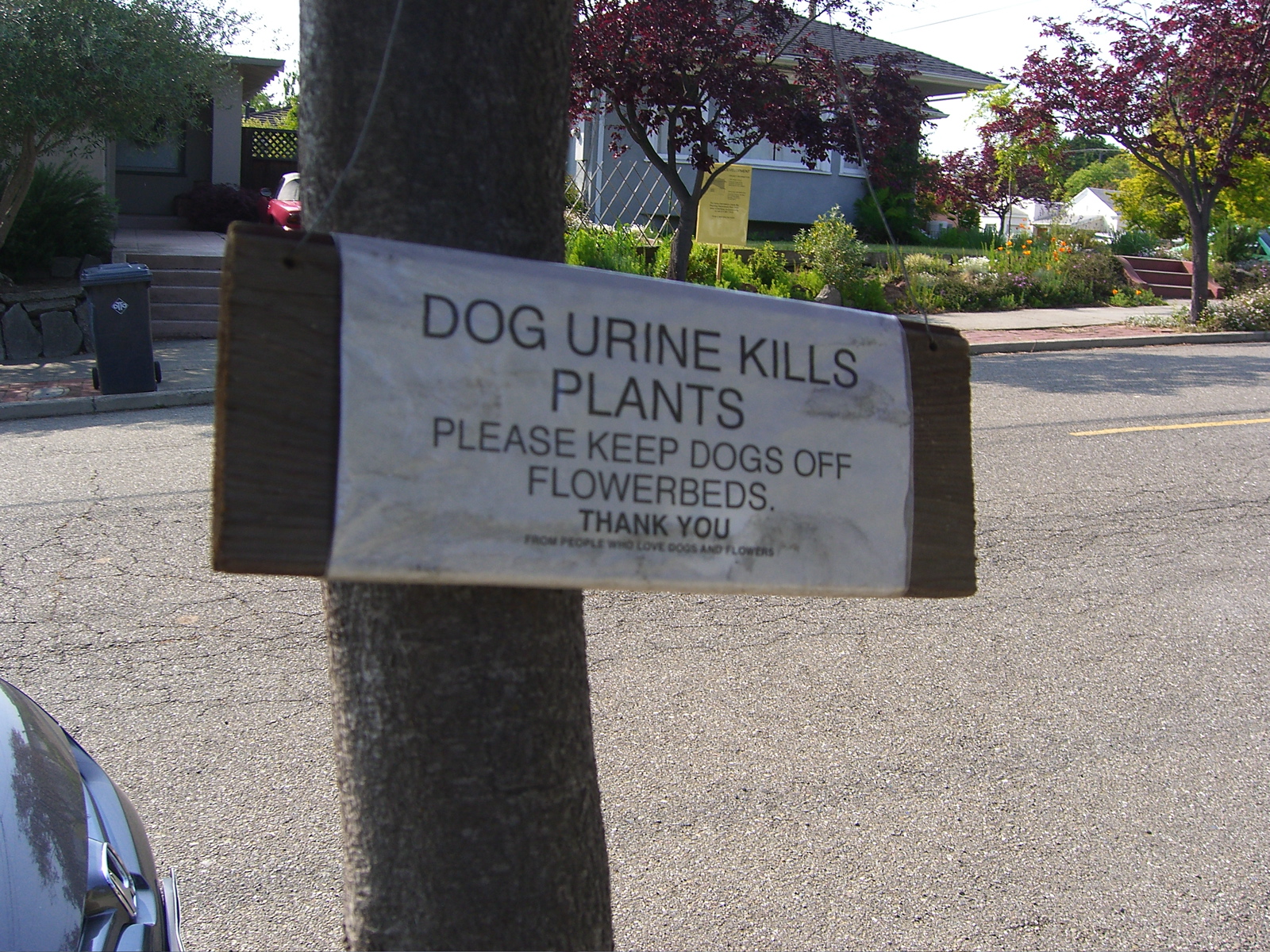
One thing about living in Berkeley: You can count on encountering advice from all quarters on how to conduct yourself in public; sometimes the advice is very detailed. Here are a couple examples dealing with the plague of dog waste, Now, the town does have a law on the books about this: If your dog bestows a precious leaving on lawn or sidewalk or village green, you, the dog’s best buddy, need to pick it up. And the evidence is that most people do. Given the number of dogs around, it’s uncommon to find evidence of their alimentary workings underfoot, and the public garbage cans all over town are brimming with those little plastic newspaper delivery bags, all filled with crap of the non-editorial variety.
I guess I wonder who the signs speak to. If you are the kind of person who thinks nothing of having your dog take a dump on someone else’s lawn, and there are plenty of that kind, do these signs stir your conscience and make you think, “Gee–I should really think about other people sometimes!” And if you are the kind of person who does your best not to leave fecal surprises for your fellow townsfolk to step in, do these signs do anything more than irritate you a little? I suppose there’s a middle population of people who walk around not knowing what they’ll do when their dog unloads. These signs might make them say, “Jeepers! That’s a good point!” But since you actually have to prepare yourself to deal with the eventuality that your dog is going to be leaving day-old Alpo around the ‘hood–you need to carry bags, etc.–there really isn’t a middle group. If you’re not prepared, by definition you’re in the Dump and Run Club.
As far as the dog urine sign below: What it says may very well be true. Though the sign says in small type at the bottom that it is the work of “people who love dogs and flowers,” I question whether the authors have actually observed one of these lovely dogs. Because, even with the most fastidious owners in the world, most dogs are gonna go where they’re gonna go (and mostly that means where another dog went).
Technorati Tags: berkeley