When the Bodies Don’t Want to Be Shown

The New York Times’s David Carr had a column yesterday — “Show Me the Bodies” — noting the relative rarity of pictures of U.S. soldiers slain in combat in Iraq. He discusses the factors involved, including squeamishness among media organizations and the many layers of difficulty, from danger to simple logistics, that conspire against such pictures being taken in the first place. He also mentions a notable exception to the general rule: A picture from the November 2004 battle in Fallujah, when Stefan Zaklin, a photographer with the European Pressphoto Agency embedded with an Army company during the fighting. Carr recounts that Zaklin “took a gritty, horrific portrait” of the company commander after he had been shot and killed by insurgent fighters — a picture widely printed at the time in Germany and France but not in the United States until long afterward (as part of stories about unpublished graphic war images.

Without going into the merits of publishing such a picture — I agree entirely with Zaklin’s argument (the picture he shot is at that link) that the image was important both for him to shoot and for viewers to see — I think Carr has missed the principal reason there aren’t more pictures like the one from Fallujah: The soldiers themselves won’t stand for it. Zaklin mentions this in his discussion of the picture:

“I stayed behind with the two men tasked with guarding the body.

One of the men was clearly on the verge of snapping; he was muttering to himself, trying to keep himself calm. It was dark, and my shutter speed was below what you would normally be comfortable using to get a sharp frame with a digital SLR. I focused the camera, and put it down from my eye. I leaned against a doorjamb, and fired two horizontal frames.

“I looked at the two soldiers, trying to gauge their reaction. One looked at me and then went back to watching the doorway he was guarding. The other kept muttering. I checked to see if the frame was sharp. It was. I rotated the camera, and shot two vertical frames. The mutterer stopped muttering, and shot me a look that sent chills down my spine. I didn’t know him as well as the other soldier, and decided to wait until the soldiers I knew better returned.

“In the end, I wasn’t ever able to take another picture of the dead captain.

“I waited two days, well after the captain’s family was notified, before I put the picture out for the world to see. I knew his family had been told because two colleagues had already interviewed the dead captain’s father about his son’s death. Despite the delay and a scrupulous reading of the embed rules, the military was furious that I sent the images at all. Nothing really came of it, I was essentially a convenient target for unfocused grief.”

Zaklin actually downplays the on-the-scene reaction to the incident. Toby Harnden, a British reporter for The Telegraph embedded with the same unit Zaklin was covering, reported on Zaklin’s ejection. After noting how well he got along with the Americans, Harnden wrote:

“But relations did sour towards the end, when a photograph of a dead soldier — whom I had been speaking to minutes before he was killed — appeared in a German newspaper.

“It was a haunting image of the body lying in a dusty kitchen, blood seeping from a bullet wound to the head. For me it summed up much of what had happened in Fallujah and was also a memorial to a brave American who died for his country.

“In the pain of the moment, Task Force 2-2 saw it differently.

” ‘Grab your stuff, asshole, and come with me,’ was how a captain addressed Stefan Zaklin, of the European Picture Agency, when news of the picture reached the unit.

“Zaklin was placed under armed guard and told he had violated the rules of propriety. Nothing in the rules had been broken. The soldiers had seen Zaklin snapping away in the kitchen — but it seemed that this was where the military and the media parted company.”

Carr mentions the frankness of the images that came out of Vietnam, when it became commonplace to see at least a slice of the grisly reality of the fighting. It’s widely observed that the military establishment, which allowed the media virtually free access to combat units, has crafted the current regime of rules for “media embeds” to avoid that kind of access and the uncontrolled flow of disturbing images and observations to the folks at home. The brass has succeeded to the point where it now takes a freedom of information request for us to get to see pictures of flag-draped coffins arriving back in the United States.

But there’s something deeper at work. I’m sure there was an us-and-them feeling at work between soldiers and journalists in Vietnam. But I wonder whether it was so deep as it is now. On one hand, the widely felt antipathy among many toward the media, especially in its connection to this war and its fancied failure to present the “real” (meaning “positive”) news about what we’re sacrificing so much blood and money for. On the other hand, the rank-and-file soldier has changed. In Vietnam, the troops a reporter or photographer encountered were nearly certain to be draftees, people who had landed in the military and sent into combat by happenstance; journalists might have been a nuisance to them, but they weren’t radically different by nature or mission. The soldiers we’re sending to Iraq may never have dreamed they’d find themselves fighting insurgents in the desert, but they’ve all chosen the armed forces, and they’re part of an institution that in many ways views itself as separate from civil society. Journalists are outsiders to this group and bound to be particularly unwelcome when they intrude too far on the lives and sensitivities of the troops. Thus the anger and outrage when a picture of a fallen warrior is run.

Technorati Tags: ,

Dump

Chavez060306

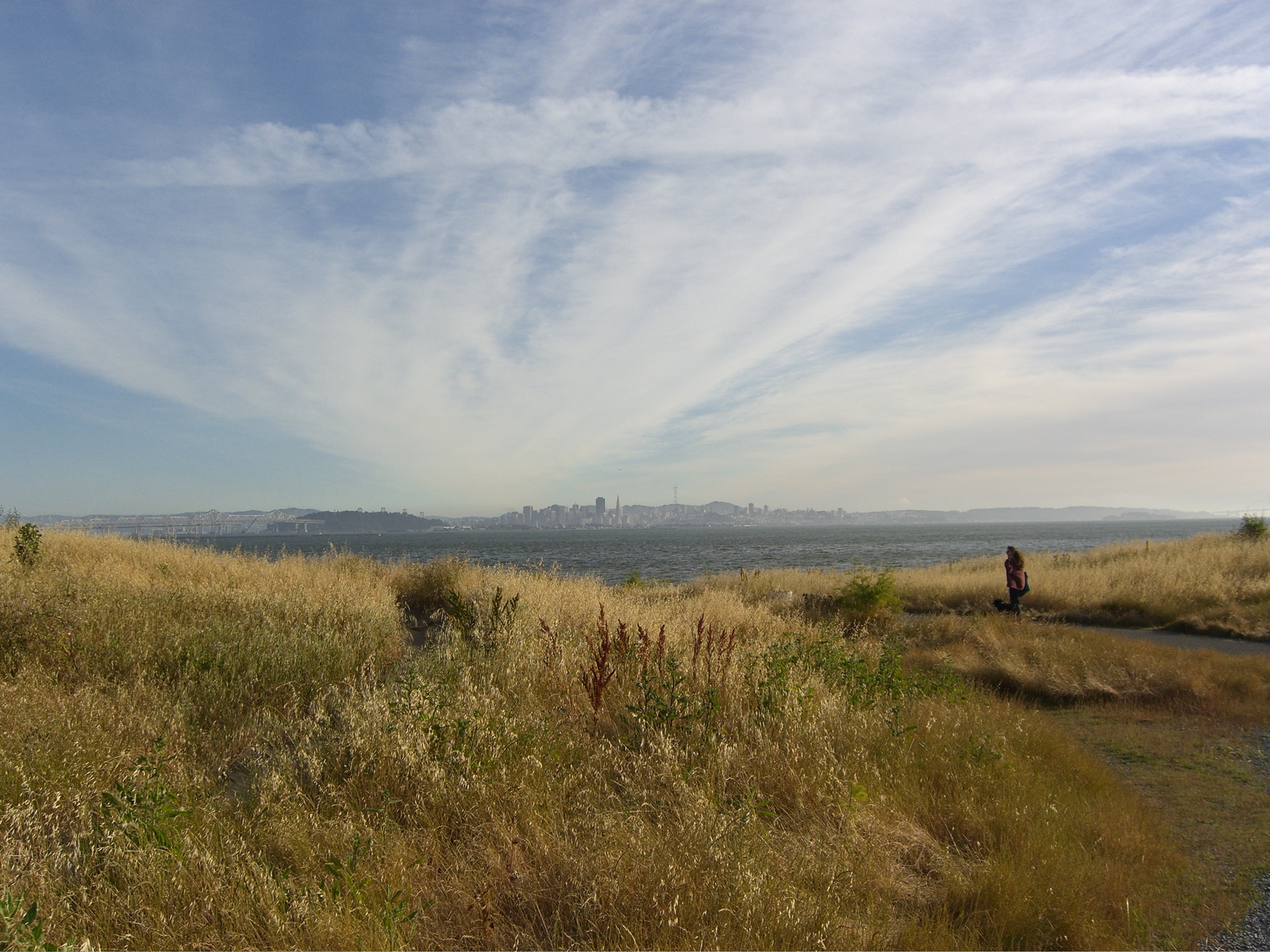
I don’t have the exact statistics at the ready, but something like 35 or 40 percent of San Francisco Bay has been filled since the region was settled in the 19th century. About 95 percent of the wetlands surrounding the bay have been diked, drained and developed. Berkeley’s most visible modern contribution to the great, undeclared bay transformation project is its old garbage dump, part of a complex of old fill projects that stretch more than a mile along the waterfront and extend more than three-quarters of a mile into the water from the old shoreline (which itself is at least one-third of a mile west of where the European interlopers found the water’s edge).

The dump was a great place. Noisy, smelly, full of garbage and construction debris, seagulls and big graders. I worked as a construction laborer for a while after I moved out here, and every once in a while was sent on a dump run to unload a pile of old shingles or lumber or fractured plaster and splintered lath. A cashier took your fee, then sent you on your way, out the potholed road to the mountain of discards. A worker out there directed you to the edge of a live pit, and you added your stuff to all the household garbage, old tires, unwanted furniture, lawn clippings and miscellaneous unidentifiable sweepings from all over the city. I would always feel a little exhilarated to see it all and to throw mine, whatever it was, in on top. The graders and other heavy equipment were constantly at work crushing the trash, packing it down, making room for more; once a pit was full, it would be covered with dirt and the garbage would go to a new one. The old pits would settle over time and be reopened to take on more refuse. This went on for years.

About two decades ago, the dump reached capacity. So much garbage had been packed in that at one point it had been squeezed out in the Bay under the dikes built to contain the fill. The city built a “transfer station,” a big open warehouse-like structure where all the trash would go to be sorted and re-transported, if it wasn’t recyclable or compostable. The old dump was covered with dirt, lots of dirt. Part of it was landscaped and turned into a manicured city park and named after Cesar Chavez, the late farmworkers’ labor leader. Most of the fill was planted with native flora and studded with pipes to vent the methane and other gases from the old buried trash. Roads and trails were built. Part of the semi-wild-looking area at the center of the old dump has been opened up as a park for off-leash canines.

So, at the end of this environmentally unfriendly epic (a story line shared with many great city parks, like Grant Park in Chicago), we’ve got a beautiful piece of waterfront property with staggering views across the bay and back toward the hills, filled with bike riders, hikers, dog-walkers, picnickers and kite-flyers. Our garbage? It’s headed someplace else, where it’s unlikely to grow into something similar.

Technorati Tags: ,

Found in Translation

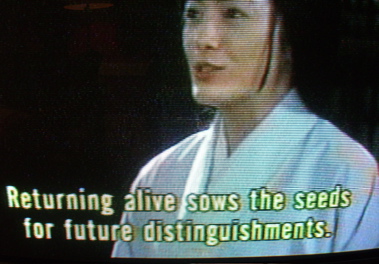
"Returning alive sows the seeds for future distinguishments."

Whereas returning on fire sows the seeds for future extinguishments.

(Happened across this, on a Japanese TV period drama, while sowing the seeds for drooling viewerment on Saturday night.)

How Not to Get Off a Bike

Late Thursday afternoon, I went out for a short ride through the Berkeley and Oakland hills; just a way to wake up my body for a planned 600-kilometer (387.5-mile) ride this weekend. I also wanted to see how my “new” bike — a beautifully painted old Bridgestone RB-1 frame I just had built up with parts from my old RB-1 — handled on a course I know pretty well. The route took me south along Skyline Boulevard past the place where I had a pretty bad crash in January 1991. Whenever I ride past the spot, I remember the fall and the aftermath. It all came back Thursday, too: How quickly I hit the road, the ambulance ride to the hospital, the gruesome picture I took of my face when I got back home.

I turned around, rode back up the hill I had just come down, and headed back toward Berkeley. The road is rolling, with a few short, curving descents and a couple of short climbs. The downhill sections are a little tricky, with some bad pavement. I rounded one right-hand turn, skirted some badly patched asphalt and picked up speed as I headed for a left-hand turn. I was probably going 20 to 25 mph. Just before I got to the curve, I hit a hole in the road and fell hard on my left side. I struck the pavement with enough force that my glasses flew off, lost their lenses, and went skidding down the road. I thought I heard my helmet hit the ground, too, but it didn’t show any signs of damage.

I’m OK. I came out of the crash with road rash on my left knee, hip, hand, elbow and shoulder and a pulled muscle (I think) in my upper back or left shoulder. Oddly, my right elbow also got a pretty good scrape, too, and I had a tennis-ball-sized knot on the inside of my right leg just above the ankle. I wound up going down to Kaiser Hospital in Oakland in an ambulance and spending about four hours there, mostly waiting and watching what was happening with people who were a lot worse off than me. About half an hour after I was rolled into the emergency room, a “Code 3” ambulance (one transporting an urgent case, operating with lights and siren) arrived with a woman in the midst of some sort of seizure; she died about 20 minutes later, about 30 feet from where I was lying. Eventually, a couple of nurses had enough of a breather from the more dire cases that they could spend some time scrubbing out and dressing my abrasions so Kate and I could leave.

What’s shakes me is how quickly and decisively something like this can happen. One second: spinning along, nurturing a picture of middle-aged bike rider as road ace. Next second: lying in the road, groaning, feeling a mixture of shock, fear, pain, and foolishness and wondering, What did I hit? Is there a car behind me? Am I going to get run over? How badly am I hurt? Is the bike trashed? What are my glasses doing over there?

After maybe half a minute or so, I untangled myself from the bike and stood up. A driver coming the other way stopped and asked whether I was OK. I think I told him, or her, that I’d see whether I was or wasn’t. That car moved on. Another came down the hill, the same direction I had been riding. The woman driving, Sylvia, stopped and got out and got me to sit down. I reaized my neck hurt. A cyclist named Dave came down the hill and hit the same hole I did and nearly fell. He cursed and then stopped to help, observing that it was the second time he’d hit that spot and that it was all but invisible because it was in a shady spot. Another rider, Doug, stopped as he rolled up the hill. The three of them convinced me it was a good idea to call 911; Dave made the call, then gave me his phone to try to call Kate; Doug, who lives nearby, agreed to hang onto my bike since I couldn’t take it to the hospital.

After another 20 or 30 minutes, the Oakland Fire Department and paramedics and police showed up. I was put in a neck brace and strapped to a backboard. I warned the paramedics, Elise and Dawn, that I weighed 215 pounds; they hefted me onto their gurney and told me I was the lightest person they’d had to lift all day. Then they drove me down the hill to the hospital. Eventually, I got hold of Kate, and she waited with me until I got cleaned up. When we left, several doctors and nurses, including the young guy who had attempted CPR on the woman who had died, told me to get well and made a point of telling me I needed to get a new bike helmet since I had probably damaged the one I had been wearing.

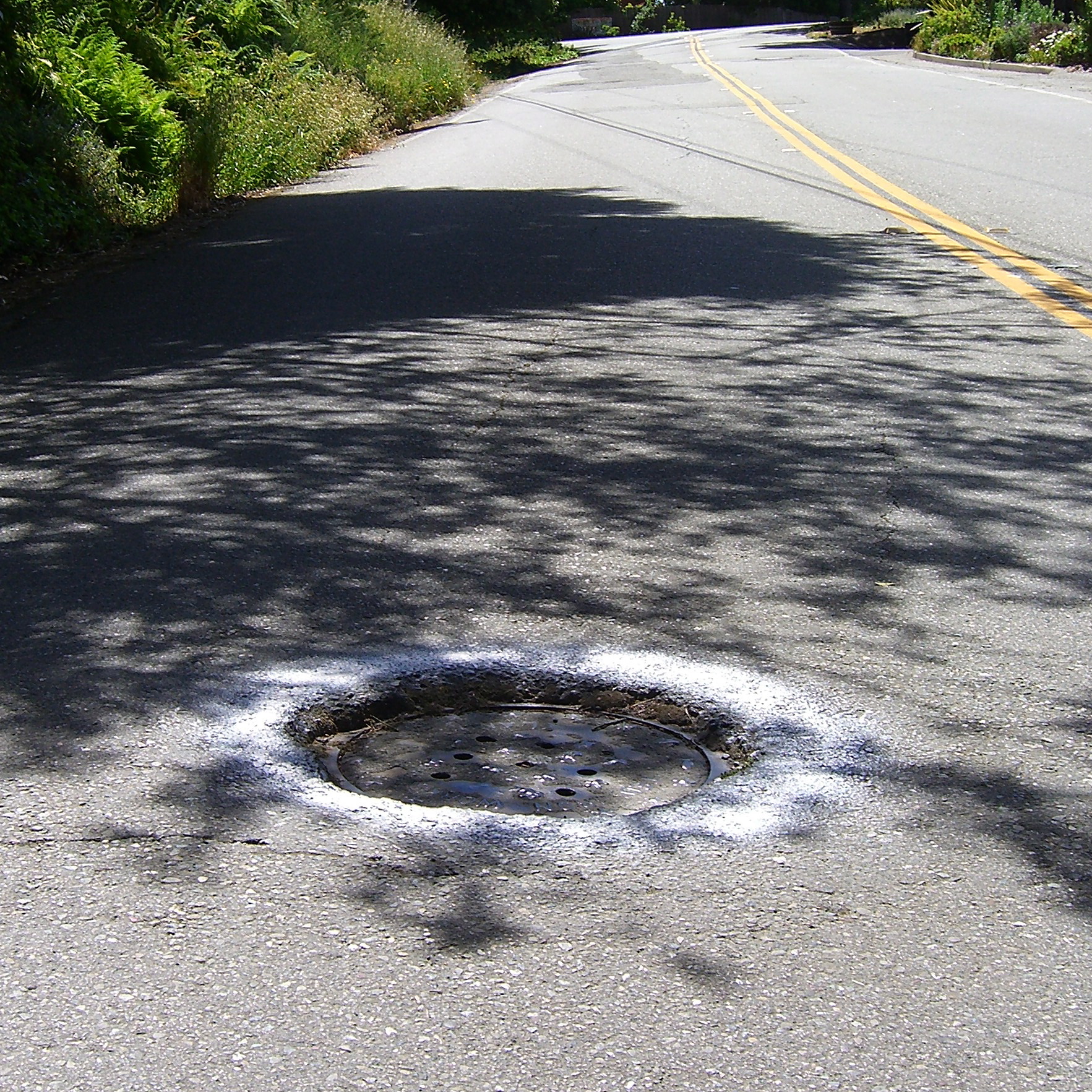
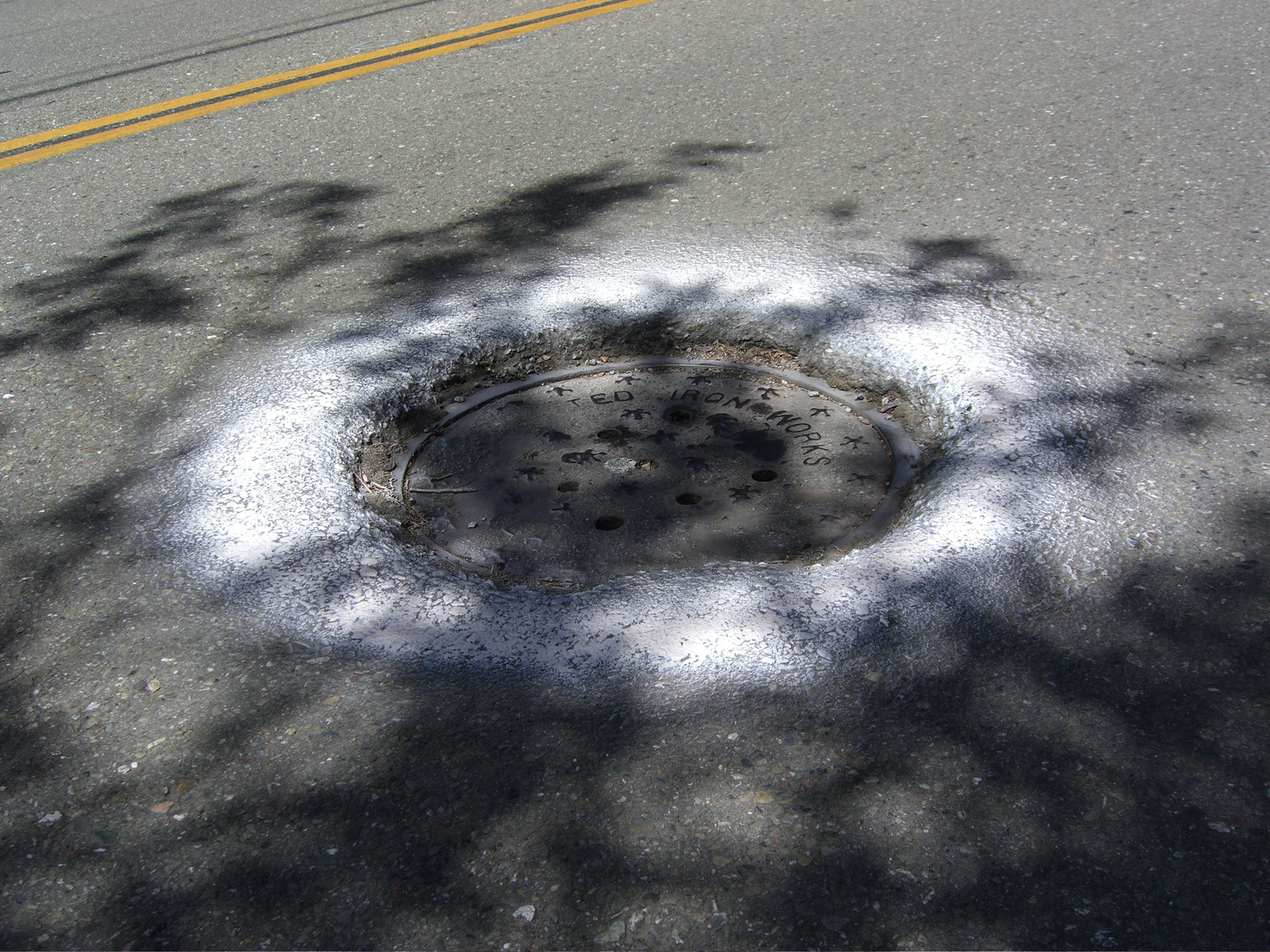
Friday afternoon, Kate and I went up to Doug’s house to pick up my bike. I was surprised to find that there doesn’t appear to be even a nick in the beautiful paint job (the handlebars are trashed, though). We loaded up the bike and then drove to where I fell. Doug had gone out and spraypainted the rim of the hole, which surrounds a manhole cover. Even though it was about an hour and 45 minutes before the time of day when I hit the spot, the shade was already crossing the road, and, even with the warning paint, I could see how close to invisible the hole was. A foot or so to the right or left, and I would have ridden home without incident (or run into some other obstacle). And I’d be out riding today instead of explaining why I’m not.

Skyline060206Skylinea060206Skylineb060206

Today’s Best Names

Ida Mae Astute: Photographer. Came across her name on a photo credit while I was reading up on what has become of Bob Woodruff, the erstwhile ABC News anchor who was nearly killed in January by a roadside bomb in Iraq.

Lastings Milledge: New York Mets phenom (if phenom is still a phenomenon — maybe we’re past that) called up to replace Xavier Nady, the former Cal star who went on the disabled list after surgery for appendicitis. (Word from the Baseball Politeness Cops at the New York Daily News is that the kid has something of an attitude.)

Walt Whitman: OK, no color in the name beyond the man who bore it. But there’s plenty there, and besides, it’s his birthday.

Two from the Road

Weedyreka

Drove back from Eugene last night and this morning. Started at 5 p.m. or so, stopped at the cheap gas station (a 76 station just south of town that is always at least a nickel or a dime a gallon cheaper than what you find near the university), then got on Interstate 5 southbound. The Sunday of Memorial Day weekend: I recommend it for your long highway trips. Very few people were on the road, and by the time we started the climb up toward the last Oregon summit on I-5, in the last hour before the sun set, it was like driving in the middle of the night.

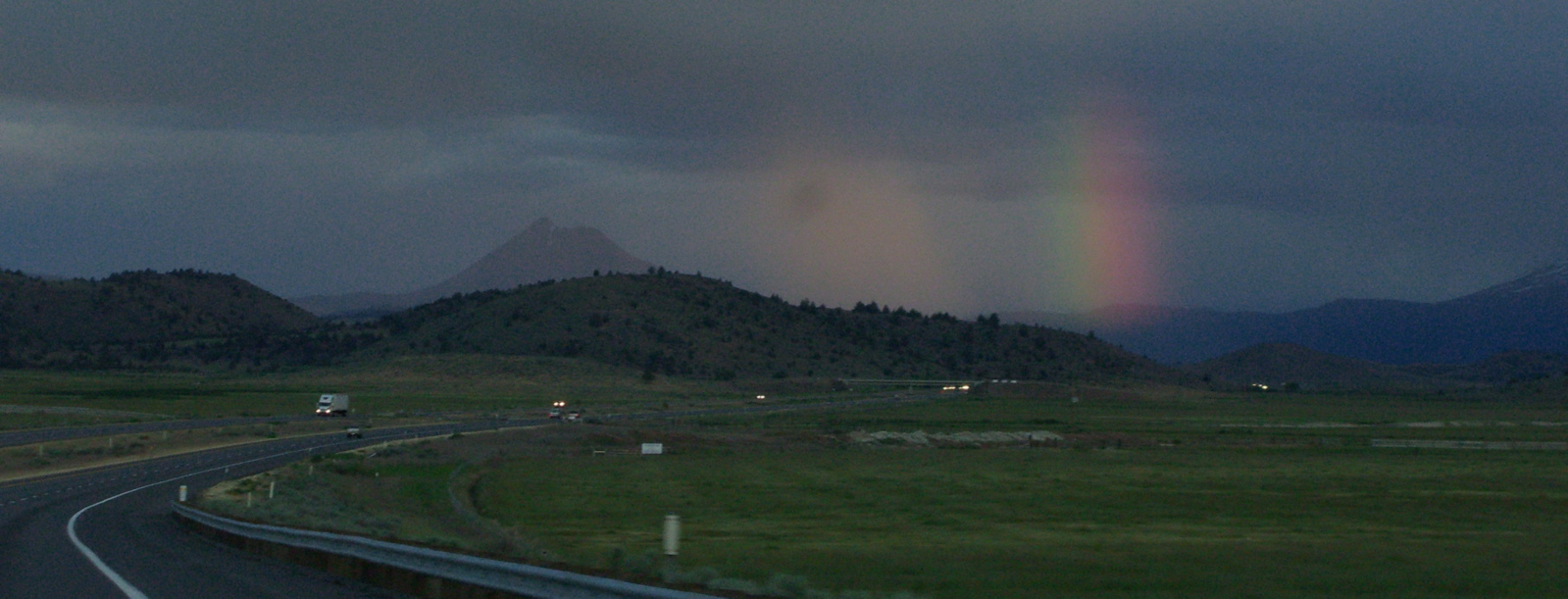
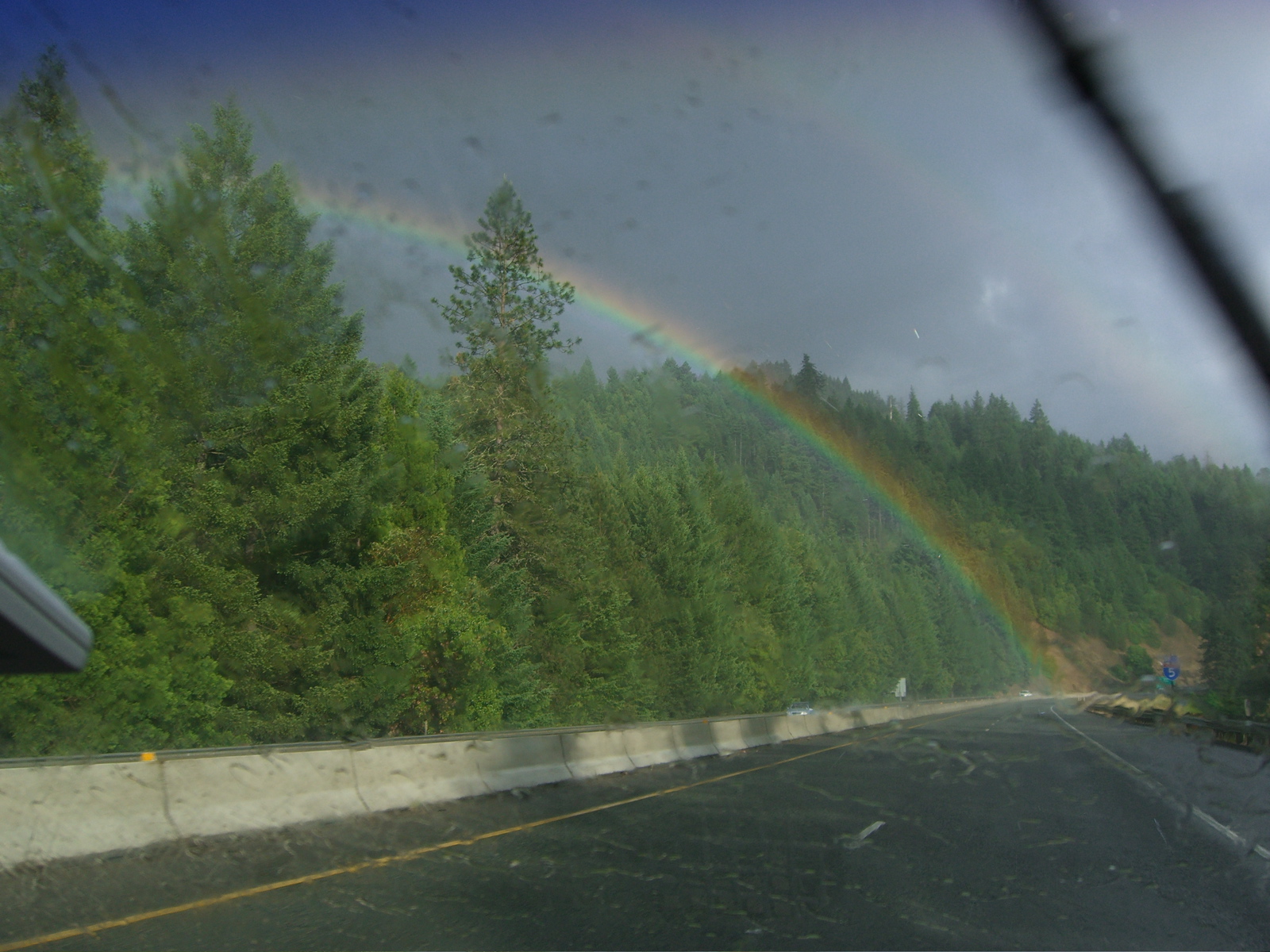
Most of the way through Oregon we drove through sunlit showers, and for a while saw a rainbow around every bend in the road. The shot above is from the stretch between Yreka and Weed, in far northern California: Rain refracted in the last light of the day, a semi-rainbow. The peak near the center is Black Butte, a small volcanic peak just to the west of Mount Shasta. The shot below: from the climb up the northern side of Canyon Creek Summit, a little more than halfway between Eugene and the California line.

I5Rainbow

Tennis in Iraq

Here’s an item from Iraq, by way of the Associated Press and the San Francisco Chronicle:

Iraqi Tennis Coach, Players Killed

“(05-27) 10:38 PDT BAGHDAD, Iraq (AP) — An Iraqi tennis coach and two of his players were killed because they were wearing shorts, apparently in violation of a warning by Islamic extremists.

“Gunmen stopped the car in which the athletes were riding and asked them to step out before shooting them Wednesday, Manham Kubba, secretary general of the Iraqi Tennis Union, said Saturday. The coach, Hussein Ahmed Rashid, was Sunni, and the two players were Shiite, Kubba said.

“The athletes were in shorts when they were killed and police believe the attack was related to a warning by extremists against such attire, police Lt. Maitham Abdul Razzaq said. He said the warning was made in leaflets distributed in the Sadiyah neighborhood in southwest Baghdad a week before the attack. …”

First thought: Unbelievable barbarity; the people who did this are beyond understanding.

Second thought: Did this happen the way the authorities say it did? Were these guys killed for wearing shorts, or for being found (Sunni and Shiite) together, or for their car? Was the warning against shorts-wearing distributed in the neighborhood where the attack took place? You have to admit, this story is tailor-made to feed feelings of disgust and revulsion for those who oppose us over there.

Third thought: Without evidence to the contrary, I’m inclined to think this really did happen. And that brings me back to my first thought: This is beyond comprehension. But is it really? My tendency is to think that wars of the past — say against Japan or Germany or Korea or Vietnam or even the less direct conflict with the Soviet Union — are easy to understand, at least on a general level. Right on the surface, you find nationalism in one form or other, a battle for territory, and an effort to extinguish competing claims to land and resources. A little below the surface, you find a struggle to impose a particular point of view of the world and our place in it. I think this is more complicated than seeing wars as struggles between fascism and democracy, communism and capitalism, or evil-doers and the rest of us.

The people we’re fighting in Iraq don’t have an army, they don’t appear to be fighting for territory or resources, and they’ve unleashed a wanton, terrorizing violence on the people they live among. So on that surface level, they simply don’t make sense. On that next level, though — exercising violence to impose their will and their view of the world — what they’re doing is as logical as anything any military commander has ever devised.

The question is: How do you oppose it, and where? Our soldiers and weapons are the best, or so we constantly reassure ourselves. But does anyone believe that they have prevailed? Or will ever prevail by themselves?

Motel Dog

I might be close to trespassing on the world’s patience — “world” in this case meaning the dozen of you who peruse these posts — by putting up a third consecutive dog picture. I’m doing it anyway.

We’re in Eugene visiting Thom. We’re parked in the Best Western right across the street from the university. Last night we had to stay about 20 miles outside town because the state high school track championships were being held today at the U of O’s Hayward Field, and every motel closer than the one we found was booked up.

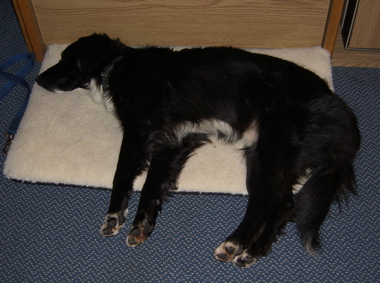
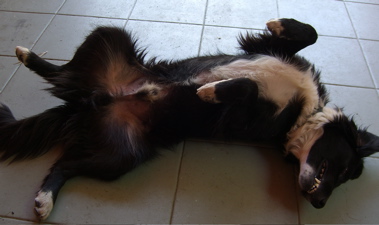
One of my mom’s distant Irish cousins, Michael Joe O’Malley, used to have an expression he used when it was time to retire for the evening: “I’m going to stretch my four legs from me.” I think he explained once that it referred to dogs going to sleep. So here’s Scout, after we walked him all over this afternoon, stretching his four legs from him. Outside the frame, Kate’s taking a nap, too. Thom just woke up from his. I’m the only one here not getting his early evening shuteye.

Scout052706

Gratuitous Dog Picture

Scout052406

OK — here’s our pal again. This was the pose he struck when I was trying to get him to come back in the house when I was headed off to work the other day (yes, he’ll stay in the house and behave himself, unless he’s making popcorn and watching pay per view behind our backs). This went on for a couple minutes and would have lasted longer if I’d let it. I especially like the teeth.