I duly shared the above via some social media platform or another. One of the things I really liked about the video is the music that accompanies it, "Dayvan Cowboy" by Boards of Canada. I didn't know from BoC, but I would characterize this as a jangly folk-rocky indie-esque electro-introspective piece.
About the same time, I got involved in a discussion about high-altitude parachute jumps. I remembered hearing or reading that sometime in the 1950s or '60s, someone had jumped from above 100,000 feet and that someone was planning to try to improve on that record. One thing always linking to another as it does out here, I found the man who made the famous skydive was Joe Kittinger, who was involved in Project Excelsior, a research program designed to develop high-altitude escape systems for the first astronauts. On August 16, 1960, he rode a balloon-lifted gondola to 102,800 feet–nearly 20 miles–above the New Mexico desert, then stepped off into the void and commenced a descent that lasted more than 13 minutes. He reached a top speed of 614 mph on the way down.
I promptly went on to other things, but the Boards of Canada music was stuck in my head. In looking for it online a couple days ago, I found an "official" video for "Dayvan Cowboy." The first segment of the video features Kittinger's Project Excelsior mission. Here:
I could hardly stop there. I figured there must be more extensive video of Kittinger's flight out there. Well, there is plenty, including several musical tributes to the flight (just Google "Joseph Kittinger" and "music"). Here's one that combines snippets of the flight video with a musical number ("Colonel Joe," by Alphaspin).
And here's one more, with a different soundtrack ("GW," by Pelican), that tech media guy Tim O'Reilly references in a blog post from a few years ago:
‘A Lone Grave, on Battle-Field of Antietam.’ (Photographer: Alexander Gardner. National Park Service: Historic Photos of Antietam battlefield. Click for larger image.)
Me: John, you’re just about the only person I know who’d be thinking about that.
John: Yeah…I looked at the date on my faithful iPhone and it jumped right out at me…It is a cool pleasant day here in the east and I reflected that some of those soldiers that day may have taken note of similar weather, never getting a chance to enjoy it…a melancholy thought. In any event, I am currently working on some glass (engraving) and am enjoying the weather as well..and remembering all those young men…149 years ago…
Me: It’s beautiful out here as well. And yes, a lot of life, and lives, were swept away that day.
If you’re not familiar with Antietam: Fought September 17, 1862, at Sharpsburg, Maryland, about 50 miles northwest of Washington. Lee’s Army of Northern Virginia, attempting its first invasion of the North, vs. McClellan’s Army of the Potomac, crippled by indecisive generalship and intelligence by way of the founder of the Pinkerton Detective Agency that Lee’s army was far larger than it was. The most common description of the battle: The bloodiest single day of the Civil War. Here’s a brief summary of the aftermath from James McPherson’s “Battle Cry of Freedom:”
“Night fell on a scene of horror beyond imagining. Nearly 6,000 men lay dead or dying, and another 17,000 wounded groaned in agony or endured in silence. The casualties at Antietam numbered four times the total suffered by American soldiers at the Normandy beaches on June 6, 1944. More than twice as many Americans lost their lives in one day at Sharpsburg as fell in combat in the War of 1812, the Mexican War, and the Spanish-American war combined.”
Today’s also Constitution Day. One of the foremost interpreters of the Constitution, long after the battle, was on the field at Antietam. Oliver Wendell Holmes Jr. was a captain in a Massachusetts regiment largely recruited at Harvard. He was shot through the neck early in the battle. Here’s an account of Holmes’s battle, from “Justice Oliver Wendell Holmes: Law and the Inner Self,” by G. Edward White:
“On the morning of September 17 the Twentieth Regiment, designated as a reserve unit, was ordered up so far toward the front of Union lines that, as Holmes put it many years later, ‘we could have touched … the front line … with our bayonets.’ When the fighting began, ‘the enemy broke through on our left,’ and the Regiment, instead of being able to repel them, was ‘surrounded with the front,’ and an order to retreat was quickly given. Holmes remembered ‘chuckling to myself as I was leaving the field,’ since at Ball’s Bluff Harper’s Weekly had made much of the fact that he had been shot ‘in the breast, not in the back.’ This time he was ‘bolting as fast as I can … not so good for the newspapers.’ As he was retreating he was hit in the back of the neck, the ball ‘passing straight through the central seam of coat & waistcoat collar coming out toward the front on the left hand side.’ “
An officer managed to secure basic care for Holmes in a private home a few miles from the battlefield, then sent a telegram to Holmes’s family in Massachusetts. His father, Oliver Wendell Holmes Sr., was a doctor and one of the North’s leading literary names, and wrote an account of what happened next, “My Hunt After ‘The Captain’ ” for The Atlantic:
In the dead of the night which closed upon the bloody field of Antietam, my household was startled from its slumbers by the loud summons of a telegraphic messenger. The air had been heavy all day with rumors of battle, and thousands and tens of thousands had walked the streets with throbbing hearts, in dread anticipation of the tidings any hour might bring.
We rose hastily, and presently the messenger was admitted. I took the envelope from his hand, opened it, and read:
HAGERSTOWN 17th
To__________ H ______
Capt H______ wounded shot through the neck thought not mortal at Keedysville
WILLIAM G. LEDUC
Through the neck,–no bullet left in wound. Windpipe, food-pipe, carotid, jugular, half a dozen smaller, but still formidable vessels, a great braid of nerves, each as big as a lamp-wick, spinal cord,–ought to kill at once, if at all. Thought not mortal, or not thought mortal,–which was it? The first; that is better than the second would be.–“Keedysville, a post-office, Washington Co., Maryland.” Leduc? Leduc? Don’t remember that name. The boy is waiting for his money. A dollar and thirteen cents. Has nobody got thirteen cents?
The elder Holmes decided to go find his wounded son and got on a train the next day. Holmes Jr. had already been sent on by the time his father got to the town named in the telegram; his father continued the search, but not before visiting the scene of the battle:
“We stopped the wagon, and, getting out, began to look around us. … A long ridge of fresh gravel rose before us. A board stuck up in front of it bore this inscription, the first part of which was, I believe, not correct: ‘The Rebel General Anderson and 80 Rebels are buried in this hole.’ Other smaller ridges were marked with the number of dead lying under them. The whole ground was strewed with fragments of clothing, haversacks, canteens, cap-boxes, bullets, cartridge-boxes, cartridges, scraps of paper, portions of bread and meat. I saw two soldiers’ caps that looked as though their owners had been shot through the head. In several places I noticed dark red patches where a pool of blood had curdled and caked, as some poor fellow poured his life out on the sod. I then wandered about in the cornfield. It surprised me to notice, that, though there was every mark of hard fighting having taken place here, the Indian corn was not generally trodden down. … At the edge of this cornfield lay a gray horse, said to have belonged to a Rebel colonel, who was killed near the same place. Not far off were two dead artillery horses in their harness. Another had been attended to by a burying-party, who had thrown some earth over him but his last bed-clothes were too short, and his legs stuck out stark and stiff from beneath the gravel coverlet. … There was a shallow trench before we came to the cornfield, too narrow for a road, as I should think, too elevated for a water-course, and which seemed to have been used as a rifle-pit. At any rate, there had been hard fighting in and about it. … The opposing tides of battle must have blended their waves at this point, for portions of gray uniform were mingled with the ‘garments rolled in blood‘ torn from our own dead and wounded soldiers.”
The National Park Service site for the Antietam National Battlefield includes an album of 30 images taken by photographer Alexander Gardner immediately after the fighting and now in the collection of the Library of Congress (the NPS site is the source of the images here). Beyond their blunt depiction of the slaughter’s aftermath, they carry a unique historical weight that Drew Gilpin Faust summarizes in “This Republic of Suffering:”
“For the first time civilians directly confronted the reality of battlefield death rendered by the new art of photography. They found themselves transfixed by the paradoxically lifelike renderings of the slain of Antietam that Mathew Brady exhibited in his studio on Broadway.”
Faust goes on to quote an October 20, 1862, article in The New York Times that discussed the impact of the photographs. Its acid tone is remarkable. “The living that throng Broadway care little perhaps for the Dead at Antietam,” the unsigned piece begins, “but we fancy they would jostle less carelessly down the great thoroughfare, saunter less at their ease, were a few dripping bodies, fresh from the field, laid along the pavement.” Eventually the writer takes us inside Brady’s studio:
“Mr. Brady has done something to bring home to us the terrible reality and earnestness of war. If he has not brought bodies and laid them in our dooryards and along the streets, he has done something very like it. At the door of his gallery hangs a little placard, ‘The Dead of Antietam.’ Crowds of people are constantly going up the stairs; follow them, and you find them bending over photographic views of that fearful battle-field, taken immediately after the action. … [T]here is a terrible fascination … that draws one near these pictures, and makes him loth to leave them. You will see hushed, reverend groups standing around these weird copies of carnage, bending down to look in the pale faces of the dead, chained by the strange spell that dwells in dead men’s eyes. It seems somewhat singular that the same sun that looked down on the faces of the slain, blistering them, blotting out from the bodies all semblance to humanity, and hastening corruption, should have thus caught their features upon canvas, and given them perpetuity for ever. But so it is.”
‘View of Ditch on right wing, which had been used as a rifle-pit by the Confederates, at the Battle of Antietam.’ (Photographer: Alexander Gardner. National Park Service: Historic Photos of Antietam battlefield. Click for larger image.)
A scrap of paper retrieved from a Brooklyn street in the aftermath of the World Trade Center attack on Sept. 11, 2001.
Revised, Sept. 11, 2019.
We all carry some part of 9/11 with us.
There’s raw memory, of course: what we recall about where we were, our experiences that day, the devastation as we saw what unfolded.
And there’s something I’ll call “considered memory”: how we see that experience through the prism of all we’ve lived through, both privately as individuals and as a nation, since that date.
For me, honestly, I’m still puzzling over it. I’ve had an absorbing interest in our history for almost as long as I can remember, since a kids’ Civil War book was put into my hands and I pronounced Potomac as “POT-oh-mack.”
As I’ve gotten older, I’ve come to understand that one attraction of history, especially the history of war, of conflict, of tragedy, is the recounting of the battle and the exploit in much the same way the epic singers of old traveled from court to court to relate “The Iliad.” The battle and the exploit, the courage or failure of courage, themselves become the moral of the tale.
Often the recounting goes no further. The Light Brigade is forever charging the guns, always fulfilling a tragic destiny. But what then? What happens after Pickett’s Charge is broken, after Appomattox, after the arms are stacked and the banners furled? What happens when we move beyond the sepia-tinted memories, the strains of elegiac strings, into the life that follows the battle?
The “what then?” is what I’ve started to think more about lately. To the extent I’m thinking about what Sept. 11 means, that’s what’s on my mind.
***
My brother John and his family lived in Brooklyn, a little more than 2 miles southeast of the World Trade Center, on Sept. 11, 2001. The attacks and their aftermath, things heard and seen, were intimate and immediate.
John’s wife, Dawn, was just emerging from the subway when a jet screamed low overhead and vanished, followed by the sound of an explosion. Looking south from the corner, she could see the World Trade Center’s North Tower had been hit.
John was at work in Brooklyn and watched from a rooftop as a second jet roared across the harbor and struck the South Tower. On the street below, New York Fire Department units sped toward the Brooklyn-Battery Tunnel to respond to the disaster across the river.
John and Dawn’s neighborhood was downwind from the towers, and the blizzard of dust and paper unleashed when the buildings collapsed scattered scraps of paper everywhere. John told me later he would go around and pick up bagsful of litter that appeared to be from the towers. At one point, he sent me a small bag with a few of the items he’d found.
I puzzle over these fragments. They’re mundane: part of a financial firm’s rules for handling trades. A blank visitor log for a government office. Design drawings for airport terminal signage. A page from a desk calendar (the date happens to be my birthday).
There’s not a human mark on those scraps of paper. But they were handled by someone, somewhere, in a place we all saw destroyed. Touching them is like touching that place, touching that destruction, touching those who were lost.
***
So what’s the “what then?” in our 9/11 story? One could say it’s too early to tell.
But is anyone, anywhere really satisfied with any of the outcomes we know about? Our ceaseless wars? Our embrace of assassination and torture as a means of making “the homeland” secure? The cost to our liberties through the adoption of such measures?
The climax of “The Odyssey” is the hero’s return home after an epic of misfortune. But it’s more than a homecoming – it’s occasion for revenge. Odysseus, his son and their allies slaughter the young men who have been courting his wife, Penelope, and despoiling his estate. But that’s not the end of it. The fathers and brothers of the murdered suitors are bent on vengeance themselves.
The goddess Athena, who has engineered Odysseus’s return and his attack on the suitors, doesn’t like what she sees brewing: an endless cycle of retaliation. She appeals to Zeus, her father, to stop it. He points out that she’s distressed about her own handiwork, but says she’s free to intervene.
“Do as your heart desires,” he says. “But let me tell you how it should be done:
“Now that royal Odysseus has taken his revenge,
let both sides seal their pacts that he shall reign for life,
and let us purge their memories of the bloody slaughter
of their brothers and their sons. Let them be friends,
devoted as in the old days. Let peace and wealth
come cresting through the land.”
Would that it were so simple, or that we had gods so direct about pulling the strings. What 9/11 means for me, more than anything, is that there is no going back to what was before.
***
I went up in the World Trade Center twice. Once during a visit in 1985, once in August 2001, about four weeks before the attacks. I was with my son, Thom, and John and his son, Sean. We were on top of the South Tower.
It was a high place with a view and some history: We talked about the guy who had climbed the tower, and the guy who had walked a high-wire between the towers.
Watching an airliner fly north over the Hudson, John recalled the story of an airline pilot who had, on a clear day, gotten off his flight path and flown his plane far too close to the towers and apparently lost his job over it. In fact, that conversation was the first thing that came to mind the morning of 9/11 when, standing in a San Francisco newsroom just before 6 a.m., I saw the first pictures of the North Tower after it had been hit.
One other memory.
I was at JFK airport, on a jet taxiing out to take off. The sun was just rising. I looked out my window and, far to the west, the towers caught that first stunning golden light. I still see them shining.
An afternoon driving around the South Side, enjoying the sudden end of summer and onset of what feels tonight like fall. Quick stops at:
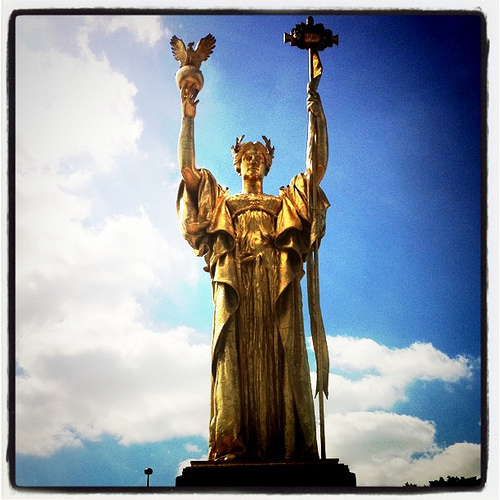
–Jackson Park, site of the 1893 World’s Columbian Exposition (featured in “The Devil in the White City”) home of the work above, “Statue of the Republic,” a scale model of the statue that was a centerpiece at that long-ago fair. (Photo by Thom Brekke.)
—Oakwoods Cemetery. Saw a great blue heron alight in a tree, then noticed that some big raptor was hanging out nearby.
–6500 block of Yale Avenue, where my great-grandparents (O’Malley/Moran) once lived. There’s a vacant lot where the house once stood.
–Holy Sepulchre Cemetery, where my brother and mom and many of her kin are buried.
–Als’s Italian Beef. The Ontario Street outlet. Tasty, if not historic.
It’s late on my dad’s day, his ninetieth birthday. He’s getting ready to pack it in, and so are the rest of us. There’s much more to say about this day and where he and the rest of us are in our lives, but for now, I’ll just offer up some links to some past observations on Dad’s birthday. And a few pictures, too, of course.
On the eve of Dadfest (his ninetieth birthday, tomorrow), I took him to a local barber for some tonsorial attention. With that seen to, we stopped at the Steak ‘n’ Shake drive-through, then headed north to intercept Sheridan Road on the North Shore. We wound up in Lake Forest, where I happened to notice a sign for a beachfront park: “Parking Entrance for Lake Forest Residents.” OK–I wanted to see what being a Lake Forest resident gets you.
I wound down a steep drive to a beautiful little beach and well-kept park and parking lot that was guarded by a young guy lounging in a lawn chair. I signaled to him we were just going to turn around and did that. I stopped and asked the guy about beach parking access. Yes, it was for residents, who could park for free. Could non-residents park there? Well, only if they have a season permit. How much is that? About $900 (and looking into things a little further, a season parking permit at the southern end of the park is $1,400). The city’s brochure on all this explains that non-residents are welcome to park at the train station in downtown Lake Forest, a mile west as the crow flies (and they’re welcome to use the beach, too, but need to pay ten bucks a head on weekends and holiday). And one last welcoming touch: Anyone who parks along any street east of Sheridan Road–close to the beach, in other words–will be ticketed and fined $125.
My beach curiosity satisfied, we continued on. Down a street marked with a “No Outlet” sign, I saw a massive gate and decided we needed to investigate that, too. It was the Lake Forest Cemetery. It’s well-tended, and many of the graves–for instance, that of 19th century wholesaling titan J.V. Farwell–are lavish.
The site above grabbed my attention. It’s the resting place of Frederick Glade Wacker, son of the man for whom Chicago’s Wacker Drive is named, and his wife, Grace Jennings Wacker–the latter once a Brooklyn Heights debutante. Their marriage in 1912 got some serious New York attention–both in The New York Times (here: New York Times wedding announcement) and in more detail in the Brooklyn Daily Eagle (here: Brooklyn Daily Eagle). Mr. Wacker didn’t reach 60. Mrs. Wacker died in the 1980s at the great age of 95, if her headstone is to be believed.
The Wackers did have children. There was a Frederick Jr., a businessman and motor sports enthusiast who died in 1998. HIs obituary in the Chicago Tribune lists three children and a grandson as survivors. Not mentioned is a brother, Charles Wacker III, who happened to be out of the country when Frederick Jr. died. Perhaps he went unlisted because of the circumstances of his absence.
In 1993, Charles Wacker III, who had made a name for himself as an owner and breeder of thoroughbred racehorses, was indicted on 16 counts related to an alleged tax-evasion scheme. Here’s how the Trib summarized the case:
“In its 50-plus-page indictment, the government alleged that the 72-year-old Wacker spent a decade creating a network of dummy corporations and hidden bank accounts from North Chicago to Hong Kong to shield himself from the IRS. Federal officials also alleged that Wacker defrauded his mother, Grace Jennings Wacker, and her estate of more than $500,000.
The story notes that the government accused Wacker of running his shell game to dodge $5 million in federal taxes and–how times have changed–says that it was the most massive personal tax evasion case in the history of the federal Northern District of Illinois. Other news accounts noted that he didn’t show for his first court appearance in Chicago. He was in England, where he ran his horse operation. His lawyer told the judge he was too ill to travel.
You see something sensational like that, and you want to know more. Whatever happened to CWIII? Is he languishing in a federal penitentiary somewhere, a la Bernie Madoff? Did he beat the rap?
Well, I couldn’t find a single news source that reported the denouement of the Charles Wacker III tax-fraud saga after the accounts of that first hearing. But I did dig up something from an online federal court file.
In 2002, the U.S. attorney for the district went to court to dismiss all charges. Why? Well, Charles was a fugitive, and prosecutors said he couldn’t be found. Also, the witnesses–Wacker’s accountant and Frederick Jr.–were deceased. And at the time the charges were dismissed. Wacker was 80. The Department of Justice motion (here: Wacker dismissal) doesn’t expand on that last fact except to imply, “What’s the point of going after him now?”
Charles Wacker III will be 90 on October 21, if he’s still living. I can’t find an obit for him. But I do find mentions as late as 2007, when he would have been 85 or 86, that he was still active in the horse-racing world.
We came across a copy of American HIstory magazine, not among the periodicals I have heretofore perused. Among the stories the editors tease on the cover: “First Twitter: Will Rogers tweeted 85 years ago.” (Really? I was thinking Samuel Pepys [Peeps] was the first Twitterer, but then I remembered he was really the first blogger.)
Anyway, the article is not yet online. It recounts how he began sending telegrams with brief observations to The New York Times in 1920 and how that turned into a daily feature in hundreds of American papers. The article has a couple of dozen of his brief messages, that were published under the headline “Will Rogers Says.” He’s fond of taking on the wealthy, the pompous, and the Republicans of his day (the closest voice I’ve heard in our day, though one much more self-consciously political, is Jim Hightower, the Texas guy). For instance, this came a couple months after the 1929 market crash:
Beverly Hills, Calif., Dec. 25, 1929–Passed the Potter’s Field yesterday and they was burying two staunch of Republicans, both of whom died of starvation, and the man in charge told me their last words were, “I still think America is fundamentally sound.”
And another, the day after FDR took office in 1933:
Santa Monica, Calif., March 5, 1933–America hasn’t been as happy in three years as they are today. No money, no banks, no work, no nothing, but they know they got a man in there who is wise to Congress, wise to our big bankers and wise to our so-called big men. The whole country is with him. Even if what he does is wrong they are with him. Just so as he does something. If he burned down the Capitol, we would cheer and say, “Well, we at least got a fire started anyhow.”
We spent a couple hours scanning in some family pictures from albums that Kate and my mom put together from the big mountain of family snapshots that had accumulated for decades and decades. A lot of what we’re scanning is stuff from our own lives, scenes and experiences that the images recall vividly and instantly.
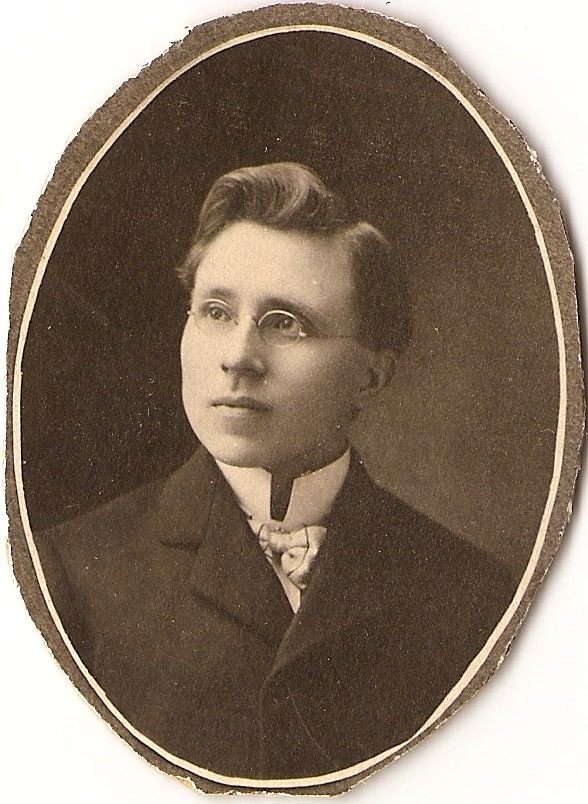
And then there’s the photo above. That’s my dad’s father, Sjur Ingebrigtsen Brekke. who passed on long before I was born. A note on the reverse in my grandmother’s handwriting says, “Lake Michigan, July 31, 1911.” (Maybe such inscriptions are passe, but if you want your own virtual mountain of digital snaps to be a little more intelligible to your posterity, leave some hint of who, what, when, where, etc.)
This man has always been an enigma. Here he is at age 35, ten years before my dad’s arrival in the world. He died a little more than ten years after that event, at age 55. I haven’t seen a picture in which he actually cracks a smile–at least not in any sense I’d recognize. Here he looks a bit put off by whoever it was talked him into coming out to the dunes in his suit. He was a Lutheran pastor in Muskegon at the time, and maybe that was the official beach uniform of his calling. (By all accounts, which means what my dad has told us, he was a kind and gentle soul and a reserved and quiet one, too.)
The photo’s composition is curious, too. Here we are in a picturesque stretch of the Michigan dunes, and the picture is framed in a way that directs attention to the smoke-emitting building in the background. (Later researches showed that the building in the background was the Muskegon waterworks. That building and the dunes in the distance are no more (the dunes were mined for sand, which removed the natural barrier that had protected the city’s harbor from westerly winds off the lake).
Below: A picture of Sjur at age 26, a little more relaxed looking, about the time he was completing his studies to become a minister.
“If the minority will not acquiesce, the majority must, or the Government must cease. There is no other alternative, for continuing the Government is acquiescence on one side or the other. If a minority in such case will secede rather than acquiesce, they make a precedent which in turn will divide and ruin them, for a minority of their own will secede from them whenever a majority refuses to be controlled by such minority. …
“A majority held in restraint by constitutional checks and limitations, and always changing easily with deliberate changes of popular opinions and sentiments, is the only true sovereign of a free people. Whoever rejects it does of necessity fly to anarchy or to despotism. Unanimity is impossible. The rule of a minority, as a permanent arrangement, is wholly inadmissible; so that, rejecting the majority principle, anarchy or despotism in some form is all that is left.”
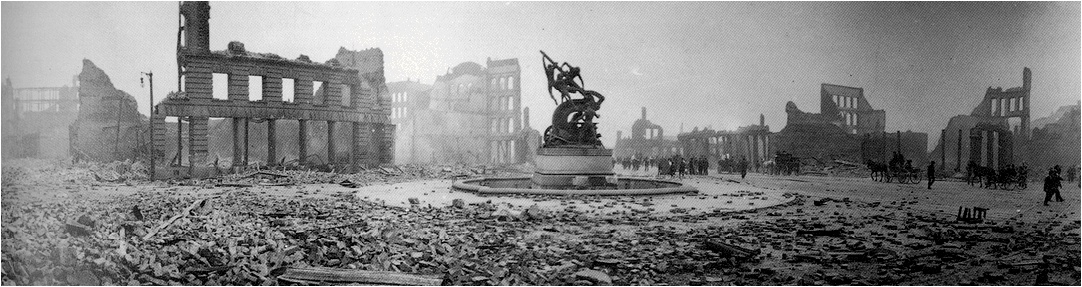
I stopped downtown on the way in to work yesterday. To give blood on Bush Street. When they’d gotten my pint, I walked down the street and got a cup of coffee (no longer recommended by the blood donation people since caffeine is a diuretic and they want to make sure you build up your fluids after you’re tapped). Right there where Bush meets Battery and Battery hits Market is this monument, the Mechanics Monument. It was created in honor of Peter Donahue, the cofounder of the city’s Union Iron Works, which I believe was the first heavy industry on the West Coast. Here’s a description of the monument from Gray Brechin in his fine and irascible history, “Imperial San Francisco“:
“Douglas Tilden‘s heroic group of five nude men straining to punch a steel plate commemorated both the family that had built the West’s first foundry and the mechanics who built the Donahue fortune. [Mayor] Phelan … reminded the crowd that from the Donahues’ primitive foundry, once located just a block away in Tar Flat, had grown the might Union Iron Words whose ships had earned San Francisco worldwide fame and wealth.”
President McKinley was in the city to unveil the monument in 1901, but begged off because his wife took ill.
(And: another view of the monument a few years after its dedication.)