
The Lewis O. Brekke Story, or Documentary Inquiries into The Life of a Non-Relative

While recently pursuing Irresistibly Absorbing Research on the origins of Oakland’s King’s Daughters Home, I happened across a resource that is itself irresistible and absorbing: The Library of Congress’s Chronicling America collection of historic U.S. newspapers. It’s an archive of selected papers published between 1836 and 1922. In doing a quick trace of the history of the King’s Daughters establishment, several stories from the old San Francisco Call, part of the Chronicling America collection, helped fill in blanks.
lewisbrekke

I went back the next day to see what else might be there. Since I’ve been doing some genealogical research, I thought I’d look at what Minnesota papers might be in the archive. My grandparents lived in several different towns up there in the 1910s and ’20s, and my dad was born in a little town in Marshall County called Alvarado. It so happens that Marshall County still has a weekly paper published in the county seat–the Warren Sheaf. The Sheaf turned out to be one of the papers digitized and included in the Chronicling America archive. I looked for the issue published the week my dad was born, in September 1921, and came across the following in the “Alvarado News” column:

“Born to Rev. and Mrs. S. J. Brekke last Saturday at the Warren City Hospital, a bright baby boy. Congratulations.”

Going through the Sheaf turned up lots of mentions of my grandfather, Sjur Brekke, who was a Lutheran minister and pastor for several Norwegian congregations in the area: in Alvarado (a town of only a few hundred which at the time had a separate Swedish Lutheran congregation with its own minister), in Viking, at a rural church called Kongsvinger, and apparently in at least one other town. Any time something was doing at the churches, the Reverend Brekke got a mention. Every once in a while, my grandmother, Otilia Sieversen, would make print, too–usually when entertaining guests or when off visiting in one of the neighboring towns in Marshall County.

I cast my search net wide, and looked for any mentions of “Brekke” in Minnesota papers in the archive; my grandfather had a brother, Johannes, who lived with his family in the Fergus Falls area around 1920. Johannes was a traveling Lutheran preacher, so I was thinking maybe I’d come across some mention of him. But I didn’t, and since Brekke is not an uncommon name in Minnesota, I got quite a few hits of folks who don’t seem to belong in the family annals. The most remarkable of these involved someone named Lewis Olson Brekke.

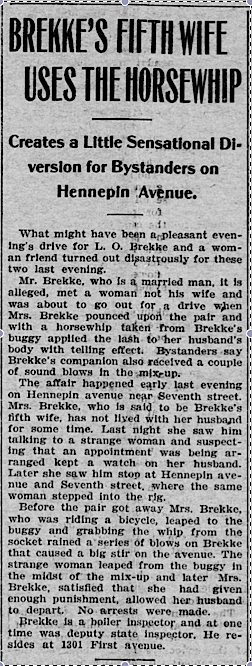
I made his acquaintance in the pages of the St. Paul Globe of Friday, July 10, 1903, under this headline:

Brekke’s Fifth Wife
Uses the Horsewhip

The story, at right above, is a classic police blotter item blown up to separate-item proportions–a marital spat that ends with an ugly scene on a crowded street. The account’s picture of Mrs. Brekke setting upon her cheating spouse with a whip is vivid. But the prize detail for me is, “…Mrs. Brekke, who was riding a bicycle, leaped to the buggy.” She sounds like quite the acrobat.

So that’s that. The unfortunate L.O. Brekke is beaten by his wife, made an object of fun in the local press, and retires to lick his wounds and his pride. Well, no. There’s more to Mr. Brekke’s story. He turns out to have been a sort of running joke for reporters covering the courts in Minneapolis. The year prior to this scuffle, several accounts appeared that detailed a divorce action between Lewis Olson Brekke, the L.O. Brekke of the story above, and his wife, Laura Runbeck Brekke. The Minneapolis Journal reported she had sued for divorce on grounds of “cruel and inhumane treatment” but “could not substantiate her allegations.” Then Lewis sought a divorce on the same grounds, citing his wife’s alleged habit of “throwing various articles of furniture at his head whenever his back is turned.” He said he feared to sleep nights lest Laura attack him, that she called him “vile and indecent names,” and that her ” ‘carryings on’ with a married neighbor had scandalized their acquaintances.” He also claimed he had discovered that she had a common-law husband and thus their marriage was never valid. (In the pages of the Globe, anyway, this way by no means an isolated case. The divorce action featuring the abusive wife appears to have been one of its staples during the turn of the last century. A chance reading of several pages of the Globe finds wives taking swipes at husbands with butcher knives, throwing crockery, wrestling over bicycles, and dumping ice water on their spouse’s heads. And that’s before “Fatal Attraction.” We could have the seeds of a dissertation here.)

It’s not clear how the Brekke divorce suit came out–maybe the stories relating the outcome have not been indexed–but I’m guessing that the “Mrs. Brekke” who resorted to the horsewhip is one and the same as the one who struck fear into her husband’s heart by hurling household objects at him. You’d really like to have a picture of this couple; the best I can do is uncover some of the traces they (and he especially he) left in government documents through the years.

Lewis Olson Brekke, born in Norway, about 1852, emigrated to the United States in the early 1870s, lived in Iowa in the ’70s, in Minnesota in the mid-’80s, then moved to Minneapolis in the early 1890s, and to the Seattle area after 1905 sometime. Lewis was about 50 when accosted by his bike-riding spouse, and Laura Brekke was about 15 years his junior. In the 1900 census, taken in April, she was listed as a servant living in Lewis’s household (the other residents were Lewis’s 13-year-old daughter, whose name was recorded as Ammanda, and three women boarders). Lewis was listed as divorced. Lewis’s and Laura’s relationship bloomed into something else, and they were married in Sepember of that year.

Was she his fifth wife, as the headline says? Maybe. Perusing census and marriage records through FamilySearch.org and Ancestry.com–yes, it’s possible to have too many research tools at hand–Lewis shows up in the company of several previous spouses: May (or perhaps Mary) Halvorsen, whom he wed near Decorah, in northwestern Iowa, on December 26, 1874; in an Iowa census taken in 1885, he’s reported as widowed, with three children; later that year, he married a Kari (or Karie or Carrie) Boxengaard in Spring Grove, Minnesota, about 20 miles up the road from Decorah; in September 1893, he married a Phoebe Slocum (she doesn’t sound Scandinavian), in Minneapolis; and then in 1900 we have him tying up with Laura. In later years, he moved to Washington state, and in the 1920 census, nearly 70, he reported himself as married, though no wife was living with him.

As I mentioned before, his divorce and horse-whipping didn’t mark the first time the papers had some fun with him. On Oct. 5, 1892, the St. Paul Globe reported on an apparently fraudulent lawsuit that Lewis had brought against an erstwhile employer:

“The damage case of L.O. Brekke against S.E. Olson & Co. [a Minneapolis “dry goods” store] is over, and the finding of the court is for the defendant. Brekke sued the firm for damages, claiming that while in the firm’s employ he sustained injuries in the store elevator which would render him lame for life. The list of injuries was a long one, as was the number of witnesses who corroborated Brekke’s testimony. The defense introduced evidence from people who lived in Decorah, Io., Brekke’s old home, which proved conclusively that the plaintiff had received the injuries he referred to twenty years ago. He had been lame for the same number of years, and long before he ever dreamed of coming to Minneapolis. Brekke’s divorced wife testified he was lame when she married him long years ago. The case was tried in the United States district court before Judge Nelson.”

A few years later, the Globe dropped in on Lewis as he pursued his duties as deputy state boiler inspector for Hennepin County. He was described as being “considerably incensed” over complaints from residential property owners who felt he was overstepping bounds to “examine every little boiler and toy engine in the city.” Later, he lost out in his bid to be chief boiler inspector for the county, a patronage job.

In various census returns, Lewis listed his occupation as “engineer” or “inventor.” And sure enough, he shows up in the U.S. Patent database for several devices registered over a period of more than 30 years. While he was undergoing his troubles with his soon-to-be horsewhipper, he patented a “folding footboard for iron bedsteads” and apparently started a company to manufacture them. What was the purpose of his innovation? As detailed in the patent application, it sounds like something out of “Seinfeld“:

It is a well known fact that many people object to iron bedsteads simply for the reason that they have no footboard against which the clothes maybe tucked and against which the feet may if desired be pressed. A permanent footboard of the proper dimensions would be objectionable for the reason that the bedclothes could not be thrown over the same in the day time or if so thrown would give to the bed a very awkward and unusual appearance. I believe I have solved the problem in practical and simple manner by providing a footboard which has a folding upper section adapted to be turned flat upon the foot end of the mattress so that the bedclothes may be thrown over the same and the bed given the same made up appearance as if there was no footboard provided. At the same time this folding section may be turned up before a person retires and the bedclothes may then be tucked between the footboard and the mattress. This being done there is nothing objectionable to the bed and the same footboard accommodation is afforded as with an ordinary wooden bedstead.

I don’t find any evidence that Lewis got rich off the revolutionary “swish and swirl” footboard. Or off his other inventions: an improved kerosene lantern, an improved stove and furnace grate, an improved grain-binder, and a draft equalizer (a device to make sure that three-horse teams would plow or pull evenly).

Loose ends I can’t tie up: What happened to those four kids of his? And where did he end up? He had one more turn in court that I can find–testifying in a 1909 death inquest in Washington that he had heard against his drunken landlord threaten to kill his wife shortly before her body was found on nearby railroad tracks. Then there’s the 1920 census, and then nothing–no inventions, no newspaper stories, and apparently no more buggy rides with women friends.
First of All Martyrs, King of All Birds

The wren, the wren, the king of all birds,
St. Stephen’s Day was caught in the furze,
Although he was little his honour was great,
Jump up me lads and give him a treat.
—”The Wren

Of course, in Ireland and like parts, the “king of all birds” was singled out for some rough treatment the day after Christmas. A somewhat sanitized version of the song, on The Chieftain’s “Bells of Dublin” album, alludes to the death of the wren, but doesn’t explain how it came to expire. Liam Clancy’s much earlier recording of a traditional number, “The Wran Song,” doesn’t leave much doubt about what had happened to the bird: “I met a wren upon the wall/Up with me wattle and knocked him down.” In fact, if you’re inclined to explore further the Irish (and fellow Celts’) Christmastime wren customs, here’s a book for you, “Hunting the Wren: Transformation of Bird to Symbol.”

A brief passage on the traditions of the wren hunt: “Typically, on the appointed ‘wren day’ a group of boys and men went out armed with sticks, beating the hedges from both sides and throwing clubs or other objects at the wren whenever it appeared. Eyewitnesses described the hunting of the wren in Ireland in the 1840s:

For some weeks preceding Christmas, crowds of village boys may be seen peering into hedges in search of the tiny wren; and when one is discovered the whole assemble and give eager chase to, until they have slain the little bird. In the hunt the utmost excitement prevails, shouting, screeching, and rushing; all sorts of missiles are flung at the puny mark and not infrequently they light upon the head of some less innocent being. From bush to bush, from hedge to hedge is the wren pursued and bagged with as much pride and pleasure as the cock of the woods by more ambitious sportsmen.”

And why is the wren “the king”? According to the book above, the appellation goes back to a fable apparently current in several cultures and in Greece and Roman tradition ascribed to Aesop: various birds vied with the eagle for the title of the king of birds. One by one, the eagle out-soared them. But the wren–the wren concealed itself in the eagle’s feathers, and as it sensed the eagle was tiring, flew up and away, farther than the eagle could reach.

But enough of the wren. I really want to talk about December 26, also known as Boxing Day (what’s that about? Here’s a rather tart view from early 19th century London) and St. Stephen’s Day. The latter is of special note for me, since my dad’s first name, and mine, are Stephen. A few years ago, my friend Pete offered up a find from an encyclopedia on Roman Catholicism on the life and times of St. Stephen, who is remembered as the first Christian martyr. The capsule version of his trouble is recounted in the New Testament book of Acts. Therein, it’s recorded that locals in the Greater Holy Land area didn’t appreciate everything Stephen, whom Jesus’s apostles had appointed a deacon and put in charge of distributing alms to poorer members of the community, had to say on theological matters. He was accused of blasphemy, hauled before the Local Religious Tribunal, and tried. During the trial, he continued to outrage his accusers, whereupon, according to Acts 8:

“…They were cut to the heart: and they gnashed with their teeth at him. But he, being full of the Holy Ghost, looking up steadfastly to heaven, saw the glory of God and Jesus standing on the right hand of God. And he said: Behold, I see the heavens opened and the Son of man standing on the right hand of God. And they, crying out with a loud voice, stopped their ears and with one accord ran violently upon him. And casting him forth without the city, they stoned him. And the witnesses laid down their garments at the feet of a young man, whose name was Saul. And they stoned Stephen, invoking and saying: Lord Jesus, receive my spirit. And falling on his knees, he cried with a loud voice, saying: Lord, lay not this sin to their charge: And when he had said this, he fell asleep in the Lord….”

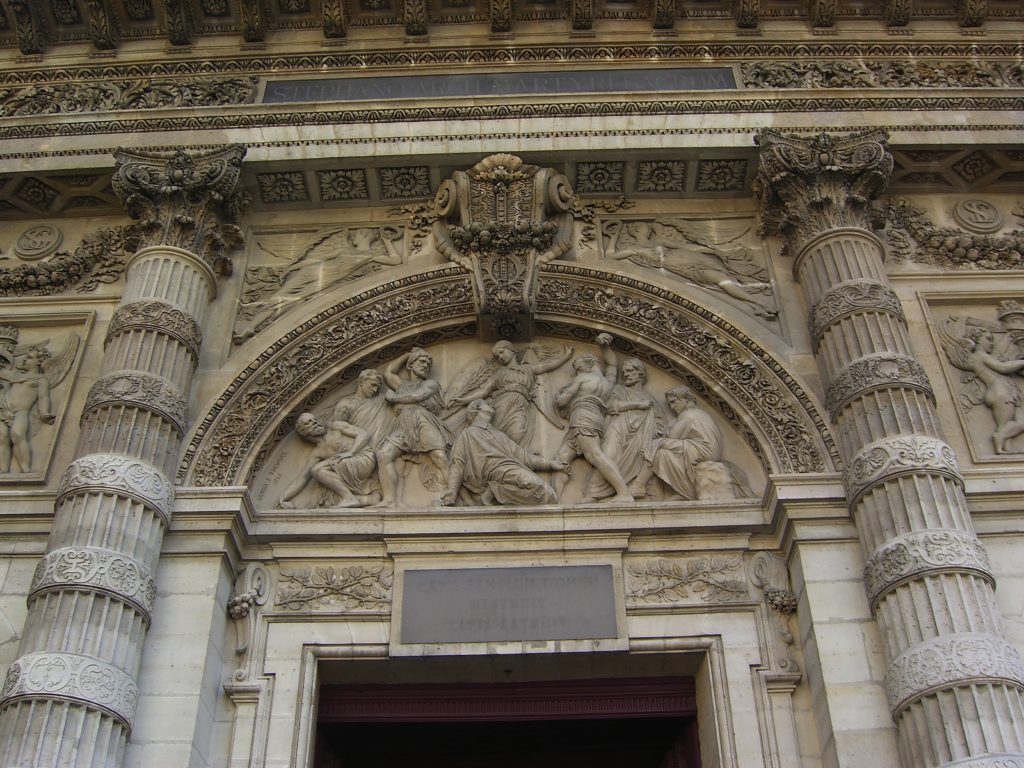
A few years ago, I was in Paris and after wandering through the Latin Quarter and up toward the Pantheon, landed in front of a church where the denouement of this story is depicted above the entrance. I only slowly put the name of the church, St. Etienne du Mont, together with the story of St. Stephen (Stephen=Etienne en français). I stand by my earlier description of the scene (picture below): “Immediately above the doorway … Stephen is about to earn his way onto the church calendar despite the presence of an angel who, though appearing benificent, doesn’t seem the least inclined to stay the hands of a bunch of guys who look not at all hesitant to cast the first stone.” One detail of this image I didn’t notice before: The sculpture was done in 1863, a good 240 years after the church was dedicated.

Boxing Day: A Critique

While perusing the Grand World Treasury of Digital Distractions for “information” about the various observances that take place December 26–including England’s Boxing Day–I happened across the following. It’s from the December 31, 1825, number of The Portfolio, a London magazine “Comprising the Wonders of Art and Nature, Extraordinary Particulars Connected with Poetry, Painting, Music, HIstory, Voyages & Travels.”

BOXING DAY

At length the long-anticipated and wished-for day arrives; all classes from the merchants clerk down to the parish Geoffrey Muffincap, are on the tip-toe of expectation. Many and various are the ways of soliciting a Cristmas [sic] gift. The clerk, with respectful demeanour and simpering face, pays his principal the compliments of the season, and the hint is taken; the shopman solicits a holiday, in full expectation of the usual gift accompanying the consent; the beadle, dustmen, watchmen, milkmen, pot-boys &c. all ask in plain terms for a Christmas-box, and will not easily take a refusal; crowds of little boys are seen thronging the streets at an early hour with rolleu papers in their hands, these are specimens of their talent in penmanship, which they attempt to exhibit in every house in their respective parishes; four or five of these candidates for a “box” are seen collected together to watch the success of one, who, bolder than the rest, has ventured first to try his luck. Woe to the tradesman who gives his mite: a hundred applications are sure to succeed a successful one, and what with their hindering the usual business of their shop, and their importunities to shew their “pieces” the poor man has no peace of his life. The money obtained in this way is generally expended the same evening at some of the theatres. It is truly amusing to trace the progress of boxing-day with the generality of those who go from ddorto door collecting this customary largess.— To illustrate this I subjoin a short journal of the day’s proceeding written by one of these gentry and forwarded to his father in the country.

BOXING-DAY

“Got up at 7 o clock—quite dark—struck a light, and cleaned my master’s shoes; while I was about it, thought I might as well clean mistress’s and little master’s—mistress gave me 5s. last year. Mary, the maid, offered to take mistress’s shoes up to her—would not let her—told her they were not finished, meant to take them up myself. Breakfasted at half past eight—could not eat muchwent up stairs to ask the governor for a day’s holiday, he grumbled, but gave me leave to go—put his hand in his waistcoat pocket—expected 5s. at least—all expectation,—he drew out his hand and with it his pen knife. I looked very foolish and felt my face as hot as fire—wished him a merry Christmas; thanked me, gave me half-a-crown, and said times were very bad—thanked him and went to fetch my mistress’s shoes up; she gave me nothing; she may do them herself another time.—Dressed myself and went out a boxing—first to Mr. Scragg’s the butcher—he told me master had not yet paid his Christmas bill—no go—went next to the bakers; got 6s. collected altogether £2. 12s.—called on Sam Groomly—went together to Pimlico, I stood treat at dinner; parted from him; and at about a quarter past four got to my dear Sally’s to tea—took her and her sister to the Olympic—a very fine place—saw them home, and promised Sal to go and see her on twelfth day night. Got back to my lodging about half past twelve with 3s. 2½d. in my pocket—spent a great deal: but Christmas is but once a year.”

This, like many other of our ancient customs, is much abused, and is made the vehicle for much annoyance; yet at the same time so much has been done towards depriving the lower classes of their amusements, that we cannot wonder at their making the most of those that remain.

J.W.F.B.

Some North Berkeley Flatlands Luminaria History

Berkeley Luminaria 2010

It’s almost that time again: Christmas Eve, the night of nights in our humble 99 percent neighborhood, where we express solidarity with all who celebrate light at this dark end of the year with–what? Paper bags, sand, and candles, also known as luminaria, luminaries, farolitos, and many other names that I am sure exist but have not yet come to my notice. Our one-night fete is the 24th, and this year will be the 20th time the neighbors here have gotten together to do this. Here are some posts from years past:

2010
Berkeley Luminaria: 2010 Edition

2009
‘Always on Christmas Night …’

2008
Luminaria Rainout
Happy Last of the Year

2007
Luminaria 2007

2006
Luminaria Streets
Hot Xmas Eve Bag Action

2005
Luminaria ’05: Pregame Report
Luminaria ’05: First-Half Action
Luminaria ’05: Second Half, Game Summary
Luminaria ’05: Maps

2004
Blogging the Luminaria

Morning-After Disassembly Line

2003
Luminaria

Family History Files: Tim Hogan

A long-ago teacher of mine–G.E. Smith, who taught English, literature, and a lot more at Crete-Monee High School in the 1960s and '70s–became interested in his family ancestry late in life. It wasn't an easy thing. I don't know a lot of his personal story, but I do know that his mother left his biological father very early in his life, back in the mid-'20s, and that he was raised by a stepfather he remembered as generous if not saintly.

Also late in life, he brought out a book of poems he had written as a much younger man. He hadn't intended to, he said, but when he started into the family history business, his work took on a different meaning: "It wasn't until I began to think, as a genealogist, about how anything written by ancient relatives–even in signature–was (or could have been) so extraordinarily precious that I decided to consider publishing. I realized that I, too, someday, would likely be a long-ago ancient relative to someone who was pursuing my family history."

That line about the actual words of a forebear being "so extraordinarily precious" stuck in my head. I've listened to perhaps hundreds of hours of stories about my dad's family and my mom's, and recently I was struck with a little sense of urgency about setting down at least the basic outlines of what I've heard. So far, that's mostly involved cemetery visits and creating the beginnings of a family tree (through the very expensive and sometimes-worth-it Ancestry.com). There's a bit of an addictive thrill in tracking down someone you've been hearing about your whole life in a century-old census record: Wow–there they are, just like Mom and Dad said, in Warren, Minnesota, or on South Yale Avenue in Chicago. But records only take you so far, and they don't really give a voice to the people listed on the census rolls or on the draft records or on Ellis Island arrival manifests.

I imagine my family is like most in that whatever words were ever written down have mostly fallen victim to fastidious housecleaning, negligence, dismissiveness, or lack of interest. You know: "Who'd ever be interested in that?" or, "Does anyone want this old stuff?" (I think pictures are the occasional exception to this rule. Plenty get thrown away, but the images have an intrinsic interest for a lot of people when they can't readily identify the subjects of the photos.) Chance, mostly, and, less often, selection determine what survives. My dad has a collection of letters his father wrote to his mother during their courtship and early in their marriage, a century and more ago. I believe they are numbered and I remember hearing that after my grandfather, Sjur Brekke, died, in their 26th year of marriage, my grandmother continued to read those letters for years afterward. There used to be another set of letters, too–my grandmother's letters to my grandfather. But at some point she destroyed them. The story I've heard is that she considered them too personal for others to read. Wouldn't we Brekke descendants love to get a look at those.

Over to my mom's side of the family: They were Irish and stereotypically more voluble than my dad's Norwegian clan. But not much has survived (that I know about) beyond the oral tradition. One rather amazing exception: my mom's grandfather.

Timhogan-twins10061933I don't know a lot about him, but Timothy Jeremiah Hogan was born in Ottawa, Illinois, in 1864 (I'll let him tell that story), lived as a child on the Great Plains (ditto), raised a family, including my grandfather Edward Hogan, in central and northern Illinois. He was a railroad man, working for one of the roads back there (on the Wabash, I believe, but don't know for sure). He was said to have spent a lot of time riding alone in the caboose and taught himself to play the guitar. He was losing his hearing at the end of his life, was described as taciturn and short with most of his grandchildren, and was reportedly heartbroken when a favorite grandson drowned in the summer of 1939. He died himself a month later.

Another thing about Tim Hogan: He had a typewriter, and he used it. He composed poems on the typewriter, and song lyrics. Here's one of his poems, about two of my mom's brothers (that's them in the picture at right) shortly after their first birthday:

October 7th.1934.
AN ODE TO OUR LITTLE
TWIN BOYS TOM, AND ED
*********************
Early in the morning
When they open up their eyes
Laying in their tiney little beds
Rolling over, over
Both the same size
Cunning little round bald heads.
You couldent help but love them
With their smileing eyes of blue
Remember it was GRAND DAD told you so,
Charming little twinners,
Only new beginers
You can almost see them grow.

Tim wrote letters, too. We only have a handful of them, but below are a couple that he produced in 1936 when he was trying to do a little biographical/genealogical research of his own. The first (click pages for larger images; full text is after the jump) is to the clerk of LaSalle County, and he's hoping to find records of his family's residence from around the time of his birth.

timhogan_1.jpeg timhogan_2.jpeg

The second letter is to the Railroad Retirement Board. He doesn't explicitly mention it here, but I recall a couple of my mom's aunts, Tim's daughters Catherine and Betty, saying he was trying to establish his date of birth in relation to a pension that might be due.

timhogan_3.jpeg

One question I have about these: Did he send them? As he says, he's earnestly interested in getting answers. So my guess is that these are copies of versions he sent. I haven't found any records in the sparse collection of family documents to suggest what answers he might have gotten. The full text of the letters is available through the link below. If the lines break in an odd way, it's because I tried to stick to how he broke the lines, starting nearly each new line with a capital letter. I've also tried to copy his punctuation and spelling.

Continue reading “Family History Files: Tim Hogan”

Family History Files: Tim Hogan

A long-ago teacher of mine–G.E. Smith, who taught English, literature, and a lot more at Crete-Monee High School in the 1960s and '70s–became interested in his family ancestry late in life. It wasn't an easy thing. I don't know a lot of his personal story, but I do know that his mother left his biological father very early in his life, back in the mid-'20s, and that he was raised by a stepfather he remembered as generous if not saintly.

Also late in life, he brought out a book of poems he had written as a much younger man. He hadn't intended to, he said, but when he started into the family history business, his work took on a different meaning: "It wasn't until I began to think, as a genealogist, about how anything written by ancient relatives–even in signature–was (or could have been) so extraordinarily precious that I decided to consider publishing. I realized that I, too, someday, would likely be a long-ago ancient relative to someone who was pursuing my family history."

That line about the actual words of a forebear being "so extraordinarily precious" stuck in my head. I've listened to perhaps hundreds of hours of stories about my dad's family and my mom's, and recently I was struck with a little sense of urgency about setting down at least the basic outlines of what I've heard. So far, that's mostly involved cemetery visits and creating the beginnings of a family tree (through the very expensive and sometimes-worth-it Ancestry.com). There's a bit of an addictive thrill in tracking down someone you've been hearing about your whole life in a century-old census record: Wow–there they are, just like Mom and Dad said, in Warren, Minnesota, or on South Yale Avenue in Chicago. But records only take you so far, and they don't really give a voice to the people listed on the census rolls or on the draft records or on Ellis Island arrival manifests.

I imagine my family is like most in that whatever words were ever written down have mostly fallen victim to fastidious housecleaning, negligence, dismissiveness, or lack of interest. You know: "Who'd ever be interested in that?" or, "Does anyone want this old stuff?" (I think pictures are the occasional exception to this rule. Plenty get thrown away, but the images have an intrinsic interest for a lot of people when they can't readily identify the subjects of the photos.) Chance, mostly, and, less often, selection determine what survives. My dad has a collection of letters his father wrote to his mother during their courtship and early in their marriage, a century and more ago. I believe they are numbered and I remember hearing that after my grandfather, Sjur Brekke, died, in their 26th year of marriage, my grandmother continued to read those letters for years afterward. There used to be another set of letters, too–my grandmother's letters to my grandfather. But at some point she destroyed them. The story I've heard is that she considered them too personal for others to read. Wouldn't we Brekke descendants love to get a look at those.

Over to my mom's side of the family: They were Irish and stereotypically more voluble than my dad's Norwegian clan. But not much has survived (that I know about) beyond the oral tradition. One rather amazing exception: my mom's grandfather.

Timhogan-twins10061933I don't know a lot about him, but Timothy Jeremiah Hogan was born in Ottawa, Illinois, in 1864 (I'll let him tell that story), lived as a child on the Great Plains (ditto), raised a family, including my grandfather Edward Hogan, in central and northern Illinois. He was a railroad man, working for one of the roads back there (on the Wabash, I believe, but don't know for sure). He was said to have spent a lot of time riding alone in the caboose and taught himself to play the guitar. He was losing his hearing at the end of his life, was described as taciturn and short with most of his grandchildren, and was reportedly heartbroken when a favorite grandson drowned in the summer of 1939. He died himself a month later.

Another thing about Tim Hogan: He had a typewriter, and he used it. He composed poems on the typewriter, and song lyrics. Here's one of his poems, about two of my mom's brothers (that's them in the picture at right) shortly after their first birthday:

October 7th.1934.
AN ODE TO OUR LITTLE
TWIN BOYS TOM, AND ED
*********************
Early in the morning
When they open up their eyes
Laying in their tiney little beds
Rolling over, over
Both the same size
Cunning little round bald heads.
You couldent help but love them
With their smileing eyes of blue
Remember it was GRAND DAD told you so,
Charming little twinners,
Only new beginers
You can almost see them grow.

Tim wrote letters, too. We only have a handful of them, but below are a couple that he produced in 1936 when he was trying to do a little biographical/genealogical research of his own. The first (click pages for larger images; full text is after the jump) is to the clerk of LaSalle County, and he's hoping to find records of his family's residence from around the time of his birth.

timhogan_1.jpeg timhogan_2.jpeg

The second letter is to the Railroad Retirement Board. He doesn't explicitly mention it here, but I recall a couple of my mom's aunts, Tim's daughters Catherine and Betty, saying he was trying to establish his date of birth in relation to a pension that might be due.

timhogan_3.jpeg

One question I have about these: Did he send them? As he says, he's earnestly interested in getting answers. So my guess is that these are copies of versions he sent. I haven't found any records in the sparse collection of family documents to suggest what answers he might have gotten. The full text of the letters is available through the link below. If the lines break in an odd way, it's because I tried to stick to how he broke the lines, starting nearly each new line with a capital letter. I've also tried to copy his punctuation and spelling.

Continue reading “Family History Files: Tim Hogan”

The King’s Daughters Home for Incurables

Gateway to the former King’s Daughters Home on Broadway in Oakland.

On Broadway in Oakland, between 40th Street and MacArthur Boulevard: I have been up and down this block hundreds of times driving, on the bus, on a bike, and on foot. Late this afternoon, while waiting for a prescription to be filled at one of the Kaiser pharmacies nearby, I took The Dog for a walk. On our way back, just below 40th Street and on what you’d call more or less accurately the east side of Broadway, we crossed a driveway and I looked up. A spare and striking archway said “The King’s Daughters Home.” I went back to the car, grabbed my camera, left the dog, then walked back to the gate. The name alone suggests there’s a story there.

The building, not pictured, is now owned by Kaiser and houses at least part of the organization’s psychiatric and counseling practice. What was it before? To me, “King’s Daughters” suggests what used to be called a lying-in or maternity hospital; maybe one for what used to be called young women in trouble.

The actual history: The Broadway facility was indeed a hospital, designed by architect Julia Morgan (perhaps best known as the architect of William Randolph Hearst’s castle on the Central California coast). A gallery of the King’s Daughters Home pictures gives its completion date as 1912, so we’re on the eve of the centennial. What kind of hospital was it?

First, the home took its name from the International Order of King’s Daughters (later “Daughters and Sons”), an interdenominational Christian organization that started in New York in 1886. According to the order’s history, the movement spread rapidly and had 50,000 members across the United States, Canada, and overseas within the first year. The group’s mission was to undertake good works in the name of Christ. If you look for the phrase “King’s Daughters” now, you come across many hospitals across the country that apparently began as projects by local King’s Daughters circles.

In 1890, a San Francisco circle organized The King’s Daughters Home for Incurables. In July 1895, the San Francisco Call detailed the home’s workings, including the high demand for services, the difficulty finding money to provide it, and rates for long-term patients (“life memberships can be secured for those above 60 years of age for $500…”). I’m not sure how long the San Francisco home lasted; I find references to it, first on Francisco Street in North Beach, then on Golden Gate Avenue in the Western Addition, through 1917.

From the September 3, 1902, edition of the San Francisco Call.

A second home, sometimes called the Alameda County King’s Daughters Home for Incurables, opened in Oakland sometime in the late 1890s (were the two operations connected? I don’t know). A story in the September 3, 1902, edition of the Call suggests the home’s first East Bay location may have been at 11th and Oak streets, near the current site of the Oakland Museum of California). The story mentions a deadly fire there, and the May 10, 1902, Journal of the American Medical Association reported: “The north wing of the King’s Daughters’ Home for Incurables, Oakland, was destroyed by fire, April 28. Despite the heroic efforts of the matron, nurses’ and attendants, one inmate was fatally burned and another will probably die from injuries received.” (The San Jose Evening News published a more complete account under the headline “Awful Fire in Oakland Hospital.” The story reports: “That so many inmates were rescued is due to the prompt and heroic action of some of Oakland’s most prominent society ladies who resided in the vicinity of the Home.”)

The fire prompted the home to move to the property at 3900 Broadway, which contained both a building that could be used for temporary quarters and room for a new, permanent hospital. In subsequent years, the Call reported on plans for the new facility (“King’s Daughter Will Erect New Home for Incurables,” March 31, 1906) and a redoubled fund-raising effort to obtain the $100,000 needed to finish the project (August 23, 1910. The story says “Every home in Oakland, Berkeley, and Alameda is asked to contribute at least one dollar. Coin envelopes are being distributed from house to house by specially appointed workers, who may be identified by a badge they wear, with ‘King’s Daughters’ printed upon it. Every family is asked to donate what it can, inclosing the amount of the gift in the envelope, which will be called for Thursday, August 25, between the hours of 5 and 8 p.m.” )

Who were the incurables? Those who medical science of the day could not treat: stroke victims, the disabled, patients diagnosed with tuberculosis. One patient in the 1930s and ’40s is said to have been Bess Maddern London — Jack London’s first wife — who had suffered a crippling stroke.

Where did the patients and residents end up? Mountain View Cemetery, less than a mile away (and designed by another notable architect, Frederick Law Olmstead), reportedly has a section devoted to Kings Daughters patients.

Among the many things I don’t know: When the facility ceased being the King’s Daughters Home for Incurables. Still on the hunt for that, but I’ve got to get to bed.

[Update: One interlocutor asks: Where did the name “King’s Daughters” come from? The order’s history says a Mrs. Irving, one of the founders, suggested that title. “The King” was to be understood to be God. An 1888 poem by an early member spells it out:

“…Her Father sent her in his land to dwell,
Giving to her a work that must be done.
And since the King loves all his people well,
Therefore, she, too, cares for them every one.
Thus when she stoops to lift from want or sin,
The brighter shines her royalty therein. …”]

R.I.P., Mary Dahl

marydahl080511.jpg

Kate took this one during an August visit to Mount Olive Cemetery, up on the North Side of Chicago. It’s where my dad’s people are, and it’s impressive to see such a collection of Danes, Swedes, and Norwegians in one place. Every once in a while–pretty frequently, actually–you come across a headstone that, with only names and dates, seems to tell a story. In this case: the three short lives of Mary Dahl.

Briefly, here’s what I can find through looking at some genealogical records. George and Mary Dahl (nee Marie Johnson) arrived in Chicago from Norway in 1883 and ’86, respectively. George and Mary had several older children, born in Norway. Their first American-born child apparently was Mary II, born in January 1889. A Cook County death certificate (below) says she died on June 28, 1893. The cause: croup, which according to contemporary reports killed hundreds in Chicago that year and was perennially listed, along with diphtheria, another disease that involved airway obstruction, as a leading cause of death for children.

So where does Mary III come in? A Cook County birth certificate (middle document below) lists the birth of a baby girl named Marie to George and Marie (Johnson) Dahl on August 18, 1893. In other words, just seven weeks after the death of Mary II. By the 1900 Census, both Marie, the mom, and Marie, the daughter, are listed as Mary. (If not for the headstone inscription, that could be dismissed as a census enumerator’s error. The 1900 Census also lists Mary I, the mother, as not speaking English.)

My no-longer-quick search doesn’t find any documents for Mary III’s death in 1903. It does turn up a death certificate for Mary I, though, on April 14, 1908, age 59. Cause of death: carcinoma of the stomach. Under “duration of cause,” the document says three years and one month.

Update: I went back to the FamilySearch.org and Ancestry.com databases to look again for the death of Mary Dahl III, born in August 1893. This time I chanced across a record on Ancestry that I hadn’t been able to find because whoever wrote out the death certificate (bottom) had misspelled her last name as “Diahl.” She died April 26, 1903, of “brain fever” with a contributing cause of “convulsions.”

record_image (7).jpg

record_image (12).jpg

record_image (13).jpg

‘Curious Abrupt Questionings’

“…I too felt the curious abrupt questionings stir within me,
In the day, among crowds of people, sometimes they came upon me,
In my walks home late at night, or as I lay in my bed, they came upon me.”

–Walt Whitman, “Crossing Brooklyn Ferry

Oversight of the Month

Confronted by all sorts of anniversaries this month: the centennial of California’s much-overexercised initiative system; the centennial of women’s suffrage in California; the twentieth anniversary of the Oakland-Berkeley Hills fire disaster; the twenty-second anniversary of the Loma Prieta earthquake; the twenty-fifth of Bill Buckner’s Error; the eighth of Steve Bartman catching hell; the five hundred ninety-sixth of the Battle of Agincourt (despite what Henry V said, I don’t feel accursed or hold my manhood cheap for not being there).

But there’s one I overlook every year: the birthday on October 5 of Brian O’Nolan, better known to many as Flann O’Brien or Myles na gCopaleen (that last name, O’Nolan’s Irish pseudonym for his long-running Irish Times column, is pronounced GAHP-a-lean, and the pseudonym is supposed to mean “Myles of the Little Horses.” Why “the Little Horses”? I cannot tell you).

It’s especially annoying to have missed his birth this time around: O’Nolan/O’Brien was born one hundred years ago this month. I have not time now to indulge in offering a passage of his work. My favorite has long been “At Swim-Two-Birds,” which has been featured at many a St. Patrick’s Day reading; I’d also recommend his collected newspaper columns (reprinted in “The Best of Myles” and other volumes) and the nightmarish “The Third Policeman” as well. Here are a couple decent posts that give some insight into his work and who he was:

Slate: “Why Flann O’Brien Is So Funny

A fan’s blog post: “Flann O’Brien Centennial

BBC Radio 4: “The Man with Many Names