Aus Chicago

A quick Father’s Day trip to Chicago. I managed to arrive just at the moment Chicagoland transitions from moderate temperatures to a mini-heat wave (high today in the low to mid 90s; tomorrow, we’re supposed to have widespread thunderstorminess and temps in the low 80s; mid-70s on Monday).

The main question with which I come forth to the universe today is: Why would someone take a window seat on an airliner then not look out the window?

I flew out of Oakland at 6 a.m. Friday. The United flight I took used a 757, and every seat was taken. I got a middle seat in row 29. No big deal. For four hours of my life, I can accept living in a semi-reclined coffin position.

My preference, though, is always the window seat. I ignore the flight attendants’ suggestion to pull down the shade so that the icabin video monitors will be glare-free during the in-flight movies and sitcoms. My in-flight entertainment is everything I can see through that little window or window and a half I can see from the coach section. Takeoffs and landings are primo, because you’re close enough to the ground to see details of the landscape or cityscape below. But everything in between is riveting, too, from the Sacramento-San Joaqin Delta to the Mississippi and Wisconsin rivers (if you approach Chicago from the northwest).

Yesterday, a bleached-blonde and pink-topped and coral-fingernailed woman sat squeezed into the window seat on my right. Before we pulled away from the terminal, she was deep into a Danielle Steel novel (“Miracle,” I think it was; I read a passage in which someone named Quinn was realizing that “his life without her was a life sentence. Life without parole”). In the sliver of a view I could see beyond the book, patches of the Bay shore and the hills to the east and the Central Valley slid by). She never once glanced out the window. Of course, she could have just been nervous; she may not have wanted to be reminded how high and fast we were moving. But then: Why take the window seat? If Danielle Steel is what you want, you could pretty much ride in the cargo hold and get your money’s worth.

The little bit of a view I had went away when the flight attendant made the “shut-your-shade-to-avoid-video-glare” announcement. My rowmate pulled down the shades on command and didn’t open them again until we were within about 10 minutes of our landing. That was OK — it gave me a chance to take the nap I would have missed while I stared down at the Sierra, the basin and range of Nevada, the Utah canyon country, the Rockies, the plains and sandhills of Nebraska, the Missouri River, the ethanol-producing Iowa corn country, the Mississippi, the Illinois farmlands giving way to the suburbs and expressways and O’Hare.

Technorati Tags:

North on 5

One last trip up to Eugene on Interstate 5. Someone asked me this morning how many times I’ve made the drive, which is about 1,030 miles round trip. Including today: Seven. At Thanksgiving, I did the trip twice in seven days, driving north on Tuesday, south on Wednesday, north and 40 percent of the way south on Sunday, and back home on Monday.

But the trip might not be as long as it sounds. I mentioned Interstate 5. It’s not an all-out raceway as it is from the Bay Area down to Los Angeles, but it moves right along going up the Sacramento Valley and doesn’t force you to slow down (too much) once you get into the mountains in the north. That’s all by way of saying that 500 miles and change might be a seven-and-a-half or eight-hour drive if you keep your stops short.

I’ll let you do the arithmetic. I’m going to bed.

Technorati Tags: , , , ,

Two from the Road

Weedyreka

Drove back from Eugene last night and this morning. Started at 5 p.m. or so, stopped at the cheap gas station (a 76 station just south of town that is always at least a nickel or a dime a gallon cheaper than what you find near the university), then got on Interstate 5 southbound. The Sunday of Memorial Day weekend: I recommend it for your long highway trips. Very few people were on the road, and by the time we started the climb up toward the last Oregon summit on I-5, in the last hour before the sun set, it was like driving in the middle of the night.

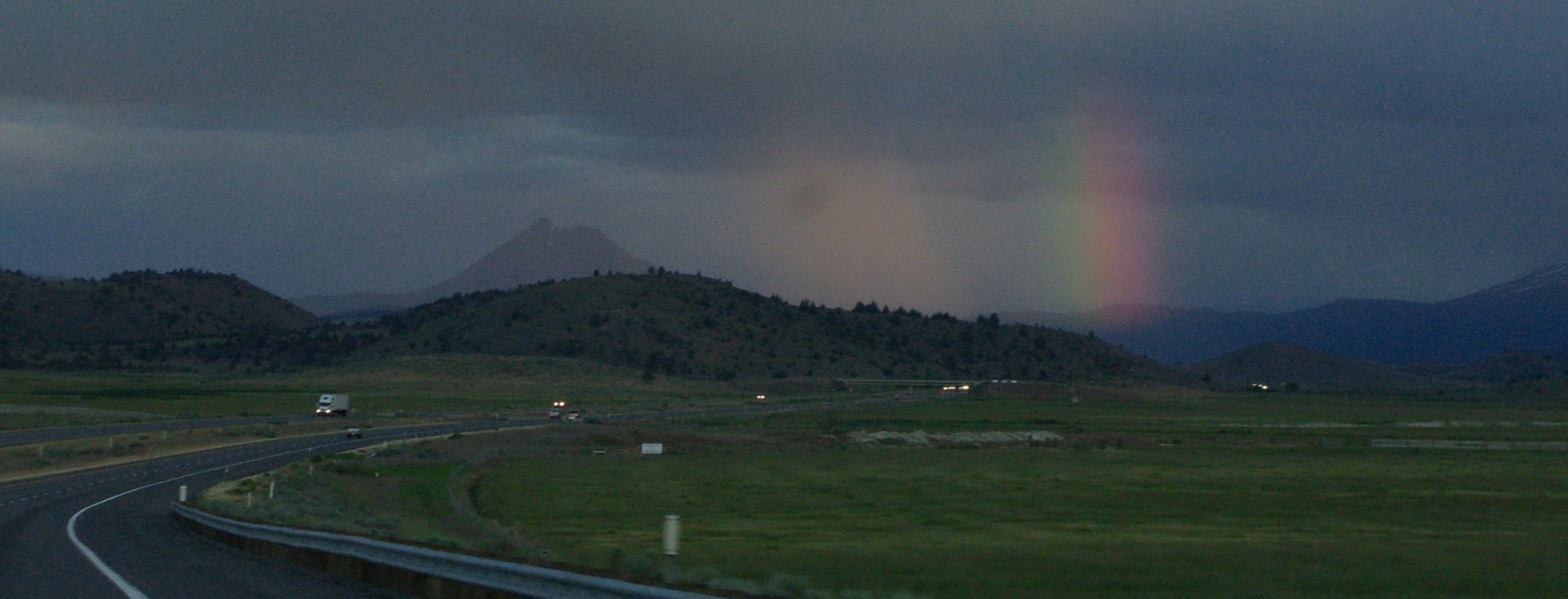
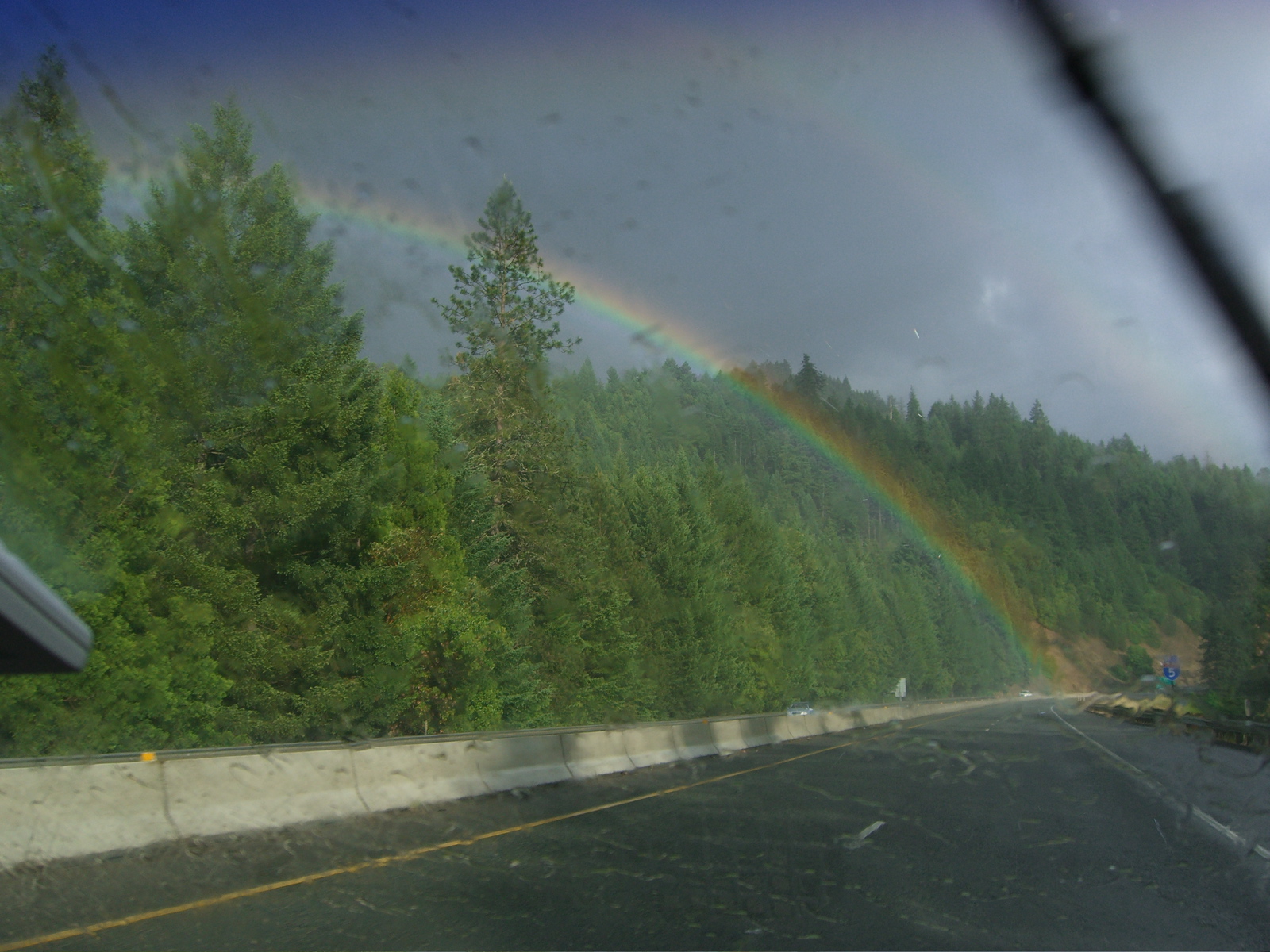
Most of the way through Oregon we drove through sunlit showers, and for a while saw a rainbow around every bend in the road. The shot above is from the stretch between Yreka and Weed, in far northern California: Rain refracted in the last light of the day, a semi-rainbow. The peak near the center is Black Butte, a small volcanic peak just to the west of Mount Shasta. The shot below: from the climb up the northern side of Canyon Creek Summit, a little more than halfway between Eugene and the California line.

I5Rainbow

Motel Dog

I might be close to trespassing on the world’s patience — “world” in this case meaning the dozen of you who peruse these posts — by putting up a third consecutive dog picture. I’m doing it anyway.

We’re in Eugene visiting Thom. We’re parked in the Best Western right across the street from the university. Last night we had to stay about 20 miles outside town because the state high school track championships were being held today at the U of O’s Hayward Field, and every motel closer than the one we found was booked up.

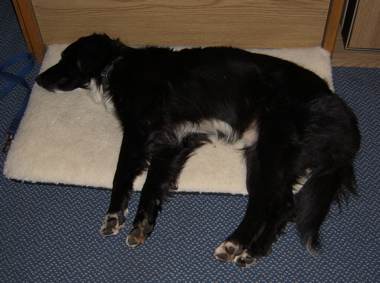
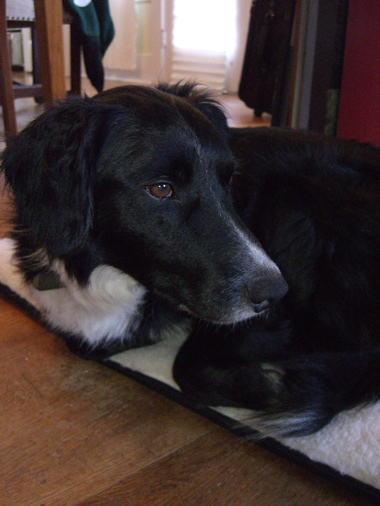
One of my mom’s distant Irish cousins, Michael Joe O’Malley, used to have an expression he used when it was time to retire for the evening: “I’m going to stretch my four legs from me.” I think he explained once that it referred to dogs going to sleep. So here’s Scout, after we walked him all over this afternoon, stretching his four legs from him. Outside the frame, Kate’s taking a nap, too. Thom just woke up from his. I’m the only one here not getting his early evening shuteye.

Scout052706

Gratuitous Dog Picture

Scout052406

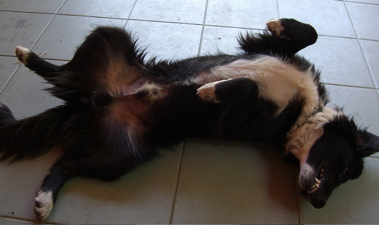
OK — here’s our pal again. This was the pose he struck when I was trying to get him to come back in the house when I was headed off to work the other day (yes, he’ll stay in the house and behave himself, unless he’s making popcorn and watching pay per view behind our backs). This went on for a couple minutes and would have lasted longer if I’d let it. I especially like the teeth.

About a Dog

Scout, upon his arrival in Berkeley.

I mentioned, more than a week ago, that I’ve got a story about a dog. Here it is:

A week ago last Saturday, we were down in Paso Robles, a town at the southern end of the Salinas Valley. For me it was a bike-riding trip: I was signed up to do the Central Coast Double Century, a ride that starts from Paso Robles, crosses the Coast Range at a relatively low spot and goes out to Highway 1, then north to the lower end of Big Sur. From there, it recrosses the mountains at a much more rugged and much higher spot, then descends into and tours the valleys and hills to the east. Two hundred and ten miles in all, and something like 14,000 vertical feet of climbing.

While I was doing all that, Kate went with a big group of people from Paso Robles down to a wild place called the Carrizo Plain. Carrizo is a national monument, a big, open expanse of rangeland at the eastern foot of the coastal mountains. It’s dry, remote and forbidding, The last California condors soar there, and pronghorn (antelope) and elk have been reintroduced.

A long story made short: The group found an abandoned dog at the edge of a dry lakebed on the plain, 10 miles from the nearest highway and 20 miles from anything you might call a town. and we wound up taking him home to Berkeley with us. We named him Scout. He’s gotten his shots and been checked out by a vet and is smart and sweet and so far very calm, which makes it all the more mysterious how he wound up out in one of those places that really is the middle of nowhere.

We’ve been checking online lost and found listings for San Luis Obispo and Bakersfield, the nearest cities (though “near” in this case means about 60 miles to either place). Lots of dogs reported lost, though none in this area and none bearing any resemblance to Scout. After a week, I called the Carrizo Plain visitors center to ask if anyone had reported a dog missing.

“No,” the woman at the center said, “and let me tell you what happens with these dogs. People come out here and just leave them, no water, no food, nothing. It’s a real bad deal.” Occasionally, she said, herders will shoot the strays to keep them from harassing sheep grazing in the area. Starvation or thirst or coyotes take care of most of the rest, though occasionally the monument’s rangers will catch a dog and take it to the animal shelter in San Luis Obispo.

“This is far enough off the road that you can put the dog out and drive away and they can’t chase you,” the visitors center woman said. “People split up and decide they can’t keep their dog, or they don’t want to take it to the shelter — over in Taft you just put the dog down a chute and they usually just put it to sleep. But this is a bad deal. You wonder what people are thinking.”

Dog

Katescout

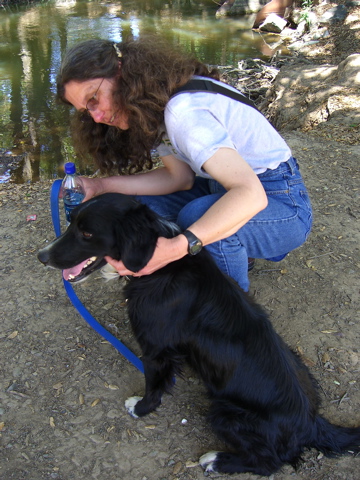
There’s a story that goes with the picture, really. But not for telling now — too tired after another hard ride, and a long drive to and from Central California on top of that. But the dog — he’s at our house. The picture is from a stop we made at a park down in Santa Clara County on the way north. The rest will wait. But I will say this animal’s arrival in our lives makes me want to re-read the Paul Auster novel “Timbuktu.”

A Day Without an Immigrant

So, I’ve been noodling postlessly over what to say about the issue of the week, the whole immigration debate. Monday, there was the Day Without an Immigrant, as KTVU News anchor Leslie Griffith called it. And today, we have Cinco de Mayo, an important day for that immigrant we went without on Monday.

There was this, too: Last weekend, while licking my wounds from my audacious 206 miles of riding the Bay Area’s highest peaks — the Devil Mount Double — I got an email from a woman in Chicago who turns out to be a third cousin on my mom’s side of the family. Our common ancestors are John and Bridget Moran, my great-grandmother’s parents, who left Clare Island, County Mayo, Ireland, in 1887 and wound up in the Back of the Yards in Chicago. Thinking about them, thinking about all the other people who had to set out during the middle and late 19th century from Ireland and Norway to assemble the pieces of what I know as my family, made me think about how connected we are, nearly all of us, to the immigration question today.

One thing led to another after I received that genealogy email, and I wound up tracking down and looking at the 1900 census records that include the Morans and also the family of their daughter Anne and the man she married, Martin O’Malley. All were new arrivals with big families. The census records contain scant information on individuals, but just enough to give you a hint about their lives. Martin, in 1900 the father of eight living children, was listed as “labor at yards.” So were his two oldest sons, living at home in their late 20s.

Going up and down the rather haphazard roster of households on West 47th Street, where the census lists the O’Malleys, and on West 47th Place, where the Morans lived, and on all the other streets nearby, you see immigrant families, most from Ireland, packed into block after block of row houses on postage-stamp lots, their “occupation, trade or profession” listed as labor at yards, farm labor, “labor at pickle factory,” teamsters, butcher’s clerks, barbers, domestics, “commission men” (which I take to be “salesmen”), cattle butchers, hog butchers, sheep butchers, meat weighers, railroad clerks, railroad swtichmen, dressmakers, shoemakers, saloonkeepers, storekeepers, housekeepers, night watchmen, telephone operators and telephone girls, messengers and messenger boys.

These weren’t rich people. They weren’t middle-class people. They weren’t warmly welcomed or well-loved by people who had been in the country longer and could afford to live in better circumstances. They were foreigners throwing their back into the work of gaining a toehold and seeing what they could do once they’d gained a purchase on this new place.

And, yes, let me be sure to say that they were legal immigrants who followed the rules when they came into the country. Let’s say that,and in the next breath acknowledge how little that really means, because in truth U.S. laws on immigration have had little to do with maintaining a neat and orderly society and much to do with exercising whatever racial and economic fear happened to be prevalent at a given moment.

For immigrants from northern and western Europe, the hardest part of the trip, practically speaking, was making it and paying for it. For those who arrived before the 1880s, once you showed up in New York or Boston or wherever you landed, you were in. Your name would be recorded somewhere, sure, but it was not as if you had passed a test of personal or civic virtue to be admitted to the United States. Starting in the 1880s, we — we meaning Congress — started to get more particular about who would be let in and who wouldn’t. For immigrants from Europe — let’s translate and say white folks, even if they didn’t speak English — a head tax was imposed (50 cents an immigrant) and some conditions were placed on admission. Unwanted: criminals, the insane, the depraved, the diseased.

That was the kind face of the new immigrations laws. The laws’ more purposeful side applied not to the millions coming from Europe, but to those from China, Japan, the Philiippines, India and other non-Caucasian places. Simply speaking, after decades of letting Chinese and other Asians into the West (mostly) to mine and build railroads and drain swamps, Congress decided we had more than enough cheap labor on hand and we could afford to make it practically impossible for Asians to get into the country.

To jump ahead to where we are today, with the House already having voted to make it a felony to illegally cross the U.S. border or to offer any aid to someone in the country without the required paperwork: One’s tempted to ask, “So what’s new?” Whenever the country has tightened its immigration laws, two factors are always present: Some target group or groups whose race, language or culture is pointed to as alien by the well-assimilated and forgetful majority (what do you mean Grandma didn’t speak English?); and some concern over what the flood of hungry, energetic, and willing-to-work-for-anything newcomers are doing to the job market.

So today, we’re pretty much back to where we were when we decided we didn’t want any more Chinese or Japanese or so many Italians, Poles and Russians. We’re not in the middle of a big winning streak for rational, well-tempered, or generous action. But action’s going to be taken — we have tangible and intangible things that people everywhere seek, and they won’t stop coming to try to find them here. Our decision might be a little less painful to look back on if our discussion could start with the awareness that when our people got here, they all looked just like the immigrants we see around us now.

Technorati Tags: ,

The 11th

Grandlate

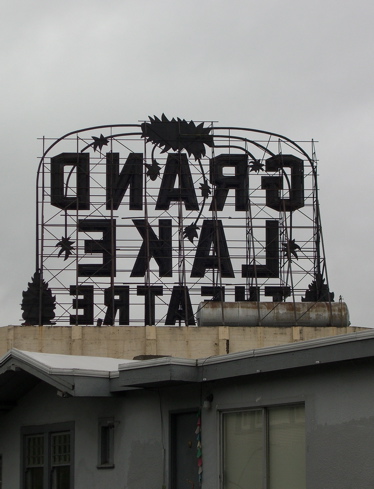
Here in the Bay Area, I left work early and went with Kate, who is off school this week, to see a late-afternoon matinee of “Inside Man.” It holds up as an entertainment. The show was at the Grand Lake Theatre in Oakland, recently pictured for its marquee broadside on fascism. It’s one of the Bay Area’s great old movie houses, subdivided, as they all are, a couple decades ago. But still beautiful in a way the old movie palaces are and still impressive for its outsize scale. We caught sight of it in the rain after parking on a hillside a couple short blocks away: its magnificent (and still operational) old sign backwards and stark. Afterwards, we thought about where we might be able to eat dinner and look out on the Bay while the rain fell. Kate came up with a true inspiration: The Dead Fish, a place in Crockett, about 20 miles north of Oakland overlooking the Carquinez Strait, the place where all the water from the Sacramento and San Joaquin rivers, and all the tributaries and reservoirs and mountains beyond, spills out into the Bay. We couldn’t get a window table in the restaurant, but we found one in the lounge and had dinner gazing out on the channel and on the bridges that carry Interstate 80 across the water. Then we drove back to Berkeley.

In Chicago, I hear it was the kind of April day that belies the lack of greenery on the Wrigley Field vines (saw them on a baseball highlights reel this evening). It was 53 years ago today that Mom and Dad were married down at St. Kilian’s, 87th and May streets, just four blocks from where Mom grew up. Not everyone in the Irish Catholic parish — notably its pastor — was too thrilled at the idea of one of the children who’d grown up coming to his church and school marrying an outsider — that is, a Norwegian Lutheran. But there’s no accounting for affairs of the heart, and everyone got over the mixed marriage they bore witness to that day. Today, Dad drove down from his place on the Northwest Side to Mom’s grave and left a spring bouquet — artificial flowers, but they’ll last (I’ve never seen Mom’s place down there without something, something she would have liked, to mark the spot). He stopped for a couple of White Castle hamburgers on the way back north.

Later, we talked on the phone about the cemetery and White Castle a little and a lot more about old movie houses, which Mom loved. The Cosmo, which I’m guessing was short for Cosmopolitan, in particular. I know it was air-conditioned in the summer and that the double bills changed twice a week. I don’t know whether it had much of a sign, but Dad’s guess is that the its gone now.

Technorati Tags: , , , ,

A Teacher (2)

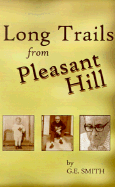
A few years ago, another former teacher of mine, Mort Castle — also a longtime friend of G.E. Smith — helped G.E. pull together the hundreds of poems he had written since he was a boy in central Illinois and select some to be self-published in what turned out to be a pretty hefty volume called “Long Trails from Pleasant Hill.”

Longtrails
At various times, G.E. talked about his youthful ambition to be a writer. Most of the time he was dismissive of his own efforts, though occasionally he would talk about the factors that led him in other directions. For instance, that other writers had already said what he wanted to say, except better (published writers are the ones who realize this and keep going anyway). More significantly: His teaching absorbed so much of his time, intellectual energy and creative attention he didn’t really have the resources to follow his writing seriously. That was not an excuse: He poured all of himself into his classes and students, to the point where the demands he placed on himself brought him to and beyond the point of exhaustion. As Mort remembered in his little introduction to “Long Trails”:

“In 1968, I was Smith’s student teacher. I saw him in action, ‘grading papers,’ and it was not a quick-scrawl ‘Nice figure of speech’ here and ‘comma splice’ there. Not infrequently, a student who handed in a two-page paper received four pages of comment, comment not limited to correcting apostrophe goofs and refining expression, but personal commentary, a Smithian response to what was said and how it was said.”

Still, G.E. had the 800 or so poems, maybe in a picturesque heap that he thought of as organization, probably piled in the post-World War II semi-finished concrete-shell basement of his co-op apartment unit at 134 Dogwood in Park Forest. They probably would have stayed that way except for Mort and a change in G.E.’s own thinking about what his writing represented. “After I left college, I had no interest in publishing my poetry,” he wrote in his book’s preface. “It wasn’t until I began to think, as a genealogist, about how anything written by ancient relatives — even in signature — was (or could have been) so extraordinarily precious that I decided to consider publishing. I realized that I, too, someday, would likely be a long-ago ancient relative to someone who was pursuing my family history.”

So he and Mort brought out the book. I’d like to say that when it arrived here in Berkeley a few years back, I dove into it. But I didn’t. G.E. wrote a long inscription that thanked me, for among other things tracking down a copy of an obscure futurist novel that he had read while sailing from Europe to the Pacific as a Navy Seabee during World War II. I flipped through the book and stopped at a few of the poems. I probably found the project of reading more than a little overwhelming; and I’m sure I also had a tinge of envy and regret that I was holding yet another book by someone I knew while I myself had produced — what, exactly? (If I had ever said anything like that to G.E., he would have had something reassuring to say, then maybe started a conversation about why exactly I thought writing a book was important. Mort would have just said to sit down and start writing if I wanted to publish a book.)

G.E.’s funeral is tomorrow, down in the town where he went to and first taught in high school, Lexington. Afterward, I imagine there will be a long, long procession out to the tiny cemetery in his real hometown, Pleasant Hill, about three miles away. It will be by far the biggest event that would-be city, which started withering when the railroads bypassed it in the 1850s, has ever seen. G.E. and his grandfather and probably many others to whom he unearthed family ties have been cemetery caretakers there; we visited the spot together a couple of times a good 30 years ago; I think I was aware even then, when he was younger than I am now, that this was where G.E. hoped to come back to; not a patch of dirt in a swath of farm and prairie, but a place where his people were.

Feeling sad about the prospect of missing G.E.’s funeral, I picked up his book of poems. I thought, there’s got to be something in there where he talks about his own passing. I turned to the back of the book, to the section whimsically titled “Fear, Aging and Death.” And found this, dated 1990:

Grave Notes from the Underground

When I am dead,
who will enter this quiet sanctuary
and, speaking softly,
(Don’t shout!
I’m not deaf, you know.)
tell me the news I want to know?

Did the Cardinals win last night–
and who was the winning pitcher?

Did the bluebirds sing this spring
on the trail along Bluebird Lane?

Has the Big One ever struck
San Andreas or New Madrid faults?
(And am I safe in Pleasant Hill?)

Have politicos on Capitol Hill
yet understood the limits …
… and limitations … of capitalism?

Do my friends I loved so much
… just once in a while, perhaps …
call or visit each other?

From the knoll and the gnarl of Old Flat-top,
does anyone ever watch, as I once did,
the sunsets west of the sanctuary?
Or the April sunrise on the trail
as it enters Canary Clearing?

Does a cool breeze still stir the air
under the sinuous branches of Old Flat-top?

Do Browns and Boggs still gather
for reunions in July?
(Or do they go their separate ways,
ignorant of the roots that nourished them?)

Is warmth still there at one-three-four
on Dogwood Drive?
Is someone nurturing those
in need of nurturing?

Who came to say goodbye
as I lay freshly dead?

I know, I know.
I can’t reply.
Nothing has really changed.
I rarely had a chance,
when lifeblood-flowed and tongue was ripe,
to sneak a word in edge-wise.

Hey, take it easy there.
Your clomp’s so hard it’s apt to wake the dead.

More on G.E. Smith
Happy 80.5, G.E.
A Teacher
In Which We Gather by the River

Technorati Tags: ,