Postscript

Back in February, the San Francisco Chronicle ran a series on violent cops on the city’s police force. In the series’ leadoff story, the paper ran an oversize picture of what it said was one of the San Francisco Police Department’s most fearsome offenders, Sergeant John Hackett. The merits of the story aside, a series of miscommunications among editors, reporters and a photographer led the Chron to print a picture of a private citizen and mistakenly identify it as Haggett.

The paper readily acknowledged the mistake — after the police chief gleefully pointed it out at a press conference — and ran a typically opaque correction that included the boilerplate “we regret the error” wording. Mea minima culpa. In due time, the man who was pictured as the rogue and perhaps racist cop sued the paper. On Thursday, the paper settled the suit out of court.

That’s that, except for this note in the story: “The Chronicle has not explained how the error occurred.” Immediately after printing the wrong picture, Phil Bronstein, the paper’s executive editor, said he was (to quote the Chron’s “readers’ representative”) “disposed toward telling whatever he can.” The readers’ rep himself said he agreed with Bronstein but was wary of a rush to judgment.

The point of telling the public how such a goof occurred isn’t merely to rub salt in the wounds or to hand over some hapless editor or photographer to a lynch mob, but to give readers an honest look at how the paper is run, even when things don’t look so good. At a time when online media offer more and more opportunities for audience engagement, it’s only smart for news organizations to be as transparent as they can be.

Now, four months have passed, and the Chron has stonewalled. Disappointing, but not surprising.

Heroes and Hoopleheads

Deadwood” begins its third season tonight, a cause for division in our household. I love the show, with all its profanity and violence; for the same reasons, Kate can’t tolerate it.

It has become commonplace to equate the show’s fine scriptwriting with the work of Shakespeare (just Google shakespeare deadwood and you’ll see what I mean). We create cliches because there’s some truth in them, and that one’s no exception. I’ve been tempted to stop episodes and transcribe characters’ speeches just for the language. There’s more to the show than the writing, though: It’s beautifully acted. It’s beautifully filmed. It’s violent and tense as hell.

It’s also conventional wisdom to think of “Deadwood” and the post-modern westerns dating back to “The Wild Bunch” as a new and better breed of drama: More frank about the blood and injustice and cynicism that older westerns soft-peddled. If you think so — and I incline to that way of thinking myself — check out A.O. Scott’s long, long piece in today’s New York Times on the DVD re-release of some of the John Wayne/John Ford westerns. He touches on how thoroughly Ford’s visual sense, especially in “The Searchers,” affected later filmmakers and films. But the heart of Scott’s essay has to do with Ford’s vision of the West and its settlement:

“The Indian wars of the post-Civil War era form a tragic backdrop in most of Ford’s post-World War II westerns, much as the earlier conflicts between settlers and natives did in the novels of James Fenimore Cooper. That the Indians are defending their land, and enacting their own vengeance for earlier attacks, is widely acknowledged, even insisted upon. The real subject, though, is not how the West was conquered, but how — according to what codes, values and customs — it will be governed. The real battles are internal, and they turn on the character of the society being forged, in violence, by the settlers. Where, in this new society, will the frontier be drawn between vengeance and justice? Between loyalty to one’s kind and the more abstract obligations of human decency? Between the rule of law and the law of the jungle? Between virtue and power? Between — to paraphrase one of Ford’s best-known and most controversial formulations — truth and legend?

“Ford’s way of posing these questions seems more urgent — and more subtle — now than it may have at the time, precisely because his films are so overtly concerned with the kind of moral argument that is, or should be, at the center of American political discourse at a time of war and terrorism. He is concerned not as much with the conflict between good and evil as with contradictory notions of right, with the contradictory tensions that bedevil people who are, in the larger scheme, on the same side. When should we fight? How should we conduct ourselves when we must? In ‘Fort Apache,’ for example, the elaborate codes of military duty, without which the intricate and closely observed society of the isolated fort would fall apart, are exactly what lead it toward catastrophe. Wayne, as a savvy and moderate-tempered officer, has no choice but to obey his headstrong and vainglorious commander, played by Henry Fonda, who provokes an unnecessary and disastrous confrontation with the Apaches. In the end, Wayne, smiling mysteriously, tells a group of eager journalists that Fonda’s character was a brave and brilliant military tactician. It’s a lie, but apparently the public does not require — or can’t handle — the truth.

“In telling it, Wayne is writing himself out of history, which is also his fate in ‘The Man Who Shot Liberty Valance’ (not, unfortunately, one of the discs in the Warner box). That film — which contains the famous line ‘When legend becomes fact, print the legend!’ —throws Wayne’s man of action and James Stewart’s man of principle into a wary, rivalrous alliance. Their common enemy is an almost cartoonish thug played by Lee Marvin, but the real conflict is between Stewart’s lawyer and Wayne’s mysterious gunman, one of whom will be remembered as the man who shot Liberty Valance.

“What we learn, in the course of the film’s long flashbacks, is that the triumph of civilization over barbarism is founded on a necessary lie, and that underneath its polished procedures and high-minded institutions is a buried legacy of bloodshed. The idea that virtue can exist without violence is as untenable, as unrealistic, as the belief — central to the revisionist tradition, and advanced with particular fervor in HBO’s ‘Deadwood’ — that human society is defined by gradations of brutality, raw power, cynicism and greed.

“If only things were that simple. But everywhere you look in Ford’s world — certainly in ‘Fort Apache,’ in ‘The Searchers,’ in ‘The Man Who Shot Liberty Valance’ — you see truth shading into lie, righteousness into brutality, high honor into blind obedience. You also see, in the boisterous emoting of the secondary characters, the society that these confused ideals and complicated heroes exist to preserve: a place where people can dance (frequently), drink (constantly), flirt (occasionally) and act silly.

Technorati Tags: ,

Post-Election Voter’s Guide

Ivoted-1California held its primary four days ago. Twenty-eight percent of eligible voters, an all-time low for a statewide election, appeared at the polls. Despite the ghost-town turnout, the votes are still being tallied in my county, Alameda. That’s because its Diebold voting machines were decertified — among other real and perceived shortcomings, they don’t produce a receipt or any kind of “paper trail” documenting votes cast — and elections officials decided to give the people what they said they wanted: supposedly unhackable paper ballots. In turning back the clock on election technology, the registrar of voters leapfrogged over the system the Diebold machines replaced: punch-cards. To avoid awakening bad chad memories, the county adopted a ballot that required voters to bubble in their choices in black ink. The ballots are machine readable, but the automation only goes so far: All week on the news, we got to see pictures of bored election workers feeding ballots one at a time into the readers. The registrar’s latest press release says 8,000 absentee ballots still need to be counted. And after that, 11,000 “provisional” ballots cast by people who had some sort of problem at the polls. And after that, a smaller but unknown number of damaged or machine-unreadable ballots.
I kind of wonder whether I’m one of the people whose ballot wound up in the provisional or damaged piles. What happened was this: When Kate and I went to the polls Tuesday night, all she had to do was turn in her filled-out absentee ballot. I still like to go through the exercise of going to the polls, so I went through the routine: Giving my name and address to the poll workers, signing the register, and getting my Democratic Party ballot. This time, it came in a legal-size manila folder. The voting booth — it’s really more of a spindly, collapsible lectern — was equipped with a pen on a string. I pulled out the ballot and started to bubble it in.

Several of the races had candidates running unopposed; and several of those involved officeholders who are trying to move into new posts because term limits are forcing them to move on; for instance: Cruz Bustamante, the lieutenant governor, who was the only Democratic candidate on offer for state insurance commissioner (the old insurance commissioner, John Garamendi, was running for lieutenant governor against two term-limited state legislators). There’s something tired and dispiriting about seeing these guys — mostly guys — swap seats with little more to recommend them than the fact hardly anyone can remember a time they weren’t haunting some committee room in Sacramento.

It’s not the first time the thought has occurred to me. Usually, I’d just pass on the uncontested races. But I don’t usually vote with a pen in my hand. With the punch-card and touchscreen voting systems, it was possible, but painful, to cast a write-in vote. With the paper ballot and the nice black felt-tip pen in the booth, confronted with the bland nothingness of an unopposed Cruz Bustamante, a write-in suddenly seemed appealing. So for every uncontested, or feebly contested, office, I cast a write-in vote. I was stumped at first about who I might vote for, but then I thought about some of my smarter and more conscientious friends. So Piero and Jill, across the street, got votes for the state Legislature; I voted for Bill for U.S. Senate (time for Feinstein to go); Larry was my choice for state insurance commissioner, and Kate got the nod for state schools superintendent. I was aware when I turned in my ballot that some poor elections worker would be forced to try to make sense of my impaired-looking block printing.

Throw-away votes? Maybe, though I feel I’d trust my choices in office at least as much as I’d trust the party retreads.I admit if I had felt anything was on the line, my friends would have lost out. Still, I walked away from the polling place feeling better about my vote than I have in a long time.

Technorati Tags: , , ,

Today’s Best Names

Nominated from the pharmaceutical category: Cephalexin and Cefoxatin, members of the cephalosporin antibotic family. The former is oral, the latter injected. I’m taking the former for 10 days after having a rear-end shot of the latter following some complications from the late unpleasantness between me and a local road. Complications? Well, I got four pretty good-sized abrasions when I fell off my bike last week. Three of them are healing just about as well as you could expect. The fourth, a big patch on my left shoulder, has been trouble; I may have suffered an allergic reaction to some antibiotic ointment I tried, from the adhesive on some high-tech dressings I tried, or maybe the thing was just infected from the start. In any case, it blew up into an angry, ugly mess that took on a life of its own (“I am not an animal! I am a human being!”). My whole left arm swoll up, as we used to say in the south suburbs. I went back to Kaiser twice. The first time, on Sunday, the doctor was unalarmed. The second time, today, the doctor blanched and said, “That’s cellulitis.” In a rare show of good taste and non-exhibitionist restraint, I’m suppressing the pictures. A day into the treatment, the thing seems to be responding, though.

Again with the baseball: Dan Uggla, rookie second baseman for the Florida Marlins. The South Florida Sun-Sentinel described his Wednesday exploits thus:

“Uggla became the first second baseman in franchise history with a multihomer game and knocked in a career-high five runs. … With the Marlins up 2-1 in the fifth, Uggla hit the first of his homers as part of four-run inning. His three-run blast to left knocked out starter Jamey Wright (5-5). In the ninth, Uggla sent another pitch into the left-field bleachers, this one from Tim Worrell with two outs and a man on.

” ‘I got lucky twice,” Uggla said. ‘I don’t even think my other at-bats were very good. A couple of balls, I guess I saw them pretty good and put good swings on them.’ ”

Uggla. Apparently it’s a Norwegian and Swedish name.

When the Bodies Don’t Want to Be Shown

The New York Times’s David Carr had a column yesterday — “Show Me the Bodies” — noting the relative rarity of pictures of U.S. soldiers slain in combat in Iraq. He discusses the factors involved, including squeamishness among media organizations and the many layers of difficulty, from danger to simple logistics, that conspire against such pictures being taken in the first place. He also mentions a notable exception to the general rule: A picture from the November 2004 battle in Fallujah, when Stefan Zaklin, a photographer with the European Pressphoto Agency embedded with an Army company during the fighting. Carr recounts that Zaklin “took a gritty, horrific portrait” of the company commander after he had been shot and killed by insurgent fighters — a picture widely printed at the time in Germany and France but not in the United States until long afterward (as part of stories about unpublished graphic war images.

Without going into the merits of publishing such a picture — I agree entirely with Zaklin’s argument (the picture he shot is at that link) that the image was important both for him to shoot and for viewers to see — I think Carr has missed the principal reason there aren’t more pictures like the one from Fallujah: The soldiers themselves won’t stand for it. Zaklin mentions this in his discussion of the picture:

“I stayed behind with the two men tasked with guarding the body.

One of the men was clearly on the verge of snapping; he was muttering to himself, trying to keep himself calm. It was dark, and my shutter speed was below what you would normally be comfortable using to get a sharp frame with a digital SLR. I focused the camera, and put it down from my eye. I leaned against a doorjamb, and fired two horizontal frames.

“I looked at the two soldiers, trying to gauge their reaction. One looked at me and then went back to watching the doorway he was guarding. The other kept muttering. I checked to see if the frame was sharp. It was. I rotated the camera, and shot two vertical frames. The mutterer stopped muttering, and shot me a look that sent chills down my spine. I didn’t know him as well as the other soldier, and decided to wait until the soldiers I knew better returned.

“In the end, I wasn’t ever able to take another picture of the dead captain.

“I waited two days, well after the captain’s family was notified, before I put the picture out for the world to see. I knew his family had been told because two colleagues had already interviewed the dead captain’s father about his son’s death. Despite the delay and a scrupulous reading of the embed rules, the military was furious that I sent the images at all. Nothing really came of it, I was essentially a convenient target for unfocused grief.”

Zaklin actually downplays the on-the-scene reaction to the incident. Toby Harnden, a British reporter for The Telegraph embedded with the same unit Zaklin was covering, reported on Zaklin’s ejection. After noting how well he got along with the Americans, Harnden wrote:

“But relations did sour towards the end, when a photograph of a dead soldier — whom I had been speaking to minutes before he was killed — appeared in a German newspaper.

“It was a haunting image of the body lying in a dusty kitchen, blood seeping from a bullet wound to the head. For me it summed up much of what had happened in Fallujah and was also a memorial to a brave American who died for his country.

“In the pain of the moment, Task Force 2-2 saw it differently.

” ‘Grab your stuff, asshole, and come with me,’ was how a captain addressed Stefan Zaklin, of the European Picture Agency, when news of the picture reached the unit.

“Zaklin was placed under armed guard and told he had violated the rules of propriety. Nothing in the rules had been broken. The soldiers had seen Zaklin snapping away in the kitchen — but it seemed that this was where the military and the media parted company.”

Carr mentions the frankness of the images that came out of Vietnam, when it became commonplace to see at least a slice of the grisly reality of the fighting. It’s widely observed that the military establishment, which allowed the media virtually free access to combat units, has crafted the current regime of rules for “media embeds” to avoid that kind of access and the uncontrolled flow of disturbing images and observations to the folks at home. The brass has succeeded to the point where it now takes a freedom of information request for us to get to see pictures of flag-draped coffins arriving back in the United States.

But there’s something deeper at work. I’m sure there was an us-and-them feeling at work between soldiers and journalists in Vietnam. But I wonder whether it was so deep as it is now. On one hand, the widely felt antipathy among many toward the media, especially in its connection to this war and its fancied failure to present the “real” (meaning “positive”) news about what we’re sacrificing so much blood and money for. On the other hand, the rank-and-file soldier has changed. In Vietnam, the troops a reporter or photographer encountered were nearly certain to be draftees, people who had landed in the military and sent into combat by happenstance; journalists might have been a nuisance to them, but they weren’t radically different by nature or mission. The soldiers we’re sending to Iraq may never have dreamed they’d find themselves fighting insurgents in the desert, but they’ve all chosen the armed forces, and they’re part of an institution that in many ways views itself as separate from civil society. Journalists are outsiders to this group and bound to be particularly unwelcome when they intrude too far on the lives and sensitivities of the troops. Thus the anger and outrage when a picture of a fallen warrior is run.

Technorati Tags: ,

Tennis in Iraq

Here’s an item from Iraq, by way of the Associated Press and the San Francisco Chronicle:

Iraqi Tennis Coach, Players Killed

“(05-27) 10:38 PDT BAGHDAD, Iraq (AP) — An Iraqi tennis coach and two of his players were killed because they were wearing shorts, apparently in violation of a warning by Islamic extremists.

“Gunmen stopped the car in which the athletes were riding and asked them to step out before shooting them Wednesday, Manham Kubba, secretary general of the Iraqi Tennis Union, said Saturday. The coach, Hussein Ahmed Rashid, was Sunni, and the two players were Shiite, Kubba said.

“The athletes were in shorts when they were killed and police believe the attack was related to a warning by extremists against such attire, police Lt. Maitham Abdul Razzaq said. He said the warning was made in leaflets distributed in the Sadiyah neighborhood in southwest Baghdad a week before the attack. …”

First thought: Unbelievable barbarity; the people who did this are beyond understanding.

Second thought: Did this happen the way the authorities say it did? Were these guys killed for wearing shorts, or for being found (Sunni and Shiite) together, or for their car? Was the warning against shorts-wearing distributed in the neighborhood where the attack took place? You have to admit, this story is tailor-made to feed feelings of disgust and revulsion for those who oppose us over there.

Third thought: Without evidence to the contrary, I’m inclined to think this really did happen. And that brings me back to my first thought: This is beyond comprehension. But is it really? My tendency is to think that wars of the past — say against Japan or Germany or Korea or Vietnam or even the less direct conflict with the Soviet Union — are easy to understand, at least on a general level. Right on the surface, you find nationalism in one form or other, a battle for territory, and an effort to extinguish competing claims to land and resources. A little below the surface, you find a struggle to impose a particular point of view of the world and our place in it. I think this is more complicated than seeing wars as struggles between fascism and democracy, communism and capitalism, or evil-doers and the rest of us.

The people we’re fighting in Iraq don’t have an army, they don’t appear to be fighting for territory or resources, and they’ve unleashed a wanton, terrorizing violence on the people they live among. So on that surface level, they simply don’t make sense. On that next level, though — exercising violence to impose their will and their view of the world — what they’re doing is as logical as anything any military commander has ever devised.

The question is: How do you oppose it, and where? Our soldiers and weapons are the best, or so we constantly reassure ourselves. But does anyone believe that they have prevailed? Or will ever prevail by themselves?

‘Baghdad ER’

HBO’s documentary on a combat surgical hospital in Iraq, “Baghdad ER,” aired tonight. See it if you can. It’s tough to watch from the bubble of safety in which most of us live because it involves viewing people who have suffered awful, often fatal injuries. On the other hand, the work of the medical people and their commitment to all those who need their help is inspiring to see.

One quote of many that stood out, from Major Martin Harnish, a surgeon:

“This war and the number of lives it’s affecting is just unbelievable. I have to think the people in this country [Iraq] are in a better place for it, or will be in a better for it. I have to believe that, because otherwise this is just sheer madness.”

Quotes like that and the film’s occasional unfiltered glance at the terrible reality that lies behind the casualty statistics is sure to provoke some in the Fox News sphere to denounce it as anti-war propaganda. I prefer to think of it as a glimpse at the price we’re all paying, some way or another, for the war.

In Passing

Stanley Kunitz, the poet, died the other day. He was 100. I’m not sure I can hear so well above the general static of life and lesser news, but he seems to have passed with hardly a sound beyond standard obituary treatments. He was not a contestant on “Idol,” a singer on the wrong side of the law, a president of the United States, a ballplayer, a fallen corporate chieftain, the architect of a policy condoning torture, a movie actor or director, a NASCAR legend, a pioneer of the Motown sound, a pitchman, the winner of a million bucks, or a suspect in a sensational crime. Not that this is a lament for unsung poets. If some network put a prime-time poet drama or sitcom on the tube, I know where I’d be: Watching “24” and “Survivor” and reruns of “L&O.” I probably wouldn’t know or care much about the poet’s TV adventures. And the real-life poets? They’d still be unknown, mostly, their voices too soft to hear.

But what voices, what profound voices, full of rain, sun and sane consideration of our condition. I wasn’t aware of Kunitz until he was 95, when he published a new collections of poems. He got a flurry of attention in poet-friendly mass media: public radio and public television (for instance, “Fooling with Words,” with Bill Moyers). I believe that on one of his appearances, someone had him read a poem he’d written when Halley’s Comet crossed our sky for the second time in his lifetime:

“Halley’s Comet”

Miss Murphy in first grade

wrote its name in chalk

across the board and told us

it was roaring down the stormtracks

of the Milky Way at frightful speed

and if it wandered off its course

and smashed into the earth

there’d be no school tomorrow.

A red-bearded preacher from the hills

with a wild look in his eyes

stood in the public square

at the playground’s edge

proclaiming he was sent by God

to save every one of us,

even the little children.

“Repent, ye sinners!” he shouted,

waving his hand-lettered sign.

At supper I felt sad to think

that it was probably

the last meal I’d share

with my mother and my sisters;

but I felt excited too

and scarcely touched my plate.

So mother scolded me

and sent me early to my room.

The whole family’s asleep

except for me. They never heard me steal

into the stairwell hall and climb

the ladder to the fresh night air.

Look for me, Father, on the roof

of the red brick building

at the foot of Green Street —

that’s where we live, you know, on the top floor.

I’m the boy in the white flannel gown

sprawled on this coarse gravel bed

searching the starry sky,

waiting for the world to end.

‘Army Issues Warning About Iraq Documentary’

Someone recently told me in passing — someone who should know, since he’s there now — that what’s been happening in Iraq the last 38 months “doesn’t really rate the word ‘war.’ ” I think I understand the sentiment. We shouldn’t raise the significance of a battle with a bunch of murderous thugs (“primitive screwheads” is the term my acquaintance used) with such an important appellation. But to me, even sheltered as I am from the reality of what’s really happening over there, the suggestion this isn’t a war just doesn’t ring true. Call it what you want: People are dying by the thousands — by the tens of thousands — in a sustained siege of organized violence. Call it a picnic or a police action or the latest beachhead for democracy, the dead and wounded and the shattered pile up just the same, whether we’re paying attention or not.

HBO is about to air a documentary on one of the remarkable stories of the war: the work of the frontline U.S. military trauma hospitals in Iraq. It is not an untold story: many big media organizations have dipped their toe into it already. The HBO movie, “Baghdad ER,” is a little different, though, in that it’s the product of a longer-term immersion into the world of combat medicine. The makers spent two months filming in a combat trauma hospital in Baghdad’s Green Zone. And the movie’s 63-minute length represents more than the usual gnat’s-attention-span treatment that TV news accords such stories.

“Baghdad ER” is scheduled to air on May 21. It’s graphic. The filmmakers say so, and the Army is backing them up, with the service’s surgeon general issuing a memo advising the film may provoke flashbacks or nightmares among those who have served in Iraq.

(The New York Times had a different spin on the story over the weekend. Quoting Army sources, a Saturday article says the Army is backing away from the documentary over concerns “that its grim medical scenes could demoralize soldiers and their families and negatively affect public opinion about the war.”)

Technorati Tags:

Beer and Miniskirts and the Non-War in Iraq

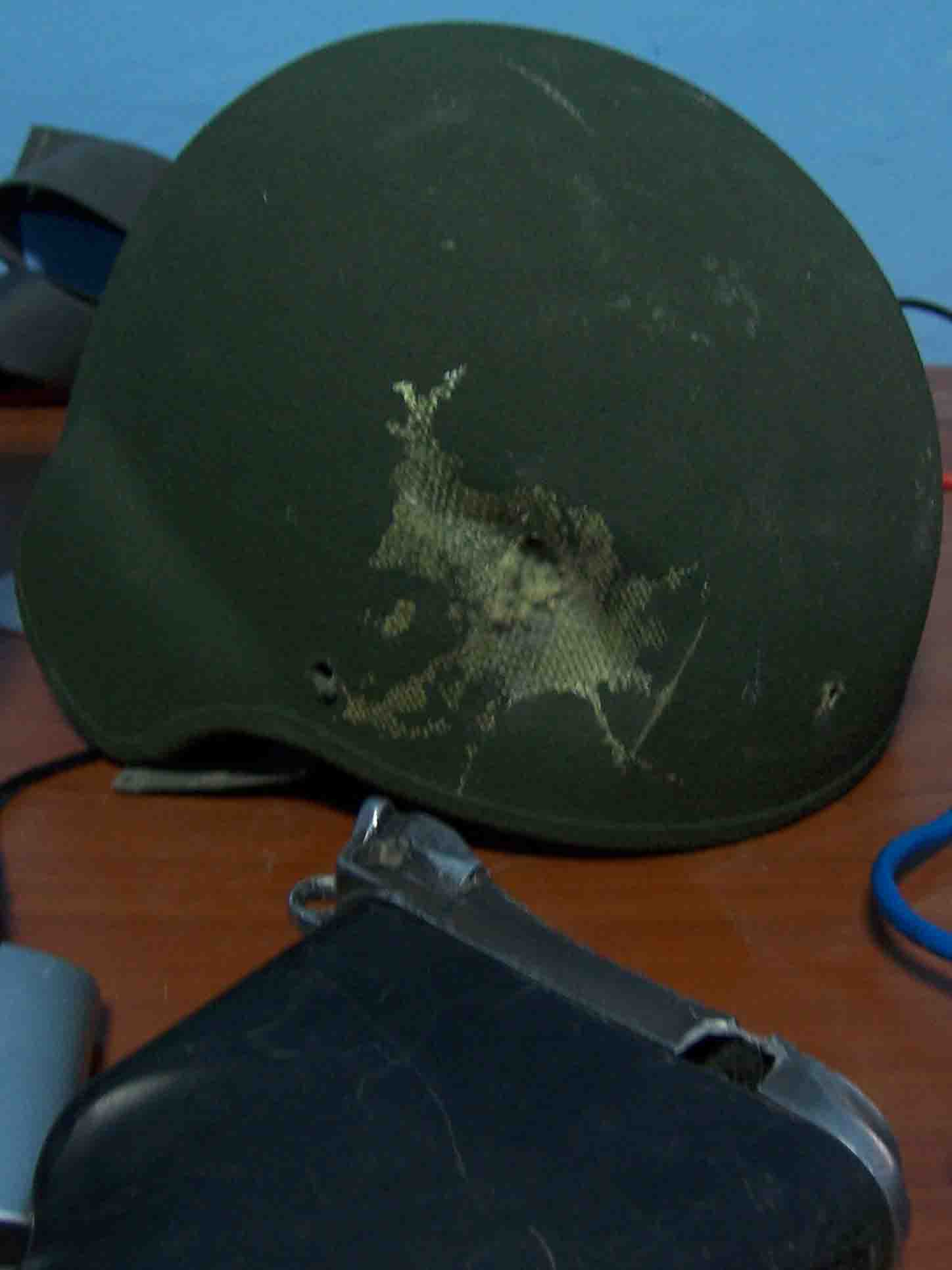
Last Monday, I posted something I’d found in my daily Iraq reading about a U.S. Army captain, John McFarlin, who had been shot in the head during a firefight with insurgents but emerged unscathed thanks to his combat helmet. I was struck by what I read as the detached, nearly clinical language McFarlin used to describe the event. The Army News Service quoted him saying, “I was suppressed for a moment and then I got back up” and returned fire. I wondered aloud, with a touch of sarcasm, whether “suppressed” was a euphemism for “stunned.” Then it was on to other business. But a couple days ago, I saw a new comment on the post:

“Stunned would be if I were disoriented and didn’t know what happened.

“Suppressed is when you get down because it seemed like the guy who was shooting at you was on target and it was a good idea to drop down for a moment. It’s a technical term and I chose it because it means “the target chooses to conceal itself instead of presenting.”

“When the gunners on the other two HMMWVs [high-mobility multipurpose wheeled vehicles] engaged him, then HE was suppressed.”

The comment was signed “John McFarlin” — the name of the man who had been shot. I was surprised, not stunned, and wrote him back, thanking him for the clarification and “for the dedication it takes to serve in such a challenging environment.”

I wasn’t entirely surprised when a few hours later, an email with a photograph attached arrived.

“Dear Dan,

“No problem!

“I really don’t want to make much of it, but really it felt like an open hand slap on the head. The equipment that we have these days is pretty good–I mean this not only in relative terms, but in absolute terms, as well. Not only was my life preserved, I was able to return to the fight at hand, though I prudently remained down until my fellows engaged the AIF [anti-Iraqi forces] individual who shot me. The photograph attached shows the exit hole of a round that passed through the buttstock of the crew served weapon I was manning. Had I been up, and that butt stock been where it normally is–out against my shoulder–the round would have struck me–although in the armored plate. So, even then, I would have been protected. Anti-climactic, I know.

“By way of letting you know that I am in fact the Soldier mentioned, I send you a photograph of the helmet. I retain the helmet to this day, and will always display it as proof of our nation’s dedication to caring for our Soldiers. This is the bottom line: I was shot in the head, and not so much as a pause in duty, let alone a Purple Heart. That’s the good news to take away from this.

“You’re very welcome, by the way. Go have a beer, lay down in the grass, or do something else pleasant that you like to do, would you? That’s part of the point of what we do as Soldiers.

“Best!

John McFarlin

CPT, AR, USA”

(By the way, all of Captain McFarlin’s remarks in this post are quoted in their entirety; I’ve spelled out some of the acronyms he uses in brackets.)

That last little paragraph rankled me. To me, it’s saying, buddy, don’t you worry about what’s happening over here. Just turn over and go back to sleep. And I told McFarlin so:

“… There’s something implied there that I object to — the notion that you and the millions like you who serve and have served in the armed forces are enduring disruptions in their own lives and putting themselves in harm’s way so that the rest of us can sit on our barstools as if we have nothing to worry about. Don’t get me wrong — I like to have a beer as much as the next guy, and I’m buying if we ever find ourselves in the same neck of the woods — but frankly I don’t want anyone risking life and limb just so I can drink my microbrew unperturbed. If you spent any time perusing my now very occasional comments on the war in Iraq, you know I’m no fan of the enterprise and never have been. In short, I’ve always felt we went into the conflict with only the most casual assessment of what the true long-term costs and effects would be; the people who have paid the immediate price for that carelessness are people like you who undertake their service in good faith and the tens of thousands of Iraqis who, with no say in the matter, have died as we remake their society for them. Ultimately I don’t expect you to agree with any of the above — in fact, I expect you to tell me how short-sighted and misguided a view it is. (But the right to freely express such disagreements — that’s worth serving for). I also think that the least we owe you as citizens is to think seriously, every day, about the war and about how to resolve the conflict before it becomes something we bequeath to the next generation, or the one after that, to take care of.”

At this point, it won’t be a shock to hear that McFarlin wrote back:

“Dan,

“Absolutely you can use anything we write to one another as you wish. Be charitable to my person, even if we may have different points of view–that’s all I ask. I know you’re not a fan of the effort in Iraq (it really doesn’t rate the word “war”), not why it was engaged, nor the sausage-making that’s going on over here as it’s presented in the news. I can appreciate that.

“It takes an effort on my part to even think of how the inconvenience and risk which I take as being part of this effort in Iraq is something I should consider being upset about. I mean, I am a member of what amounts to a modern warrior-monk society. Think about it: no sex, no beer, plenty of privations, and the opportunity for bodily mortification. Many of the discussions about the deeper politics surrounding why we are here never really enter into our minds. Or if they do, they enter them quietly, sit down, read a newspaper and have a smoke, and then tiptoe out the way they came. We’re differently minded people, I guess. Maybe this is some sort of congenital blue-statism. Or maybe there’e something more to it than is easily or glibly explained.

“This thing that happened to me, getting shot. It’s great, a great success story about how a nation graced with smart people, liberty, and money has been able to defeat the weaponry of our would-be killers–a bunch of primitive screwheads without a moral leg to stand on, straight criminals, really. Not with bullets–though we have plenty of those–but with synthetics and ceramics worn by a Soldier on a hot April day in Diyala Province, Iraq. This is both remarkable and anti-climactic. Some person with a twenty-pound brain worked out the material science that permitted me to live. It had nothing to do with heroics or MY effort at all–although some Soldier before me secured the blessings of liberty so that the person with the twenty pound brain could concentrate on material science instead of how to navigate the maze of corruption and race hatred so prevalent in so many parts of the world. I want people to know that I got shot. And lived. And more than that, I wasn’t even hurt. I was right back in the fight, and I think it’s important for people to know that we live in an amazing country, and that the most misguided of adventures (for those who characterize the extraordinary effort in Iraq as such) can result in sublime moments. Moments that throw into sharp relief the difference between who we are as a people, and the peoples of the rest of the world. Even if I died for something as obscure as the right or the opportunity for a skinny, thick-glasses wearing kid to excel in material science, it would be enough. Because that’s worthy.

“But, regarding the notion that the millions who serve don’t do so to allow their countrymen to live in peace and prosperity: If I were to say to you that it is a common saying here–in reference to some idiotic celebrity news headline, or the latest imbroglio over which American Idol contestant is going to continue, or the no holds barred fight over a leather covered ball striking a player in a game where the wages are ridiculously inflated–that we fight so that people in America can live so well, that these are their concerns, rather than the horrid, inhuman concerns that people in Iraq must bear…would you believe it? We look at our countrymen living well in America, and we smile crookedly at our own privations, knowing that the terrorists are losing. BIG TIME. Every beer that is drunk. Every woman who wears a mini-skirt to a bar and goes home with a guy she picks up. Every porno mag that gets bought. Every Jew that says “Shalom” to a Muslim. Every inane television program. These are victories–we live vicariously through our countrymen–and so it’s no stretch at all to say that we enter the heart of our discontent and find solace in the fact that our sacrifices have some meaning in a greater context which, though it can be hard to comprehend day to day, makes some sense in a long view. We say, over our meals while shaking our heads over some idiotic sensationalism, “We fight, so that people can worry about that stupid crap,” and we mean it. Unbelievable, but true. I know you don’t want guys like me putting our lives on the line so you can knock back a nice cold one in comfort while watching Battlestar Galactica, but most of us in uniform are convinced that we already won the lottery, even by being born in the United States, and the least we can do is shoulder a share of the burden.

“I hope that I have presented this strange point of view that drives many Soldiers without being overly pedantic, but there’s something profound in the selflessness of many Soldiers. We talk a good game about how we’re in it for us, and about how we’re going to go buy a Harley when we get back, or blow it all on strippers, or some other misuse of our wages (I personally am getting my credit card debt paid down a bit) but in truth, we’re the workhorses of empire–an empire that every American, whatever his political stripe, shares in, just by virtue of the freedoms and luxuries which they take for granted–or even not for granted–every day. And this empire always existed, and was always secured by force: sometimes bald-faced, sometimes sublimated in some way that was not so offensive to the sensitive.

“I hope that this rambling is comprehensible, and that you understand that not once have I taken any easy path in expressing what must necessarily be a complicated web of thought. As for any differences in opinion we may have: We believe what we believe because it seems right to believe the way we believe, and not because of any fundamental difference in the quality of who we are. So much public discourse is shameful, with accusations and attempts to annhilate those of different perspective–a great waste of energy. I hope that in this case, I have expressed how what I believe provides a context for the decision to volunteer for deployment to Iraq, rather than the very much less worthwhile discussion methodology of trying to convince someone that what they believe isn’t correct.

Best,

John”

I haven’t written back, yet, beyond a small note of acknowledgment. Somehow, in the spirit of the exchange, I feel I need to let him have the last word till I write a more thoughtful response to him. Stay tuned.

Technorati Tags: