
McCain

John McCain was on Letterman Wednesday night and announced (or pre-announced) that he’s running for president. There was a moment a few years back when I felt pretty good about McCain. You know: stand-up guy, moderate, rational, independent thinker, as demonstrated by his willingness to go against Bush, Cheney and company on the issue of the United States employing torture against detainees enemy combatants. McCain managed to rally veto-proof majorities in both houses of Congress for his anti-torture bill and got Bush to publicly acquiesce and sign the thing. Here’s what’s strange about that story, though, and a hint about what’s wrong with McCain’s quest for the presidency: He uttered not a whisper of public protest when news reports disclosed that Bush had appended a signing statement to the new law that said, essentially, the executive branch would enforce it as it saw fit.

Why would McCain not raise a fuss about that? It’s as if, having made his principled stand, having won his public relations victory, he couldn’t be bothered with confronting Bush’s designs to thwart his work. It’s as if the only way he can imagine becoming president is to be part of the team that’s running things now.

And then, of course, there’s Iraq. McCain not only supports the “surge,” a piece of window dressing designed to buy time, but he has long called for the United States to send a far larger force into Iraq. That’s his answer to the Bush/Rumsfeld/Cheney “mismanagement” of the war–an American army big enough to bang heads together and “create the conditions” for peace. I’ll give Letterman credit: He left off fawning long enough to ask McCain a hypothetical question that was at least as probing as what he’d get from the likes of Tim Russert or Katie Couric:

“The country of Iraq is stabilized, the government is now, as you described, stabilized, the violence is now significantly reduced; the net benefit to the United States, beyond Americans have stopped losing their lives there, is what?”

To which McCain responded:

“Probably that we have a functioning democracy or a government that will become a democracy, that there will be oil revenues which will then be used by the Iraqis to build up there own country. And maybe it will spread in the region. You know, there are really only two democracies in the region, Israel and the other is Turkey, in the whole region, and obviously we would like to see that.

“I think I know what you’re getting at, and that is should we have gone in in the first place. There was massive intelligence failures and books have been written about the mismanagement of the war, and I would recommend ‘Fiasco’ and ‘Cobra Two’ or one of these other books. But we are where we are now–we are where we are now–and rather than reviewing all the problems we have, if we withdraw early, every expert I know says it will descend into chaos, sectarian violence and even genocide, so that’s why when I say this may be our last chance to succeed, because Americans are very frustrated and they have every right to be. We’ve wasted a lot of our most precious treasure, which is American lives, over there.”

So, part one of the answer is the same old fairy tale: If we try hard enough, we’ll turn Iraq into a functioning democracy or start the evolutionary process toward democracy in motion (hey, a Republican who believes in evolution!). And maybe it will spread to the other benighted corners of the Middle East, like those governed by our closest Arab allies.

Part two is also getting to be an old saw: If we withdraw, there will be unimaginable violence (senator, check your morning paper). In short, this is the same answer we’d get from Bush, complete with occasional signs of the same fractured syntax (though I note that McCain slipped and said American lives have been wasted in Iraq, which is a heresy among the true believers; if some Democrat had said that, Fox News and the whole right-wing opinion mob would be flaying them alive, the mainstream media would be picking up on it, and a mealy-mouthed clarification/apology would be in the works).

The bottom line is nuts: We’re gonna fight our way out of this, only smarter this time. Don’t ask what it costs, because we can’t afford to fail.
Technorati Tags: ,

‘Nemesis’

NPR’s "Talk of the Nation" had Chalmers Johnson on Wednesday talking about his new book, "Nemesis: The Last Days of the American Republic." Johnson is a harsh critic of the way our military has come to dominate at least the foreign policy agenda of our government, and he offers no comfort for those (like me most of the time, to be honest) who believe we’ll just find a way to muddle through:

"One of the oddest features of political life in the United States in
the years since the terrorist attacks is how few people have thought or
acted like Barbara Lee. The public expresses itself in opinion polls,
which some students of politics scrutinize intently, but there is
little passion in the society, certainly none proportionate to the
threats facing our democratic republic. The United States today is like
a cruise ship on the Niagara River upstream of the most spectacular
falls in North America. A few people on board have begun to pick up a
slight hiss in the background, to observe a faint haze of mist in the
air or on their glasses, to note that the river current seems to be
running slightly faster. But no one yet seems to have realized that it
is almost too late to head for shore.

"Like
the Chinese, Ottoman, Hapsburg, imperial German, Nazi, imperial
Japanese, British, French, Dutch, Portuguese, and Soviet empires in the
last century, we are approaching the edge of a huge waterfall and are
about to plunge over it."


And he also points out what’s obvious now that we’ve gotten to watch Congress’s first impotent response to Bush’s Iraq policy:

"I believe that George W. Bush and Dick Cheney have led the country into
a perilous cul-de-sac, but they did not do it alone and removing them
from office will not necessarily solve the problem. The crisis of
government in the United States has been building at least since World
War II. The emergence of the imperial presidency and the atrophying of
the legislative and judicial branches have deep roots in the postwar
military-industrial complex, in the way broad sectors of the public
have accepted the military as our most effective public institution,
and in aberrations in our electoral system. The interesting issue is
not the damage done by Bush, Cheney, and their followers but how they
were able to get away with it, given the barriers that exist in the
Constitution to prevent just the sorts of misuses of power for which
they have become notorious."

The Softball Team

Pete Dexter, the former great newspaper columnist and author of one of my favorite novels (“Deadwood”) was on KQED’s “Forum” Wednesday morning, part of a tour promoting a new book, “Paper Trails.” At the prompting of host Michael Krasny, he told this story (the MP3 show audio is here):

“It started with a column about some drug activity in a real bad part of, well wasn’t that bad a part of Philadelphia, it was the Tasker neighborhood, and this kid had gotten himself killed in a drug deal. And I wrote about it, they had a meeting that I wasn’t supposed to go to but I knew a lot of guys in Tasker, so I went to the meeting and wrote about it. It was really too bad, because this was a kid who woulda–he wasn’t a bad kid. So you’re against drugs, big deal. So I write the column and I get a call; the column came out weeks after the incident and right after the meeting. And I got a call from the kid’s mother and she was hysterical saying I’d brought it all back and stuff and I felt real bad and apologized and she wanted a retraction. I didn’t know what she was gonna retract, I mean the kid got hit in the back of the head so hard with a baseball bat that one of his eyeballs had come out and they found him dead in a stream.

“I was very nice to her, but she wasn’t having it, and then her older son called and we go through the same song and dance. And at some point in this conversation the guy started talking about how he was going to come find me and he was gonna break my legs and break my hands and all this stuff. At that point in my life, you said something like that to me I wasn’t going to come looking for you to hurt you but I was going to make myself available. I was in the gym every day then, I could take care of myself.

“I said where are you and he told me he worked in a neighborhood called Devil’s Pocket; it’s a real well-named place in Philadelphia, it’s about the worst neighborhood in that city. I went over there at 8 o’clock at night and he was sitting in there with four or five guys … we talked a little bit and I thought everything was settled and I turned away and somebody hit me, then I got hit with a beer bottle. I wasn’t hurt–my teeth were sheared and my lips were busted up–but I wasn’t hurt. And that night, it was December and I was going over to a birthday party at my friend Randall Cobb, who at the time was a–you know Randall didn’t have the talent to beat Larry Holmes, probably, but he had a fight with Mike Weaver who was the WBA champion at that time and he probably would have beaten Weaver because Cobb you could hit him with a pipe and he just could hardly be hurt. He was a pretty good fundamental boxer, wasn’t fast, didn’t have much talent or a whole lot of punch but he had beaten Ernie Shavers and he probably would have beaten this guy Weaver. Which means when he fought Larry Holmes and lost, which wound up happening, he would have come in as a white heavyweight champion of his own fighting the other guy and it would have been a huge money match. We’re just talking dollars and cents here–he would have gotten five or ten million dollars for that fight.

“I went to Cobb’s birthday party, I think it was his 28th birthday, and he saw me and asked what happened and I told him and he said, well, do you want to go talk to them about it? And it’s one of the many moments of my life where I wasn’t thinking in everybody’s best interest; I said all right and so we went back over and talked to these people a little bit. And Cobb kept saying to me, well what do you want to do? Well one of the guys sitting in there, this little fat guy, ran out the back door. The last thing I really wanted to do–I wasn’t there to get even, we just walked in there, there’s four or five guys, I don’t know, maybe six sitting there. Cobb and I–we had nothing to take care of that but all of a sudden this guy–in two minutes that place just filled up with people with softball bats and reinforced steel with little tape markings on the handles where they would use them to hit people, and crowbars. And I remember Cobb looking at the–it was snowing outside by now, and Cobb looking at these people pouring into the bar and saying to me, ‘Don’t you hope that’s the softball team?’ I was so scared I really could hardly laugh. And one thing led to another. …”

You guys got worked over pretty bad.

“I ended up–my back was broken.Yeah, giving the guy credit, he said he’d break my legs, and he did break a leg. I had bleeding on the brain. To this day things don’t work right.

“But the more expensive damage was probably done to Cobb, because he broke a little bone in his left forearm which is for a right-handed fighter, for Cobb anyway, that was all his offense anyway, he was a jabber. So he didn’t get the fight with Weaver, the fight fell through, so when he fought Holmes he got half a million dollars for it. “

Odd Find

I just heard a blurb on NPR on a recently unearthed home movie of the Kennedy motorcade through Dallas on November 22, 1963. The movie was turned over to the Sixth Floor Museum at Lee Harvey Oswald’s former workplace. After hearing the bit on the radio, I knew just what to do: check the museum’s website for the video. But the site was slammed with traffic. No problem: YouTube or Google Video (or both–are they the same now?) would surely have it. And they did–thirty-nine seconds’ worth, which might be all that the museum made public; or maybe that’s all that the amateur cameraman, George Jefferies, shot. (Jefferies, 82, a former insurance executive, says the home movies sat in a dresser drawer for more than four decades before he recently asked his son-in-law whether he’d like to see some footage of Kennedy’s visit to Dallas.)

Thirty-nine seconds. Not much. A crowd in the street. Limousines approaching and passing. A group of smiling passengers: the Kennedys, the Connollys. In less than two minutes, all that would change. But beyond the haunting irony in the pictures, I was surprised to see that Kennedy had drawn a big crowd and that the city had made a big deal out of the visit; in the clip, you see the flags and bunting and banners flying on lightpoles into the distance. I never realized that the city had enthusiastically welcomed Kennedy. Here’s John Connolly, quoted in the House Select Committee on Assassinations report:

“The further we got toward town, the denser became the crowds, and when we got down on Main Street, the crowds were extremely thick. They were pushed off of curbs; they were out in the street, and they were backed all the way up against the walls of the buildings. They were just as thick as they could be. I don’t know how many. But, there were at least a quarter of a million people on the parade route that day and everywhere the reception was good.”

Kennedy personally stopped the motorcade twice to speak to spectators. Imagine that happening now. The report went on to say: “Governor Connally noticed that Mrs. Kennedy, who had appeared apprehensive the previous day, was more relaxed and enjoyed the Dallas crowd. The only hostile act he remembered was a heckler with a placard that read ‘Kennedy Go Home. The President noticed the sign, and asked Governor and Mrs. Connally if they had seen it. Connally said, Yes, but we were hoping you didn’t.’ ”

Technorati Tags: , ,

Tonight’s Reading

The New Yorker’s February 19th issue includes a take-out on “24,” its use of torture as both plot device and tool to extract information from evil-doing characters, and its impact in the real world (“Whatever It Takes,” by Jane Mayer). We’d like to convince ourselves that our prime-time television is all just play acting, that grown-ups can tell the difference between what’s made up and what’s not, and that viewers will maintain a balanced image of the world after immersing themselves in a hyper-violent, hyper-paranoid adventure like “24.” But the article points out that officials in the Army and FBI, people responsible for real-life interrogations and for training those that do them, find “24” not laughably implausible but actually harmful.

The story details a meeting between some of the show’s producers and writers and a group of officials including Army Brig. Gen. Patrick Finnegan, the dean of West Point. Finnegan and “three of the most experienced military and F.B.I. interrogators in the country” met the “24” team to discuss the impact of the show’s depiction of the unrestrained use of torture (Joel Surnow, the co-creator of the show, its executive producer, buddy of Rush Limbaugh, and convinced right-winger, declined to meet with Finnegan et al.). As Mayer recounts:

“Finnegan told the producers that ’24,’ by suggesting that the U.S. government perpetrates myriad forms of torture, hurts the country’s image internationally. Finnegan, who is a lawyer, has for a number of years taught a course on the laws of war to West Point seniors—cadets who would soon be commanders in the battlefields of Iraq and Afghanistan. He always tries, he said, to get his students to sort out not just what is legal but what is right. However, it had become increasingly hard to convince some cadets that America had to respect the rule of law and human rights, even when terrorists did not. One reason for the growing resistance, he suggested, was misperceptions spread by ’24,’ which was exceptionally popular with his students. As he told me, ‘The kids see it, and say, “If torture is wrong, what about ’24’?” ‘ He continued, ‘The disturbing thing is that although torture may cause Jack Bauer some angst, it is always the patriotic thing to do.’ ”

Mayer notes that “24” isn’t the ultimate source of the moral fog surrounding U.S. policy on torture. No, the problem for people like Finnegan is that the our government is in the hands of people who promote torture as an acceptable weapon in our state of permanent war. If you’re paying attention to the regime that Bush, Cheney, Gonzalez and their brief writers are trying to put in place, the troops might be forgiven for thinking that Jack Bauer is a model they might aspire to.

In passing, one of the people who comes out looking OK in Mayer’s story is Kiefer Sutherland, who actually seems to think about the issues his character raises.

Technorati Tags: , , ,

Today’s Reading

Kate pointed this story out in today’s New York Times, and read it aloud:

He Confirmed It, Yes He Did: The Wicked Witch Was Dead

“Like any coroner, he has seen some things. But one case stays with him nearly 70 years after the fact, like some old song he can’t get out of his head.

“He couldn’t shake this case even if he wanted to, what with all the videotapes, the DVDs, the television broadcasts replaying the gruesome aftermath over and over, in vivid Technicolor. Those striped socks, curling back like a pair of deflating noisemakers. …

“The coroner’s name is Meinhardt Raabe, and he lives in a retirement community tucked between here and there. He can’t see or hear too well, and his short legs need the assistance of a three-wheeled walker with hand brakes. But none of this means that at 91 he has forgotten much, because he hasn’t — especially about that case.”

It might be hard to believe a profile on one of the bit players in “The Wizard of Oz” might make compelling fare, but the story’s worth reading just for the writer’s touch; the story he tells is touching, too. There’s a catch, though: For a reason that escapes me–probably because this is the work of a highlighted national columnist, Dan Barry–the story is only available online as part of the Times Select service (we get Times select because we shell out for a daily subscription to the paper). It’s hard to see how this really helps the Times much. It’s one thing to put op-ed columnists and older-than-two-week archives under wraps and make people pay to see them, though I wonder if even that’s a winning proposition in the long term. This is just a lovely slice of life, and it comes as something of a rude surprise that it can’t be shared (unless, I suppose, people want to make do with email copies).

Technorati Tags: ,

Pictures

Whitehouseradio

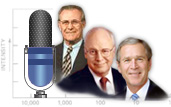
Perusing the White House website this morning for more of the president’s wisdom, I came across the image to the left, which is still on public display. I see Senator Palpatine, in the middle; and Anikin, on the right. But I can’t quite place the figure on the left. Not the microphone–the other one.

Speaking of images, the San Francisco Chronicle this morning has a big front-page story on the identity of the source who in 2004 leaked transcripts from a federal grand jury to two reporters at the paper. Accompanying the story, both print and online, are pictures (different ones in each place, but taken at the same time and place by the same Chronicle photographer) showing the reporters, Lance Williams and Mark Fainaru-Wada, and their Hearst Corporation lawyer. But there’s someone else in the pictures, too: Chronicle Editor Phil Bronstein, who is such a key part of today’s stories that he is never mentioned. So why did the paper, which has a stack of Williams/Fainaru-Wada images as high as an elephant’s eye (speaking figuratively), use pictures with Bronstein? I can’t believe Bronstein had anything to do with choosing the images. In some way, it looks like the boss’s vanity and self-importance have become institutionalized.

Technorati Tags: , , ,

Now Batting: The Decider

The most important words in 18th century American history: “Life, liberty and the pursuit of happiness.”

In the 19th: “Government of the people, by the people, for the people.”

In the 20th:

First third: “We have nothing to fear but fear itself.”

Middle third: “I have a dream.”

Final third: “Can’t we all just get along?”

Too early to tell about the 21st century. If unreserved arrogance is the theme, Bush and his folks have a lock on it.

Today

Lincoln & Darwin Day: Lincoln, born the same date and year as Charles Darwin. “Happy birthday” doesn’t fit Lincoln. Too much tragedy, too much gravity there. As I’ve said before, I don’t know whether it’s the Illinoisan in me or not, but there’s no other figure in history who seems so close in every day life; and also so distant, always receding and unknowable. As to Darwin, there’s probably no single person who has more to do with how we–must I define “we”?–see our world, though he’s far from the palpable presence for me that his birthday-mate is.

Comic Nurse Day: An informant reminds me that it’s the Comic Nurse’s fortieth birthday. Happy birthday, Comic Nurse!

Nap Day:Study: Napping might help heart

“CHICAGO – New research on napping provides the perfect excuse for office slackers, finding that a little midday snooze seems to reduce risks for fatal heart problems, especially among men.

“In the largest study to date on the health effects of napping, researchers tracked 23,681 healthy Greek adults for an average of about six years. Those who napped at least three times weekly for about half an hour had a 37 percent lower risk of dying from heart attacks or other heart problems than those who did not nap. …”

Tmails

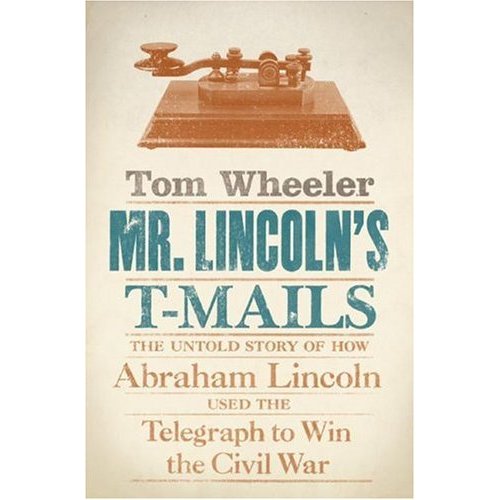
Best Lincoln Piece of the Day (sez me): “Lincoln Online,” by Tom Wheeler, in the Washington Post. Wheeler’s book, “Mr. Lincoln’s T-Mails,” is an examination of Lincoln’s voluminous trove of … telegraph messages. Excerpt:

“Consider this glimpse into how Lincoln dealt with the war’s grinding pressures. The peripatetic Mary Todd Lincoln had wired from New York seeking cash. Her note’s perfunctory ‘Hope you are well’ was followed with instructions on where to send a check. Then she tacked on without punctuation a last-second message from their son, ‘Tad says are the goats well.’

The president promptly responded that the check would go in the mail, then seized on the query about the White House pets to comment on his own well-being: ‘Tell Tad the goats and father are very well — especially the goats.’ The few words speak volumes about Lincoln’s spirits and the refuge he found in wit.

Technorati Tags: ,

Sweeping the Nation

I laid a new word on Kate as she unoffensively walked the dog last night: “Obamania. What do you think?” After considering for several long milliseconds, she said, “God, that’s terrible.”

Terrible, yes, But also widely used. As of this morning, a Google search turns up 147,000 instances of “Obamania” on the Web. That’s up 1,000 from last night. And–a surprise to me–it’s not a recent coinage. The very first item in that list of 147,000 dates back to July 2004, the day after then Illinois state Senator Barack Obama delivered the keynote address to the Democratic convention. A leading promoter of the term Obamania: “The Daily Show,” which also shows up prominently among deployers of “Barack the vote” (791 instances). Obamarama scores 75,800. Obamarific: 23. Obamomentum: 1.

Coinages associated with other candidates?

Bidenmania: 6.

Kucinichmania: 231

Vilsackmania: 0

Vilsack fever: 3,290

Hillarymania: 938

Hillary fever: 385

Hillary syndrome: 223

Technorati Tags: