December

Codorniceswest

Remembering Christmas, a poet said: “December, in my memory, is white as Lapland, though there were no reindeers.” The snow was like a living thing: “It came shawling out of the ground and swam and drifted out of the arms and hands and bodies of the trees; snow grew overnight on the roofs of the houses like a pure and grandfather moss. …”

That was Wales. And this is California. December on the weather side of the East Bay hills may produce the odd sunny day. I’m not complaining that we don’t have more. But mostly, it’s gray, as gray as the sopping thick felted clouds stretching overhead from the hills a mile to the east all the way past Hawaii to the tropics. No sunset, no moonrise, no stars. Just the same blanket of heavy, sodden gray pressing down day after day.

At least it’s warm.

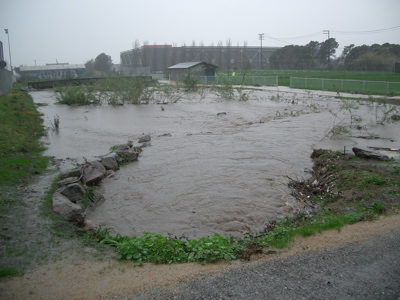
(Pictured above: Codornices Creek, where it exits the city storm drains for the Bay, during a heavy rain on Thursday; most of the year, the channel is just a trickle. Beyond the reclaimed soccer field on the right is a big new Target store, and beyond that is the interchange for Interstates 80 and 580.)

Notes

Note 1

As John B. points out, there’s a hoax question hanging over the story about the Massachusetts student who says he got sweated by the Department of Homeland Security for trying to get Chairman Mao’s original, unexpurgated “Little Red Book” through interlibrary loan (see my previous post). OK — the original story does have vague elements I noticed but didn’t pay attention to: mostly the fact the entire story is secondhand. That having been said, no one has shown yet that that the story is untrue, and (famous last words) the reporter who wrote it says he stands by it. BoingBoing is doing a pretty good job following the hoax allegation.

Note 2

A long, cold bike ride in the rain sounds like it builds character (or affords one the chance to display the character you’ve already built), but: Last Saturday, I went out on what was supposed to be a 95-mile ride down to a town southeast of Berkeley called Livermore. By the time we left at 8 a.m., the chance of rain for the day was up to 60 percent — but it sounded as if the incoming storm wouldn’t arrive till mid-afternoon at the earliest. Of course, it started raining about 10:30 or so, maybe 10 miles north of our turnaround destination. Most of our little group of riders bailed and rode over to catch a commuter train back to Berkeley. Still, we were on the road for 20 miles in the rain, and by the time we got to the train station it was 39 degrees (chilly for the Bay Area). So I got to demonstrate my mettle. And since Sunday, I’ve been home sick with the first real cold I’ve had in many months. From now on, I’m going to reserve my character-building activities for warm, dry days.

Berkeley Flood Terror

Hollyflood

Well, the mainstream media is giving all its precious attention to stories like Iraq and what Bush is doing to protect us from ourselves, so the networks and big-shot papers like The New York Times will be ignoring the plight of a Berkeley neighborhood (mine) struck by the ravages of minor flooding for about half an hour earlier today.

It’s been a dry fall for the most part, but it started raining hard late last night. Just before 11 this morning, we had about 15 or 20 minutes of very intense rain as a line of thunderstorms moved over. I found one online rain gauge in the Oakland Hills that got .85 of an inch of rain between 10:30 and 11:30, and a station up at UC Berkeley’s Lawrence Hall of Science recorded a rainfall rate of 2.4 inches an hour at 11 a.m. But after a while, the rain slackened, then stopped entirely as the storm moved to the northeast.

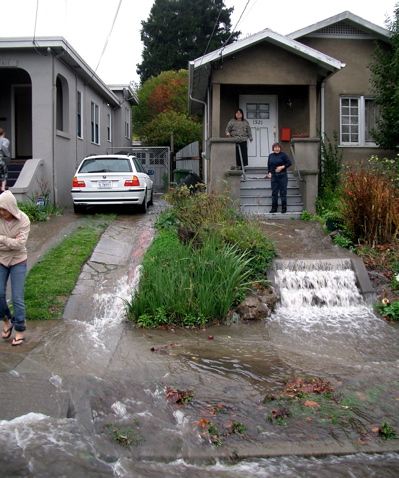
About 20 minutes later, Kate exclaimed about a river flowing through our back yard. I looked out, and half the yard had turned into a stream bed, with water running out toward the street. About eight inches more, and the water would have been flowing through the house. Out on the street, the three houses to the south of us had water tumbling down driveways and cascading down front steps (all of our homes are built in the channel of Schoolhouse Creek, which many decades ago was piped into a massive underground culvert that drains into the bay).

Cimg4829
Cimg4834
Cimg4842

The earlier deluge had been so intense that the culvert had apparently filled with water and started to back up through the storm sewers, which flowed back out onto the streets. A large pond formed on California Street, a block to the east and slightly uphill. When the pond got high enough — high enough to float a minivan out from the curb and to stall out a class GM station wagon whose driver tried to drive though — the water did what it does naturally and flowed straight through our yards toward the Bay. We’ve lived in our house going on 18 years, and we’ve seen it rain very hard here, but this is the first time we’ve seen anything like flooding here.

Once the storm sewers started flowing again, though, the pond drained away in less than half an hour.

We’ve Got Lights

Lights05

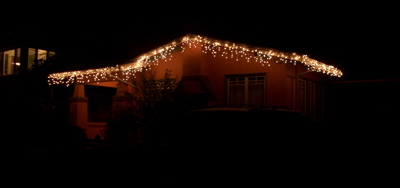
Thom and I put up our outside lights this afternoon. The process featured a tangled extension cord — Thom undid it, using mysterious skills he learned in the Sea Scouts — and my mostly silent concern that in my 50-plus clumsiness gravity would get the better of me, I’d pitch off the roof and wind up as a 1-column, 2-inch item in a local daily as a seasonal casualty. I’m still here, and noting the concern, so the worst didn’t come to pass. In fact, it only took us about half an hour to hang the strings, and everything was lit up by dusk.

Now we’re set till that day after the first of the year when the ladder comes out and I go back aloft to take the lights down.

Whither?

If you noticed something different about the blog earlier: Typepad, the paid service that hosts this here site, had a major service outage starting late Thursday night. I didn’t notice until I tried and failed to post something around midnight. A side effect of the outage: The service was forced to rely on a five-day old backup version of hosted blogs, so the most recent visible posts were from last Saturday.

If you’re reading this, the service is back to normal. And if you didn’t notice anything missing in the first place: As you were.

Game of Knaves

Cribbage: The game of knaves, or at least of people who like to play cards. (Reported origin: The Wikipedia article on the game says it was invented by a British poet, Sir John Suckling. in the 17th century. Really.)

It’s an official Subject of Interest (SoI) because Thom, home from school for his Christmas break, wants to polish up his skills so that he can beat his roommate next quarter (the roommate has proven dominant in a more cutting-edge entertainment, Madden NFL 2006). So he hunted for our board out in the shed, and the last couple of nights we’ve played. For the uninitiated, it’s a pure numbers game, with a special emphasis on putting together combinations of cards that add up to 15; play too much and you’ll drift off to sleep thinking of great cribbage hands (my favorite: a 4-5-6, with any one of the cards doubled; I can hardly begin to tell you how exciting it is). There’s more to it than that — much more — but that’s a central feature.

Interesting that cribbage has come into the picture. Growing up, my family was given to games like — excluding those of a purely psychological nature — Scrabble,Yahtzee, Milles Bornes, and Monopoly. Chess and Risk sometimes, though the disadvantage of board games was the way they tended to fly into the air at particularly tense moments. Uno. Hearts. Spades. Trivial Pursuit, when it arrived. A made-up trivia game called “the alphabet game.” But no cribs.

Just Once

Just once I’d like to be out on the road — driving, cycling or walking — and not find myself saying, in a tone considerably above sotto voce, “What a f___ing a__hole!” to my fellow road users.

This isn’t really a plea for everyone else to reform. I mean, I’d like it if people like the UPS driver who looked me straight in the eye as I approached an intersection on my bike this morning would have refrained from easing out in front of me as if daring me to smash into the side of his truck. But what are the chances that other people are going to suspend their road antics just because I want them to? The true answer would be a negative number, if that were possible, but for purposes of this discussion I’ll settle for zero.

What I’m looking for is the day I’ll rise above it all and just smile and wave when someone cuts me off. Either that, or just admit to myself that I’ve long since joined the fun and that for every time somebody does something to trigger a stream of profanity from me, I’ve probably pressed someone else’s buttons the same way.

December 11: Last Light

Briones_1

The usual late afternoon/early evening ride: Spent the rest of the day on — well, not much. Hit the road around 3, crossed the hills, and rode a steeply rolling road to the east. After 20 miles, I turned around and rode back; the main alternate return route from where I was has some high-speed traffic on it, and the sun was getting ready to set. This is from one of the high points along Bear Creek Road (click for a larger image): The Berkeley Hills are in the distance, an arm of Briones Reservoir, one of the big local holding basins for water piped down from the Sierra Nevada, is to the lower left.

The Wreck of Old No. 11

As I write, Thom is on an Amtrak train back home from Oregon for his holiday break. The train, the Coast Starlight, arrived in Eugene early yesterday evening from Seattle, already two and a half hours late. Amtrak’s “schedule” says the southbound Starlight should arrive in Emeryville, just down the track from Berkeley, at 8:10 in the morning. We’re several hours past that. Where’s the train? Still more than a hundred miles away, laboring down the valley somewhere north of Sacramento. Amtrak’s website says the train is now due in at 2:08 p.m., 5 hours and 58 minutes late. That’s a fantasy, since the run got to its last stop 6 hours and 46 minutes overdue.

I don’t mean to beat up on Amtrak (aka the quasi-private National Railroad Passenger Corporation). It’s not news that its long-distance trains can’t keep to a schedule. The Department of Transportation’s fiscal 2004 summary of Amtrak’s performance shows the Coast Starlight makes it to the end of the run when the schedule says it will 22.3 percent of the time. The figure for the Sunset Limited, which operates between Los Angeles and Orlando, is 4.3 percent (4.3 percent! Riding an on-time run on that train would be like winning the lottery). Only the shorter routes, like the Capitols in California, the Hiawathas (Chicago-Milwaukee) and the fast intercity runs on the East Coast have on-time rates higher than 70 percent.

Amtrak doesn’t really try to hide this. Its website cautions that if you’re booking a trip on the Coast Starlight or California Zephyr (Chicago-Emeryville) you might want to “plan for the possibility of delays due to freight traffic, track work “or other operating conditions.” This points to a widely cited Amtrak problem: that it’s treated as a second-class service by the companies that actually own the rails it uses. At the same time, though, Amtrak persists in describing rail travel as a wonder not to be missed. The timetable for the Coast Starlight urges you to “discover one of Amtrak’s most awe-inspiring travel experiences.” Of course, there’s more than one way you can read that.

Another well-known part of the Amtrak story is its perennial deep deficit. The Department of Transportation offers a statistic on each line’s loss per passenger. Generally (and predictably), the shorter, more heavily traveled routes — the ones mentioned above that tend to be on schedule sometimes — show the smallest per-passenger loss. The longer the trip, the bigger the loss and necessary public subsidy. Not that there’s anything wrong with transportation subsidies — we wouldn’t have roads, airports or seaports without them. But if you’re underwriting a $466 per passenger loss (the fiscal 2004 figure for the Sunset Limited; the number for the Coast Starlight is $152), you expect to get a little something in return; a meaningful estimate of when the trains arrive and depart would be a start.

I’ve always loved trains, or at least the idea of trains, and have taken a few long trips starting with my first visit to California from Illinois in 1973. The appeal to me of traveling by rail is pretty much the one Amtrak is trying to sell: You get to see the country close up instead of blasting over it in an aluminum tube. But it’s one thing to support a service that’s basically necessary, or if not necessary, more or less efficient; it’s another to pay for something that’s essentially broken and doesn’t appear to have any prospect for getting better the way things are being run now.

So something’s got to change: Do whatever needs to be done and pay whatever needs to be paid to improve service and make it reliable (fat chance; Amtrak has only grudging support from Congress). Or stop pretending you run the long-distance trains on a schedule: just tell passengers you’re pretty sure you can get them where they’re going eventually and to enjoy the scenery. Or let private operators take the lines and see if there’s any way they can both provide service and make them pay, or at least lose less. Or just let the trains go and shove everyone on to buses and planes.

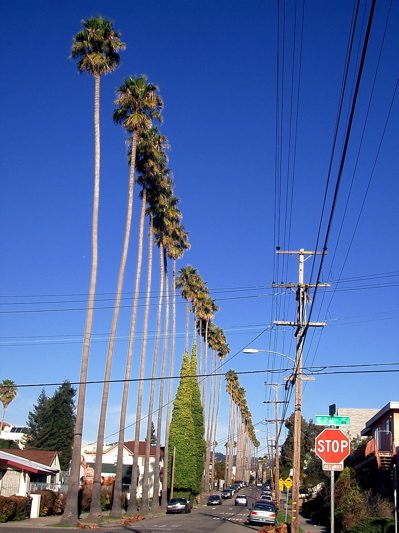
Oakland Street Palms

Oaklandpalms

An Oakland landmark: A long line of palms running north along 9th Avenue from East 24th Street (I’ve never felt totally comfortable in cities that let numbered streets cross). I have no idea who planted the trees, when, or why exactly, since you don’t see many palms planted along residential streets. Since 9th Avenue is near the top of a ridge, you can see the trees for miles. Took the picture Friday on my way back to Berkeley from running an errand out to Kate’s school.