July, California

Pleasantsa070706 Pleasants070706

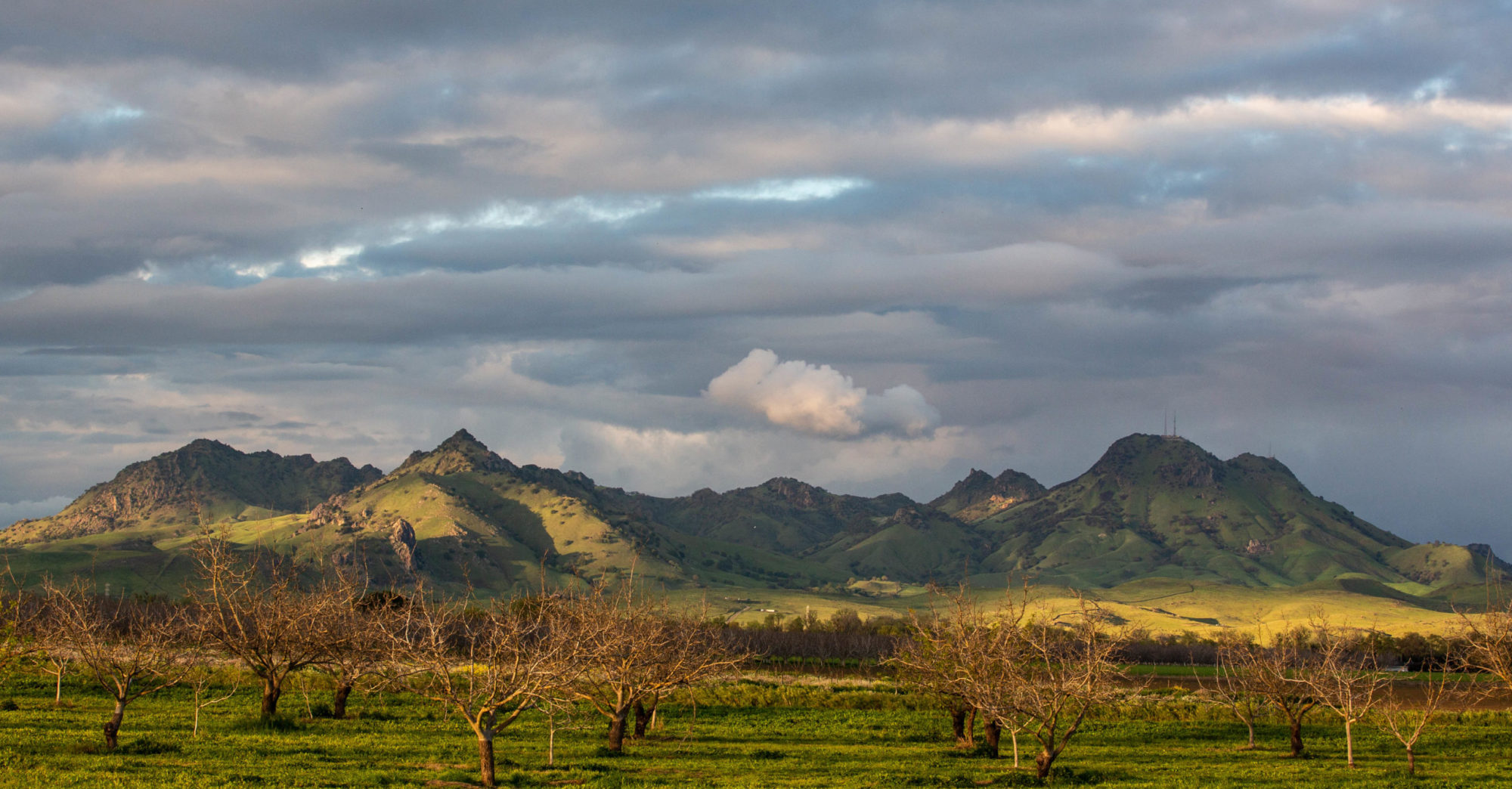
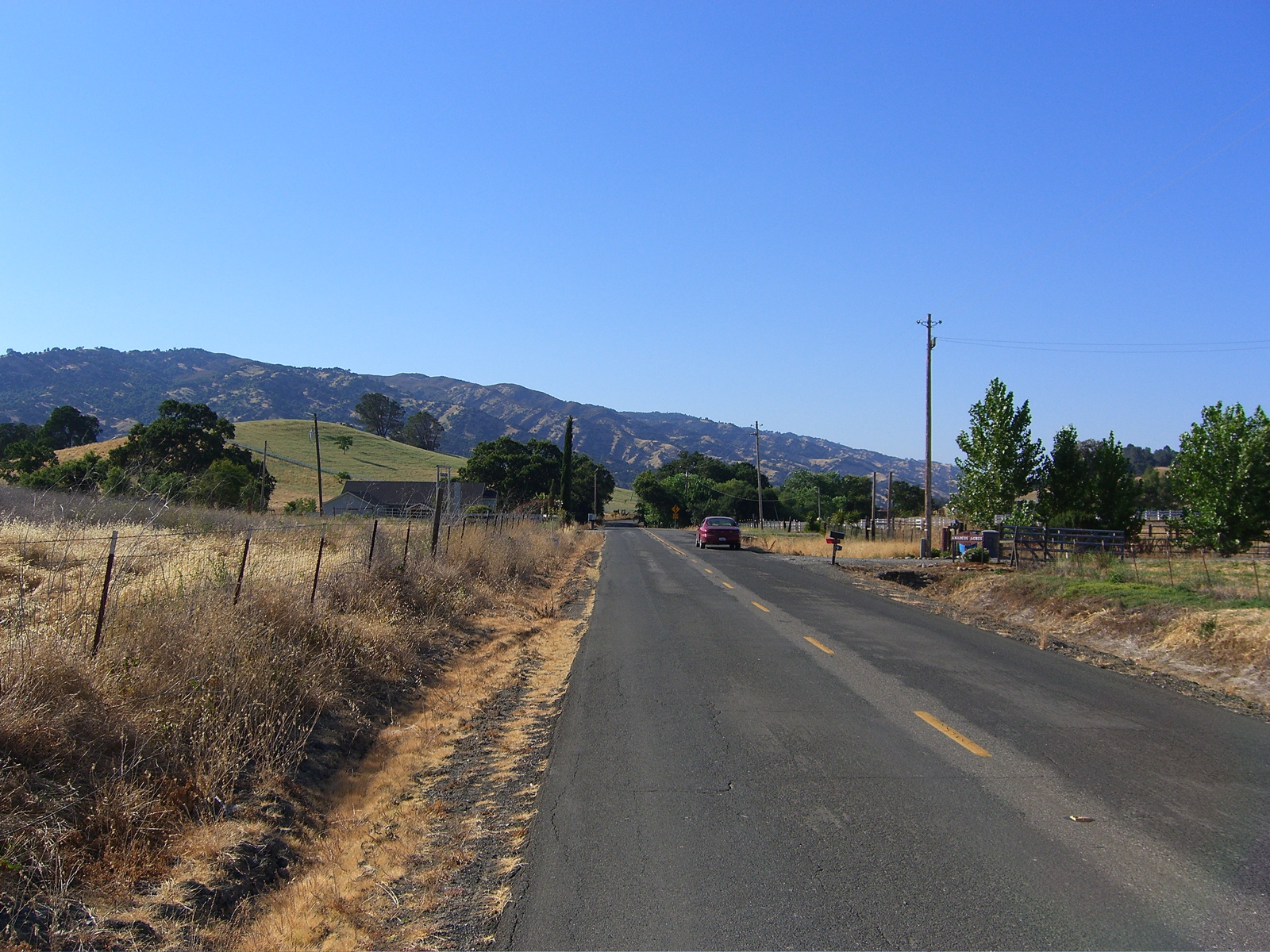
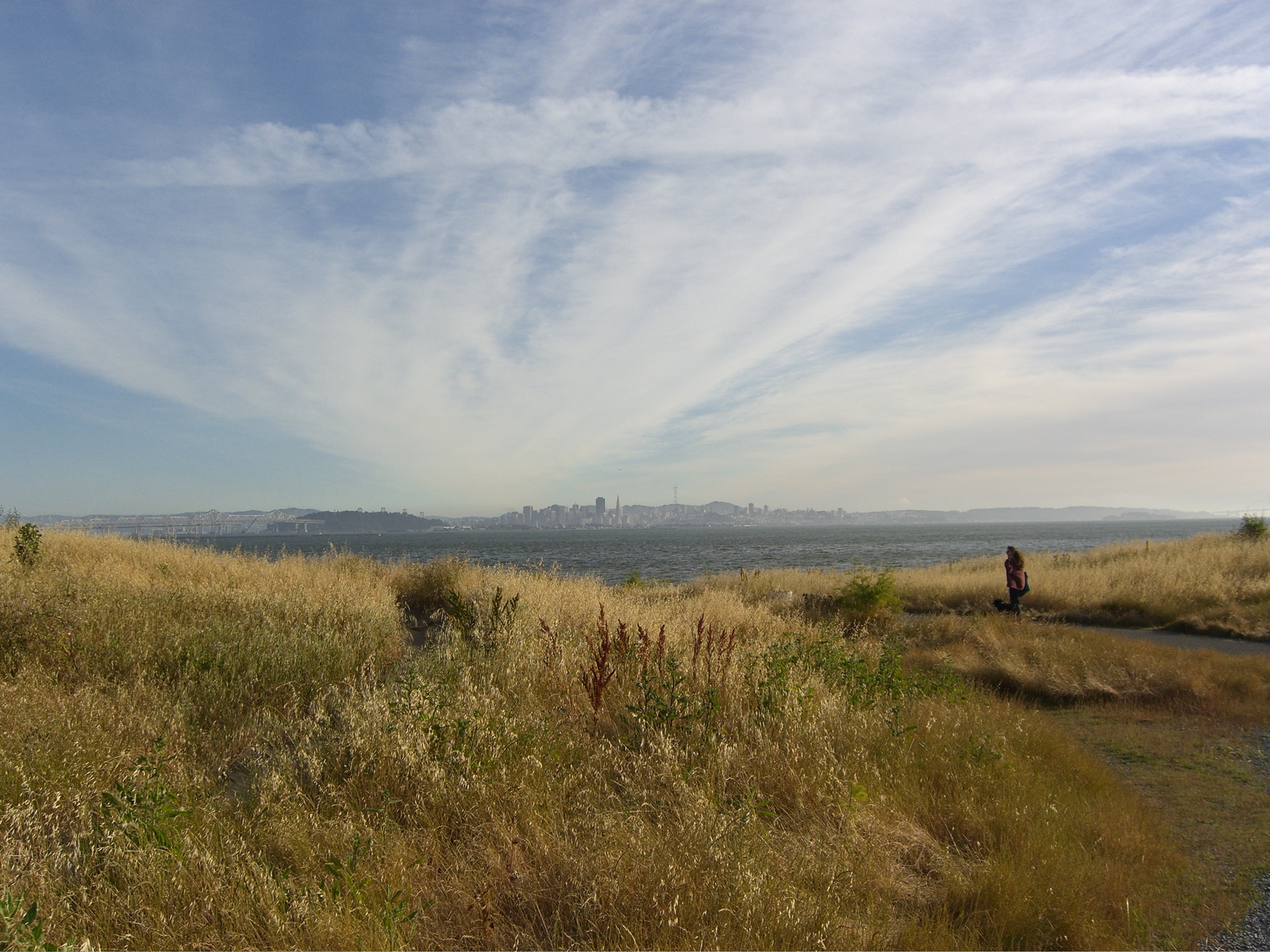
One of my favorite landscapes: Pleasants Valley Road, running north from the Fairfield/Vacaville area, just north of Interstate 80, up to pretty close to nowhere on state Highway 128. This is one of the places I think of as a real California place: hills and low mountains folded up, the winter’s green grass turned golden in the heat of the early summer, and just three or four miles to the east, the table-flat margin of the Sacramento Valley.

Kate and I were going up to some friends in Fair Oaks, east of Sacramento, on Friday. I took the afternoon and early evening to ride from Berkeley to Davis, about 100 miles the way I go. In the summer, you can count on much warmer weather as you travel from the coast to the interior here. Define “much warmer.” It might be in the low 60s at the beach, low 70s around the shore of San Francisco Bay, and in the low 90s to low 100s as you move from the valleys east of the coastal mountains into the Central Valley. In Berkeley, the transition happens as you cross the hills headed east; there’s a short stretch on one of the roads up there where in the space of 100 yards or so the marine influence vanishes, the temperature rises, the humidity drops, and you’re in the interior.

I could tell Friday’s ride would be warm. It was pushing 80 in Berkeley when I left at 12:30 p.m. I couldn’t have told you how hot it was later, just that it was. Later I saw that the official temperature was in the mid to upper 90s along the route I took; my bike computer’s thermometer, which gets the sun-affected, on-the-asphalt reading, recorded a high of 115.

On my route, you hit Pleasants Valley Road after 65 miles or so. It marks the only place along the way where you have an extended feeling of having left the sprawl truly behind: 13 rolling, twisting miles, orchards giving way to ranches, deluxe estates, and then ranches with orchards. Beautiful even in the heat, though I was less inclined than usual to just drink in the scene.

Technorati Tags: , , ,

Dead Horse Beaten, with Gusto

Leslie062906

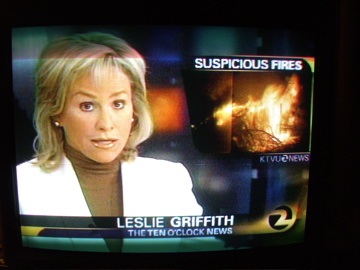
“An arsonist may be on the loose in Contra Costa County. We’ll tell you about the string of suspicious spires.”

The way it works with TV news shows and anchors is this: A group of writers and producers craft the bulk of the script for the hour or half-hour; the anchors appear on camera and read what has been written for them. The best anchors will write some of their own material. A competent one will go over the script before going on the air and perhaps work with producers or writers to tweak it.

One of the fun aspects of TV newswriting is to learn how the talent — the on-air people — read and talk. You learn by trial and error, by writing something that comes out sounding great or something that causes the talent to trip over the words. If you get to write for the same people long enough, the process is a little bit the way I imagine playwriting might be: The anchor or reporter becomes a character; when you write for them, you’re seeing and hearing them speaking the words on stage, as part of a dramatic production.

The goal in TV newswriting is short, straight-ahead sentences. They’re easy to read and understand. In my single on-air writing and editing gig, for TechTV’s “Tech Live” daily news show, I had to unlearn my habits of inserting all sorts of clauses and parenthetical comments into sentences. Not because TV news writing is dumber by nature, but because those kinds of sentences are harder to read aloud as they scroll up the teleprompter. Those clauses and asides become invitations to falter when they go from the page to oral delivery. That having been said, you learn which talent can handle a complex thought and sentence structure when it can’t be avoided and which ones can’t.

Which brings us to KTVU’s Leslie Griffith. (There’s nothing that makes her stand out from the mass of bad news anchors. She just happens to be one I see fairly often.) On one hand, you’ve got her trademark fumbles and stumbles; “suspicious spires” for “suspicious fires” right off the top of tonight’s newscast, for instance. On the other, you’ve got her tendency to plow through a story with odd pauses, misplaced emphases and out-of-breath gasps — the way most people would sound if they were reading something they had never seen before in public.

What does someone make for a performance like that? Well, the president of the United States makes $400,000 a year. Rumor has it that Leslie makes a quarter-million more than that, though I have to admit that despite her problems, she’s a better reader and hasn’t started a single war during her tenure.

Technorati Tags: , ,

Diversions

What I meant to be doing this week was doing a long, hard ride in Washington state (3.75 days, 770 miles). But my crash on the 1st and subsequent slow healing took care of that. It’s hardly the next-best or next-worst thing, but the organizers of the ride, the Cascade 1200, have a pretty neat blog going that really gives a good feel for what it’s like out there (and what it’s like out there is: hilly, very hot, and dry. “Very hot” and “dry” aren’t words we normally associate with Washington, which has a pretty solidly entrenched reputation as cool and rainy. But two-thirds of the state lie east of the Cascades, a range that effectively wrings out storms blowing in from the Pacific and Gulf of Alaska; as in California and Oregon, the mountains wall out cool marine air from reaching the interior, so the summers are hot and dry (and maybe a little more so than usual right now with a high-pressure system keeping rain out of the entire Pacific Northwest).

***

Saturday, when I thought I’d be up near Seattle, riding down the western flank of the Cascades, I was up in the Napa Valley with my friend Pete, doing a short ride. The main event of the day occurred after we got off the bikes, though. Pete and his 6-year-old son, Niko, built a wood-fired stove in their backyard for pizza and bread-baking. A pretty amazing father-son project, the result is absolutely gorgeous. The only question was: Would it work? On Saturday, we dismantled and burned about half of an old oak wine barrel in getting the thing good and hot (nothing’s more fun than an outdoor fire, especially if you can keep it under an acre). Then Niko and Pete made some personal-size pizzas. Then we ate and ate and ate. (Pete blogged the event, complete with pictures).

North on 5

One last trip up to Eugene on Interstate 5. Someone asked me this morning how many times I’ve made the drive, which is about 1,030 miles round trip. Including today: Seven. At Thanksgiving, I did the trip twice in seven days, driving north on Tuesday, south on Wednesday, north and 40 percent of the way south on Sunday, and back home on Monday.

But the trip might not be as long as it sounds. I mentioned Interstate 5. It’s not an all-out raceway as it is from the Bay Area down to Los Angeles, but it moves right along going up the Sacramento Valley and doesn’t force you to slow down (too much) once you get into the mountains in the north. That’s all by way of saying that 500 miles and change might be a seven-and-a-half or eight-hour drive if you keep your stops short.

I’ll let you do the arithmetic. I’m going to bed.

Technorati Tags: , , , ,

Coffee

Overheard by Kate at the Solano Avenue Peet’s:

Clerk: Would you like a complimentary cup of coffee with that purchase?

Customer: Nah, I’ve had enough coffee today. If I have any more I’m going to pull my lower lip up over my head.

Kate: It’s a good thing to know your limits.

Technorati Tags:

Post-Election Voter’s Guide

Ivoted-1California held its primary four days ago. Twenty-eight percent of eligible voters, an all-time low for a statewide election, appeared at the polls. Despite the ghost-town turnout, the votes are still being tallied in my county, Alameda. That’s because its Diebold voting machines were decertified — among other real and perceived shortcomings, they don’t produce a receipt or any kind of “paper trail” documenting votes cast — and elections officials decided to give the people what they said they wanted: supposedly unhackable paper ballots. In turning back the clock on election technology, the registrar of voters leapfrogged over the system the Diebold machines replaced: punch-cards. To avoid awakening bad chad memories, the county adopted a ballot that required voters to bubble in their choices in black ink. The ballots are machine readable, but the automation only goes so far: All week on the news, we got to see pictures of bored election workers feeding ballots one at a time into the readers. The registrar’s latest press release says 8,000 absentee ballots still need to be counted. And after that, 11,000 “provisional” ballots cast by people who had some sort of problem at the polls. And after that, a smaller but unknown number of damaged or machine-unreadable ballots.

I kind of wonder whether I’m one of the people whose ballot wound up in the provisional or damaged piles. What happened was this: When Kate and I went to the polls Tuesday night, all she had to do was turn in her filled-out absentee ballot. I still like to go through the exercise of going to the polls, so I went through the routine: Giving my name and address to the poll workers, signing the register, and getting my Democratic Party ballot. This time, it came in a legal-size manila folder. The voting booth — it’s really more of a spindly, collapsible lectern — was equipped with a pen on a string. I pulled out the ballot and started to bubble it in.

Several of the races had candidates running unopposed; and several of those involved officeholders who are trying to move into new posts because term limits are forcing them to move on; for instance: Cruz Bustamante, the lieutenant governor, who was the only Democratic candidate on offer for state insurance commissioner (the old insurance commissioner, John Garamendi, was running for lieutenant governor against two term-limited state legislators). There’s something tired and dispiriting about seeing these guys — mostly guys — swap seats with little more to recommend them than the fact hardly anyone can remember a time they weren’t haunting some committee room in Sacramento.

It’s not the first time the thought has occurred to me. Usually, I’d just pass on the uncontested races. But I don’t usually vote with a pen in my hand. With the punch-card and touchscreen voting systems, it was possible, but painful, to cast a write-in vote. With the paper ballot and the nice black felt-tip pen in the booth, confronted with the bland nothingness of an unopposed Cruz Bustamante, a write-in suddenly seemed appealing. So for every uncontested, or feebly contested, office, I cast a write-in vote. I was stumped at first about who I might vote for, but then I thought about some of my smarter and more conscientious friends. So Piero and Jill, across the street, got votes for the state Legislature; I voted for Bill for U.S. Senate (time for Feinstein to go); Larry was my choice for state insurance commissioner, and Kate got the nod for state schools superintendent. I was aware when I turned in my ballot that some poor elections worker would be forced to try to make sense of my impaired-looking block printing.

Throw-away votes? Maybe, though I feel I’d trust my choices in office at least as much as I’d trust the party retreads.I admit if I had felt anything was on the line, my friends would have lost out. Still, I walked away from the polling place feeling better about my vote than I have in a long time.

Technorati Tags: , , ,

Today’s Best Names

Nominated from the pharmaceutical category: Cephalexin and Cefoxatin, members of the cephalosporin antibotic family. The former is oral, the latter injected. I’m taking the former for 10 days after having a rear-end shot of the latter following some complications from the late unpleasantness between me and a local road. Complications? Well, I got four pretty good-sized abrasions when I fell off my bike last week. Three of them are healing just about as well as you could expect. The fourth, a big patch on my left shoulder, has been trouble; I may have suffered an allergic reaction to some antibiotic ointment I tried, from the adhesive on some high-tech dressings I tried, or maybe the thing was just infected from the start. In any case, it blew up into an angry, ugly mess that took on a life of its own (“I am not an animal! I am a human being!”). My whole left arm swoll up, as we used to say in the south suburbs. I went back to Kaiser twice. The first time, on Sunday, the doctor was unalarmed. The second time, today, the doctor blanched and said, “That’s cellulitis.” In a rare show of good taste and non-exhibitionist restraint, I’m suppressing the pictures. A day into the treatment, the thing seems to be responding, though.

Again with the baseball: Dan Uggla, rookie second baseman for the Florida Marlins. The South Florida Sun-Sentinel described his Wednesday exploits thus:

“Uggla became the first second baseman in franchise history with a multihomer game and knocked in a career-high five runs. … With the Marlins up 2-1 in the fifth, Uggla hit the first of his homers as part of four-run inning. His three-run blast to left knocked out starter Jamey Wright (5-5). In the ninth, Uggla sent another pitch into the left-field bleachers, this one from Tim Worrell with two outs and a man on.

” ‘I got lucky twice,” Uggla said. ‘I don’t even think my other at-bats were very good. A couple of balls, I guess I saw them pretty good and put good swings on them.’ ”

Uggla. Apparently it’s a Norwegian and Swedish name.

Dump

Chavez060306

I don’t have the exact statistics at the ready, but something like 35 or 40 percent of San Francisco Bay has been filled since the region was settled in the 19th century. About 95 percent of the wetlands surrounding the bay have been diked, drained and developed. Berkeley’s most visible modern contribution to the great, undeclared bay transformation project is its old garbage dump, part of a complex of old fill projects that stretch more than a mile along the waterfront and extend more than three-quarters of a mile into the water from the old shoreline (which itself is at least one-third of a mile west of where the European interlopers found the water’s edge).

The dump was a great place. Noisy, smelly, full of garbage and construction debris, seagulls and big graders. I worked as a construction laborer for a while after I moved out here, and every once in a while was sent on a dump run to unload a pile of old shingles or lumber or fractured plaster and splintered lath. A cashier took your fee, then sent you on your way, out the potholed road to the mountain of discards. A worker out there directed you to the edge of a live pit, and you added your stuff to all the household garbage, old tires, unwanted furniture, lawn clippings and miscellaneous unidentifiable sweepings from all over the city. I would always feel a little exhilarated to see it all and to throw mine, whatever it was, in on top. The graders and other heavy equipment were constantly at work crushing the trash, packing it down, making room for more; once a pit was full, it would be covered with dirt and the garbage would go to a new one. The old pits would settle over time and be reopened to take on more refuse. This went on for years.

About two decades ago, the dump reached capacity. So much garbage had been packed in that at one point it had been squeezed out in the Bay under the dikes built to contain the fill. The city built a “transfer station,” a big open warehouse-like structure where all the trash would go to be sorted and re-transported, if it wasn’t recyclable or compostable. The old dump was covered with dirt, lots of dirt. Part of it was landscaped and turned into a manicured city park and named after Cesar Chavez, the late farmworkers’ labor leader. Most of the fill was planted with native flora and studded with pipes to vent the methane and other gases from the old buried trash. Roads and trails were built. Part of the semi-wild-looking area at the center of the old dump has been opened up as a park for off-leash canines.

So, at the end of this environmentally unfriendly epic (a story line shared with many great city parks, like Grant Park in Chicago), we’ve got a beautiful piece of waterfront property with staggering views across the bay and back toward the hills, filled with bike riders, hikers, dog-walkers, picnickers and kite-flyers. Our garbage? It’s headed someplace else, where it’s unlikely to grow into something similar.

Technorati Tags: ,

Found in Translation

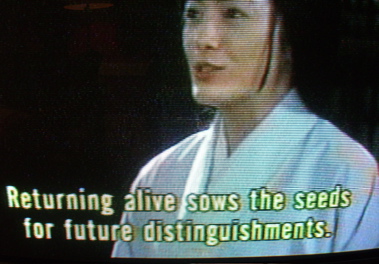
"Returning alive sows the seeds for future distinguishments."

Whereas returning on fire sows the seeds for future extinguishments.

(Happened across this, on a Japanese TV period drama, while sowing the seeds for drooling viewerment on Saturday night.)

How Not to Get Off a Bike

Late Thursday afternoon, I went out for a short ride through the Berkeley and Oakland hills; just a way to wake up my body for a planned 600-kilometer (387.5-mile) ride this weekend. I also wanted to see how my “new” bike — a beautifully painted old Bridgestone RB-1 frame I just had built up with parts from my old RB-1 — handled on a course I know pretty well. The route took me south along Skyline Boulevard past the place where I had a pretty bad crash in January 1991. Whenever I ride past the spot, I remember the fall and the aftermath. It all came back Thursday, too: How quickly I hit the road, the ambulance ride to the hospital, the gruesome picture I took of my face when I got back home.

I turned around, rode back up the hill I had just come down, and headed back toward Berkeley. The road is rolling, with a few short, curving descents and a couple of short climbs. The downhill sections are a little tricky, with some bad pavement. I rounded one right-hand turn, skirted some badly patched asphalt and picked up speed as I headed for a left-hand turn. I was probably going 20 to 25 mph. Just before I got to the curve, I hit a hole in the road and fell hard on my left side. I struck the pavement with enough force that my glasses flew off, lost their lenses, and went skidding down the road. I thought I heard my helmet hit the ground, too, but it didn’t show any signs of damage.

I’m OK. I came out of the crash with road rash on my left knee, hip, hand, elbow and shoulder and a pulled muscle (I think) in my upper back or left shoulder. Oddly, my right elbow also got a pretty good scrape, too, and I had a tennis-ball-sized knot on the inside of my right leg just above the ankle. I wound up going down to Kaiser Hospital in Oakland in an ambulance and spending about four hours there, mostly waiting and watching what was happening with people who were a lot worse off than me. About half an hour after I was rolled into the emergency room, a “Code 3” ambulance (one transporting an urgent case, operating with lights and siren) arrived with a woman in the midst of some sort of seizure; she died about 20 minutes later, about 30 feet from where I was lying. Eventually, a couple of nurses had enough of a breather from the more dire cases that they could spend some time scrubbing out and dressing my abrasions so Kate and I could leave.

What’s shakes me is how quickly and decisively something like this can happen. One second: spinning along, nurturing a picture of middle-aged bike rider as road ace. Next second: lying in the road, groaning, feeling a mixture of shock, fear, pain, and foolishness and wondering, What did I hit? Is there a car behind me? Am I going to get run over? How badly am I hurt? Is the bike trashed? What are my glasses doing over there?

After maybe half a minute or so, I untangled myself from the bike and stood up. A driver coming the other way stopped and asked whether I was OK. I think I told him, or her, that I’d see whether I was or wasn’t. That car moved on. Another came down the hill, the same direction I had been riding. The woman driving, Sylvia, stopped and got out and got me to sit down. I reaized my neck hurt. A cyclist named Dave came down the hill and hit the same hole I did and nearly fell. He cursed and then stopped to help, observing that it was the second time he’d hit that spot and that it was all but invisible because it was in a shady spot. Another rider, Doug, stopped as he rolled up the hill. The three of them convinced me it was a good idea to call 911; Dave made the call, then gave me his phone to try to call Kate; Doug, who lives nearby, agreed to hang onto my bike since I couldn’t take it to the hospital.

After another 20 or 30 minutes, the Oakland Fire Department and paramedics and police showed up. I was put in a neck brace and strapped to a backboard. I warned the paramedics, Elise and Dawn, that I weighed 215 pounds; they hefted me onto their gurney and told me I was the lightest person they’d had to lift all day. Then they drove me down the hill to the hospital. Eventually, I got hold of Kate, and she waited with me until I got cleaned up. When we left, several doctors and nurses, including the young guy who had attempted CPR on the woman who had died, told me to get well and made a point of telling me I needed to get a new bike helmet since I had probably damaged the one I had been wearing.

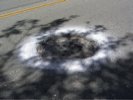
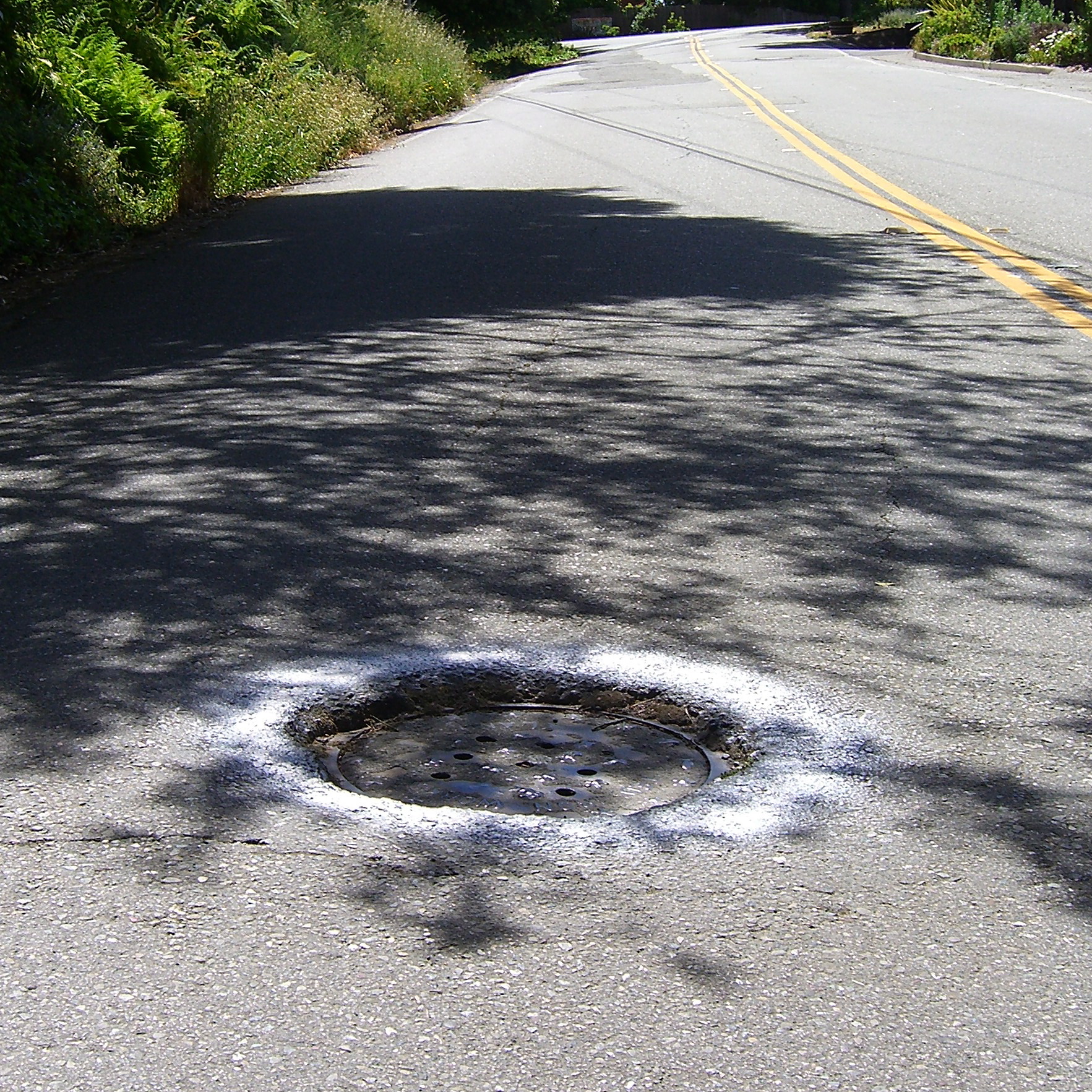
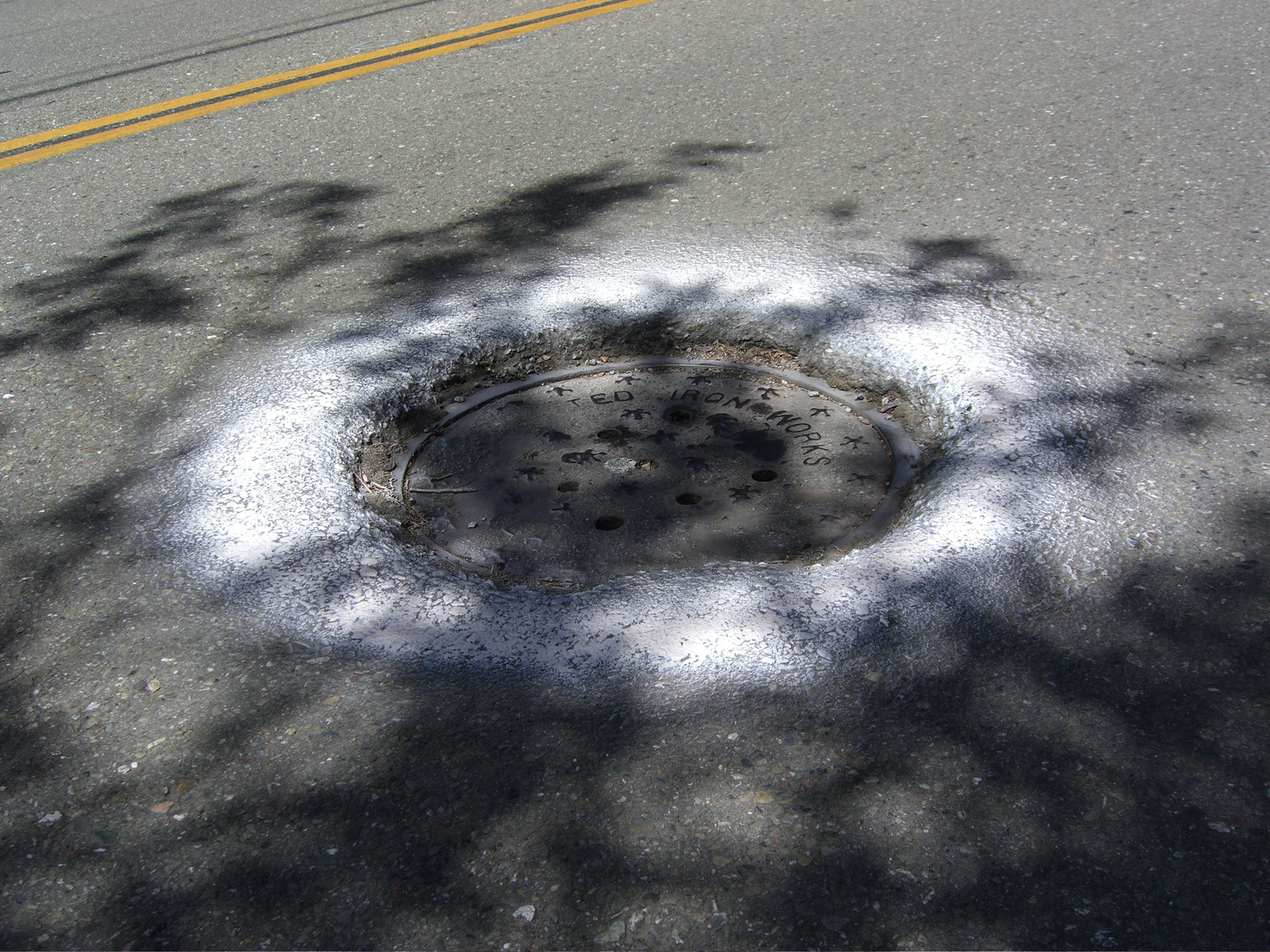
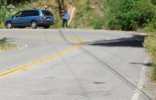
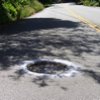
Friday afternoon, Kate and I went up to Doug’s house to pick up my bike. I was surprised to find that there doesn’t appear to be even a nick in the beautiful paint job (the handlebars are trashed, though). We loaded up the bike and then drove to where I fell. Doug had gone out and spraypainted the rim of the hole, which surrounds a manhole cover. Even though it was about an hour and 45 minutes before the time of day when I hit the spot, the shade was already crossing the road, and, even with the warning paint, I could see how close to invisible the hole was. A foot or so to the right or left, and I would have ridden home without incident (or run into some other obstacle). And I’d be out riding today instead of explaining why I’m not.
Skyline060206Skylinea060206Skylineb060206