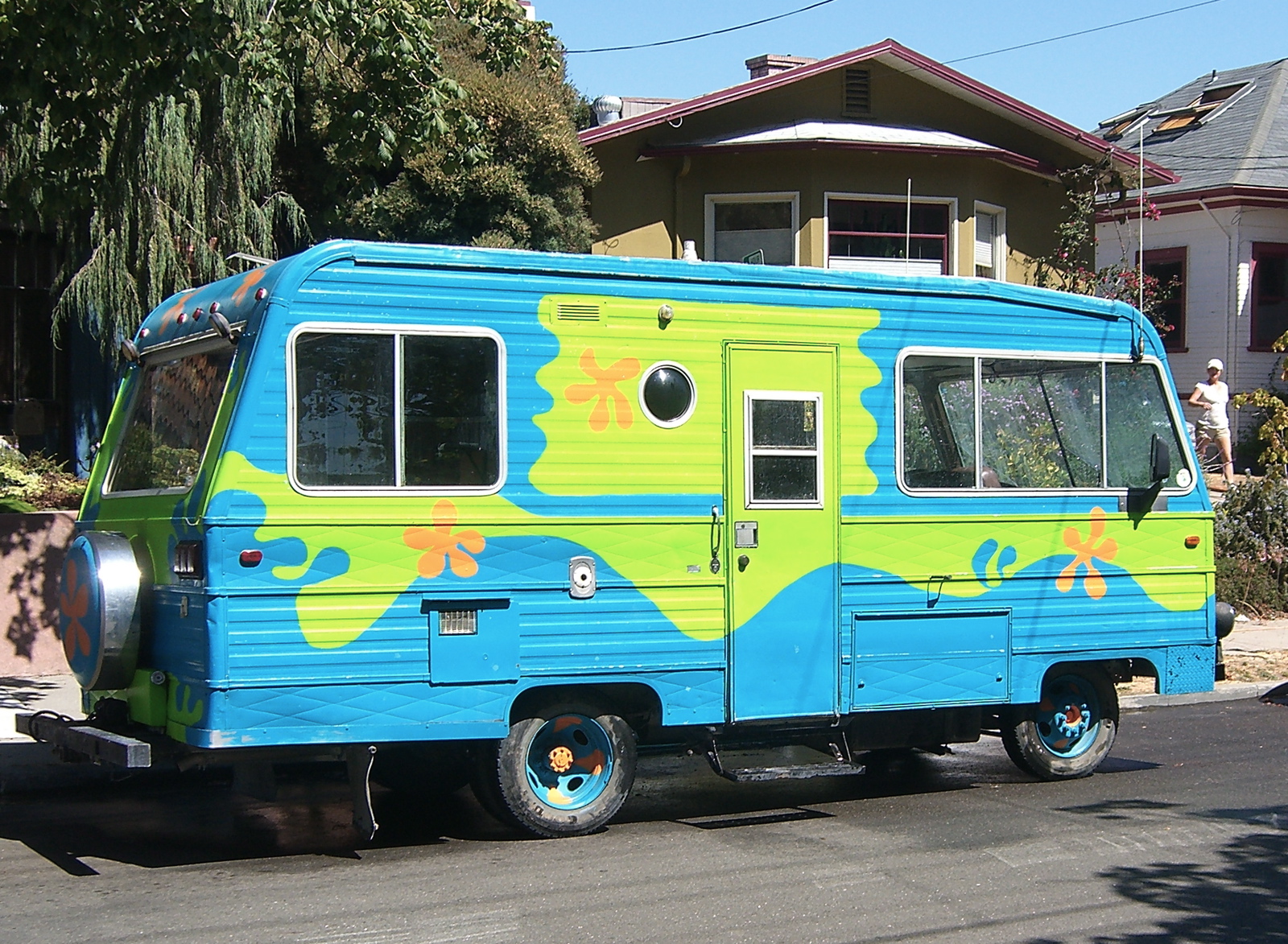
On Delaware Street, at Ohlone Park: A vintage RV with what I want to call a Cowsills paint job. The thing runs–I saw it being turned around–and for a vehicle that’s got to be pushing 40 years old, it’s pristine. A couple was washing it on the street, and now that I’m remembering the sort of chalky dust they were rinsing off, I wonder if they had it up at Burning Man, which was held in the Black Rock Desert, northeast of Reno, last weekend.
City Art
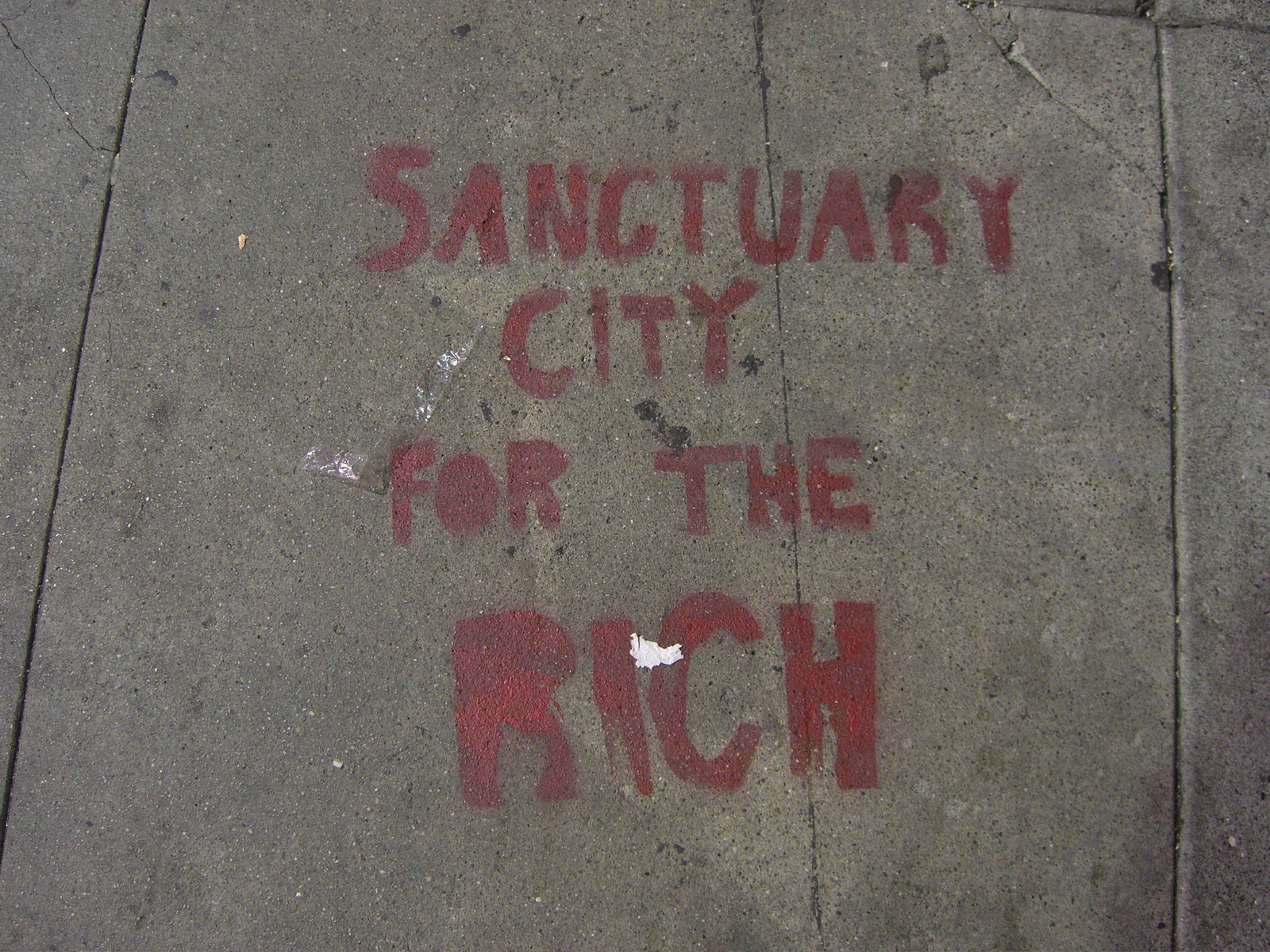
On the sidewalk in front of the Burger King on 16th, right outside the BART station. (I gather it’s aimed at mortgaged plutocrats such as myself.)
Sidewalks in San Francisco are becoming a canvas for stencil artists. “Are becoming” is my way of saying I don’t know how long it’s been going on, though it reminds me a lot of the stencils that have appeared over at the Albany Bulb. Check out this, spotted within the past several days a couple blocks from the message above and which looks like the same hand at work. And then there’s this: Maybe the Best Multipanel Sidewalk Stencil Graffiti Ever? (also in the Mission).
Technorati Tags: san francisco
Muni Yard
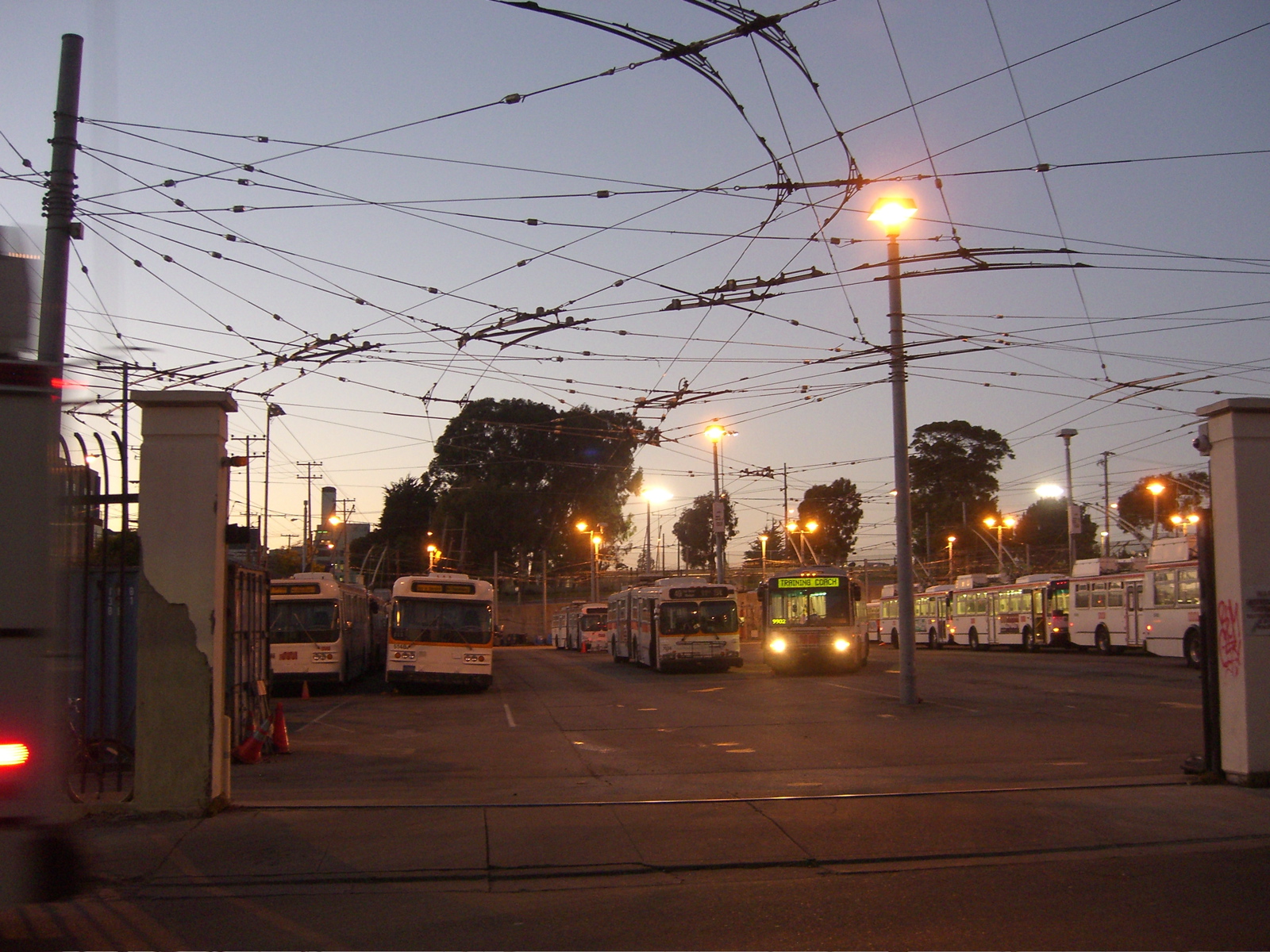

KQED is at Folsom Bryant and Mariposa, which is in what I describe as a seam between the Potrero Hill neighborhood to the east and the Mission to the west and south. One of the neighborhood landmarks is the big Muni bus yard, which has its entrance at York and Mariposa. Muni is both a source of pride to locals and a wilted flower. The system covers the city very well, but it has long struggled to provide reliable, on-time commute-hour service along the busiest corridors. One of the Muni’s undisputed gems, though, is its network of electrified trolley buses. They’re clean and quiet and run mostly on hydroelectric power supplied by one of San Francisco’s biggest environmental crimes, the O’Shaughnessy Dam that impounds the Tuolumne River and floods the Hetch Hetchy Valley in the Sierra Nevada (no less a nature guy than John Muir proclaimed Hetch Hetchy the fair sister to Yosemite).
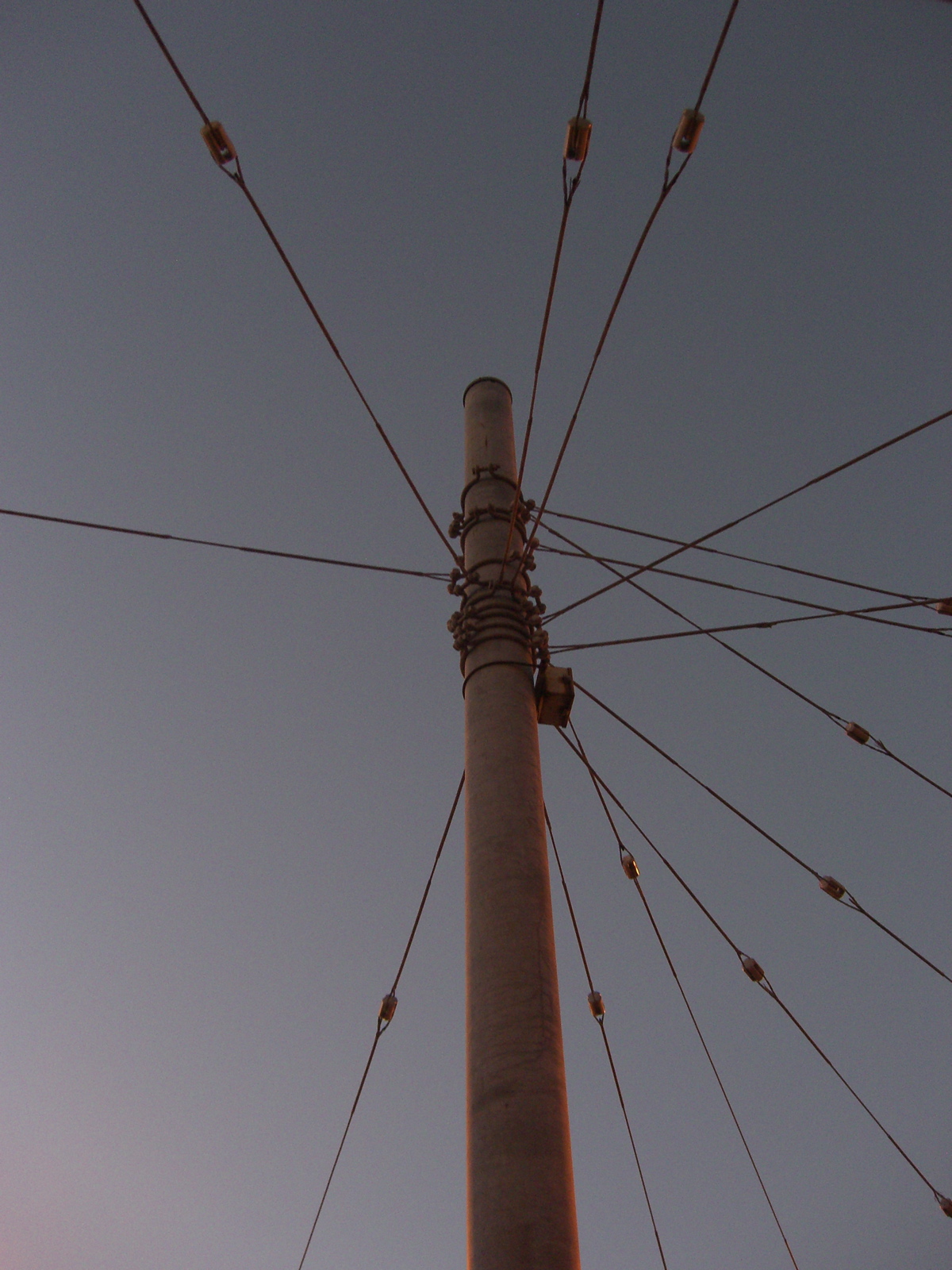
Since a lot of Muni’s electric buses are garaged at the Mariposa yard, the entire neighborhood is strung with overhead wires. If you happen across vintage pictures of American cities circa 1900 or so, the streets appear forested with poles supporting improbable masses of wires. Most of those are gone are underground now, so the Muni’s wires are more of a city signature against the sky, graceful and geometrically refined. You could lose a day, maybe days, following them with a camera. I made do with a few minutes on the perimeter of the yard after I left work this evening.
(Pictures from top: Bus exit at Mariposa and Bryant; a trolley wire stanchion (or whatever it’s called), which is also visible on the left of the first picture; looking southwest across the yard from 17th Street (KQED is the light colored building in the left-center background.)
Troubadour Moment
I rode up to the Peet’s at Vine and Walnut to buy a pound of coffee early this evening. I got a free cup of coffee and sat at an outside table. A guy with an acoustic guitar, and an open guitar case to receive the offerings of passers-by, had taken up a position on the corner. He played halfway decently. I heard a couple of lines from a song he was singing in sort of a scratchy bass monotone and recognized it as “When You Awake,” an old favorite that The Band recorded in 1969 on a brown-covered album called “The Band.” It’s sort of a winsome remembrance of childhood. Rick Danko sang it in a pure, lonesome tenor that I could instantly hear when I realized what the streetcorner troubadour was playing. I got up, walked over to where he was standing, and dropped a bill into the guitar case. “I love that song,” I said.
Then I went and sat down. He started another song. “Time to Kill.” I got ready to leave, and walked over to him again. “You’re partial to The Band,” I said. “Yeah. Especially that brown album,” he replied. Then he said, “How about this one,” and started playing the song “Stage Fright.” I couldn’t help myself. Having sung that song thousands of times along with the record, I joined in. A couple strolled up the street, and I wondered how much I might resemble one of the corner denizens hustling change (I’m convinced that in my well-worn shorts and flannel shirts I look more and more like a panhandler as I get older). Never mind. I kept singing. He took a short cut past my favorite part of the song —“Now when he says that he’s afraid, better take him at his word. / For the price this poor boy has paid, he gets to sing just like a bird” — because he said it was too high for him to sing. We got to the end. I thanked him, and he thanked me. As I walked away, he started into another favorite, a gloomy romantic number called “All La Glory.” I was tempted to try a duet on that, too, but went on my way.
Technorati Tags: berkeley
Incensed Irony
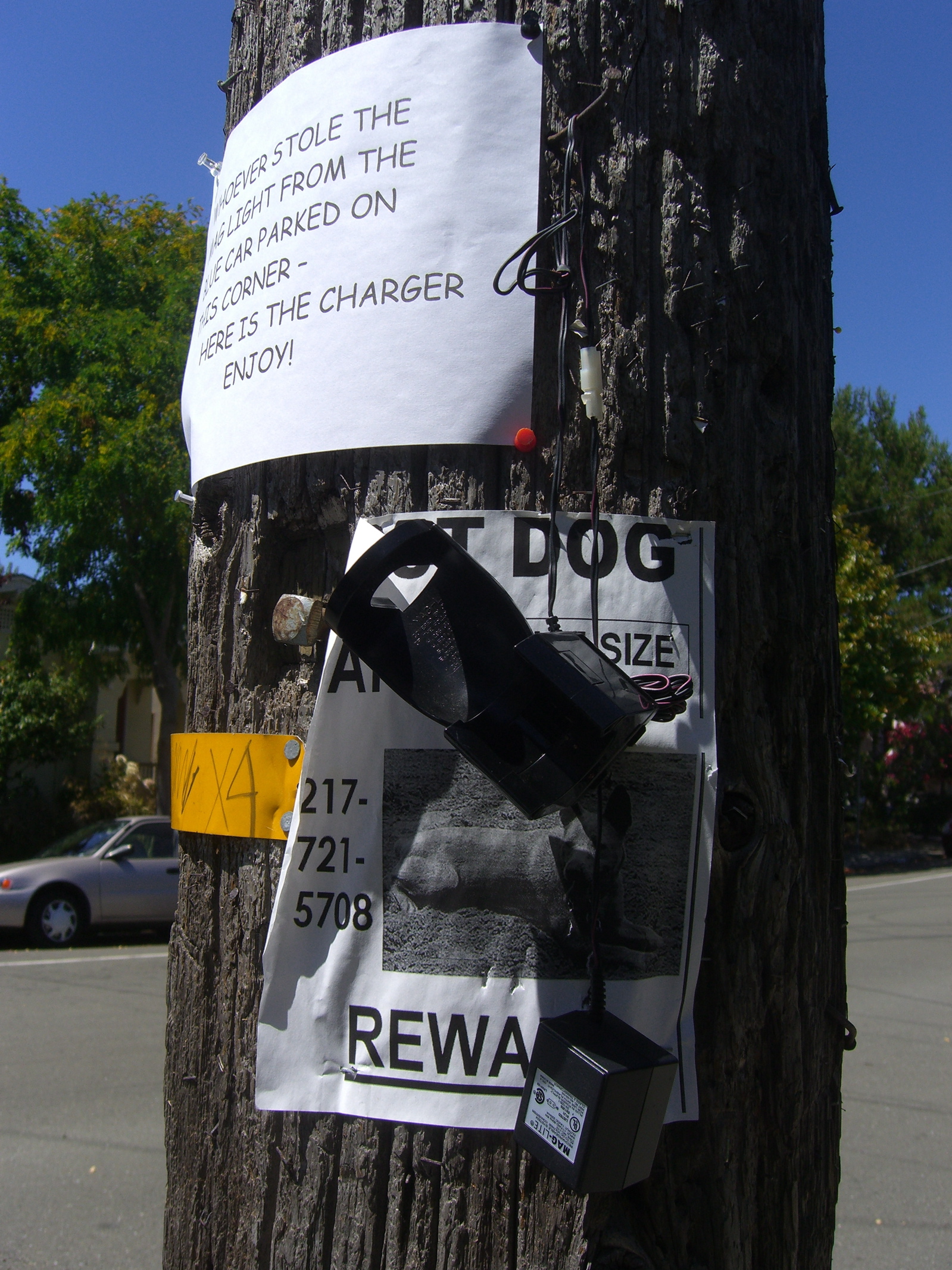
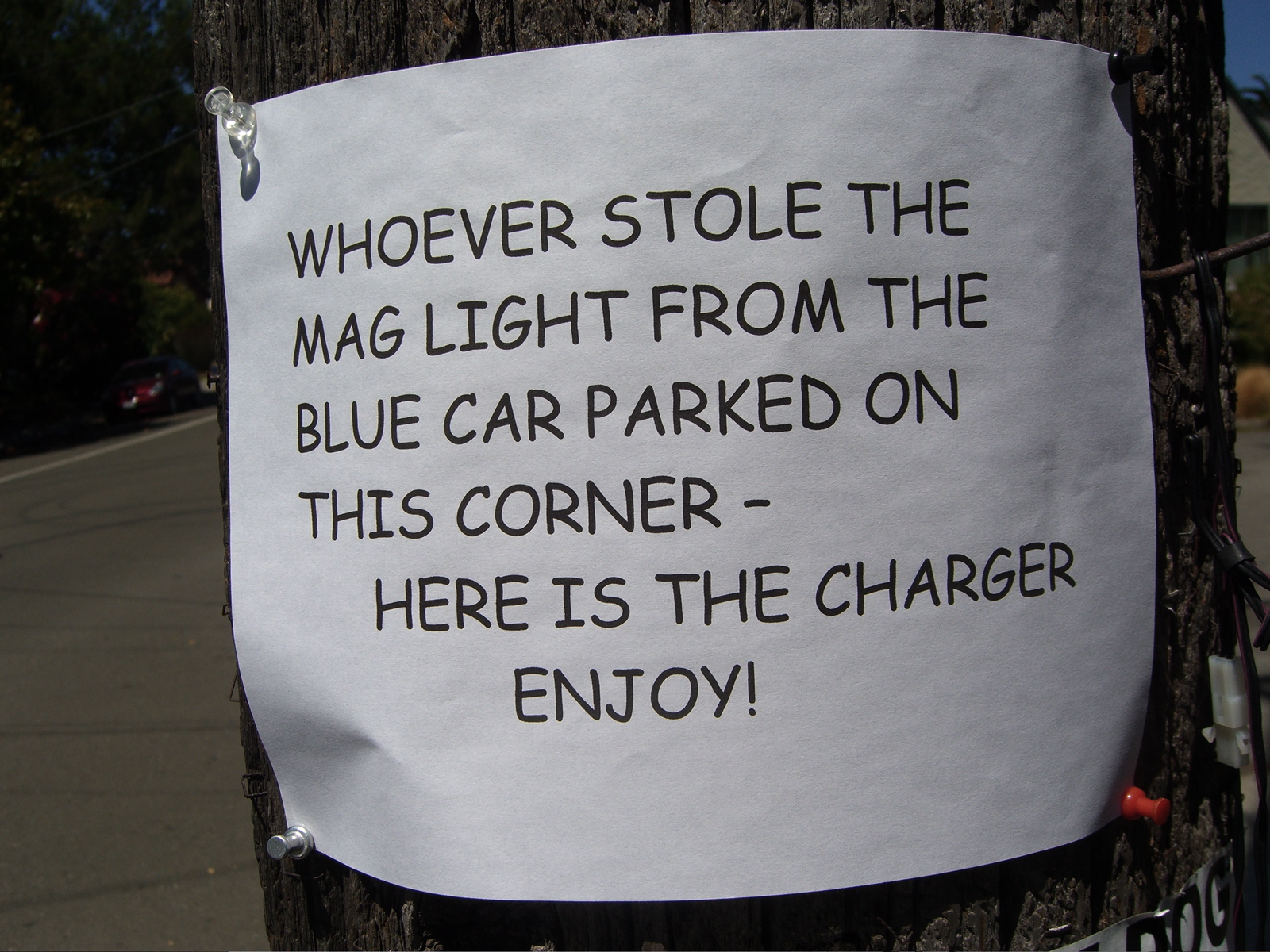
This is on the next street over from our place, of California Street at Jaynes. Not sure how long it has been hanging there. The message gets four stars on a scale of four, especially with the charger hanging there. I’m also taken by the font the aggrieved party has employed here–jaunty, but without detracting from the words’ impact. Henceforth, I’ll think of this typeface as Incensed Irony.
Technorati Tags: berkeley, berkeley crime
Man with Box

Going up 19th Avenue on the 28 Muni bus yesterday, a man got on carrying a long, haphazardly folded cardboard box. My guess is that it was his bed for the night. Without comment from the driver, he took a seat at the front of the bus, placing his box in the center aisle. The box extended across the feet or shins of several other riders; when those riders got off, the box blocked other people from taking their seats. When new passengers got on the bus, they had to gingerly make their way past the box; that proved to be a challenge for a couple of senior passengers who got on with walkers.
Still, the driver said nothing, and neither did any of the other passengers. The man, wearing a hooded UCLA sweatshirt, got off when we neared Golden Gate Park. My brother John, the New Yorker, took a look up and down the bus, and said, “What a tolerant bunch of people.” Heoffered the opinion that on buses or subways back home, the box would have prompted at least one “What the hell is this?” I can’t account for the scene on the San Francisco bus except to think people who ride Muni have probably seen it all and are past complaining or commenting.
Technorati Tags: muni, san francisco
Daily Adventure
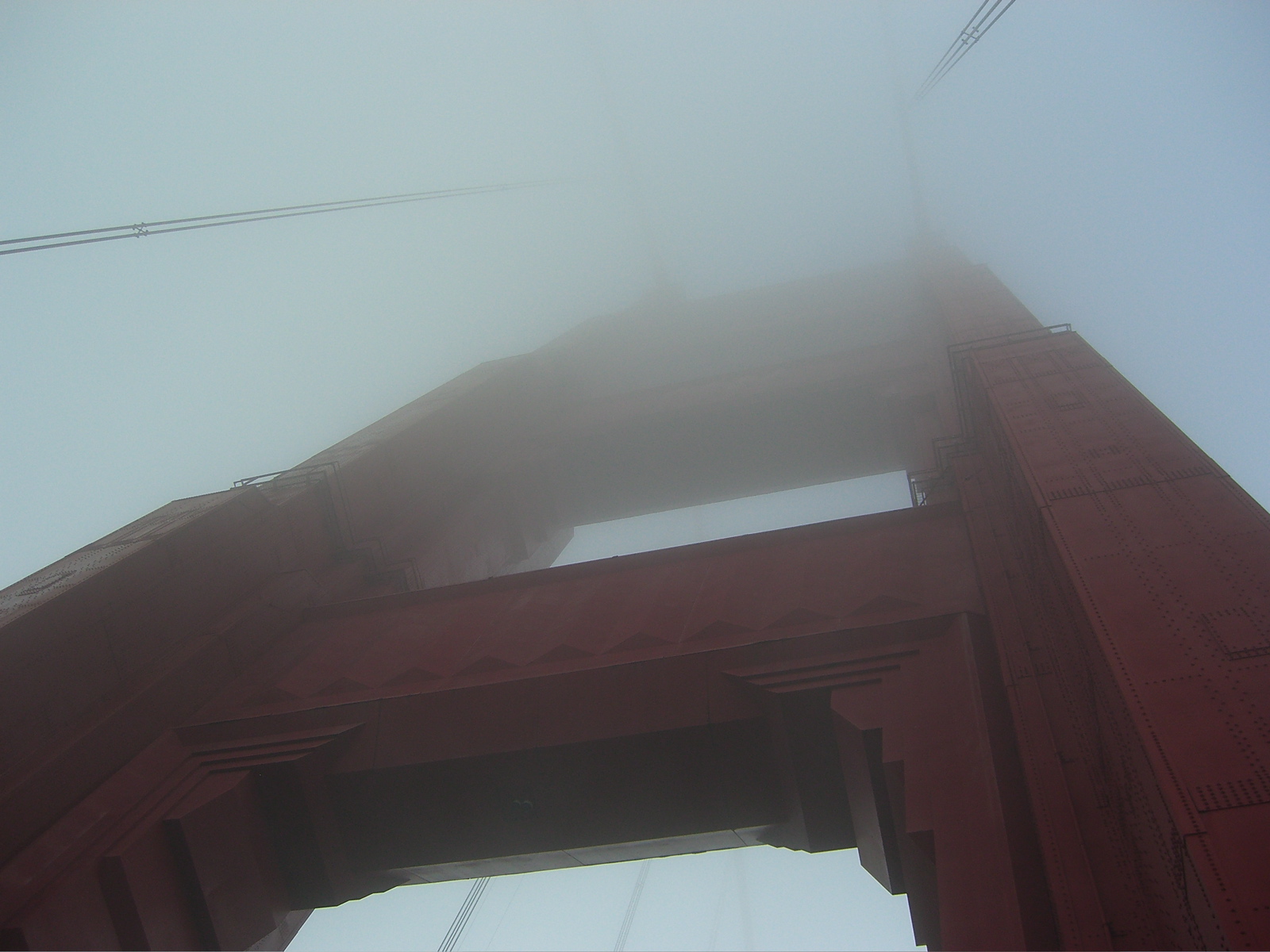
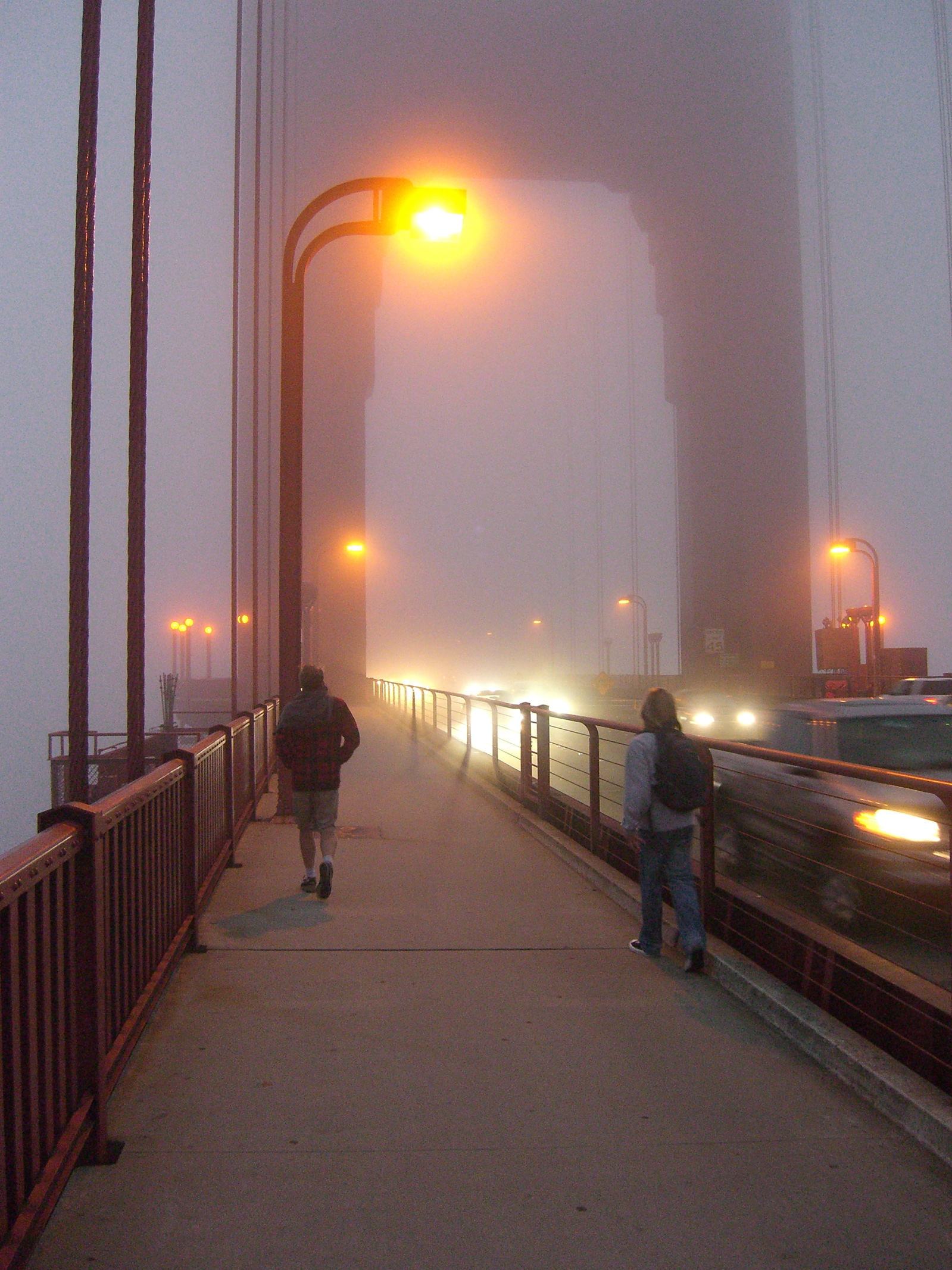
John and Sean’s last (full) day here on this visit. Late in the afternoon, we went on an expedition, via BART (to Daly City) and Muni (the No. 28 bus up 19th Avenue) to the Golden Gate Bridge. We could tell looking across the bay from Berkeley as we left that the bridge was fogged in. That’s typical for August. Then again, everything might be different after an hour or hour and a half train-and-bus ride. But when we got off the 28 at the bridge visitors center, the fog was so dense that even on the very edge of the bridge the towers were completely invisible. We walked across anyway. The foghorns were blasting from the base of the bridge. Dew rained from the cables. The traffic roared. We went over and back, and the light was unusual and beautiful the whole way. As we neared the southern side again, deep in the twilight and just 15 minutes before the walkway was closed to pedestrians for the night, the damnedest thing happened: it cleared up enough that we could see all the way across the bay to Berkeley and out through the Golden Gate to the remnants of the sunset. Then, after watching the skunks gamboling around the visitors center parking lot, we got back on the bus to BART and then home.
Technorati Tags: golden gate bridge, san francisco
Family Day in the Dump

My brother John and nephew Sean are visiting for a week. As honored guests, we’re taking them to all our favorite local spots. Such as the Albany Bulb–the abandoned landfill on the bay just north of Berkeley. It is part of a state park now and has long since become the haunt of dogwalkers, strollers, postmodern nature lovers, scrap artists, and pagan cultists of various light and dark stripes (to judge from some of the artifacts dredged up from or hauled down to the dumpland).
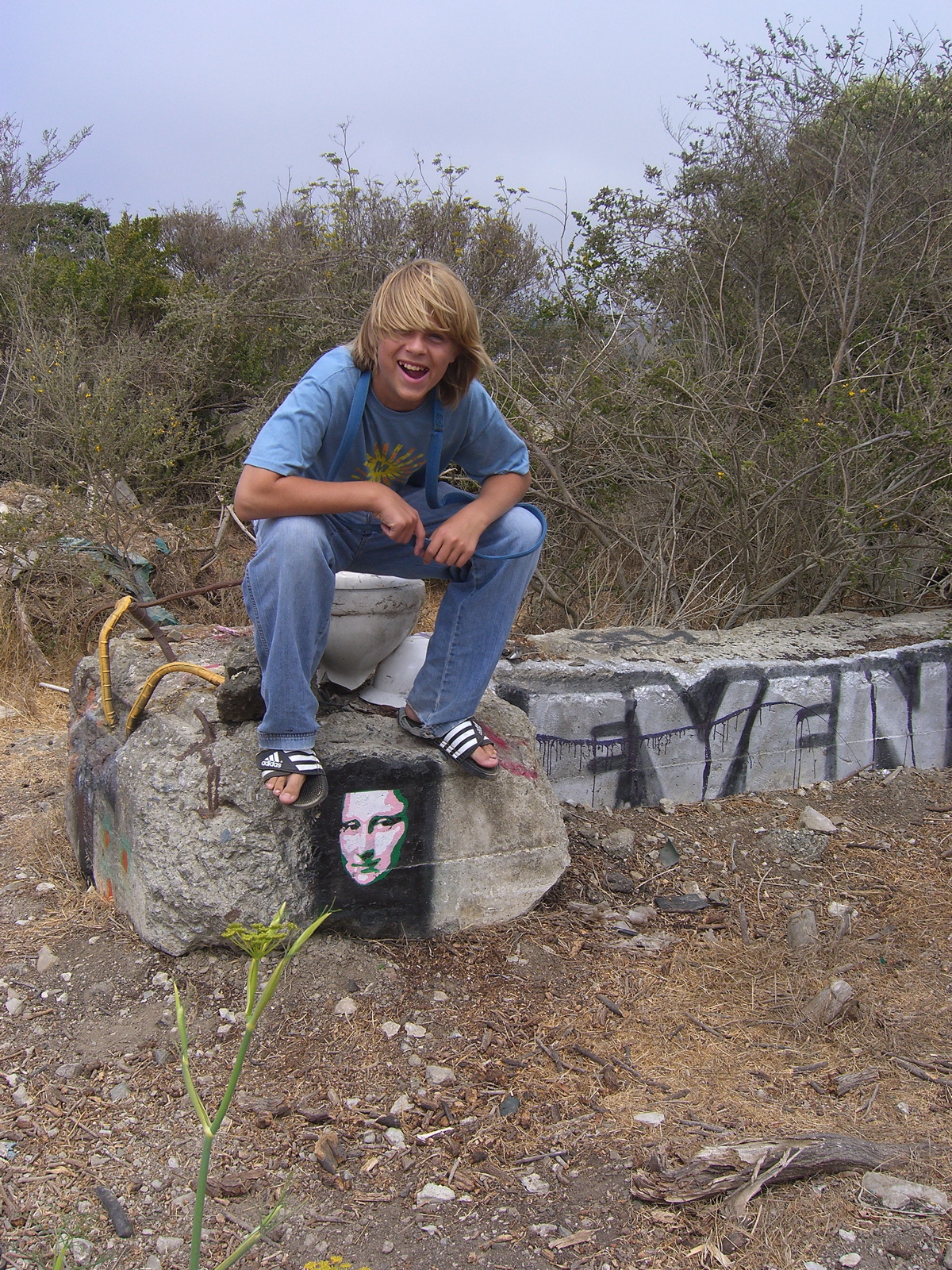
An artist (artists?) whose anonymous work we see down at the bulb stencils well-known images onto chunks of concrete: Amelie, the French movie character; Albert Einstein, theoretical physicist and pop icon; and Mona Lisa, Leonardo’s girlfriend. Down at the bulb Saturday, John and Sean got right into the spirit of the place. John spotted a piece of likely debris in the underbrush and placed it in suggestive juxtaposition to Mona Lisa; Sean then supplied a piece of performance art.
Technorati Tags: albany bulb
King Philip Came …
A couple of acquaintances–fellow dog owners whom we sometimes encounter up at the neighborhood middle school–both teach in the biological sciences at UC-Berkeley. This morning, one of them was complaining that incoming students don’t know some of the basics, such as the Linnaean taxonomy scheme (you know–the “genus/species” one that breaks down the world of living organisms into related groups). I’d have to plead guilty to that myself, though I’ve got some notion of how it works. Anyway, one of these teachers said there’s a well-known mnemonic aid for remembering the scheme and keeping its levels in order. It’s the phrase, “King Philip Came Over From Germany Stoned” (or alternately, “…Came Over From Germany Seeking Victory”). And the order the phrase prompts is: kingdom/phylum/class/order/family/genus/species/(variant).
Here’s an example of the scheme in action: the Pacific chinook (or king) salmon, also known as Oncorhynchus tshawytscha:
Kingdom: Animalia
Phylum: Cordata
Subphylum: Vertebrata
Class: Actinopterygii
Order: Salmoniformes
Family: Salmonidae
Genus: Oncorhynchus
Species: Oncorhynchus tshawytscha
A favorite trivia bit related to this name: Although we think of the chinook salmon as one of the great, emblematic, wild species of North America’s Pacific coast (and the name chinook originated with a Columbia River tribe) , the species name “tshawytscha” actually comes from a native word for the fish on Russia’s Kamchatka peninsula. European biologists first encountered the fish there in the 18th century (the species names for chum, sockeye, and pink salmon as well as for steelhead trout also have roots in Kamchatka or Russia).
Technorati Tags: salmon
More Advice from the Neighbors

We do “pick up after” our dog. But if I were to somehow not see The Dog take a dump after dark, or forget to bring a plastic bag with me, or suffer some other lapse of responsibility, I sure hope the pile would happen right under this sign. My antagonism toward this precious advisory isn’t rational, and I can’t really explain it. I suspect, though, that part of my feeling arises from the belief that the sort of people who put up notes like this wouldn’t give you the time of day if you passed on the street–unless it was to tell you that if you want the time, you should be careful enough to own and wear a watch.
The other day, I was walking The Dog when we approached a woman sitting in a lawnchair alongside the sidewalk. Her back was to us. The Dog was about 40 or 50 feet ahead of us. He passed Lawnchair Woman, and I approached. I got ready to say, “Hi, there,” which is my normal greeting to someone I meet in such circumstances. But as I approached, I heard her croak, “Six feet.”
Me: “What?” “Six feet. The city ordinance says you have to be within six feet of your dog.”
Discussing this later, I agreed with someone who has a much calmer demeanor than my own that the proper response to such an utterance is a simple, “Thank you.” After offering thanks, the proper course of action is to continue on your way and count yourself lucky that this person does not live next door.
I won’t recount what I actually said or what Lawnchair Woman said by way of retort. But it wasn’t “thank you.”