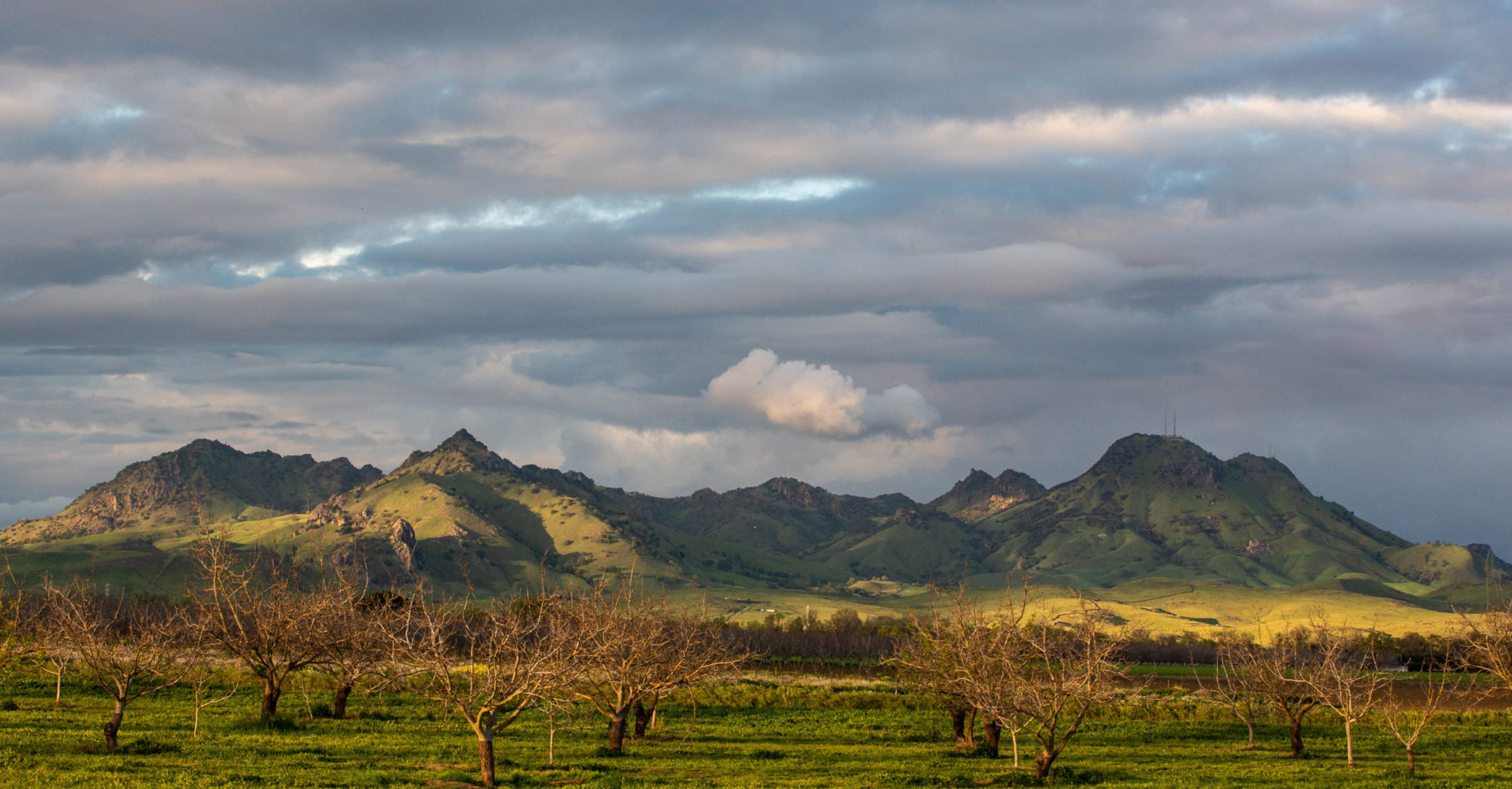

A shot across the street from our place, looking north on Holly toward and beyond Buena Avenue. A capsule summary: the lights seemed to stretch farther than ever tonight, and neighbors to the east of us shut down a block and had a communal dinner in the middle of the street. Lots of people were out walking, and lots of the walkers stopped by the table in front of our place for cider and baked stuff and stayed to talk. A special night. And a special day to come for all, I hope. Merry Christmas.
Luminaria 2011: The Cider

The Christmas Eve mulled cider is on (thanks to Kate). Apple juice, citrus, spices, and heat.
Luminaria 2011: Before the Lights

The neighborhood’s getting ready for tonight (“tonight” being this). Dozens of people over at our neighbor Betsey’s house, around the corner, getting luminaria bags and dispatching them via wagon and wheelbarrow all over the neighborhood. It’s still a surprising and amazing spectacle, even after seeing it year after year. (Pictured above: corner of Buena Avenue and California Street).
More later.
Some North Berkeley Flatlands Luminaria History
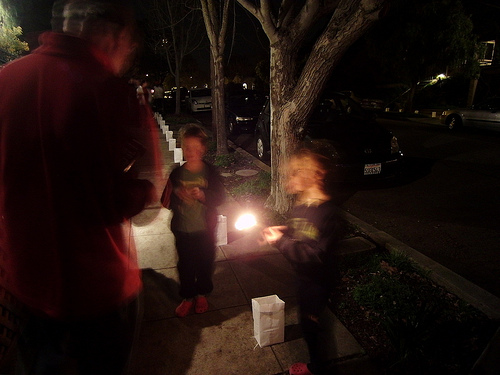
It’s almost that time again: Christmas Eve, the night of nights in our humble 99 percent neighborhood, where we express solidarity with all who celebrate light at this dark end of the year with–what? Paper bags, sand, and candles, also known as luminaria, luminaries, farolitos, and many other names that I am sure exist but have not yet come to my notice. Our one-night fete is the 24th, and this year will be the 20th time the neighbors here have gotten together to do this. Here are some posts from years past:
2010
Berkeley Luminaria: 2010 Edition
2009
‘Always on Christmas Night …’
2008
Luminaria Rainout
Happy Last of the Year
2007
Luminaria 2007
2006
Luminaria Streets
Hot Xmas Eve Bag Action
2005
Luminaria ’05: Pregame Report
Luminaria ’05: First-Half Action
Luminaria ’05: Second Half, Game Summary
Luminaria ’05: Maps
Morning-After Disassembly Line
2003
Luminaria
Dry December Update
“Rain, rain, rain, rain,
Why’d you cause me so much pain?”
—”The Rains Came,” Sir Douglas Quintet
Southern California got a little spritz of rain over the weekend—nearly a fifth of an inch yesterday in the desert town of Blythe. Here, it’s dry, and the California-Nevada River Forecast Center sees only a small chance that rain will fall over the northern part of the state in the next week (and that will be far north of the Bay Area). Our local National Weather Service forecast office, in Monterey, reads the models the same way: “Dry and mild weather will continue through at least the next 7 days … with little variation in the upper level weather pattern. A series of storm systems will move towards the region over the next week … but pass to the north and east of the area. ” The longer-range outlook from NOAA’s Climate Prediction Center is for drier and warmer than median weather.
Here’s the local NWS table on precipitation so far this year. And below that, today’s theme song
| Station | July 1-Dec. 18, 2011 | % of Normal | July 1-Dec. 18, 2010 | % of Normal | July 1-Dec. 18 Normal | July 1-June 30 Normal |
| SFO Int’l Airport | 2.87 | 50 | 5.76 | 101 | 5.69 | 20.11 |
| Oakland Airport | 3.06 | 52 | 6.66 | 113 | 5.91 | 17.42 |
| Mountain View Airport | 1.73 | 45 | 3.24 | 85 | 3.83 | 13.35 |
| San Jose Airport | 1.53 | 39 | 3.05 | 77 | 3.95 | 15.08 |
| Santa Rosa Airport | 4.45 | 42 | 13.19 | 123 | 10.70 | 31.91 |
| Salinas Airport | 3.31 | 103 | 3.45 | 107 | 3.21 | 12.91 |
| San Francisco Downtown | 3.35 | 47 | 7.88 | 111 | 7.08 | 22.28 |
Chicken Coop Portraiture

Among my many other claims to greatness, I’m currently the Mayor of Berkeley’s Edible Schoolyard Chicken Coop on Foursquare (I know–it’s hard to believe I’ve been able to fit so much into one short life). The coop is a regular stop on our Saturday morning perambulation through the neighborhood with The Dog; his attention focuses alternately on the chickens, who I imagine look like tasty friends, and the many squirrels chasing through an adjacent live oak. The chickens are fascinating to me, too–mostly in that this group (about 15 chickens and two or three ducks) has, notwithstanding the occasional expiration, appeared to stay so healthy for so long.
Hey, Rainmaker
A dry summer, and then comes the fall
Which I depend on most of all.
Hey rainmaker can you hear the call?
Please let these crops grow tall.—The Band, “King Harvest”
We had some rain overnight–just enough to keep the dust down, if there had been any dust (we did have plenty of crap in the air, though: a miasma of car exhaust, smoke, and other metropolitan exhalations that led the regional air district to ban wood fires for four days in a row). The “storm” total in San Francisco for the rain that started falling last night is .04 of an inch–four-hundredths–and according to the National Weather Service is the first rain since we got .21 of an inch on Thanksgiving.
Meantime, continuing my claim to be the first in my neighborhood to express precipitation anxiety this year, the state Department of Water Resources and its California Data Exchange Center are out with their latest summary of hydrologic conditions for the state. Here’s my summary of their summary: November 2010 was wet, November 2011 was dry. Or in the summary’s own machete-proof prose:
On November 30, the Northern Sierra 8-Station Precipitation Index Water Year total was 6.5 inches, which is about 70 percent of the seasonal average to date and 13 percent of an average water year (50.0 inches). During November, the total precipitation for the 8-Stations was 2.6 inches, which is about 41 percent of the monthly average. Last year on November 30, the seasonal total for the 8-Stations was 15.5 inches, or about 167 percent of average for the date. On November 30, the San Joaquin 5-Station Precipitation Index Water Year total was 4.0 inches, which is about 59 percent of the seasonal average to date and 10 percent of an average water year (40.8 inches). During November, the total precipitation for the 5-Stations was 1.5 inches, or about 32 percent of the monthly average. Last year on November 30, the seasonal total for the 5-Stations to date was 14.4 inches, or about 212 percent of average for the date.
Of course, one or two good drenchings will make all this early-season anxiousness go away.
Related:
It’s December. Do You Know Where Your Rain Is?
KQED: California Reservoir Watch
Lights, With Moon Riding Shotgun
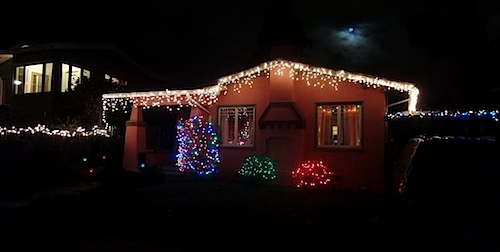
The manse on Holly Street, in (nearly) full holiday regalia, with the moon riding shotgun in the clouds.
Curbside Eclipse

This morning’s lunar eclipse, shot across the roof of a house across the street. Not many this morning trod the frosty street, to paraphrase Dylan Thomas, but when Kate and I went out to watch, about 6 o’clock, we heard voices of a couple of neighbors down the block. So we had a small viewing party, five of of us in all plus The Dog, conducted (for me) without the intervention of caffeine. Now we’re back indoors, the sun’s coming up, and I’m going back to bed.
Here’s the slideshow, with good shots and bad and a few that put the one above in neighborhood context:
It’s December. Do You Know Where Your Rain Is?

It’s December now in the Bay Area, and if you’re fastidious about your weather expectations, you look out the window and want to see rain. Or at least a little gray. But in the wake of the little wind event of the past couple of days, what I see out there is a sparkling azure sky without a hint of a cloud.
Our climate is mostly dry from sometime in April to sometime in October, mostly wet from October to April, except when it’s not. And when it’s not, we’ve got trouble. Yes, things in the cities are beautiful, and when you turn on the spigot, water from somewhere magically appears. But you know that somewhere–up in the Sierra, out in the Valley–things aren’t so good. There won’t be enough mountain snow to help replenish the reservoirs in the spring. The farmers will want water they cannot get. The fish and wildlife that depend on an abundant flow of water through the Delta, species threatened because for decades they were last in line when people thought about how to spend the water we bank, will suffer. The edge to the anxiety comes from the knowledge that drought happens here, and drought can become a social and political as well as a natural and environmental mess.
Feeling nervous yet? I am. I follow Jan Null, a Bay Area meteorologist. Here’s his climate summary for last month:
November 2011 was a cool and mostly dry month across California. Monthly average maxima anomalies were -1.0 (San Jose) to -3.6 degrees (Los Angeles), while monthly mean anomalies were -0.8 to -2.3 degrees. North of the Tehachapis rainfall was well below normal ranging from 28% of normal (Sacramento) to 69% (Eureka) while Southern California was quite wet with Los Angeles and San Diego at 152% and 309% of normal respectively.
Sometimes, to reassure myself that all will soon be well, I might take a spin through weather and climate sites to see what the professionals are saying about the forecast. That image to the right is a graphic of the Quantitative Precipitation Forecast from the California Nevada River Forecast Center. During a wet period, the map will be a glorious swirl of color–blue and green and yellow, depicting progressively heavier precipitation, and sometimes orange and splashes of red and magenta when it’s really wet (there’s a scale at the top of the map; click on the image for a full-size version). Gray, on the other hand, means dry. No rain in the lowlands. No snow in the uplands. No reassurance.
Next, here’s how one of the meteorologists down in the Bay Area National Weather Service office in Monterey sums up the coming week in the Area Forecast Discussion (using familiar all-caps weather advisory style):
DRY WEATHER LOOKS TO BE IN STORE FOR THE DISTRICT SUNDAY THOUGH NEXT WEEK. HOWEVER…THE MODELS ARE STARTING TO SHOW SOME DIFFERENCES. THE ECMWF KEEPS A STRONG RIDGE ALONG 135W STRETCHING INTO THE GULF OF ALASKA WITH A STRONG SHORTWAVE DIVING DOWN THROUGH THE GREAT BASIN LATE THURSDAY INTO FRIDAY. THIS SCENARIO WOULD BRING ANOTHER BOUT OF GUSTY OFFSHORE WINDS. THE GFS WEAKENS AND FLATTENS THE RIDGE BY THE END OF NEXT WEEK…WITH A SHORTWAVE MOVING INTO THE NORTHERN PLAINS NOT DIVING SHARPLY SOUTHEAST. THIS WOULD NOT BE A WINDY SCENARIO FOR THE DISTRICT. REGARDLESS OF THE MODEL…DRY WEATHER IS IN STORE THROUGH THE END OF THE NEXT WORKWEEK.
Got that? The major question the weather persons are dealing with is whether or not the forecast models indicate another windstorm for the coming week. Chances of rain–none apparent.
The pluviophile now turns eyes to the coming month, even though we’re exiting the realm of forecasting and prediction and entering into one of probabilities and outlooks. But here goes: The National Weather Service Climate Prediction Center says the Bay Area should have “near median” precipitation in the period from eight to 14 days from now (median in this case meaning rainfall along the lines of the “middle 10 years” of the past three decades in terms of rainfall); the northern quarter of California is looking at below-median rainfall during that period. The center’s one-month outlook shows equal chances of above, below, or near median precipitation. That’s because “there were no strong and consistent climate signals” among the forecast models.
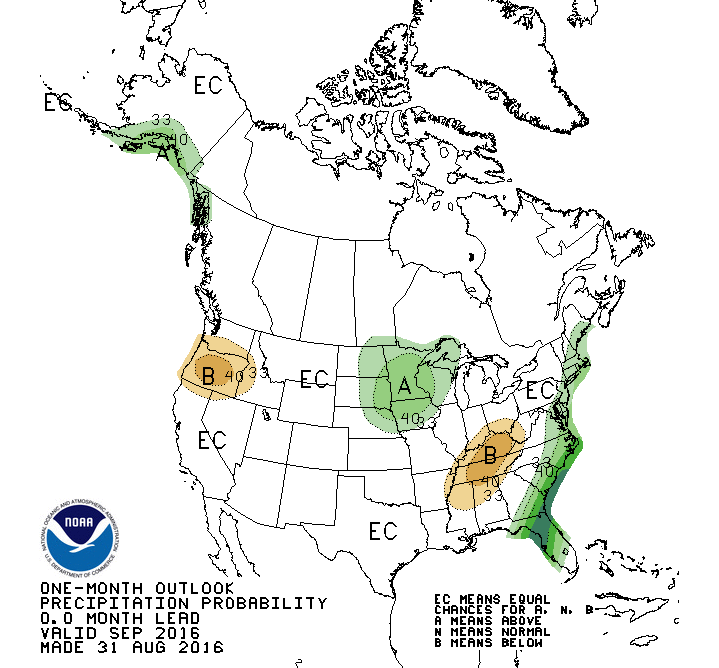
And one last stop: Both the most recent U.S. Drought Monitor report and the seasonal outlook, through the end of February, show California drought-free (things look scary in Texas, though).
So where’s the rain? Like that TV show used to say: Out there. Somewhere.