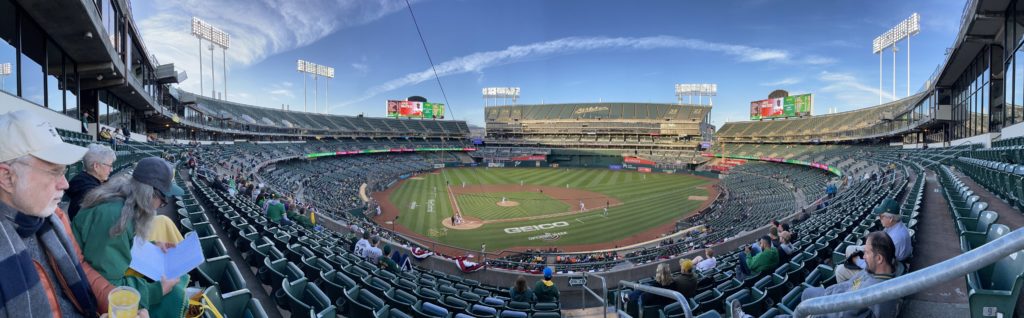
Ballpark attendance isn’t one of the pressing issues of our times. Yet, as a fan who has always watched the numbers — I think the last time the Chicago Cubs drew less than 1 million fans, which used to be some kind of yardstick of, well, something, was 1966, and it made an impression — the story of Major League Baseball in Oakland is perversely fascinating. I won’t go into all the reasons right now the home team, the Athletics, are such a lousy draw. But a lousy draw they are. Tuesday night games are especially lightly attended, and given recent trends, I figured that maybe 5,000 people would show up for the unmesmerizing non-spectacle of the A’s playing the recently very dreadful Baltimore Orioles. But my expectations had been set a little too high. The reported attendance was 3,748, perhaps the smallest crowd I’ve been a part of in more than 40 years of attending games at the Coliseum. Those who made it to the ballpark did get to spread out and enjoy a beautiful evening, pictured above, and see the home team win, if that’s what they were hoping for.
Doing impromptu research on railroad mayhem of yore — unwary yard workers and pedestrian getting their feet caught in frogs and then run over by trains and the like — I found myself looking through old, old numbers of the long dead but still remembered Berkeley Gazette.
For a town that had maybe 10,000 people in the mid-1890s, Berkeley seems to have more than its share of dreadful rail episodes. The Gazette did not hold back on details, though it sometimes illustrated an odd sense of priority (no, not propriety) in how it ordered its facts.
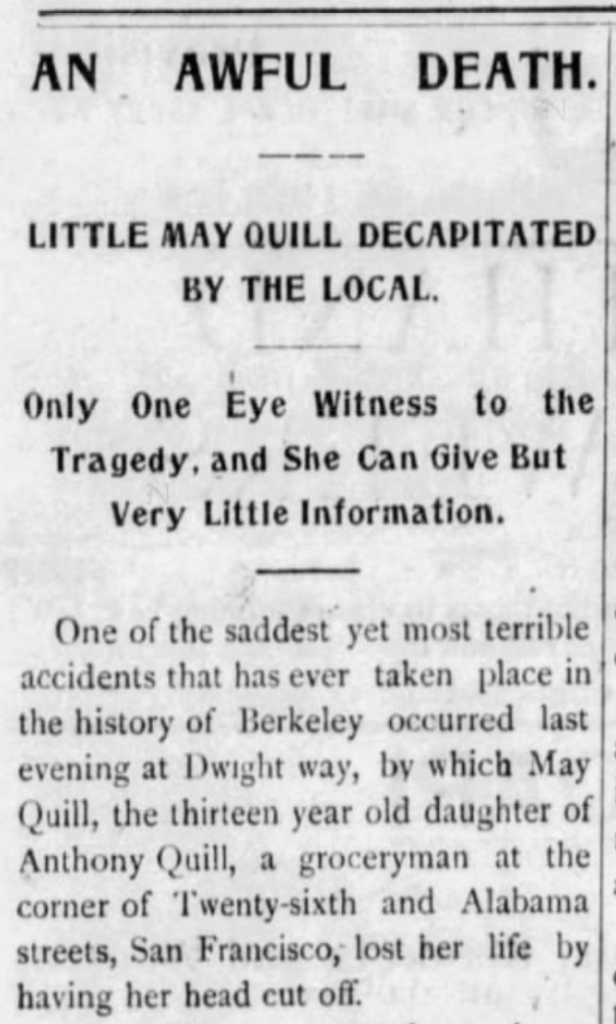
Only One Eye Witness to the Tragedy, and She Can Give But Very Little Information.
One of the saddest yet most terrible accidents that has ever taken place in the history of Berkeley occurred last evening at Dwight way, by which May Quill, the thirteen year old daughter of Anthony Quill, a grocery man at the corner of Twenty-sixth and Alabama streets, San Francisco, lost her life by having her head cut off.
I know the style of the day was to provide layers of detail in the descending series of headlines and subheads above the story, but I can’t help but admire the writers and editors who managed to work in the employment details of the victim’s father in the lede without touching on how the victim suffered her gruesome injuries.
Here’s how the San Francisco Call of the same date, on page 11 under the heading “Interesting Report of Up-to-Date News Items From Alameda County”:
Awful Death at Berkeley.
Young Girl Crushed Under the Wheels of a Local Train.
Was Killed Instantly.
The Wheels Passed Over Her Neck and Severed the Head from the Body.
There Was But One Witness.
Little May Quill the Victim—The Train Went on to the Next Station—Who Is to Blame?
Berkeley, Cal., Feb. 16.—May Quill, a girl of 13 years, who lives with Mrs. Michael J. Powell at the corner of Magee [sic] and Allston way, Berkeley, was instantly killed by the 7 o’clock south bound local train this evening while attempting to alight from it near Dwight way station. The wheels passed over her head, completely severing it from her body and crushing it beyond description. No other injuries to her body were sustained save a few bruises. Her clothing was not even tattered.
(Brutally explicit descriptions of streetcar victims seems to have been a specialty for the Call. Here’s how it described a 1906 incident in which a teenage girl was struck by a car at Mission and Third streets in San Francisco: “Mowed down by the thirty-ton juggernaut, her body was churned round the forward wheels and mangled so frightfully that it became almost welded to the [car] and could not be removed for more than an hour. When it was finally recovered the appearance it presented unnerved the great gathering that had watched employees of the United Railroads working round the car with primitive wrecking apparatus, and heads were turned away as it was borne to the Morgue wagon.”)
I see regular reports about rail deaths in the Bay Area today — mostly involving BART and Caltrain. The prevailing presumption is that most of these cases involve people taking their own lives. BART generally describes these incidents only as “major medical emergencies.” Perhaps the next day, BART police will refer to the incident by saying that they responded to “a report of a person under a train” and adding that the local coroner was called to the scene.
I often feel like those reports are overly sanitized and we ought to know more about the circumstances. How much more? Well, enough to have some insight into whatever the authorities know about the circumstances. The further gruesome details so frequently printed at the turn of the 20th century — no, I don’t need those. But those old accounts do make me wonder about the public appetite for that kind of reporting back then and about how sensitivities appear to have changed so much, at least in some respects, today.
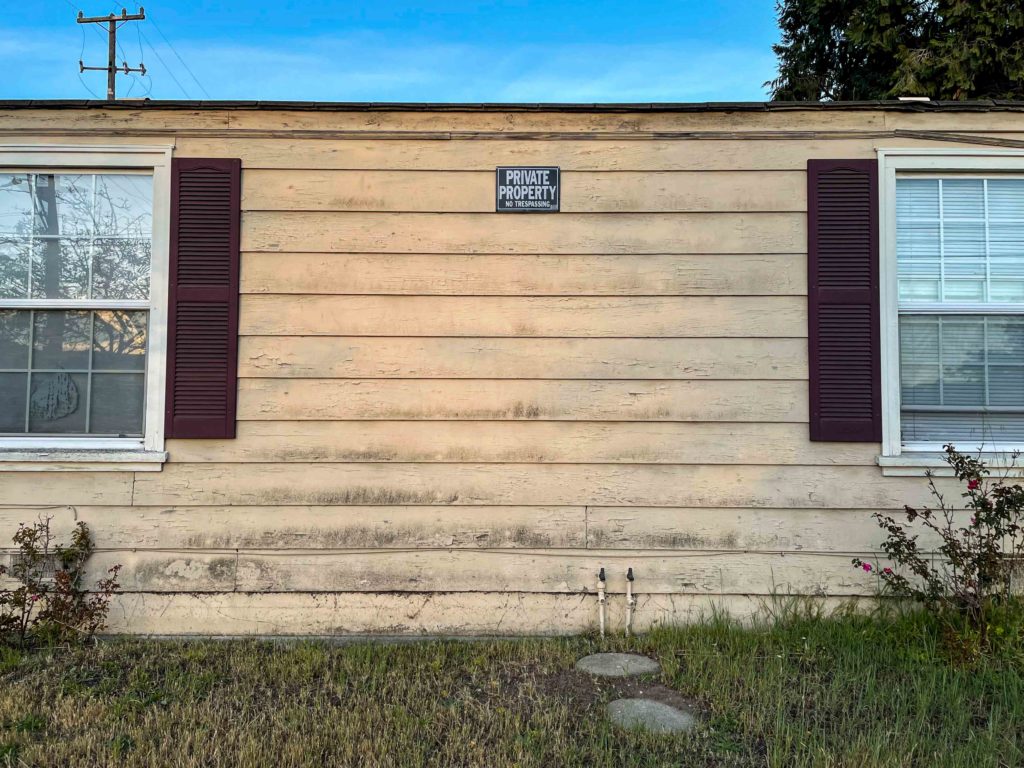
I’ve been walking past this place for years, a house on the corner of Fifth Street and Allston Way in West Berkeley. I’ve always been struck by the place’s battered look and the declaration that it’s private property. I’m kind of wondering whether this is a warning to would-be trespassers or an announcement of principle. In Berkeley, you never quite know.
Mrs. B— not her real name — has been a schoolteacher for some time. She’s retired from full-time work, but continues as a science curriculum consultant, as a substitute and as a volunteer for a very program called Trout in the Classroom.
The program is the work of Northern California conservationists and fishing groups and teaches about one of the native wonders of our state, the rainbow trout,Oncorhynchus mykiss. The program distributes specially prepared fish tanks and other equipment to classroom and delivers rainbow trout eggs. The kids get to study the fish as they emerge from the eggs and grow just big enough over a couple months to release in local lakes. (Given the state of some of our urban East Bay lakes , sometimes that doesn’t seem like such a great deal for the baby trout. But I guess Nature and Science Education have a plan.)
The other day, Mrs. B was at a nearby school where she was helping an elementary grades science teacher set up her trout tank. When she was done, she was invited to stay for lunch, and she did that.
She went and asked a group of second- and third-graders if she could sit at their table. “Oh, sure,” they said. “We’re just talking about the war in Ukraine.”
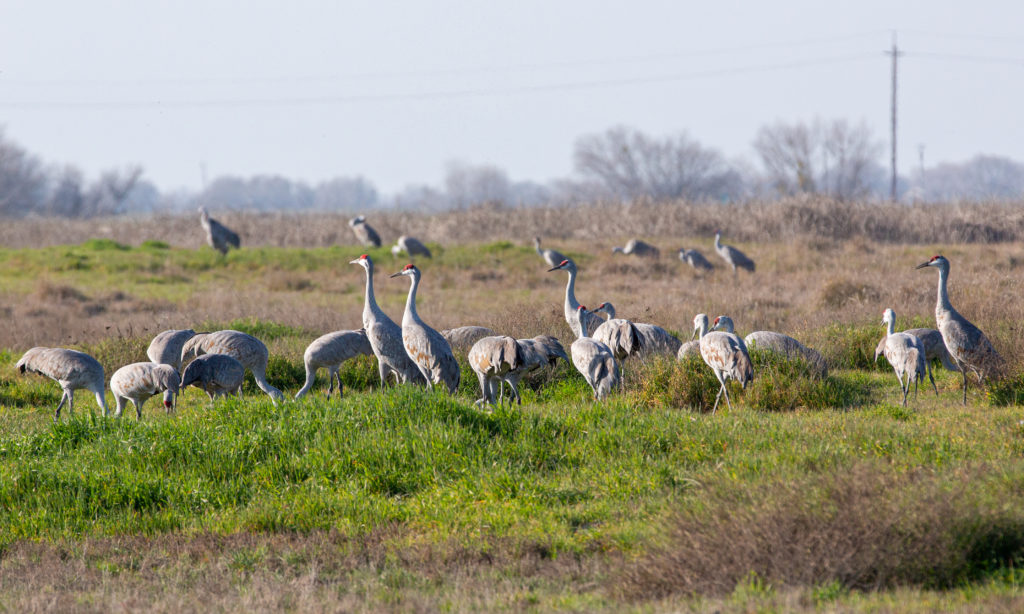
Sandhill cranes at Merced National Wildlife Refuge. February 14, 2022.
We spent last weekend in the San Joaquin Valley looking at birds. Thousands and thousands of birds — snow geese and white-fronted geese, shovelers, pintails and teals, killdeer and meadowlarks, avocets and ibises, stilts and wrens, red-winged blackbirds and red-tailed hawks, tundra swans and sandhill cranes.
Part of the experience of entering into the world of the birds is the sound. Actually: part of the experience? Visiting these places where tens or hundreds of thousands of migrating birds have gathered is mesmerizing, electric, sometimes overpowering, utterly enveloping and at moments gives a hint of what this place we live was like before we began the project of radically reshaping it.
Here are three snippets of that sound. The first is from Super Bowl Sunday, when Kate and I found ourselves virtually alone — except for the birds — in the 10 square miles of the Los Banos National Wildlife Refuge. After that clip are a couple from the Merced National Wildlife Refuge — the crazily energetic stylings of a marsh wren and a surprise overflight of about 300 sandhill cranes at midday on Valentine’s Day.
I insist I don’t spend a lot of time in cemeteries. But when I do, I’m always conscious of the capsule histories that many grave markers contain. I tend to notice children’s graves a lot, maybe because my brother Mark died at age 2, an event that I remember vividly. Occasionally, you come across what looks like a family story — like the grave we once spotted that is marked as the final resting place of three people named Mary Dahl — a mother and two of her daughters who all shared the name.
During a visit to Chicago several years ago, I went over to Mount Olive Cemetery, where my dad’s parents and many members of his extended family are buried. It’s a beautiful green place in the summer, and you can see that nature will have no problem taking back the property once someone skips mowing the grass for a few years. The older, heavily Scandinavian sections of the cemetery have lots of markers that have shifted askew or fallen, and I always wonder whether there’s any family left to visit these long departed forebears.
On this particular visit, I was stuck by how many graves declared a relationship: father, mother, husband, wife, daughter, son, sister, brother. One of the markers I spotted was unique: “Wife and Baby,” it says. Not “Wife and Daughter” of “Mother and Daughter.” Both had died in 1906, and the child was just five months old. I snapped a picture and later, having taken note of the names and dates, tried to find out what had happened.
“Carrie A. Dunham,” listed in the Chicago Tribune’s Feb. 28, 1906, “Official Death Record” column (p. 9).
“Ebba C. Dunholm,” listed in the Chicago Tribune’s May 22, 1906, “Official Death Record” column (p. 10).
I can’t say I found out much beyond the fact that no two people, including the person put in charge of engraving a substantial and expensive headstone, agreed on the spelling of the family name.
The stone itself says “Dunhom,” as you can see — but that surname doesn’t appear anywhere in genealogical records or in Chicago phone books from this period (though losts of people didn’t have phones in this era). The name used in the “Official Death List” published in the Chicago Tribune several days after Carrie A. “Dunhom” died in February 1906 is “Dunham.” That agrees with a Cook County death index record that lists her full name as Carrie Anderson Dunham and adds that she had been born in Norway in 1883.
As to Carrie’s daughter, she is listed in the Tribune’s death list as Ebba C. Dunholm. Again, there are no Dunholms or Dunhoms in other records. Again, there’s a Cook County death record that uses the surname Dunham — but lists her given name as Effa. One guesses that there were serial transcription errors that led to all these different renditions of the name. It’s impossible to figure it out without disappearing down some rabbit hole, and I’m not sure you’d be able to sort it out even then.
But I do wonder about the “husband and father” who presumably had this headstone placed. Presumably he had some idea of how he wanted the name spelled. I can’t find any record of him though — no marriage record, no birth record for the daughter. I hope whoever carved the stone rendered it just the way it was handed to him. That, at least, would have been some comfort to the mourner.
From a 2013 Werner Herzog interview with the magazine 032c. This has been sitting for years as an unfinished (or should I say barely begun?) post. I was taken with his description of how he was determined to work out how pre-industrial humans had managed to erect immense stone monoliths in Brittany.
Herzog: “Fitzcarraldo” came to me when I was in Brittany looking for a storm-tossed coastline setting for another film. I slept in cars on the trip, or broke into vacation homes with surgical instruments.
Q.With a lock pick?
Herzog: No, no, you can only use those for old-fashioned locks. For a security lock you need two fine, needle-like instruments. In any case, it was evening near Carnac as my headlights suddenly hit these menhir. There were over 4,000 menhirs, weighing up to 600 tons; they were dotted up and down the hills of the landscape. It was as if I had been struck by lightning and I slept on the edge of the menhir field. The next morning, when the tourist shop opened, I bought a brochure. It said that only extraterrestrials could have made them. I thought, what complete and utter nonsense; I will only leave this place when I know, as a Stone Age man, how I would have carried these stones across the land and erected them. Within a day I had a solution – ultimately that was the same technique used in “Fitzcarraldo” to get the boat over the mountain, with ropes and pulleys.
Q.That’s where the film came from?
Herzog:That was one part. This question completely captivated me: How can I move a thousand tons over land? Later, a friend in Peru told me about a rubber baron who had 4,000 slaves, a billionaire who drowned in a boating accident at 35. It sounded boring. The friend had almost left when he opened the door one last time and said: “Incidentally he dismantled an ocean liner into hundreds of parts and managed to travel via an isthmus to another river system, which wasn’t passable further upstream because of rapids. That’s how he was able to get a huge rubber territory for himself.” I knew then, that’s “Fitzcarraldo,” and he has to get a ship over a mountain. Overnight the entire film was there.
bSandhill cranes at San Luis National Wildlife Refuge
The title overpromises. Here’s just one bird in review from a weekend in the valley: the sandhill crane, Antigone canadensis. Among many other things one might write about the bird is the fact the original English common name assigned to these creatures in the mid-18th century was “the brown and ash-colour’d crane.”
Where can you see them? Over the late fall and winter, we’ve encountered them at several wildlife refuges: Llano Seco (near Chico), Cosumnes, Merced, and San Luis. There were small groups at most of these places when we visited. At Merced, we saw thousands.
More sandhill crane lore (and birds to be reviewed) later.
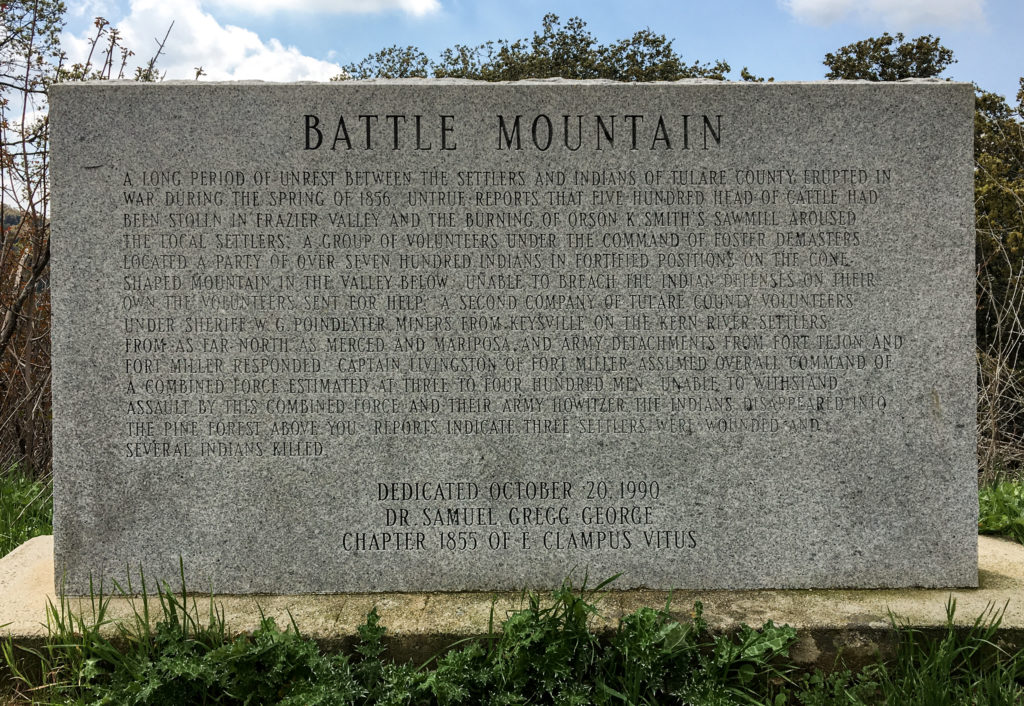
Battle Mountain historical marker, Tulare County, California (see text below).
Kate and I encountered the marker above a few years back while driving on a back road in the southern Sierra Nevada foothills. The text is hard to read, but it’s transcribed in full below.
Battle Mountain
 A long period of unrest between the settlers and Indians of Tulare County erupted in war during the spring of 1856. Untrue reports that five hundred head of cattle had been stolen in Frazier Valley and the burning of Orson K. Smith's sawmill aroused the local settlers. A group of volunteers under the command of Foster DeMasters located a party of over seven hundred Indians in fortified positions on the cone-shaped mountain in the valley below. Unable to breach the Indian defenses on their own, the volunteers sent for help. A second company of Tulare County volunteers under Sheriff W.G. Poindexter, miners from Keysville on the Kern River, settlers from as far north as Merced and Mariposa, and Army detachments from Fort Tejon and Fort Miller responded. Captain Livingston of Fort Miller assumed overall command of a combined force estimated at three to four hundred men. Unable to withstand assault by this combined force and their Army howitzer, the Indians disappeared into the pine forest above you. Reports indicated three settlers were wounded and several Indians killed.
 Dedicated October 20, 1990
Dr. Samuel Gregg George Chapter 1855 of E Clampus Vitus
When it comes to roadside markers, the easiest thing in the world to do is pick apart their abbreviated rendition of past events. There is no way that even a relatively prolix text, such as the one on this marker, can convey much in the way of detail or nuance. Too bad they don’t contain hyperlinks, though now that I’ve had that thought: QR codes. You know: “To read more about the Chicago Fire, or the Haymarket Square affair, or the assassination of Mayor Carter Harrison, scan this code.” (Yes, I know there is history outside my native city.)
So perhaps the highest and best functions of these markers is to awaken someone’s interest to past events and send them looking for more. I know that’s what happened five years ago when I was driving around Oroville, a town that had been evacuated because of fears that part of a dam would give way, and happened across a marker commemorating Ishi.
As I wrote at the time, “Ishi is an instantly recognizable name for those who have spent any time in California. Ishi is the legendary last member of his native tribe, the Yahi. In 1911, he was ‘discovered.’ Meaning: starved and alone, he gave up his home country in the foothills on the northeastern side of the Sacramento Valley and entered “civilized” California.”
Here’s what Ishi’s plaque says:
The Last Yahi Indian
For thousands of years, the Yahi Indians roamed the foothills between Mt. Lassen and the Sacramento Valley. Settlement of this region by the white man brought death to the Yahi by gun, by disease, and by hunger. By the turn of the century only a few remained. Ishi, the last known survivor of these people, was discovered at this site in 1911. His death in 1916 brought an end to Stone Age California.
“His death brought an end to Stone Age California.” An entire people, an entire world, dispatched in one succinct sentence. But stumbling upon the plaque prompted me to finally read a well-known and unwittingly tragic account of Ishi’s life and final years, “Ishi in Two Worlds.” It’s a story I think of often as a reminder of how complex the history around us is and how little I know.
But back to Battle Mountain. What to make of this marker, erected in 1990 by a society dedicated to the lore, if not always the true history, of old California? There are some details in the account that don’t smell right. One I wondered about was the notion that a force of white volunteers encountered “over seven hundred Indians in fortified positions.” The concluding line about casualties — three white settlers wounded “and several Indians killed” also sounds vague and sanitized.
What do other sources say?
Wild West magazine recounts the battle as part of “The Tule River War.” That account suggests a much higher casualty count among the Native Americans — members of the Yokuts group of tribes who also faced some ugly post-battle repercussions.
The Last “End of the Tulare War.’— We have frequently had occasion to remark that the accounts of Indian hostilities, not only in the north, but in the south, are almost invariably exaggerated. A small affair is soon magnified into a battle, and the origin is not unfrequently attributed to Indian outrages, when the account should read “white man’s oppression.” The following extract from a private letter written to a gentleman in San Francisco, from a friend at Fort Miller, and bearing date the 25th of May, is the latest, and it may be one of the most truthful accounts from that quarter:
“The Indian war is defunct. The volunteers from this place have returned, swearing most roundly at the [white] Four Creeks people, whom they term Petticoat Rangers, from a kind of armor made with canvas padded with cotton, which they wear in shape of a frock or blouse around their persons for protection. The whole matter has been a cowardly farce, the threatening legions of Indians turning out to be but about one hundred, seeking refuge in a brush from the rowdies, who, on the least occasion, delight in the sport of shooting them.
“As in all cases of the kind, the fault has been with the whites. The herds of cattle said to have been stampeded, have turned out to be a single calf taken to supply the deficiency of meat during an Indian feast. Retaliation, of a brutal character, for this trifling offense, created all the disturbance.”
There are plenty of other newspaper accounts of the “war” published around the same time. Some contend the tribe’s “depredations” warranted a violent response, but most seem to have held to the view that the initial provocation — the “theft” of a small number of cattle during a time of starvation — served as a pretext for wanton killing of indigenous people wherever they were to be found in the area. It is not a unique story. But it’s disappointing that such a credulous mid-19th century narrative made its way onto a marker placed at the end of the 20th century.
“He was almost always mentally irritated. The slightest flaw, real or imaginary, in his companions’ statements, caused in him intellectual indignation of the most intense kind. And there seemed to be something in him which took it for granted that anything said by anybody except himself needed immediate denial or at least substantial modification.”
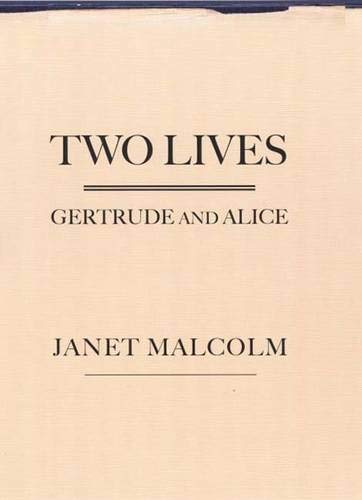
That’s in Janet Malcolm’s “Two Lives: Gertrude and Alice,” in a passage describing Gertrude Stein’s brother Leo. Gertrude and Leo had a falling out driven by Leo’s conviction that his sister was “basically stupid” but had won literary acclaim and celebrity through a combination of clever artifice, self-admiration and self-assurance. The only reason I’m mentioning it here is that sometimes you come across a description that holds up a mirror to one of your less attractive qualities. “Always mentally irritated … intelllectual indignation of the most intense kind … anything said by anybody except himself needed immediate denial”? I recognize that guy.
“Two Lives” is wonderful, by the way, if you’re looking for a quick but absorbing read.