The Hitchhiker: Heading West Through Amarillo, 1974

Foggy Interstate 40 on the western outskirts of Amarillo, November 2025.

Kate and I stopped overnight in Amarillo, on the plains of the Texas Panhandle, a few nights before Thanksgiving last fall. Fog descended on the area just after we got to our motel on the city’s western outskirts. The misty scene along Interstate 40 demanded an attempt to try to capture it, and the best camera I had for an immediate shot was my cellphone. I’m not unhappy with the result, though as usual I think about what I might do differently next time.

What the picture makes me think about now, though, is the first and I’m guessing only previous time I happened across this stretch of highway.

It was in late December 1974. I had taken it into my head that during Illinois State University’s holiday break, I’d visit friends in Berkeley and San Francisco. Furthermore, I’d decided to hitchhike from the Chicago area to Northern California. My concession to winter weather and the potential of freezing to death while waiting for a ride somewhere along Interstate 80 was to take a southern route that followed the old path of U.S. 66: first along Interstate 55 to St. Louis, then Interstate 44 through Tulsa to Oklahoma City, and from there along Interstate 40 to California. About 2,400 miles.

My mom drove me the first 30 miles or so from our place on the southern edge of Chicago’s south suburbs to Wilmington, a town on the Kankakee River and I-55. She didn’t say anything, or anything that I remember, to try to discourage me. I’m trying to imagine what she was really thinking as I climbed out of the car late on the afternoon of the day after Christmas. By this time, my brothers John and Chris and I had each taken at least one long hitch-hiking trip, so maybe she was thinking, “Well, I guess he knows what he’s doing.” Just as likely, she was saying a prayer that I’d come back in one piece.

Looking back from this distance, I don’t remember most of how that trip came together. How did I get through Bloomington, Springfield and St. Louis? I can’t tell you, but I’m sure it involved a series of short hops. I do remember being in a 1950s-era Chevy with two couples who liked REO Speedwagon and played it loud, maybe on an eight-track. It was near freezing and raining during that part of the drive, in MIssouri. I remember Tulsa, late on a sunny afternoon about 24 hours after I’d set out. The next place I remember clearly is Amarillo, or rather a spot that was far enough out into the country west of town that I didn’t see any lights except for a gas station just off the interstate.

It was after midnight, moonlit and cold, with virtually no traffic along the highway. Looking out over the countryside, the moonlight seemed to outline ravines stretching off into the distance. The impression that’s always stuck me was of being alone in a vast, silent, mysteriously bleak landscape. I could only guess when the next ride would come.

It couldn’t have been too long. I got to Grants, New Mexico, about 350 miles west, near the Continental Divide, just after sunrise. It was very cold — about 10 below zero. I was wearing a big orange down parka that was probably suitable for Everest base camp wear and made me reasonably visible to passing drivers, so I wasn’t too worried about the chill.

I stood on the side of the Interstate for all of 10 minutes before a Chevy sedan with California plates stopped. As I climbed in, the driver asked where I was headed. “Berkeley,” I said. “I’m going to Oakland,” he said. And he wound up driving me right to my friends’ house, where I announced my arrival to a sleeping household at 2 in the morning. There are stories to tell about the rest of that night and my New Year’s stay, but the one person I’d really like to reminisce with is no longer among us. After a week or so in Berkeley, I flew back to Chicago and returned to Illinois State and another semester of underachievement.

There isn’t a straight line between that moment of arrival in Berkeley and this one, which finds me living only a mile or two from where that trip ended. But in a way that I could never have foreseen standing in the moonlight outside Amarillo so long ago, that night along the highway, was a step on the path to everything that’s happened since.

The Llano Estacado: ‘As If We Had Been Swallowed Up by the Sea’

Lea County, New Mexico, December 1, 2025.

 “I reached some plains so vast, that I did not find their limit anywhere I went, although I traveled over them for more than 300 leagues … with no more land marks than if we had been swallowed up by the sea …. [T]here was not a stone, nor bit of rising ground, nor a tree, nor a shrub, nor anything to go by.”

That was Coronado in 1541, describing his journey across the Plains in search of nothing that was actually there. Of course, the Llano Estacado — the Staked Plain — is anything but trackless today. I’ve driven through parts of it more than once. But despite all the ranching, farming, fencing, drilling and pumping that’s gone on there and is still going on, it retains a feeling of vast space.

(Here’s an excellent post on a ghost town in eastern New Mexico that talks about the origin of the name Llano Estacado.)

Road Blog: Away Down the Valley.

7th Standard Road, Kern County.

Above: A sighting just after getting off Interstate 5 to cut over to Highway 99 on our way to the desert and (eventually) the Dallas-Fort Worth area.

The irony of the sign — one of dozens or maybe even hundreds by this time scattered across the southern two-thirds of the Central Valley — was too good to pass up. The area has had about 2 inches of rain in the past week, benefiting from the big storm that swept through the rest of Southern California.

We’re in Barstow tonight after about seven hours on the road today. Thinking we’ll be in Flagstaff tomorrow night.

Jimmy Kimmel and a Lesson in Sharing Grief

A friend shared the video below of Jimmy Kimmel paying tribute to Cleto Escobedo, a lifelong friend and the bandleader on his show who died earlier this week. “I feel like you’ll appreciate this,” my friend said. “It’s apropos of nothing relevant, but I found it pretty moving.”

It is moving, for sure. Kimmel takes 22 minutes to recount his friendship with Escobedo, which started when he was 9 years old, and how they came to work together on late-night television. The story is both funny and wrenching as Kimmel makes it clear how much he loved his friend and how heartbroken he is at losing him.

I wonder whether honest displays of sadness and grieving and genuine expressions of love like this can have a wider impact on our culture, much of which is dominated by phony, ginned-up histrionics designed to provoke outrage and stir our sense of grievance. Which isn’t to say there isn’t plenty to be outraged by in this world of ours. But we might live in a healthier, more humane world if we learn to talk honestly with each other about all our joys and sorrows, not just the stuff that enrages us.

The Retirement Chronicles

The Oxford English Dictionary definition of “retirement,” sense 4.a, which is said to have been in common use since the mid-18th century:

“The state or condition of having left office, employment, or service permanently, now esp. on reaching pensionable age; the period of a person’s life after retiring from office or employment. Also: the state of having withdrawn permanently from one’s usual sphere of activity. Frequently in in (one’s) retirement.”

I’m looking that up because — here’s my buried lede — I’ve worked my last day as a staff reporter and editor at KQED in San Francisco, and, having reached my early 70s, the popular notion of what lies ahead is retirement. I don’t think the OED definition quite fits me, though. I refer to the “condition of having left employment … permanently.” As I’ve been telling people, I don’t feel like I’m done with journalism, where I’ve spent nearly all of my adult life. I feel like I’ll always have stories to tell and will find ways of telling at least a few of them. But maybe that’s insecurity speaking, prompted by all the uncertainty I feel about what really comes next.

I’ll leave The Retirement Chronicles there for now. More to come.

The Chief Medical Examiner’s Sketchbook

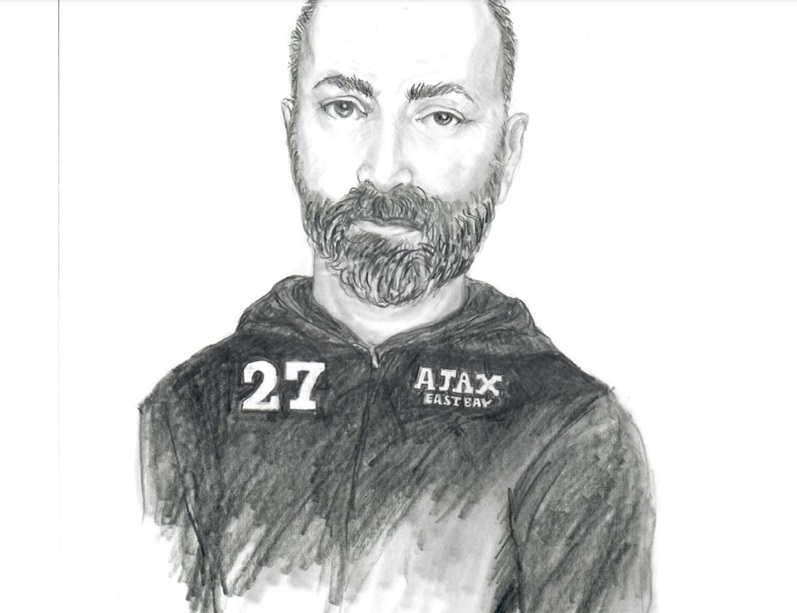
San Francisco’s Office of the Chief Medical Examiner is attempting to identify this man, who was found deceased in a vacant lot on 5th Street in October 2024.

It’s not important to say how I got to the website for San Francisco’s Office of the Chief Medical Examiner. But I will say that I was following a line of research on the number of traffic fatalities in the city going back to the 1950s or so. Just part of some history I’ve been gathering.

I forgot about that purported mission when I got to the chief medical examiner’s home page. It features sketches of deceased people the office has been unable to identify. The sketches are arresting because they take people who have been found in the worst of circumstances — dead on the street or in a park restroom, for instance — and portray them as they might well have looked in life and as their friends and loved ones might imagine them. Clearly the artist is attempting more than creating a likeness. The work here is an exercise in trying to restore dignity and humanity to those denied it at the end of their lives.

The man pictured above was found in October 2024 in a vacant downtown lot, lying in a pool of water. The medical examiner’s office released this sketch about three months later, along with a brief description of the case:

The decedent is a white male, approximately 50 years of age with brown hair and brown eyes. He is 5 feet and 6 inches tall and weighs 168 pounds. He was found in an abandoned lot that was filled with water at 348 5th Street, San Francisco. The decedent was found in the water dressed in multiple layers of clothing including an AJAX East Bay sweatshirt, a Kobe Bryant #24 jersey, and a Lakers #8 jersey.

Several news outlets around town duly published the sketch and the medical examiner’s press release, which noted that this was a rare case of it being unable to identify a decedent. Sometimes, publishing the sketches pays off with a relatively quick identification. Late last year, a woman lying unresponsive on a downtown street was identified just a few days after her drawing was posted; in late 2023, it took about three weeks before someone supplied a name for a man who’d been found dead on the roof of a parking garage.

So far, though, the man found lying in the water wearing the Kobe Bryant jersey remains unknown.

Conor McGregor: ‘P.S. He’s a Wanker’

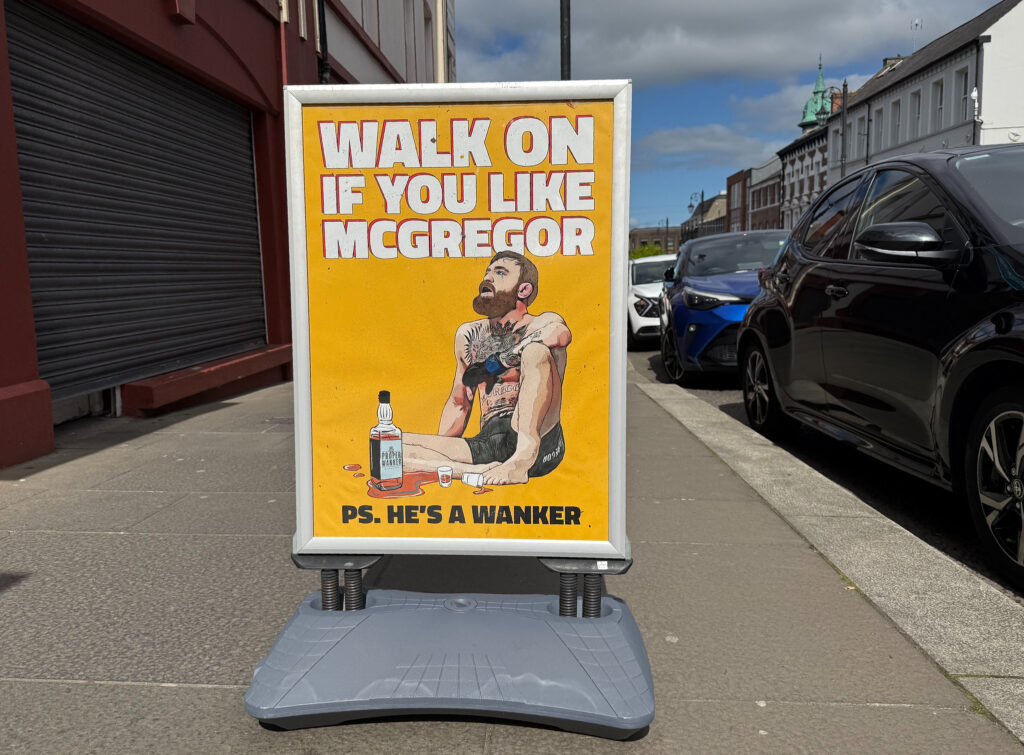
Conor McGregor, as seen in central Derry, May 2025.

What’s going on here?

Conor McGregor, the former cage-fighting champion and Irish whiskey entrepreneur, has become de facto leader of an Irish anti-immigrant campaign with strong echoes of the U.S. MAGA movement. Further MAGA parallels: McGregor, who lost a civil suit alleging sexual assault earlier this year, has announced he’ll run for the Irish presidency. See: “Conor McGregor, MMA fighter, alleged rapist, Ireland’s next president?

The first day of our trip to Ireland, back in late April, we ran into the aftermath of a McGregorite anti-immigrant rally in Dublin. It was staged just two days after the anniversary of the 1916 Easter Rising, which opened Irish nationalists’ initially failed, ultimately victorious effort to end British rule. Rally participants wrapped themselves, literally, in the Irish tricolor, and some chanted slogans like “Ireland for the Irish.” In Trumpian fashion, McGregor claimed a vast throng of more than 100,000 people turned out. Having been in the area where the rally was held, there ain’t no way a crowd anywhere near that size was present. Most sources estimated it at about 5,000.

The anti-immigrant gathering was followed immediately afterward by a smaller anti-racist rally and march that began in front of the General Post Office on O’Connell Street, hallowed ground in modern Irish history as the site where the Easter Rising of April 1916 began. We walked alongside the march a few blocks to its end point outside the Garden of Remembrance, dedicated to the memory “of all those who gave their lives in the cause of Irish freedom.”

Why were we seeing a sign mocking Conor McGregor and his followers in Derry, a place where he won’t be running for anything? I think it’s because McGregor’s rhetoric touches a nerve in a place that at least outwardly is still closely linked to the struggle for Irish independence and the associated fight to achieve civil rights for the minority Catholic population.

The city is part of the six counties partitioned from the rest of Ireland in the early 1920s, which remain part of the United Kingdom as Northern Ireland. The very name of the place is contested; in United Kingdom parlance, the town is called Londonderry. It’s famously divided along sectarian and the associated political lines, Protestant/Loyalist and Catholic/Republican. In Catholic/Republican parts neighborhoods, which is mostly what we saw, the ideology expressed in street art is still strongly, even radically, Republican, and embraces other liberation causes (Palestinian nationalism, for instance) and rejects McGregor’s narrow, reactionary, anti-immigrant nationalism.

Newly painted Palestinian nationalist/Irish Republican mural in Derry’s Bogside neighborhood, May 2025.

Folly

Hussey’s Folly, Dingle Bay, County Kerry, Ireland. May 2025.

“If you ever find yourself in Dingle” sounds like the start of a joke. I don’t know what the rest of it would be, but if you do ever find yourself there, there’s a beautiful walk out from the town’s harbor, past this tower, and then to the cliffs beyond.

The date given for the tower, called Hussey’s Folly, is 1845. That was the first of Ireland’s devastating famine years. The construction was a make-work project, something devised by a local landholder for the poor and hungry to do in return for wages or food. Similar projects, often involving exhausting physical labor like road-building, were carried out all over Ireland as the country starved. Here’s a decent writeup on the “famine roads,” some of which are still used as part of the national road network: www.frrandp.com/2025/01/famine-roads.html.

To Streets Broad and Narrow

What I really wish I had right now was a picture of 19-year-old me getting ready for my very first airplane flight, O’Hare to JFK, on the first leg of a trip to Ireland, my first time out of the country. But no picture from that day in September 1973 exists, so I’ll have to content myself with the memory of my excitement as the plane left the ground — I was actually whooping as the plane made a big turn to head east toward New York. Flying really was pretty cool.

That trip lasted three months. I left Chicago with two friends, Dan Shepley and Gerry Valenti. Dan peeled off for Germany and Oktoberfest a few days into the trip. Gerry and I spent the rest of September, all of October and November and most of December hiking and hitch-hiking around the country, mostly on the western coast. The centerpiece of the trip was a visit to Clare Island, at the mouth of Clew Bay off County Mayo. It was home to part of my mom’s family, O’Malleys and Morans, who had left for Chicago in the 1880s and ’90s.

We stayed with a second cousin of mom’s, Michael Joe O’Malley, for several weeks, getting more of a glimpse of what island life was really like than we had bargained for. There is a lot more to be said about Michael Joe and that stay, which I’ll try to do in the coming days. But the reason for remembering all of that today is that Kate, our son Thom and I are flying to Dublin in just a few hours for three weeks in Ireland. It’s my first time back since that trip I made as a teenager.

(And why haven’t I returned before? Maybe that’s something I’ll explore, too — an interior travelogue.)

Road Blog: Independence at Night

We’re staying tonight in Independence, the seat of Inyo County, along U.S. 395 near all sorts of history. Manzanar, the World War II concentration camp for Japanese-Americans, is just to the south. We’re in the middle of the Owens Valley, a place defined in modern times by the loss of its water to sharp operators from Los Angeles.

More immediately, one thing that strikes me about staying along U.S. 395 is the all-night truck traffic. It’s not a constant, relentless parade. But every few minutes or so, an eighteen-wheeler rolls through, either headed north to connect with Interstate 80 in Reno or south toward Los Angeles or maybe the desert routes to Phoenix.

Scenes from a late-night stroll through town: