 So after the shooting outside my office the other day, the ambulance came and left without taking anybody away, and it was apparent that the driver who’d been shot was dead in the front seat of his truck. He was killed about 1:55 p.m. — everyone who watched assumed it was a man; and I thought briefly about what the percentage of police shooting involving women might be; 5 percent or less, I’d guess. His body stayed where it was for about three and a half hours while police investigators went over the scene.
Our office was buzzing. One person who walked into the newsroom said, “Cool!” when they heard why everyone was clustered at the windows. Standard cheerful post-tragedy newsroom fare (I’ve said a lot worse myself). Down the hall, where people had a slightly better vantage point, maybe 15 people were taking in the view, and one of our photographers was zooming in on the truck cab with his camera; he said he could see the driver slumped over in his seat.
One thing I started thinking about was just who was the dead man, how he’d arrived at this point, who might be waiting to hear from him or waiting for him to come home, who was in for the worst news they could ever hear. The first-day newspaper and TV stories didn’t say anything about that. I missed the morning story on day two that identified him and gave his resume as a car thief:
Dean, 32, a Mission District resident and former parolee, had two
convictions for auto theft. He had a failure to appear warrant stemming from an auto theft at the
time of the incident. The $20,000 warrant was issued Jan. 12.
That’s all the personal information about Mr. Dean (or his like — ne’er-do-wells who wind up catching a police bullet in the midst of apparent lawbreaking) that most news stories will ever give you. And that’s a not-so-subtle way of coloring the news — giving nearly absolute initial credence to what the authorities say and reducing their suspect to a rap sheet — that you see in almost all police reporting. Every suspect starts out guilty in the media — that presumption of innocence happens inside the walls of the courthouse
only, if there.
But I found out a little more about him when I walked past the scene of the shooting yesterday. I came: across a little memorial. A bunch of flowers at the base of a telephone pole. The remains of a couple dozen candles burned down to the ground. A black ribbon. A farewell note from someone talking about how crazy and fun and out of control and larger than life Paul was (maybe I’ll go back out there and copy it down). And also the poster pictured above (shot with the phonecam) — Paul Dean and his kid, and a bitter message to the police. I mentioned seeing this to a colleague, and she told me she had seen about eight or nine people out there the night before holding a vigil. Those were the people who got the news.
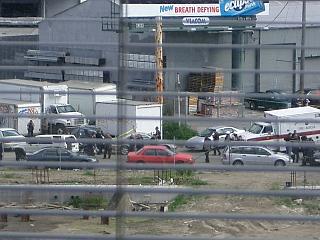 At work the other afternoon, about 1:55 p.m., I heard a series of quick gunshots. An opening shot, just a blink of a pause, then four very rapidly. Several people commented on the shots, and after a few seconds, I climbed up on my desk to look through the blinds. My window has a view to the south overlooking a construction site on Townsend Street; beyond lie a series of streets that lead up to Potrero Hill or toward a commuter railyard. It wasn’t clear where the shots were coming from, but someone exclaimed, “Look at that truck,” and said something about a cop. Across the way, maybe 60 or 70 yards from us, we saw a white pickup-type truck (others recognized it as a Toyota 4Runner) with smoke or steam coming up from the front. Also, a motorcycle policeman who apparently had fired the shots; can’t remember exactly where he was when I first saw him — behind the truck, I think. Within 30 seconds or so, other police units started arriving; in a couple minutes, about 15 or 20 squad cars and police motorcycles had arrived, and officers clustered around the truck. It looked like there was a figure in the driver’s seat — but given the distance and the angle we had, it was hard to tell. After another five minutes or so — or about seven or eight minutes after the shooting (2:02 or so), a San Francisco Fire Department ambulance arrived; paramedics went to the truck with some kind of hand-carried case while others got a stretcher out of the back of their vehicle. Within two or three minutes, they took the stretcher back to the ambulance. Everyone watching knew whoever was in the truck was dead.
 So a Victoria’s Secret commercial comes on during tonight’s “Survivor.” Nothing unusual in that. But there’s this music playing as the soundtrack — a Bob Dylan song. Strange! But I lost track of his career somewhere back there around “Blood on the Tracks,” so what do I know about him anymore (I didn’t even know the name of the song, which turned out to be “Love Sick”; it was just that his voice is so distinctive you couldn’t miss it). We’re watching this sort of odd presentation, and then suddenly, there’s Bob himself, looking sort of made up. Or maybe that’s just the way he looks. Everyone’s (everyone who’s not a Dylan fanatic) got the same general take (like


