Monday Meatballs

Meatballs_2

Thom was gone for the weekend, off on his first solo journey (with friends only, no shepherding adults) to a far-off music festival. It was a big deal event down at Coachella, in the desert east of Los Angeles. The New York Times took note (of the music, not Thom’s attendance); so did NPR. For Kate and me, the biggest deal was that Thom was off on his own on a trip that required two late-night drives — late Friday into early Saturday to get down there (it’s about a 500-mile trip), and late Sunday into early Monday to get back (Thom’s friends dropped him off in downtown Berkeley so that he could go straight to school to take a test). It reminds me of Eamon and his friends driving off late on stormy night to cross the Sierra on their way to see the Winter Olympics in Utah. The thrill of the road trip.

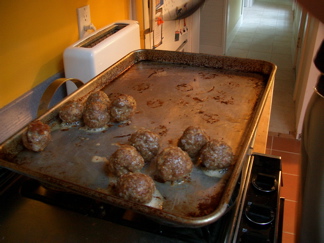
Anyway, he made it there and back, and had a great time that he talked about all afternoon and evening, when he wasn’t napping, and when we didn’t have "24" on the tube. To celebrate, Kate made spaghetti and meatballs (despite my a little too up-close-and-personal portrait of the meatballs, they were extra-tasty).

Aspirador Solo

Vacuum3

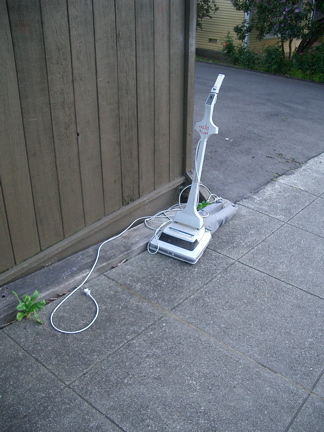
A question from the audience: Whatever happened to that vacuum cleaner?

Frankly, I thought I’d ridden that humble household appliance clear round the bend when I found myself turning it into "The Velveteen Vacuum."

But I did go out and check on it one more time. It had migrated from its corner a little way down the street and stood suggestively close to a Dumpster (out of sight in a driveway in the picture) the last time I saw it. Inspecting it, I saw that someone was very concerned that whoever used the vacuum cleaner ("el vaccuum" here, instead of the more common "el aspirador") switched it to the off position when they were done with it.

Siempreoff

The label reads: "Siempre OFF. Solo ON mientras lo uses. Ponlo OFF cuando acabes de hacer el vaccuum." Online translation — Google’s, which is among the many sites I tried that couldn’t handle the word "ponlo" — renders the message thus: "Always OFF. Only ON while you use it. [Ponlo] OFF when you finish making the vaccuum."

Note that el aspirador is switched off. Someone was finished making the vacuum.

April in Iraq

“But Iraq has — have got people there that are willing to kill, and they’re hard-nosed killers. And we will work with the Iraqis to secure their future. A free Iraq in the midst of the Middle East is an important part of spreading peace. It’s a region of the world where a lot of folks in the past never thought democracy could take hold. Democracy is taking hold. And as democracy takes hold, peace will more likely be the norm.”

–Bush, press conference, April 28, 2005

Killed in April:

–51 U.S. troops, including 11 in the month’s final three days. The total for March and April is the lowest two-month toll since February and March 2004, immediately before the Shiite uprisings in Baghdad and elsewhere. The total number of U.S. soldiers who’ve died in the Iraq war is now 1,586.

–501 Iraqi civilians, police and military. The breakdown: 302 civilians, 199 police officers and troops. Those are rough numbers compiled by Iraq Coalition Casualties and don’t include any accounting of insurgent deaths; nor do they resolve uncorroborated casualty reports.

–At least 20 foreign contract workers, from Australia, Britain, Bulgaria, Canada, Fiji, the Philippines, and the United States.

Our Most Important Product

In connection with my just-posted rant on Steve Jobs and his silly reaction to an unauthorized biography — “iCon: Steve Jobs, the Greatest Second Act in the History of Business” — I looked up the Amazon sales rank for “iCon.” Four weeks before publication, it’s either at No. 92 or Number 131, depending on which Amazon page you believe. Not stunning, but not bad, either.

Then I started looking at what books are on top of Amazon’s sales chart.

A “Harry Potter” title is Number One, natch. “He’s Just Not That Into You: The No-Excuses Truth to Understanding Guys” — yeah, right — is No. 6 (“Be Honest — You’re Not That Into Him, Either” is No. 210). A couple Malcolm Gladwell titles, “The Da Vinci Code,” G.E.’s Jack Welch telling the world, yet again, how great he is, Jane Fonda. I’m getting to the mid-teens on the list when I see a title that prompts me to see what it’s about:

On Bullshit.”

Knowing nothing about the book — though I see it has been featured in The New York Times, feted on “The Daily Show,” and there appear to be more than 20,000 Google references to it — I was curious.

The writer is an emeritus professor of philosophy from Princeton named Harry Frankfurt. He says, in a video interview on the Princeton University Press site, that he’s interested in bullshit because he believes it “poses certain dangers to the foundations of our civilization.” Bullshit involves “a lack of concern for the difference between truth and falsity,” Frankfurt says, and it’s thoroughly woven into the world we’ve built:

“The increase in the amount of bullshit in contemporary life … is because of the intensity of the marketing motive in contemporary society. We’re constantly marketing things — selling products, selling people, selling candidates, selling programs, selling policies — and once you start out by supposing that your object is to sell something, then your object is not to tell people the truth about it but to get them to believe what you want them to believe about it, and this encourages the resort to bullshit.”

So what’s the danger to “the foundations of civilization” to which Frankfurt refers? The Times story summed it up:

“…Any culture — and he means this culture — rife with [bullshit] is one in danger of rejecting ‘the possibility of knowing how things truly are.’ It follows that any form of political argument or intellectual analysis or commercial appeal is only as legitimate, and true, as it is persuasive. There is no other court of appeal.

“The reader is left to imagine a culture in which institutions, leaders, events, ethics feel improvised and lacking in substance. ‘All that is solid,’ as Marx once wrote, ‘melts into air.’ ”

“On Bullshit” started out as an essay in the 1980s. It has long since spawned a sort of school of philosophical bullshit-parsing (for instance, a rebuttal entitled “Deeper Into Bullshit,” by G.A. Cohen of Oxford).

Steve Jobs: Marketing Megagenius

Earlier this week, the San Francisco Chronicle (and other sources) reported that

Apple’s Steve Jobs, in a display of his master-of-the-universe clout, had directed his company’s stores to get rid of books from a publisher that’s coming out with a Jobs biography in May.

Today, The New York Times gets around to the story. Much is made of the book’s title, “iCon: Steve Jobs, the Greatest Second Act in the History of Business.” Call me obtuse, but when I saw that the other day, I thought it sounded like hagiography. The Times points out that many read “iCon” as a double entrendre — that the title intends to convey the notion Jobs is a con man. In the article, the book’s co-author, Jeffrey S. Young, is kind of confusing on that point, saying both that rendering “icon” the way he did was meant only as a play on popular Apple product names: iMac, iBook, iPod, and iTunes, for instance. Later in the piece, though, Young is quoted as saying Jobs “has an amazing ability to con people.”

But Young’s real offense isn’t the title — it’s that he tried to breach Jobs’s self-crafted image as creator and savior of the personal computer revolution, product visionary, anti-Microsoft guru, movie-animation mogul, and all-around superstar. Handsome as all get out, too. From what you read about this “iCon” book, that’s how he’s portrayed. But when you’ve risen to the Olympian heights Jobs has — and he’s just one of a growing circle of tech supergeniuses who have all somehow singlehandedly saved the world — you can’t just let some schlub try to tell the public how great you are.

Fair enough. This kind of thin-skinned, hyper-controlling egocentrism among corporate titans is an old story.

What’s not so easy to resign one’s self to is that Jobs, in his pique, feels it’s necessary to punish all the other authors who’ve had Apple-related works put out by John Wiley & Sons, the publisher of “iCon.” For the unauthorized biographizing of one, all must be banned from Apple’s stores. Wiley says sales at Apple’s stores don’t make up a significant fraction of overall trade for the books in question. Still, it’s the nastiness of Jobs’s gesture that counts.

Maybe the best part of the story is that, except for its subject’s meddling, “iCon” likely would have gone unnoticed except among the most devoted Apple acolytes. Thanks to Jobs’s megagenius marketing move, it’s guaranteed a much bigger audience.

The Music Thing, Again

So tonight, in between watching “Survivor” and “CSI” on TiVo and wallowing in other popular culture activities, I’m loading some more music into my iTunes library. This way, my Top 25 will show my to be a more well-rounded person. Except: I realize that the pile of albums I’ve picked out so far mark me as a fossil — a real classic-rock FM kind of guy.

Already loaded: Bob Dylan — “Nashville Skyline” and “Highway 61 Revisited.” Bob Dylan and The Band — “The Basement Tapes.” B.B. King — “Blues is King.” Van Morrison — “St. Dominic’s Preview.” Frank Zappa — “Hot Rats.”

Still to come: James Taylor — yes, yes, I’m not holding anything back. The White Album. Let It Bleed. Jimi Hendrix.

What does any of it have in common? Virtually none of that stuff was recorded after 1969. I see in my stack still to go on the computer that I have a couple real hot recent numbers that spoil the trend — a Dire Straits compilation and an album from Susannah McCorkle, a wonderful jazz singer who met a tragic end a few years back.

But for the most part, it’s like my ears and musical taste ossified at age 15.

Whipping post!

Where We Were

The map jones never stays quiet for long, though my habit is really just an incidental one. In late March, I wrote something in passing about Google Maps and what I liked about them. Since then, Google has combined its maps with the database of aerial and satellite photographs I think it acquired when it bought a company called Keyhole. Now you can specify any location in the United States — maybe the world, but I haven’t tried that — and in addition to the traditional map, you can also see an aerial image that matches the maps frame precisely.

So one of my first impulses is to look up places I lived growing up — like 196 Monee Road, in Park Forest, where we lived from 1958 through 1966 (the house had great heating ducts for storing beer, but my brothers have to relate that story).

Here’s a map that shows 196 Monee Road (unfortunately, I can’t figure out how to display the Google map on this page — if indeed that’s possible for a mere Web mortal such as myself).

Here’s the corresponding aerial image.

And here’s an aerial that shows how to get from 196 Monee Road to the next house we lived in, on Oak Hill Drive, a mile away.

That Sound You’re Hearing

The Apple iBook I bought last year came with iTunes. As far as I was concerned when I got the computer, iTunes was a service to buy songs online. And iTunes does facilitate that. But I didn’t get that it was also an application to manage your music library, listen to MP3 streams online, and do other things I haven’t figured out yet.

One of the things iTunes does in its library-managing function is keep track of how often you’ve listened to your music tracks; based on that, it builds your own personal Top 25 list. I don’t have a big collection of stuff on my machine — fewer than 100 songs. That’s OK, because I grew up in the AM Top 40 era and got in the habit, never broken, of listening to favorite songs over and over and over again. So that’s why my timing on that little break and screams on The Young Rascals’ “Good Lovin'” (6th grade, June 1966) was so perfect when I sang along. I played the 45 about 500 times in a week and listened for it nonstop on the radio. So having fewer than 100 tunes to listen to — no problem. Many are handpicked for obsessive repeat listening.

So here’s what the Top 10 (edited to omit artist repeats) of my Top 25 looks like, according to iTunes. It’s an odd collection. I’ll only explain that what has gotten the Number One song played as much as it has is the studio band, especially the bass player, James Jamerson. Oh, yeah, the Prokofiev thing, sandwiched between Shuggie Otis and Aretha Franklin: That’s the only classical stuff I have on my machine. It’s good, though.

1, I Was Made to Love Her — Stevie Wonder

2. Gardening At Night — R.E.M.

3. Strawberry Letter 23 — Shuggie Otis

4. Alexander Nevsky, Op. 78 — Prokofiev/Chicago Symphony Orchestra

5. Until You Come Back to Me (That’s What I’m Gonna Do) — Aretha Franklin

6. Crazy — Seal

7. The Pretender — Jackson Browne

8. Ray Of Light — Madonna

9. Daughters — John Mayer

10. Happy Valentine’s Day — Outkast/Andre 3000

’24’: Week in Review

Week after week, I’ve cursed “24” — like I don’t have anything better to do — for its insistence on portraying senior government officials, even the president — no, especially the president — as cartoonish dolts devoid of common sense and bent on making the wrong decision whenever the opportunity arises. (Tonight’s example: The president — actually the vice president who has taken the helm after the president was critically injured in the downing of Air Force One — orders the Secret Service to arrest a counterterrorist agent who’s in the midst of busting a bad guy who’s determined to set off a nuclear weapon. Because of the president’s idiocy, the bad guy gets away. Of course.)

At the same time, on the strength of seeing the first two or three seasons of “The West Wing” on DVD, I’ve been struck at what an idealistic, admiring portrait of the presidency that show presents. Among liberals, anyway, I think it’s been commonplace to think what a wonderful world this would be if only President Jed Bartlett were running the show (a few years ago, Martin Sheen came to talk at a church here in Berkeley, and the audience treated him with something like reverence that it was clear was due in part to his role as “West Wing” president).

Now I realize that I’ve been cursing and admiring the wrong TV presidents. Yes, the chief executives on “24” are pathetic morons who never let good counsel get in the way of a bad move. And Jed Bartlett’s White House really is too good to be the real nerve center of the free world. But: The “24” version of “reality” is great comic relief, and even the current president looks like a giant compared to the idiots who show up as president on its episodes. “The West Wing” just depresses me with the illusion that we could have leadership so much better than what we’ve settled for.

Sunday …

Cimg3745… in the yard … with, you know.

Today’s task: Continue the reclamation of the north 40 — our back yard — which was a construction area for all of 2004 and is now relapsing into its former identity of wild kingdom." Nice day to be out beating down the weeds, though.