What Are They Fighting For?

One of the most unsatisfying aspects of the ongoing coverage of the Iraq war: The failure of the media to make more than a token stab at explaining and exploring the insurgency. Generally, you get one of two types of approach in most stories: a simple gloss over — we can’t tell you who these people are or why they’re doing what they’re doing, but we can tell you they set off six more car bombs today; or a gloss over that follows the “coalition” line on explaining the insurgents — they’re thugs, murderers, enemies of democracy.

They may be all of these things. But it’s hardly acceptable to leave it at that. Our leaders have given us the gift of Iraq, and it’s one of those gifts that keeps on giving. Unless we think we can kill everyone who’s disinclined to go along with us over there, we better start figuring out the more complex reality driving the violence.

The New York Times had a story Saturday — “The Mystery of the Insurgency” — that’s the first attempt I’ve seen in the mainstream press to directly raise the question of what lies behind the insurgents’ tactics:

The insurgents in Iraq are showing little interest in winning hearts and minds among the majority of Iraqis, in building international legitimacy, or in articulating a governing program or even a unified ideology or cause beyond expelling the Americans. They have put forward no single charismatic leader, developed no alternative government or political wing, displayed no intention of amassing territory to govern now.

Rather than employing the classic rebel tactic of provoking the foreign forces to use clumsy and excessive force and kill civilians, they are cutting out the middleman and killing civilians indiscriminately themselves, in addition to more predictable targets like officials of the new government. Bombings have escalated in the last two weeks, and on Thursday a bomb went off in heavy traffic in Baghdad, killing 21 people.

This surge in the killing of civilians reflects how mysterious the long-term strategy remains – and how the rebels’ seeming indifference to the past patterns of insurgency is not necessarily good news for anyone.

There are no answers in the story, really. But beginning to explore the questions the insurgency raises is a start.

Iraq Reader

Demise of a Hard-Fighting Squad

Washington Post, May 12

“Among the four Marines killed and 10 wounded when an explosive device erupted under their Amtrac on Wednesday were the last battle-ready members of a squad that four days earlier had battled foreign fighters holed up in a house in the town of Ubaydi. In that fight, two squad members were killed and five were wounded.

“In 96 hours of fighting and ambushes in far western Iraq, the squad had ceased to be.

“Every member of the squad — one of three that make up the 1st Platoon of Lima Company, 3rd Battalion, 25th Regiment — had been killed or wounded, Marines here said. All told, the 1st Platoon — which Hurley commands — had sustained 60 percent casualties, demolishing it as a fighting force.

” ‘They used to call it Lucky Lima,’ said Maj. Steve Lawson, commander of the company. ‘That turned around and bit us.’ ”

***

Authorities find missing ex-soldier blinded by Iraq blast

(Associated Press, May 11)

“DUNBAR, Pa. — A former soldier blinded by shrapnel while serving in Iraq was found alive Tuesday night, a day after he disappeared after telling an ex-girlfriend he was depressed, police and his family said. …

“Salvatore “Sam” Ross Jr., 23, of Dunbar Township, will be admitted to a veterans’ hospital psychiatric unit for observation, his aunt, Tina Pifer, told The Associated Press. …

” ‘I just don’t understand what low he’s at right now because everything seemed to be coming together with building his house,’ Pifer said. ‘But, you know what? This kid is suffering so bad from depression. People just don’t understand the things this kid has been through over the last two years.’ ”

[I thought there was something familiar to me about Ross when I first read about his disappearance the other day. He’s one of the injured soldiers featured in Nina Berman’s “Purple Hearts — Back from Iraq.”]

***

Iraqi police vent anger at US after car bombings

(Australian Broadcasting Corp., May 10)

“Iraqi police hurled insults at US soldiers after two suicide car bomb blasts in Baghdad killed at least seven people and left 19 wounded, including policemen.

” ‘It’s all because you’re here,’ a policeman shouted in Arabic at a group of US soldiers after the latest in a bloody wave of attacks that have rocked Baghdad this month.

” ‘Get out of our country and there will be no more explosions,’ he told the uncomprehending Americans staring at the smouldering wreck of a car bomb.”

***

Army to Spend Day Retraining Recruiters

New York Times, May 12

“Responding to reports about widespread abuses of the rules for recruitment, Army officials said yesterday that they would suspend all recruiting on May 20 and use the day to retrain its personnel in military ethics and the laws that govern what can and cannot be done to enlist an applicant.

” … At least one family in Ohio reported that its mentally ill son was signed up, despite rules banning such enlistments and records about his illness that were readily available.

“David McSwane, a 17-year-old who lives outside Denver, also recently caught one recruiter on tape, advising him on how to create a fake diploma, and another helping him buy a product that purportedly cleansed his system of illegal-drug residue. This week, a CBS affiliate in Houston, KHOU-TV, played a voice mail message from a local recruiter that threatened a young man with arrest if he did not appear at a nearby recruiting station.

“Army statistics show that substantiated cases of improprieties have increased by more than 60 percent, to 320 in 2004 from 199 in 1999. Recruiters and former Army officials say they are related to the extraordinary pressure being put on recruiters, who must meet quotas of roughly two recruits a month. The strain is breeding not just abuses, they said, but also stress-related illnesses, damaged marriages and even thoughts of suicide among some.”

Playing the Numbers

Fortune

We got Chinese food last night from a neighborhood joint. Scarfing my fortune cookie, I briefly looked at the message and the lottery number and thought about buying a ticket (I haven’t bought one in a while; buying one usually gives rise to full-on Walter Mitty reveries surrounding all the generous things I’ll do with the dough. Kind of a mind game to show the universe’s lottery-controlling powers that I’m worthy of a jackpot).

In any case, I haven’t gone out to buy a ticket. But this morning, there’s a great story in The New York Times today about a bunch of people who bought tickets in the Powerball lottery using their fortune-cookie numbers and won:

"Chuck Strutt, executive director of the Multi-State Lottery Association, which runs Powerball, said on Monday that the panic began at 11:30 p.m. March 30 when he got a call from a worried staff member.

"The second-place winners were due $100,000 to $500,000 each, depending on how much they had bet, so paying all 110 meant almost $19 million in unexpected payouts, Mr. Strutt said. (The lottery keeps a $25 million reserve for odd situations.)

" ‘We didn’t sleep a lot that night,’ Mr. Strutt said. ‘Is there someone trying to cheat the system?’ …

… Then the winners started arriving at lottery offices.

" ‘Our first winner came in and said it was a fortune cookie,’ said Rebecca Paul, chief executive of the Tennessee Lottery. ‘The second winner came in and said it was a fortune cookie. The third winner came in and said it was a fortune cookie.’ "

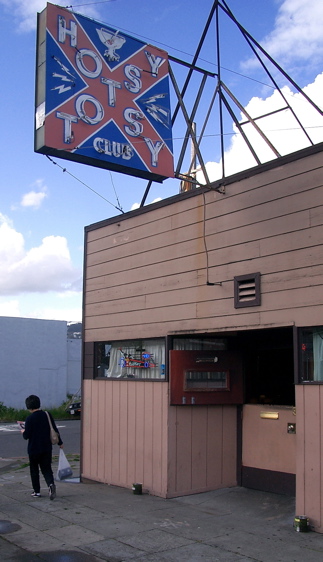
Hotsy Totsy

Hotsy

San Pablo Avenue runs from downtown Oakland through Emeryville, Berkeley and Albany as it heads toward industrial Contra Costa County. Up there, it passes the old dynamite-making village of Hercules and the current oil-refining town of Rodeo before ending near the big C&H sugar mill in Crockett (home of Aldo Ray).

Albany’s a little bedroom community that borders Berkeley on the north. Most of the town is solid middle class, angling for genteel. But where San Pablo cuts through it, it still shows a little bit of its less staid self in a series of bars along the street: The Ivy Room, Club Mallard, and, my favorite (namewise, anyway — I’ve never gone inside any of these places), the Hotsy Totsy Club. I’ve always loved the sign.

The Commander in Bondage

Commanderad

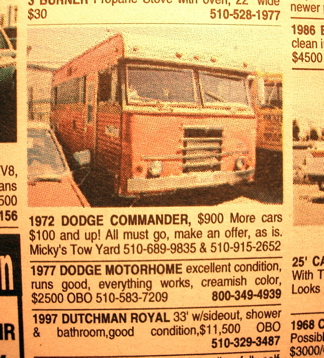
The Commander, a battered old Dodge RV that until a couple of months ago was a familiar habitué of local byways, is for sale. Big deal. But here’s the drama: The owner, a Berkeley denizen without fixed address (though not exactly homeless, since he had the Commander), made a reputation for himself in the neighborhood by stowing his vehicle wherever his fancy led him.

Naturally, it led him to park in front of a lot of houses whose residents started out annoyed when the Commander took up station at the curb and soon became irritated, if not hostile, with its owner’s habit of not moving until he’d been parked for the maximum 72 hours and gotten tagged with a warning to move or be towed. If the guy had been a sociable sort, maybe his more traditionally domiciled fellow Berkeleyans would have eventually cottoned to him and his semi-nomadic ways. It’s that kind of town, filled with that kind of people. But his general practice was to avoid all contact with the locals; those who managed to speak to him — your correspondent not being in this elite group — found him defensive and truculent in answer to most inquiries. Without putting too fine a point on it, the guy was a pain in the ass and apparently reveled in it.

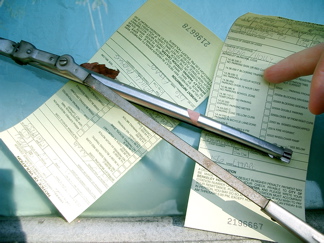
Late last year, people from several blocks that furnished some of the Commander’s favorite resting places conferred with the neighborhood beat cop. It turned out that the Commander is big enough it qualifies as a commercial vehicle; under Berkeley ordinance, it was an infraction to park it on residential streets from 2 a.m. to 5 a.m. The police, who had a file with more than 50 complaints about the Commander just from this little slice of Berkeley, agreed to come out and cite the vehicle every night that someone complained about its presence. The fine for each ticket is about $30. The bet was that the rapid accumulation of fines would force the Commander — for me, owner and vehicle became one — to find friendlier, or at least less complaining, environs.

Commandertix

He didn’t give up right away, though. He piled up lots of citations throughout November, reportedly went to court to try to get them thrown out, then temporarily departed the neighborhood before Christmas. He reappeared after the first of the year, and the same routine started. He got towed and paid to get his vehicle back. Then one night, after the Commander had been parked in one spot about a block from us for two weeks, the police arrived with a tow truck at about 4 in the morning. They hooked up the Commander — the owner climbed out of the back, where he’d been sleeping — and it was hauled off. Now it’s for sale. As is.

The owner has apparently been taken in by a friend a few blocks away. We’re all wondering if he’ll go to the wrecking yard that’s selling the Commander to try to buy it back.

Lipto s

Liptos

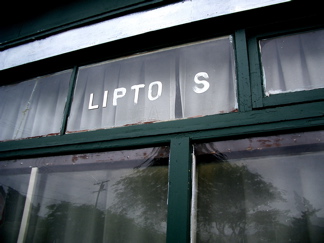
Lipto s. That’s all there is to say, really.

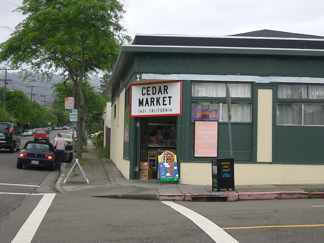
But for those who want the full story: We have a little store around the corner from our house. Cedar Market, at California and Cedar. Berkeley used to be full of them. Not just on the intersections of major streets, but on corners on residential blocks away from the commercial thoroughfares. They’re nearly all gone, but you can recognize a lot of the old ones from the way their doorways open onto the corner at  45-degree angles or sometimes from the big commercial-size windows that have been clumsily integrated into an apartment front.

I might have even seen the sign at Cedar Market when it still said “Lipton’s Tea.” I definitely remember that “Tea” was still there sometime in the last 15 years or so. Now it’s just “Lipto s.” The market itself just changed hands. A Chinese immigrant couple owned it, and they sold a few months ago to an Arab family. The new owners have made some changes. They’re open later — till 9 p.m — and on Sundays, too. But so far they are content to leave “Lipto s” be.

Cedarmkt

Citizens of the World

Earlier this week on my friend Endo’s excellent blog, he had a brief comment on the winners of the Webby Awards. He made the comment that his post was part of his "ongoing quest" to care about the prizes. I’m in the same boat. The awards, which started in the Web’s Paleozoic Era (mid-’90s) in San Francisco, have appeared to be a testament to the stamina and ego and hopes of becoming a household name of someone named Tiffany Shlain.

But I digress. My perusal of the Webby list was arrested at the very first entry, for the "activism" category. And the Webby goes to … The World Citizen’s Guide. The link goes to a site from a group called Business for Diplomatic Action. The guide’s home page explains that it’s a project involving students from Southern Methodist University who worked with BDA to get to the bottom of a troubling trend in this global free-trade world of ours: Lots of people outside the United States don’t like the United States very much; more to the point for the business group, many folks outside our borders look on U.S. corporations and brands with a mixture of envy and loathing; that’s a bottom-line problem now and could become a crisis.

So Business for Diplomatic Action sent people out into the world to find out why non-Americans aren’t in love with America, and the guide says the group identified four causes: "our U.S. public policy, the negative effects of globalization, our popular culture, and our collective personality."

"Collective personality"?  That one hurts, especially since I like to be considered a jerk on my own considerable merits instead of getting lumped in with the rest of the rubes and yahoos.

The online guide can’t do much about "our U.S. public policy," or globalism, or our popular culture. So it’s designed to address the collective "Not Only Ugly, But Loud and Ignorant American" issue. That’s a pretty ambitious task in itself, and the online guide is disappointingly thin, consisting of a handful of official resources for Americans traveling abroad; a collection of some of the flags of the world, each accompanied by a fun fact about the country ("While in Syria, pass things with your right hand or both hands, but never pass anything with just your left hand."); and there’s a Harper’s-index style rundown on the world’s population that’s not bad.

There’s an accompanying five-page brochure you can download that offers a lot more traveler-specific advice: Don’t talk religion. Try the local language. Be interested in the local version of "American Idol." Don’t forget to smile (though some travel guides will tell you that smiling is one of the very American habits that non-Americans distrust.

So the least of my questions is what the judges saw here that merited an activism award. I also wonder whether the well-meaning people behind the effort really think this is the kind of "activism" that will make a difference in a world that’s come to distrust and dislike us for a lot more than our habit of raising our voices to make our English easier to understand.

It’s easy to mock an effort like this; but I suppose it’s a good cause — trying to make us all aware that we’re ambassadors for the U.S.A. when we travel. Yet — is my unintentionally boorishness, or some other Yank’s culturally sensitive grace, really going to sway someone who’s real fear of my country comes from what’s becoming a habit of fixing the world by sending in the troops, damn the facts, the expense, and the world’s opinion?

Back at the Crossroads

In yesterday’s New York Times: A review of the first of Cream’s reunion concerts in London. Without going too far down memory lane again — though I have to mention that where I heard Cream the first time was in Randy Robinson’s basement on Monee Road, the setting for many then-avant-garde rock moments — the review, by Times staffer Jon Pareles, was a joy to read for both its historical appreciation of the band and its music and for its close examination of why the show the other night was less than ecstatic:

“…The neatness and order of the music were precisely what made Cream’s first return engagement underwhelming. It wasn’t unity that made Cream one of the great 1960’s rock bands. It was the same friction – of personalities, methods and ambitions – that would soon tear the band apart. …

“… In its most incendiary 1960’s shows, Cream played like three simultaneous soloists, relentlessly competitive and brilliantly volatile. Back then Mr. Clapton didn’t need Robert Johnson’s hellhound on his trail; he had Mr. Baker and Mr. Bruce snapping at his heels, goading him with bass countermelodies and bursts of polyrhythm. It was the brashness of youth in sync with the experimental spirit of the era. Cream played with reckless intensity, as if sure that all the risks would pay off; most often, they did. ”

The soundtrack I hear when reading this: “Crossroads.”

‘News’: Worse than Pot

The Voice of the West — aka, the San Francisco Chronicle — picked up a two-week-old press release from London Wednesday morning and ran it under this headline and subhead:

E-mail addles the mind

Endless messaging

rots brain worse than

pot, study finds

To be fair to the Chron’s reporter — though he did lift quotes directly from the release, attributing one to "a statement" — he did some imaginative legwork. He visited a couple of San Francisco’s medical marijuana clubs to get the proprietors’ views on email.

The source for the story’s dire yet entertaining revelation is HP’s operation in the United Kingdom. It put out a release on April 22 warning of the dangers of a new malady called "Info-Mania" and reporting the results of a study the company commissioned on how distracting modern information technology can be to office workers.

The press release, complete with important-looking footnotes, has an urgent lead: "The abuse of ‘always-on’ technology has led to a nationwide state of ‘Info-Mania’ where UK workers are literally addicted to checking email and text messages during meetings, in the evening and at weekends." 

Britons checking messages — away from the office. And on weekends. Where will they find  time for soccer hooliganism or producing new episodes of "Masterpiece Theatre"?

Continue reading “‘News’: Worse than Pot”

Bashõ’s Take

Late, and without a blog entry. I resort to another’s words:

“Having no talent,

I just want to sleep,

You noisy birds.”

That’s Bashõ, from Robert Hass’s “The Essential Haiku.”

Noisy birds or no, I’m going to sleep.

Later.