The latest on Eamon’s collapsed lung is this: I talked to Sakura about midnight Monday, Pacific time (about 4 p.m. Tuesday, Tokyo time). Eamon’s doctor recommended a surgical procedure — something like arthroscopic surgery, carried out with a probe — to repair the lining surrounding the lungs and thus prevent a recurrence of this episode. Sakura, who was at the hospital with her mom (who had traveled down from their family home in Ibaraki prefecture, north of Tokyo), said the doctor told her everything went fine. Eamon was still knocked out when we spoke. It will probably be a while before we speak directly, because there are no phones in his hospital room, and apparently the hospital forbids using cellphones in the rooms, too. His only telecommunications option is to go to a public phone elsewhere in the hospital, but apparently he’s been in too much pain to get to it so far.
Greatest Americans
All right — it’s hard to resist the temptation to mock The Discovery Channel’s "Greatest American" series, to say that it’s just another opportunity to see our clueless fellow rubes and yahoos at work. Not that I don’t believe that. Please enter as people’s Exhibit A the appearance of George H.W. Bush and First Lady Babs and George W. Bush and First Lady Laura — four Bushes in all — in the original top 100 nominees list; meaning that there were only 96 candidates for Greatest American not named B-u-s-h.
But pointing out the drooling superficiality of that first list is just too easy. People’s B: Tom Cruise. Yes, I loved the underwear dance in "Risky Business," too. But still.
See? That is too easy. And besides, it’s actually interesting to see who survives the media-mediated winnowing process to rise to the top.
The process is down to the Top 25: Muhammad Ali, Neil Armstrong, Lance Armstrong, G.W. Bush, Bill Clinton, Walt Disney, Tom Edison, Albert Einstein (if I’m not mistaken, the only non-American-born figure in the group), Henry Ford, Ben Franklin, Bill Gates, Billy Graham, Bob Hope, Thomas Jefferson, JFK, Martin Luther King Jr., Abe Lincoln, Rosa Parks, Elvis, Ronald Reagan, Eleanor Roosevelt and, separately, her husband, Franklin, Geo. Washington, Oprah, and, collectively, Orville and Wilbur Wright.
What I’m struck by at first glance:
–How the first 125 years or more of our history vanishes. Only five of the 25 are truly pre-20th century figures (Washington, Franklin, Jefferson, Lincoln and Edison), and they’d be on absolutely anyone’s greatest hits list. Heck, if they’re on money, they must be great.
–The two Armstrongs: I can’t understand how Neil makes it. Maybe he makes the grade because, as far as we know, he didn’t wet himself when his big moment came. But how, except for the luck of the draw, can he possibly be distinguished as great from any of the other first-generation astronauts? If you need someone to specifically represent the incredible accomplishment of getting to the moon — an OK idea — you need to recognize another immigrant: Wernher von Braun.
Then there’s Lance: Fine. He is a most excellent champion, a peerless model of the will to transcend and win. But his appearance on the list is due only to his recent run of victories in the one race that more than a tiny, tiny club of Americans know about. How many of the voters could name the first American to win the Tour (or know the story of his miraculous comeback from a brush with death)? How many could name another U.S. pro cyclist — just one, without looking (I declare that the readership of this blog is not representative of America At Large for the purposes of proving my point)?
–The two Roosevelts: It’s rather astounding that both members of a couple made the Top 25 list in their own right. You gotta have FDR — he meets the money test, for pity’s sake (until Reagan takes over the dime, anyway). And even if the current Bush is in the process of trying to abolish much of FDR’s legacy, he guided the nation through one of its most perilous periods. But Eleanor — I’m of two minds about her, and neither of them is filled with a lot of factual information. You kind of get the feeling she’s there because, well, we’re not quite clear about or comfortable with any other accomplished American women who don’t have talk shows. Susan B. Anthony, anyone?
(Here are my top 5 from that list of 25: Lincoln. King. Parks. The Wright Brothers (well, I just read a fine book about them, "To Conquer the Air"). And FDR. )
One Thousand Seven Hundred and Two
It’s a beautiful, dry, warm day in the Bay Area. What’s mostly preoccupying us here today, if you go by the local media: a recent fatal pit bull attack on a 12-year-old boy; the woeful state of our resident sports franchises; a deadly highway accident; the cost of replacing the Bay Bridge. We know there’s a war on out there someplace. But most of us are lucky enough to live outside the pall it casts, even when we hear the latest news mentioned: Twenty U.S. troops (and scores more Iraqis) have died in the last four or five days; a total of 1,702 American soldiers, Marines and sailors have died since the first casualty was recorded on March 21, 2003. Check back tomorrow. The number will be higher, and the end won’t be any clearer.
Pneumothorax
The phone rang early this morning; not super early, but about 7 a.m., earlier than we usually get calls on a Sunday. It was Sakura, our daughter-in-law, calling from Tokyo. The combination — early morning, and the fact it was Sakura, not Eamon, on the phone, had an instantly alarming effect; that only increased as I listened to Kate’s end of the conversation — something had happened with Eamon, and he was in the hospital.
After a minute, I groggily got on the phone. The story is this: Eamon apparently woke up Sunday morning and found it extremely difficult to breathe. Sakura called an ambulance, and he was taken to a hospital. Once there, doctors determined Eamon had suffered a collapsed lung (also known as "pneumothorax").
That’s easy enough to treat, apparently, though the process doesn’t sound pleasant. Here’s the way one option is described: "Definitive treatment involves placing a plastic tube within the chest cavity, through a small incision near the armpit, under suction and water seal. This chest tube may need to stay in place for a few days before it can be removed."
In terms of what causes a spontaneous pneumothorax, smokers are at higher risk than most people. But Eamon’s not a smoker. It turns out he falls into another risk group — tall, thin people, among whom this condition occurs more frequently than among us somewhat shorter and wider folk. The doctor who saw him after he was admitted said surgery might be necessary to prevent a recurrence.
So what do we do now? Just wait to hear from Eamon. Under normal circumstances, it’s so easy to communicate back and forth that the 5,000-plus miles between us doesn’t seem like a big deal. Suddenly, we have a situation where there’s no substitute for physical presence in terms of being able to give comfort (and get it) and really size up the situation. Having the impulse (or the need) to go is one thing, and going is another: I actually just found a round-trip United flight to Tokyo from San Francisco that’s priced at … $9,555.24. Seriously. (I also found a flight on a non-household-name airline, Asiana, for something like $1,400).
Law School Gig, Week 2
Times I’ve locked myself out of my office: 1. Boalt Hall has one, and only one, "key lady," someone named Wendy, who made the long trek up to my little room to let me back in.
New term: "Chart strings" (University of California talk for "account numbers" when you need to bill expenses, like those for business cards or stationery.
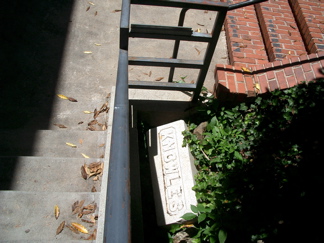
Sight I can’t account for (above): A stone bearing the legend "Knowles" that sure looks like a grave marker. It’s in an out of the way place in the angle between stairways at Boalt’s northwest corner. I haven’t been able to find a record of anyone named Knowles who ever went to the law school, or who has figured prominently in the university’s history. An architect named Knowles did design a nearby house for a professor, but that wouldn’t explain the marker.
Odd experience: Talking to reporters who are looking for sources for stories. Hey, until not too long ago, I was on that side of the fence.
Brilliant idea that went nowhere, for now: To have Barack Obama come out and do some event for the law school. It’s too long a story for tonight. But for one thing, I hear that about 400 people have the same brainstorm every week.
Iraq: The Next Generation
One: A long Chicago Tribune piece (the version I saw was reprinted in the Tallahassee Democrat; Democrat?) on a debate going back to the late 1980s about re-configuring the U.S. armed forces to fight the kind of war we’re in the middle of now. The story focuses on proponents of a philosophy called “fourth-generation warfare” who have been highly critical of the Pentagon’s persistence, even now, in developing and maintaining a war machine designed to fight a big tank war against a great power like the Soviet Union:
Nearly 16 years ago, a group of four military officers and a civilian predicted the rise of terrorism and anti-American insurgencies with chilling accuracy.
The group said U.S. military technology was so advanced that foreign forces would be unlikely to challenge it directly, and it forecast that future foes would be non-state insurgents and terrorists whose weapons would be suicide car bombs, not precision-guided weapons.
“Today, the United States is spending $500 million apiece for stealth bombers,” the group wrote in a 1989 article that appeared in a professional military journal. “A terrorist stealth bomber is a car with a bomb in the trunk – a car that looks like every other car.”
The critics conclude that despite some well-meaning attempts at adopting new tactics in Iraq — trying to train troops in the rudiments of the local language and culture (which doesn’t seem like such a new thing, really) — the war has gone so far down the wrong road that it’s doomed. One of the critics, who sounds like an ultra-conservative war-hawk type, says simply: “There’s nothing that you can do in Iraq today that will work. That situation is irretrievably lost.”
The News: It’s Wet
Rain in Berkeley today. Light rain, for sure, but still: it’s drizzling down; gurgling in the drainpipes; creating adventurey driving conditions for weather-challenged Bay Area commuters. The reason it’s worth mentioning in a forum as august as this here scribblefest: It’s a rather rare occurrence — one of the local weatherpersons said on the radio that it’s only rained on June 8 14 times since the start of official meteorological record-keeping hereabouts 150 years or so ago.
Film at 11.
Bye, TJ
Recent front-page news in Berkeley: Parents, students and teachers at Jefferson Elementary School voted to change the institution’s name to Sequoia. Why? Because, as a slaveholder, he was judged unworthy of the honor and influence of having a school named after him.
Sure — there’s no arguing that he owned slaves. And that he didn’t free them. And that his life fell far short in many important respects from the beautiful rhetoric of freedom he crafted. Granting all that, I still don’t buy that the way to deal with that history is to try to expunge it. I also wonder how we benefit by subjecting every figure from our past to the absolute judgment of our current keen wisdom. It’s one thing to shelve once-distinguished personages who have become less relevant to who we are as a people. In Berkeley, schools memorializing James A. Garfield and John Greenleaf Whittier, remote 19th century icons with no lasting standing in most of today’s culture, have been renamed. Garfield morphed into Martin Luther King Jr. Middle School, and Whittier became Berkeley Arts Magnet.
But Jefferson isn’t like Whittier or Garfield. His ideas and flaws are still crucial to our sense of who we are. Better to face that, make his name and legacy something to study for insight into what the United States was, is, and will be than to dump his name as a gesture of multicultural sensitivity. Not too many of the Dead White Men (formerly Founding Fathers) will stand up to a close inspection for political correctness. Even the Great Emancipator — hey, Abe! — comes off as a white supremacist bigot (and a gay one, at that — go figure).
Next on the History Cleansing Hit List: Washington School. Unless it’s named for Booker T., not George. Which would create its own problems for the progressives.
(And the fun sequel to all that is this correction in our town’s semi-daily newspaper, The Daily Planet: “In a June 3 article about the vote to change the name of Jefferson Elementary, Thomas Jefferson was erroneously referred to as the second president of the United States. He was the third.”)
Sky Antlers in Flight
Researching a randonneuring trip to Portland and what airlines will charge for flying my bike as luggage, I checked the American Airlines site for details. I remember from a couple years ago that they charged $80 for the bike. That’s still true.
But American’s list of “sports equipment” it will fly is unexpectedly entertaining. It includes antlers (“must be as free of residue as possible; the skull must be wrapped and tips protected”), bowling balls (bowling ball cleaning fluids may be dangerous cargo), javelins ($80 each), “pole vaults” (I assume they’re talking about the poles, and they’re not allowed).
The DSL Connection Gig
To continue an earlier post of astonishing importance, the DSL connection is back up here at Infospigot corporate HQ. All it involved was about an hour on the phone to India, an actual service call here at our Berkeley premises to confirm that our line was OK (it was), and the chance discovery that our provider, SBC, had actually changed the log-in required to connect to its network. Once I discovered this last fact — which was not advertised in advance, so far as I can tell, but was mentioned in a recorded service announcement I heard when I called the company for help — it was just a matter of figuring out what our account’s actual user name and password were. Thanks to Kate’s diligent retention of notes I made on our account about six or seven months ago, I realized at about Hour 54 of the Great DSL Crisis that the name and password were totally different from the ones I had been trying and trying and trying, in lab-monkey fashion, since Thursday.