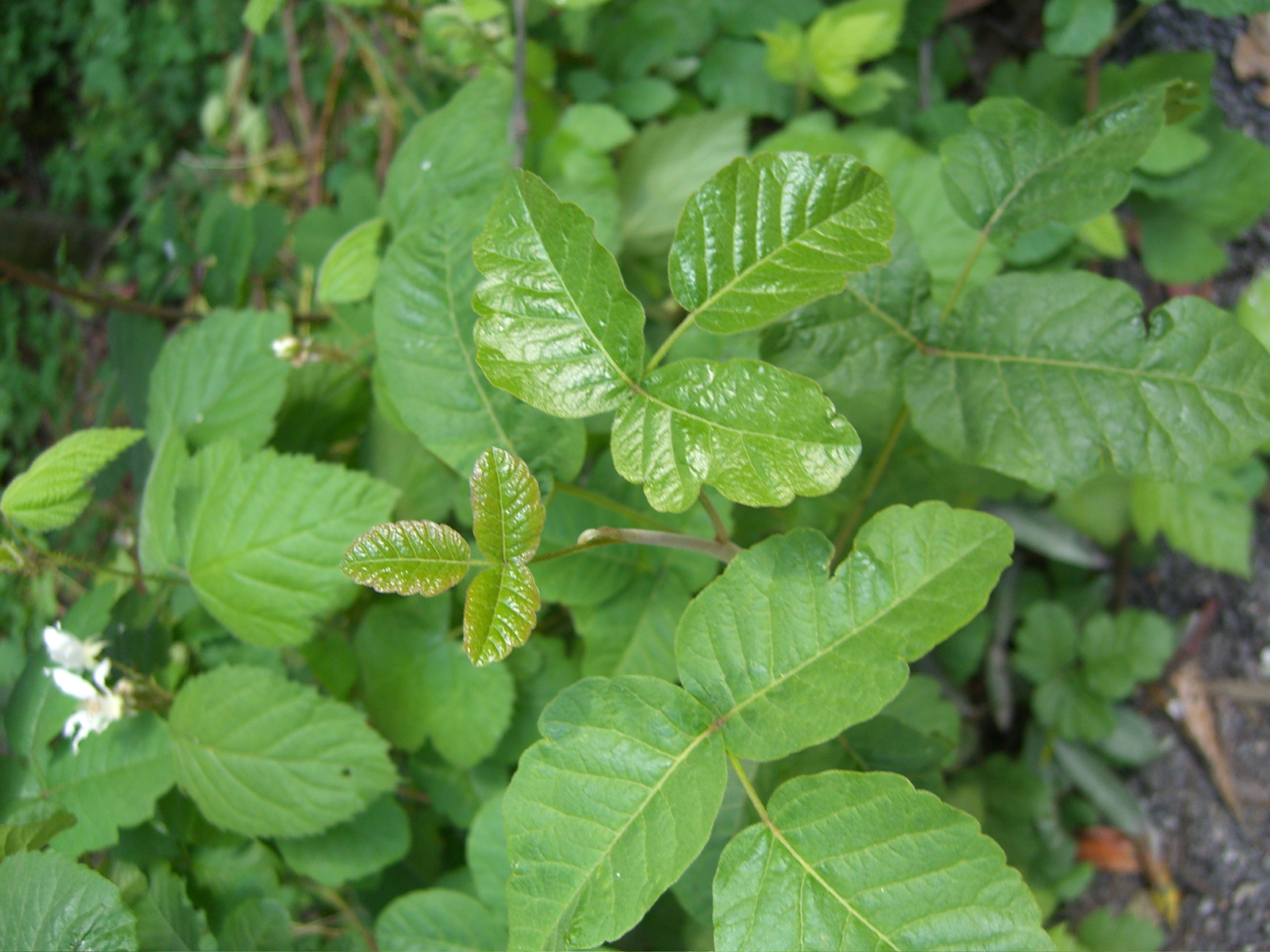
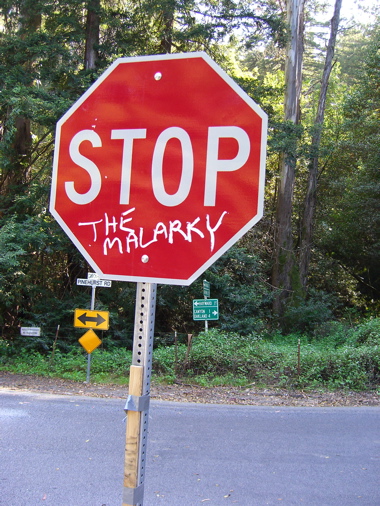
 One of the prettiest plants in the woods: poison oak (known, according to one authority, by two Latin names: Rhus diversiloba (old) and Toxicodendron diversilobum (new)). Kate and I were driving home Saturday from Moraga, a town east of the hiills, after spending a few hours preparing food for our bike club’s annual century ride. We were taking the back road through Canyon, a hamlet hidden in the redwoods and eucalyptus on the lee side of the Oakland hills, when we spotted the “Stop the Malarky” sign below. Getting back into the car, Kate said, “Poison oak.” There was a profusion of it mingling with blackberry vines on the roadside.
My Sentiments …
… exactly.
A Day Without an Immigrant
So, I’ve been noodling postlessly over what to say about the issue of the week, the whole immigration debate. Monday, there was the Day Without an Immigrant, as KTVU News anchor Leslie Griffith called it. And today, we have Cinco de Mayo, an important day for that immigrant we went without on Monday.
There was this, too: Last weekend, while licking my wounds from my audacious 206 miles of riding the Bay Area’s highest peaks — the Devil Mount Double — I got an email from a woman in Chicago who turns out to be a third cousin on my mom’s side of the family. Our common ancestors are John and Bridget Moran, my great-grandmother’s parents, who left Clare Island, County Mayo, Ireland, in 1887 and wound up in the Back of the Yards in Chicago. Thinking about them, thinking about all the other people who had to set out during the middle and late 19th century from Ireland and Norway to assemble the pieces of what I know as my family, made me think about how connected we are, nearly all of us, to the immigration question today.
One thing led to another after I received that genealogy email, and I wound up tracking down and looking at the 1900 census records that include the Morans and also the family of their daughter Anne and the man she married, Martin O’Malley. All were new arrivals with big families. The census records contain scant information on individuals, but just enough to give you a hint about their lives. Martin, in 1900 the father of eight living children, was listed as “labor at yards.” So were his two oldest sons, living at home in their late 20s.
Going up and down the rather haphazard roster of households on West 47th Street, where the census lists the O’Malleys, and on West 47th Place, where the Morans lived, and on all the other streets nearby, you see immigrant families, most from Ireland, packed into block after block of row houses on postage-stamp lots, their “occupation, trade or profession” listed as labor at yards, farm labor, “labor at pickle factory,” teamsters, butcher’s clerks, barbers, domestics, “commission men” (which I take to be “salesmen”), cattle butchers, hog butchers, sheep butchers, meat weighers, railroad clerks, railroad swtichmen, dressmakers, shoemakers, saloonkeepers, storekeepers, housekeepers, night watchmen, telephone operators and telephone girls, messengers and messenger boys.
These weren’t rich people. They weren’t middle-class people. They weren’t warmly welcomed or well-loved by people who had been in the country longer and could afford to live in better circumstances. They were foreigners throwing their back into the work of gaining a toehold and seeing what they could do once they’d gained a purchase on this new place.
And, yes, let me be sure to say that they were legal immigrants who followed the rules when they came into the country. Let’s say that,and in the next breath acknowledge how little that really means, because in truth U.S. laws on immigration have had little to do with maintaining a neat and orderly society and much to do with exercising whatever racial and economic fear happened to be prevalent at a given moment.
For immigrants from northern and western Europe, the hardest part of the trip, practically speaking, was making it and paying for it. For those who arrived before the 1880s, once you showed up in New York or Boston or wherever you landed, you were in. Your name would be recorded somewhere, sure, but it was not as if you had passed a test of personal or civic virtue to be admitted to the United States. Starting in the 1880s, we — we meaning Congress — started to get more particular about who would be let in and who wouldn’t. For immigrants from Europe — let’s translate and say white folks, even if they didn’t speak English — a head tax was imposed (50 cents an immigrant) and some conditions were placed on admission. Unwanted: criminals, the insane, the depraved, the diseased.
That was the kind face of the new immigrations laws. The laws’ more purposeful side applied not to the millions coming from Europe, but to those from China, Japan, the Philiippines, India and other non-Caucasian places. Simply speaking, after decades of letting Chinese and other Asians into the West (mostly) to mine and build railroads and drain swamps, Congress decided we had more than enough cheap labor on hand and we could afford to make it practically impossible for Asians to get into the country.
To jump ahead to where we are today, with the House already having voted to make it a felony to illegally cross the U.S. border or to offer any aid to someone in the country without the required paperwork: One’s tempted to ask, “So what’s new?” Whenever the country has tightened its immigration laws, two factors are always present: Some target group or groups whose race, language or culture is pointed to as alien by the well-assimilated and forgetful majority (what do you mean Grandma didn’t speak English?); and some concern over what the flood of hungry, energetic, and willing-to-work-for-anything newcomers are doing to the job market.
So today, we’re pretty much back to where we were when we decided we didn’t want any more Chinese or Japanese or so many Italians, Poles and Russians. We’re not in the middle of a big winning streak for rational, well-tempered, or generous action. But action’s going to be taken — we have tangible and intangible things that people everywhere seek, and they won’t stop coming to try to find them here. Our decision might be a little less painful to look back on if our discussion could start with the awareness that when our people got here, they all looked just like the immigrants we see around us now.
Technorati Tags: chicago, immigration
‘Suppressed for a Moment’
With the Army in Iraq:
The Army News Service reports that Capt. John McFarlin, attached to the 3rd Heavy Brigade Combat Team, 4th Infantry Division, Task Force Band of Brothers’ Military Transition Team, recently had a close call during a battle with insurgents: He owes his life to the Army Combat Helmet.
“While McFarlin’s unit recently responded to attacks on an Iraqi police station in Buhriz, he was hit in the helmet with a shot from an AK-47.
“I was suppressed for a moment and then I got back up” and returned fire, said McFarlin. “…Things are going to happen. You’ve got your equipment: you’ve got your IBAS, you’ve got your Kevlar and you’ve got your eye pro. (You need to) offer as little target as you need while doing your job.”
Suppressed? Is that the same as stunned?
Technorati Tags: iraq
Riding Devil Mountain
Just briefly: I’ll be out tomorrow — in just a few hours, really — to do a double century. That’s 200 miles in a day. The twist on this ride, the Devil Mountain Double, is the amount of hill climbing required to complete the course: something like 18,000 feet in all. I know most of the roads and have done most of the climbs, but never on the same day, and some not in years. I’m sure I won’t be back in to write about it tomorrow night. But Sunday — Sunday I’ll have something to say. (And wish me luck — even retrospectively!)
My Beautiful Blogette
I’d love to be able to say I’m above being self-conscious about this, My Beautiful Blogette (as an aside, try the following as a one-evening Daniel Day-Lewis triple bill: “Last of the Mohicans,” “A Room with a View,” and “My Beautiful Laundrette”).
Alas, I am self-conscious, mostly about the recent attenuation of the previous steady stream of smart, not to say indispensable, Infospigot observations about the world both in and around my navel. I mean to say I haven’t been posting a lot the last few weeks.
The principal reason: I’m spending lots of time working on The Personal Bee, the little Web publishing startup I signed on with in January. We just launched our live test site (beta for those in the software development world), and there’s lots and lots of refinement to do. Nearly all of The Personal Bee work is online, and often the last thing I want to do is sit down in the evening (or early in the morning) and start tapping away at the keyboard some more. So that’s why you’re seeing more pictures and less of the brilliant dissection of reality that has come to typify work associated with this site.
For now, anyway. The Bee is a startup project with startup funding, and it has emerged at a time when everyone and his Uncle Moe has decided that Web news-and-information sites represent a business opportunity. We’ll see (and I’ll write more about the Bee later, too).
The Birds
A couple of towhees — they’re sparrow-like little brown birds, common here — showed the shocking lack of judgment to build a nest in a potato vine on our back porch. They must have worked fast, too, because one day I had no idea they had moved in and the next they were fighting a scrub jay to protect their place. Kate and I heard the commotion early Sunday morning, and even our neighbor on that side of the house commented on it.

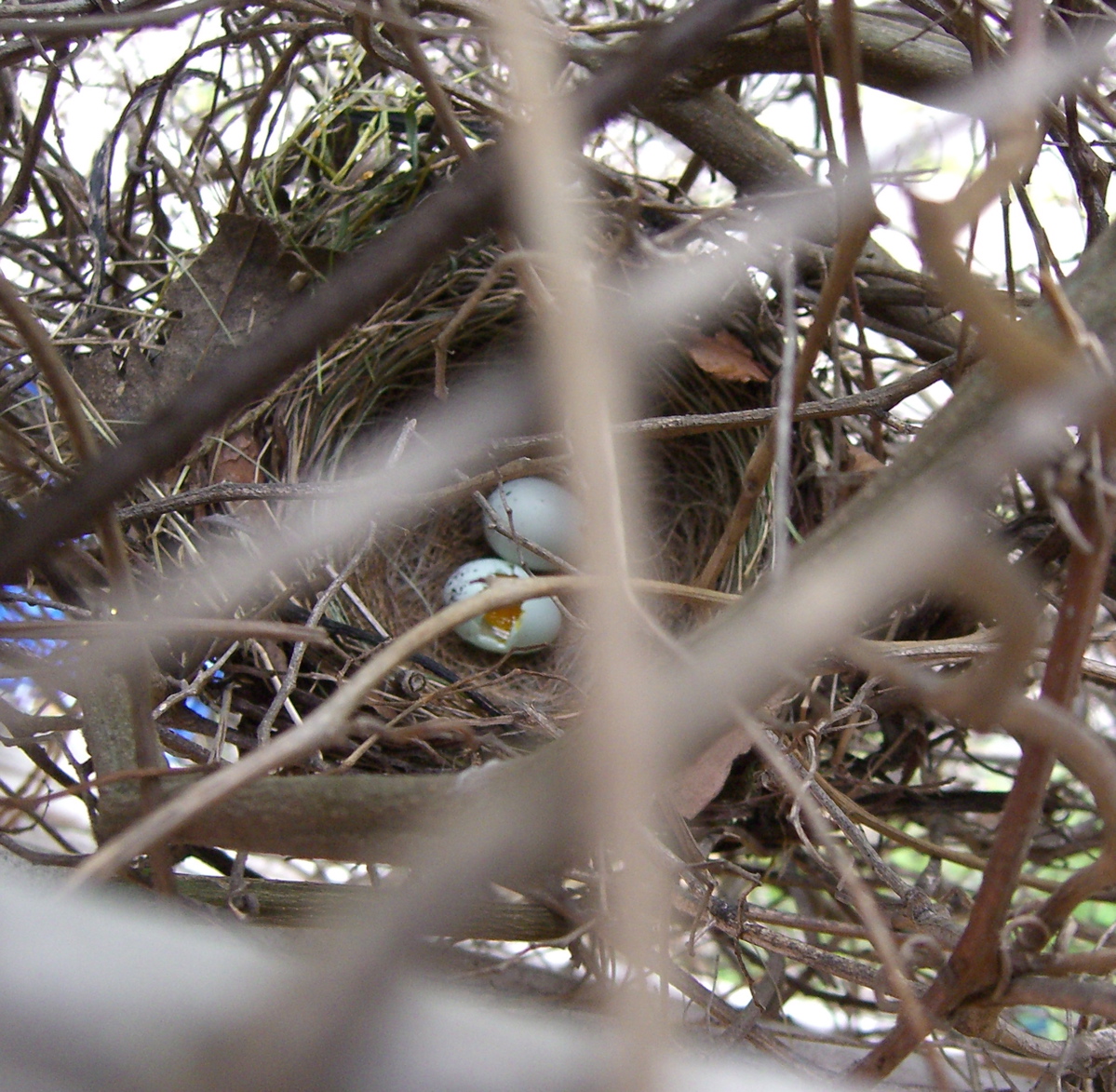
The towhees seemed to have two tactics to try to fend off the jay, which we figured was trying to get at any eggs they had in the nest. First, one of the birds would try to distract the jay by fluttering weakly along the ground near the nest; second, if the jay took that bait, both birds would fly into a bush nearby, puff their feathers up, and try to counterattack the bigger bird. But the jay wasn’t to be distracted, and kept coming back to the next despite a local human’s attempt at intervention. He, or she, was scared off several times, but kept returning. When he was gone, one of the towhees would return to sit on the nest. But eventually I looked out and saw the jay was standing on the little round of twigs and pecking at something.
I chased him off and climbed up to take a look inside the next. Sure enough: two pale blue eggs, one perfect and one broken. With the jay gone, the smaller birds returned to take a look. They didn’t leave, but neither did they sit on the nest again. The jay come back once more and got at the second egg, and after a little while, the towhees were gone. The last time I looked in the nest, the ants were already at work on what had been left behind.
New Jersey Elected Official …
… And other notes:
Apropos of — well, you’ll have to figure it out: Al Prazolam, mayor of the Jersey shore town Swamp River Island Beach.
Berkeley has designated the barn owl as its official city bird. Oakland concedes it has no city bird but says through a spokesperson that it “welcomes and embraces all birds.”
Triptych
This has nothing to do with the famous Dr. Shabubu. (But it is part of a long-running Telegraph Avenue poster drama.)
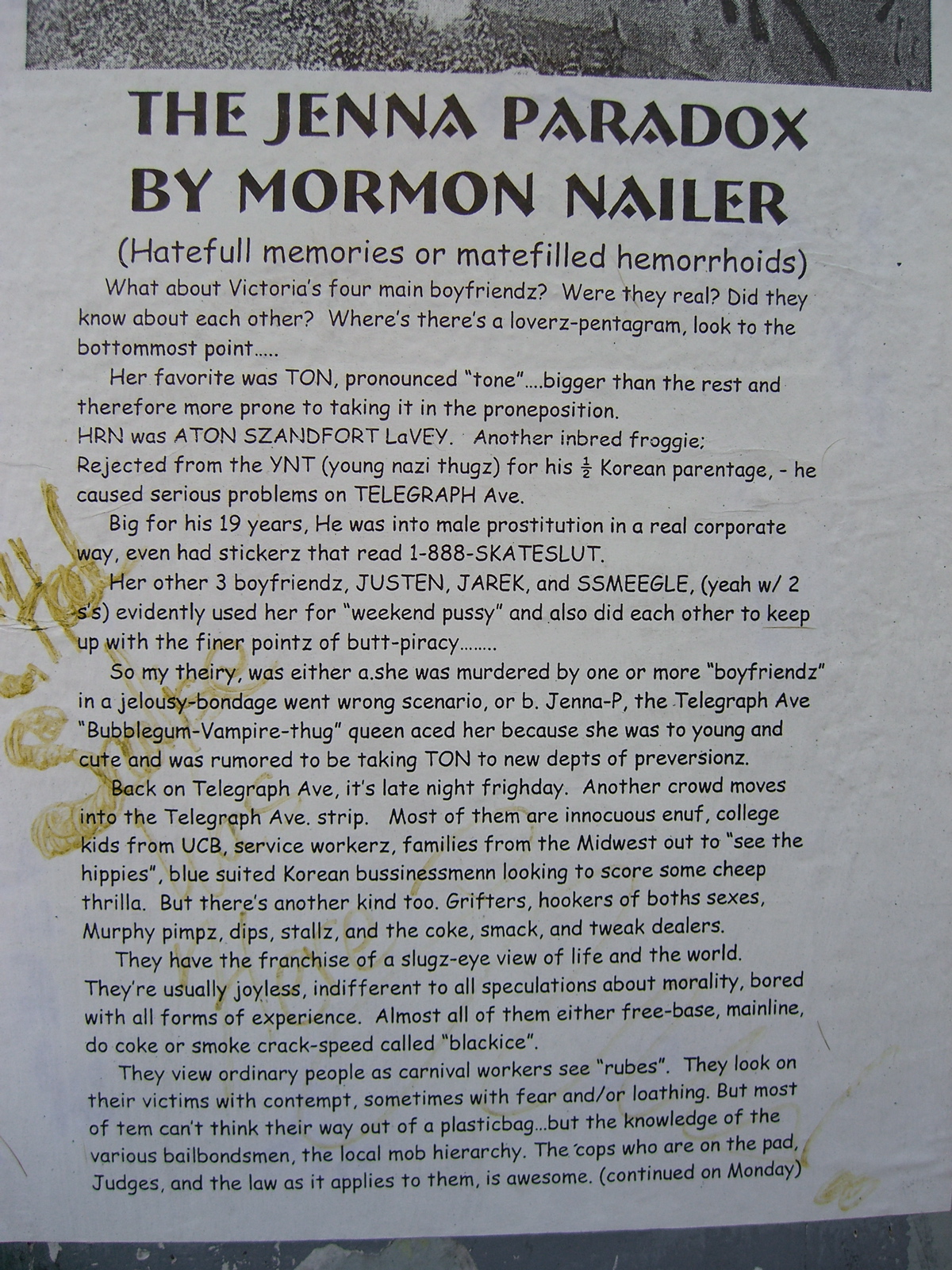

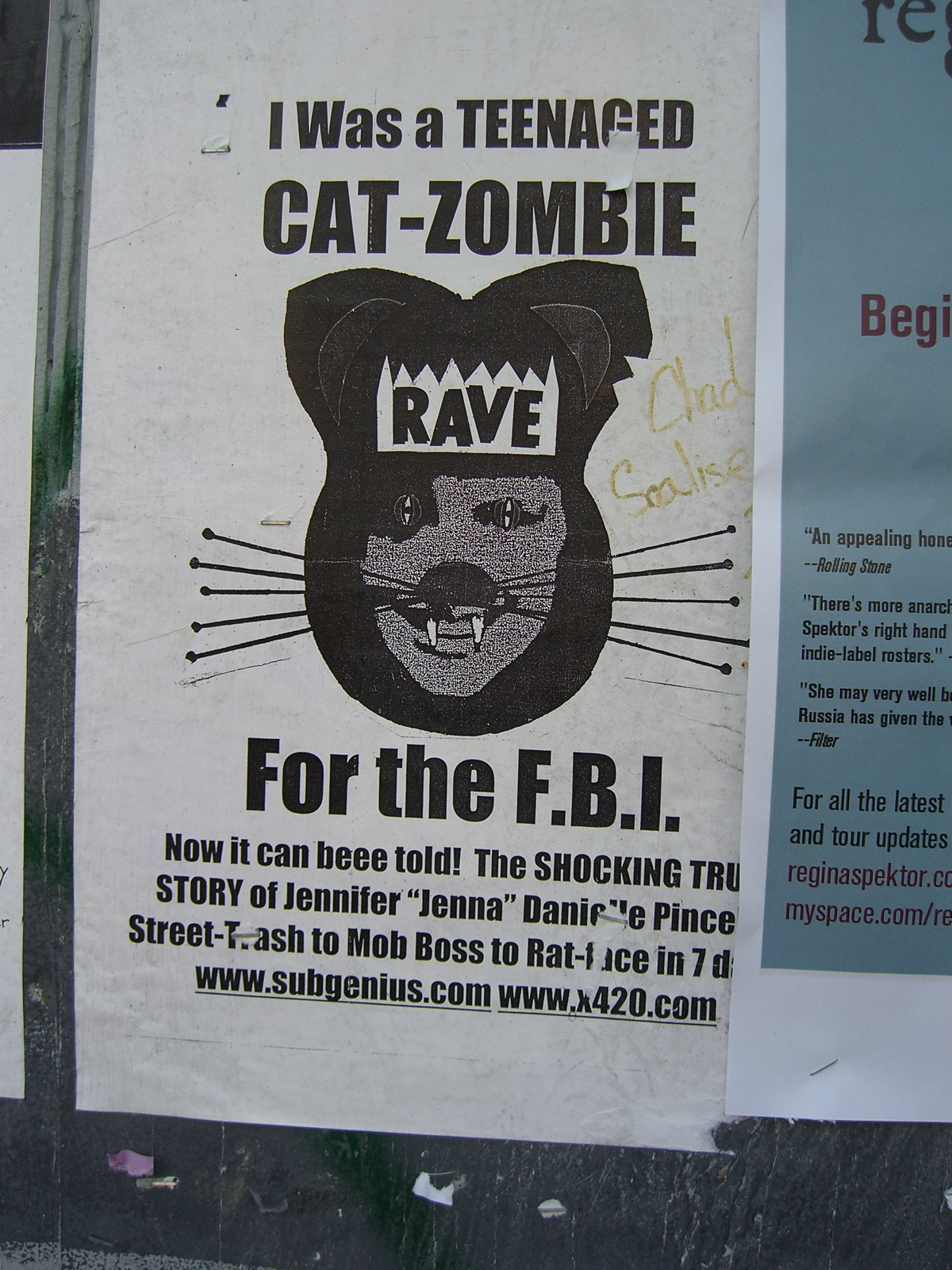
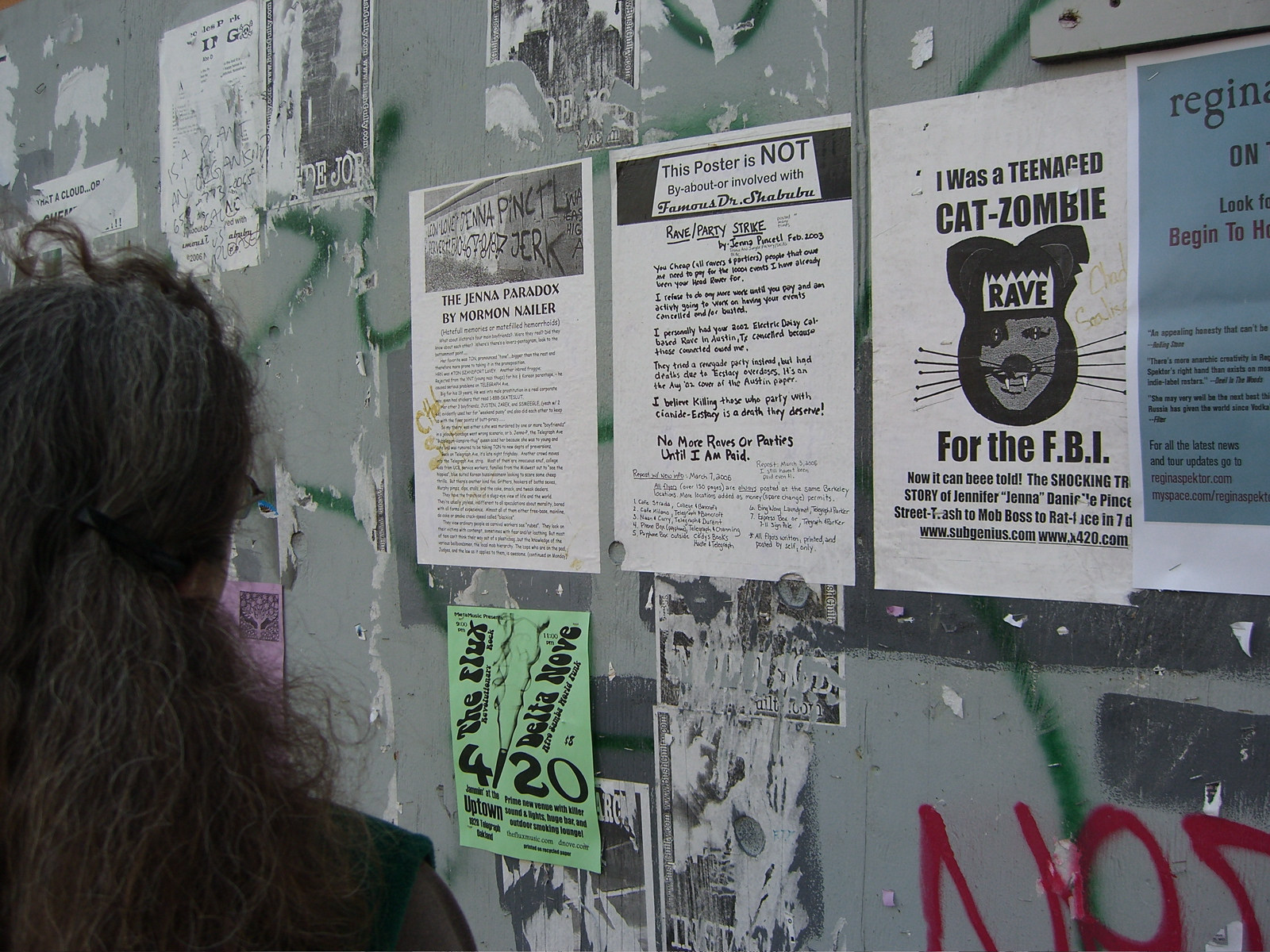
Bay Region Scorches Under Cloudless Skies
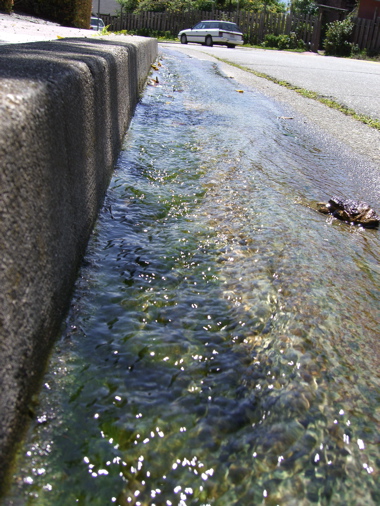
Gosh — Infospigot has been on walkabout this week. Yeah, that’s what it is — Walkabout Week. After my reiterative weather plaints of recent weeks, I think it’s time to report that spring — the season that showed up for a day last week — has turned in a longer appearance this week. It’s been warm and sunny everywhere, and the Chronicle shifted gears from wet-weather coverage today to report on its front page that we’re about to suffer the ravages of a prolific pollen season. I promise that unless we have a rapid-forming glacier in the Berkeley Hills, a Category Two williwaw, or some similarly traumatic event that this will be the last weather news for the season (barring popular demand for more, of course). In the meantime, a reminder of the nearly departed monsoon: Up in the soaked hills, small streams are gushing down the street under clear skies. As below, on La Loma Avenue near Buena Vista Way:
Technorati Tags: berkeley, california, rain, weather
View of the Buttes
I’ve been away. Friday — getting ready for a bike ride. Saturday on a ride that lasted 24 hours, into Easter morning. Easter, sleeping; and eating. Today, tax day.
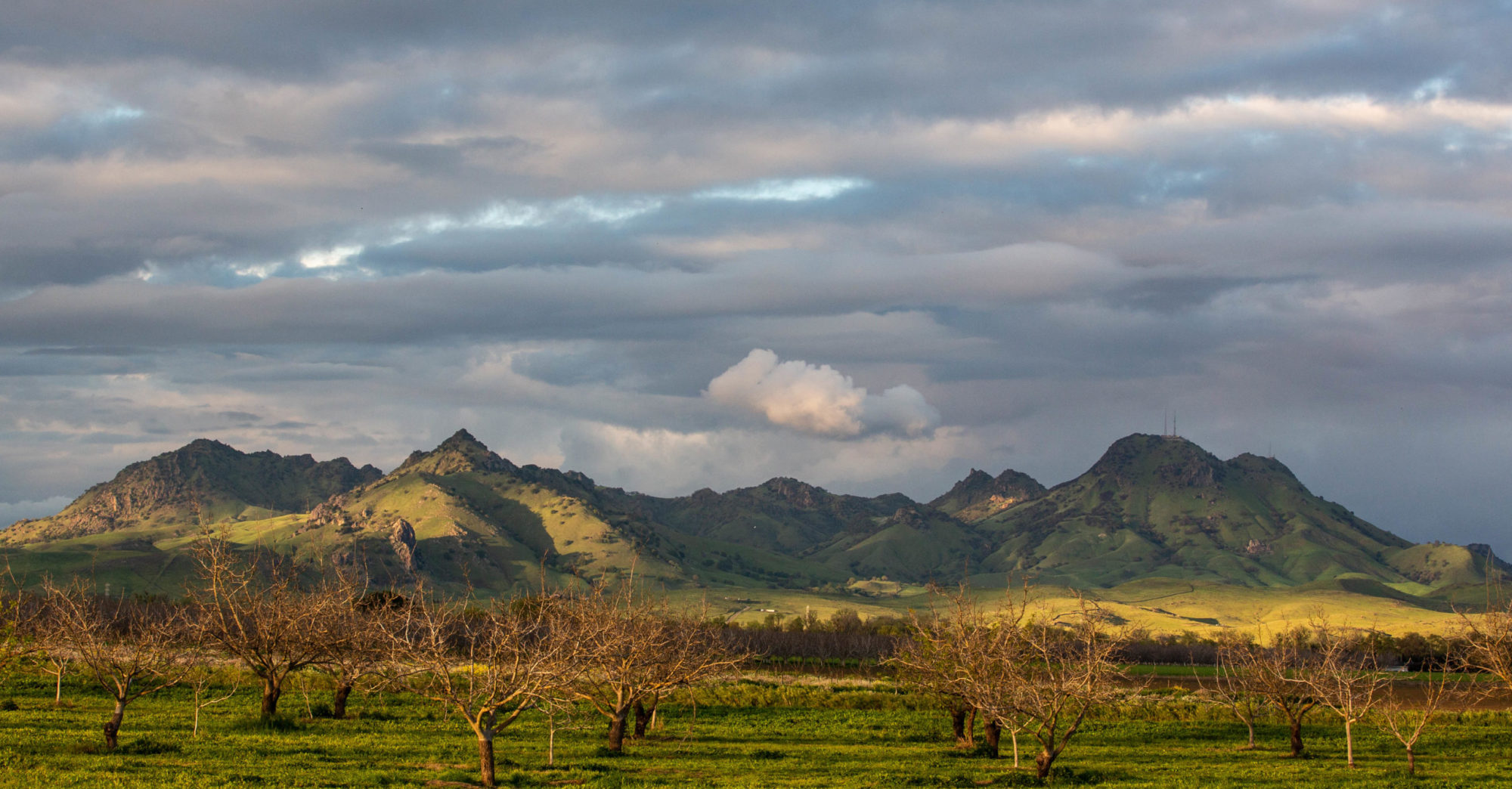
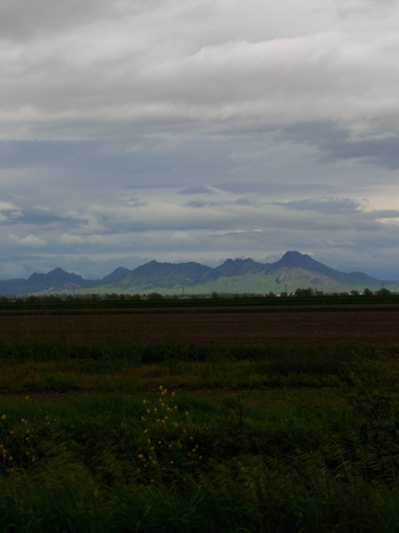
More about the ride later, but just one glimpse of what we took in on a route that went from the shore of San Francisco Bay up into the Central Valley, then across to the Sacramento River and tributaries to the very edge of the eastern foothills, then back to the lowlands in Davis. These are the Sutter Buttes, an isolated pocket of dead volcanic peaks that rise (the tallest is about 2,300 feet, I think) right in the middle of the valley. Since they’re surrounded by table-flat terrain for at least 30 miles in every direction, you can see them a long way off, they always look different depending on the light, and they always make an impression. Here, they were about 20 miles from where I was, just east of the town of Williams.
Technorati Tags: california, cycling