About a Dog

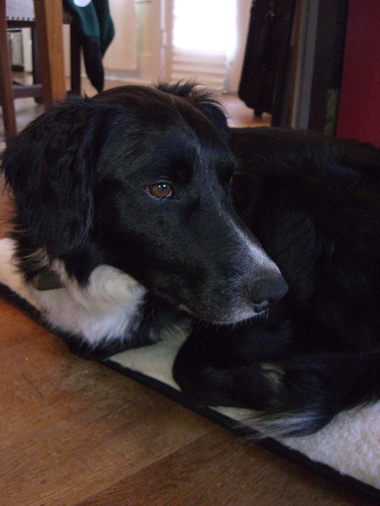
Scout, upon his arrival in Berkeley.

I mentioned, more than a week ago, that I’ve got a story about a dog. Here it is:

A week ago last Saturday, we were down in Paso Robles, a town at the southern end of the Salinas Valley. For me it was a bike-riding trip: I was signed up to do the Central Coast Double Century, a ride that starts from Paso Robles, crosses the Coast Range at a relatively low spot and goes out to Highway 1, then north to the lower end of Big Sur. From there, it recrosses the mountains at a much more rugged and much higher spot, then descends into and tours the valleys and hills to the east. Two hundred and ten miles in all, and something like 14,000 vertical feet of climbing.

While I was doing all that, Kate went with a big group of people from Paso Robles down to a wild place called the Carrizo Plain. Carrizo is a national monument, a big, open expanse of rangeland at the eastern foot of the coastal mountains. It’s dry, remote and forbidding, The last California condors soar there, and pronghorn (antelope) and elk have been reintroduced.

A long story made short: The group found an abandoned dog at the edge of a dry lakebed on the plain, 10 miles from the nearest highway and 20 miles from anything you might call a town. and we wound up taking him home to Berkeley with us. We named him Scout. He’s gotten his shots and been checked out by a vet and is smart and sweet and so far very calm, which makes it all the more mysterious how he wound up out in one of those places that really is the middle of nowhere.

We’ve been checking online lost and found listings for San Luis Obispo and Bakersfield, the nearest cities (though “near” in this case means about 60 miles to either place). Lots of dogs reported lost, though none in this area and none bearing any resemblance to Scout. After a week, I called the Carrizo Plain visitors center to ask if anyone had reported a dog missing.

“No,” the woman at the center said, “and let me tell you what happens with these dogs. People come out here and just leave them, no water, no food, nothing. It’s a real bad deal.” Occasionally, she said, herders will shoot the strays to keep them from harassing sheep grazing in the area. Starvation or thirst or coyotes take care of most of the rest, though occasionally the monument’s rangers will catch a dog and take it to the animal shelter in San Luis Obispo.

“This is far enough off the road that you can put the dog out and drive away and they can’t chase you,” the visitors center woman said. “People split up and decide they can’t keep their dog, or they don’t want to take it to the shelter — over in Taft you just put the dog down a chute and they usually just put it to sleep. But this is a bad deal. You wonder what people are thinking.”

Naked Guy

One Saturday back in the last decade, I stood at the corner of University and Shattuck avenues, downtown Berkeley’s always faintly shabby main intersection, waiting for the light to change. I noticed a tall, well-built, handsome young guy on the opposite corner. I think he wore sunglasses and sandals, and nothing else. His name was Andrew Martinez, and by the day I spotted him he’d become a local celebrity known as the Naked Guy. He came by the name through his one-man campaign to liberate the human spirit by going naked to class at Cal (and just about everywhere else, including a court date to defend himself against a charge of indecent exposure).

Anyway: Me and Andrew Martinez, Shattuck and University. I wish I could say I high-fived him as we passed or said something memorable, but all I recall is trying not to stare. For me, the idea of being naked in public is the stuff of unpleasant dreams, not liberation. That was the first and last I saw of the Naked Guy. Sooner or later, Martinez left Berkeley. I remembered him, though I never thought about what became of him.

Today’s Chronicle had the story, or at least its end: Martinez, who was 33, died in jail in San Jose last week, an apparent suicide:

“… After his days as the Naked Guy, Martinez spent the next decade bouncing among halfway houses, psychiatric institutions, occasional homelessness and jail, but never getting comprehensive treatment, his family said. His life ended in an apparent suicide Thursday morning.

” ‘It was an endless cycle of trying to get answers but never getting any,’ said his mother, who requested that her name not be used. ‘It was endless, endless, endless.’

“… But before his mental illness wreaked havoc on his and his family’s lives, Martinez was a bright, charismatic, sweet-natured youth with a promising future.”

Technorati Tags:

‘Baghdad ER’

HBO’s documentary on a combat surgical hospital in Iraq, “Baghdad ER,” aired tonight. See it if you can. It’s tough to watch from the bubble of safety in which most of us live because it involves viewing people who have suffered awful, often fatal injuries. On the other hand, the work of the medical people and their commitment to all those who need their help is inspiring to see.

One quote of many that stood out, from Major Martin Harnish, a surgeon:

“This war and the number of lives it’s affecting is just unbelievable. I have to think the people in this country [Iraq] are in a better place for it, or will be in a better for it. I have to believe that, because otherwise this is just sheer madness.”

Quotes like that and the film’s occasional unfiltered glance at the terrible reality that lies behind the casualty statistics is sure to provoke some in the Fox News sphere to denounce it as anti-war propaganda. I prefer to think of it as a glimpse at the price we’re all paying, some way or another, for the war.

In Passing

Stanley Kunitz, the poet, died the other day. He was 100. I’m not sure I can hear so well above the general static of life and lesser news, but he seems to have passed with hardly a sound beyond standard obituary treatments. He was not a contestant on “Idol,” a singer on the wrong side of the law, a president of the United States, a ballplayer, a fallen corporate chieftain, the architect of a policy condoning torture, a movie actor or director, a NASCAR legend, a pioneer of the Motown sound, a pitchman, the winner of a million bucks, or a suspect in a sensational crime. Not that this is a lament for unsung poets. If some network put a prime-time poet drama or sitcom on the tube, I know where I’d be: Watching “24” and “Survivor” and reruns of “L&O.” I probably wouldn’t know or care much about the poet’s TV adventures. And the real-life poets? They’d still be unknown, mostly, their voices too soft to hear.

But what voices, what profound voices, full of rain, sun and sane consideration of our condition. I wasn’t aware of Kunitz until he was 95, when he published a new collections of poems. He got a flurry of attention in poet-friendly mass media: public radio and public television (for instance, “Fooling with Words,” with Bill Moyers). I believe that on one of his appearances, someone had him read a poem he’d written when Halley’s Comet crossed our sky for the second time in his lifetime:

“Halley’s Comet”

Miss Murphy in first grade

wrote its name in chalk

across the board and told us

it was roaring down the stormtracks

of the Milky Way at frightful speed

and if it wandered off its course

and smashed into the earth

there’d be no school tomorrow.

A red-bearded preacher from the hills

with a wild look in his eyes

stood in the public square

at the playground’s edge

proclaiming he was sent by God

to save every one of us,

even the little children.

“Repent, ye sinners!” he shouted,

waving his hand-lettered sign.

At supper I felt sad to think

that it was probably

the last meal I’d share

with my mother and my sisters;

but I felt excited too

and scarcely touched my plate.

So mother scolded me

and sent me early to my room.

The whole family’s asleep

except for me. They never heard me steal

into the stairwell hall and climb

the ladder to the fresh night air.

Look for me, Father, on the roof

of the red brick building

at the foot of Green Street —

that’s where we live, you know, on the top floor.

I’m the boy in the white flannel gown

sprawled on this coarse gravel bed

searching the starry sky,

waiting for the world to end.

‘Army Issues Warning About Iraq Documentary’

Someone recently told me in passing — someone who should know, since he’s there now — that what’s been happening in Iraq the last 38 months “doesn’t really rate the word ‘war.’ ” I think I understand the sentiment. We shouldn’t raise the significance of a battle with a bunch of murderous thugs (“primitive screwheads” is the term my acquaintance used) with such an important appellation. But to me, even sheltered as I am from the reality of what’s really happening over there, the suggestion this isn’t a war just doesn’t ring true. Call it what you want: People are dying by the thousands — by the tens of thousands — in a sustained siege of organized violence. Call it a picnic or a police action or the latest beachhead for democracy, the dead and wounded and the shattered pile up just the same, whether we’re paying attention or not.

HBO is about to air a documentary on one of the remarkable stories of the war: the work of the frontline U.S. military trauma hospitals in Iraq. It is not an untold story: many big media organizations have dipped their toe into it already. The HBO movie, “Baghdad ER,” is a little different, though, in that it’s the product of a longer-term immersion into the world of combat medicine. The makers spent two months filming in a combat trauma hospital in Baghdad’s Green Zone. And the movie’s 63-minute length represents more than the usual gnat’s-attention-span treatment that TV news accords such stories.

“Baghdad ER” is scheduled to air on May 21. It’s graphic. The filmmakers say so, and the Army is backing them up, with the service’s surgeon general issuing a memo advising the film may provoke flashbacks or nightmares among those who have served in Iraq.

(The New York Times had a different spin on the story over the weekend. Quoting Army sources, a Saturday article says the Army is backing away from the documentary over concerns “that its grim medical scenes could demoralize soldiers and their families and negatively affect public opinion about the war.”)

Technorati Tags:

Dog

Katescout

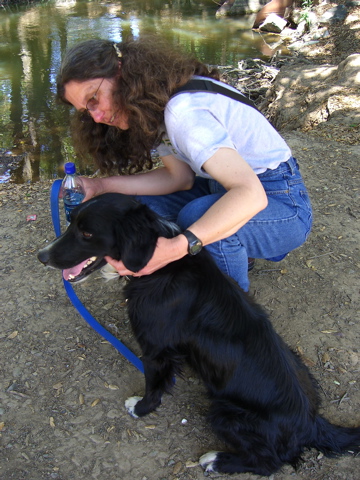
There’s a story that goes with the picture, really. But not for telling now — too tired after another hard ride, and a long drive to and from Central California on top of that. But the dog — he’s at our house. The picture is from a stop we made at a park down in Santa Clara County on the way north. The rest will wait. But I will say this animal’s arrival in our lives makes me want to re-read the Paul Auster novel “Timbuktu.”

‘Good Guy, Bad World’

Floyd Patterson died, and now that’s mostly a reminder of a time when there weren’t three or four or seven world championships in every boxing weight class; in other words, a time when boxing was a marquee American sport and the heavyweight championship had an aura of importance about it. I remember my mom’s enthusiasm for Patterson, listening to his fights with Ingemar Johansson on the radio, her excitement when Patterson won back the title Johansson had taken from him. The New York Times’s obit of Patterson talks about his “sensitivity”:

“He was a good guy in the bad world of boxing. He was sweet-tempered and reclusive. He spoke softly and never lost his boyhood shyness. Cus D’Amato, who trained him throughout his professional career, called Patterson ‘a kind of a stranger.’ Red Smith, the New York Times sports columnist, called him ‘the man of peace who loves to fight.’ ”

How “shy” and “sensitive” was Patterson? David Remnick’s beautifully written “King of the World” recounts many of the Patterson anecdotes you’re likely to read in the obituaries and more than a few that go beyond the usual euphemisms. When he beat Johansson to take back the title, he helped his stricken foe back to his corner. In another fight, Patterson knocked his opponent’s mouthpiece out. The dazed fighter lowered his gloves and proceeded to search for the missing gear; Patterson stopped and helped him before going on to knock the guy out. Part of Patterson’s odd legend is that he sometimes carried a fake beard with him to his fights in case he lost and wanted to depart the arena incognito; in fact, he used it after losing the championship to Sonny Liston at Comiskey Park in 1962.

But the Remnick passage that came to mind when I heard Patterson died is one that explores the depths of Patterson’s humiliation when he lost to Johansson:

“Patterson was a speed fighter, but against Johansson he never made his move. He froze, and Johansson, a burly Swede of modest talent, unloosed what his camp called, so annoyingly, his ‘toonder and lightning.’ After the first knockdown, Floyd got off the canvas and began walking dreamily toward his corner. Leaving the neutral corner, Johansson came in from Patterson’s blind side and struck him down again; the assault looked less like boxing than an angry drunk splitting open another man’s skull with a beer bottle. By around the fourth knockdown, as Patterson crawled around the canvas, staring through the ropes, his eyes locked on John Wayne, who was sitting at ringside, and, as he stared at the actor, Floyd felt embarrassed. Embarrassment was Patterson’s signature emotion, and never more so than now. The fight was not even over before he started to wonder if everything he had fought for — his title, his belonging to a world greater than the one he grew up in — if all that was now at risk. Had he ever deserved any recognition, any belonging in the first place? What would John Wayne think of him? The referee, Ruby Goldstein, stopped the fight after Patterson had gone down for the seventh time.”

Technorati Tags:

Requiem for a Road Bike

Fifteen years ago, after having done a few long rides, including the Davis Double Century, I bought a bike I had developed a lust for (a lust, but only the chaste cycling kind). It was a Bridgestone RB-1, and was well-known for being a relatively light and sporty lugged steel road bike with a nice mix of components for a relatively modest price. I bought it at The Missing Link, a co-op shop in downtown Berkeley with a vague counterculture reputation, for about eight hundred dollars. I picked it up the week before the Grizzly Peak Century, a hilly 100-mile ride, and wondered during and after whether I had made a mistake. The bike worked fine, but it was geared sort of aggressively for a non-hill climber like myself. Back then, it wouldn’t have soon occurred to me to change the components to make it easier to ride, and I just got used to riding hills with what for me was an uncomfortably large smallest gear — 42×23 in cycling jargon (meaning my smaller front chainring had 42 teeth and my biggest rear cog had 23 teeth; in practical terms, that meant the rear wheel would turn about 1.85 times for every revolution of the cranks; that’s a big gear for a mere mortal struggling up a steep hill).

Crackedframe1Crackedframe2

Since I bought the bike, I’ve had years where I rode a lot and many more when I did not. Sometimes the RB-1 would sit so long between rides that I had to dust it off before I took it out. But in 2003, when I decided to try to do Paris-Brest-Paris, the quadrennial 750-mile, 4-day ride in France, I decided I’d do it on the RB-1 rather than spring for a fancier and more expensive bike. By then, the bike had been out of production for nearly a decade, and it had sort of a cachet to it. I decided to strip off the original parts, have the bike repainted (by Ed Litton, a framebuilder up in Point Richmond), put new components on (including a triple crank with some low gears for when I started to fade) and ride it as new during the qualifying brevets leading up to PBP as well as during the main event. Ed’s paint job was simple but elegant — a dark green with a single ivory panel that displayed the Bridgestone decal. The bike’s spare, classic appearance and relative rarity — first that it was an RB-1, second that it was a lugged steel frame at a time they’re disappearing from the road in favor of titanium, carbon fiber and aluminum frames — drew some comment. Eventually, I, or maybe it was Kate, even gave it a name: Tir na nOg, Irish for “Land of the Young” (see the movie “Into the West” — the reference is explained there), which is where you get to on long, long bike rides.

PBP ’03 was a great experience, but then with one thing and another, I rode less in 2004 and 2005 before ramping up again this year in anticipation of PBP ’07. A couple months ago, though, I started to have some problems with Tir na nOg — the front derailleur seemed to not want to stay in adjustment. I fiddled with it myself, and so did more than one of the folks at The Missing Link. On April 1, I did a 300-kilometer brevet from Santa Cruz, through the mountains near town, and down to the Pinnacles and back. At the end of the ride, the shifting problem was bad. I put the bike aside afterward and have done some long rides since on my son Thom’s bike — a more modern steel Bianchi. I finally decided to take the RB-1 in to get looked at, again, yesterday. When I described what was going on, and how the crank seemed to be warped, Chuck, the mechanic, took a look at the frame near the bottom bracket.

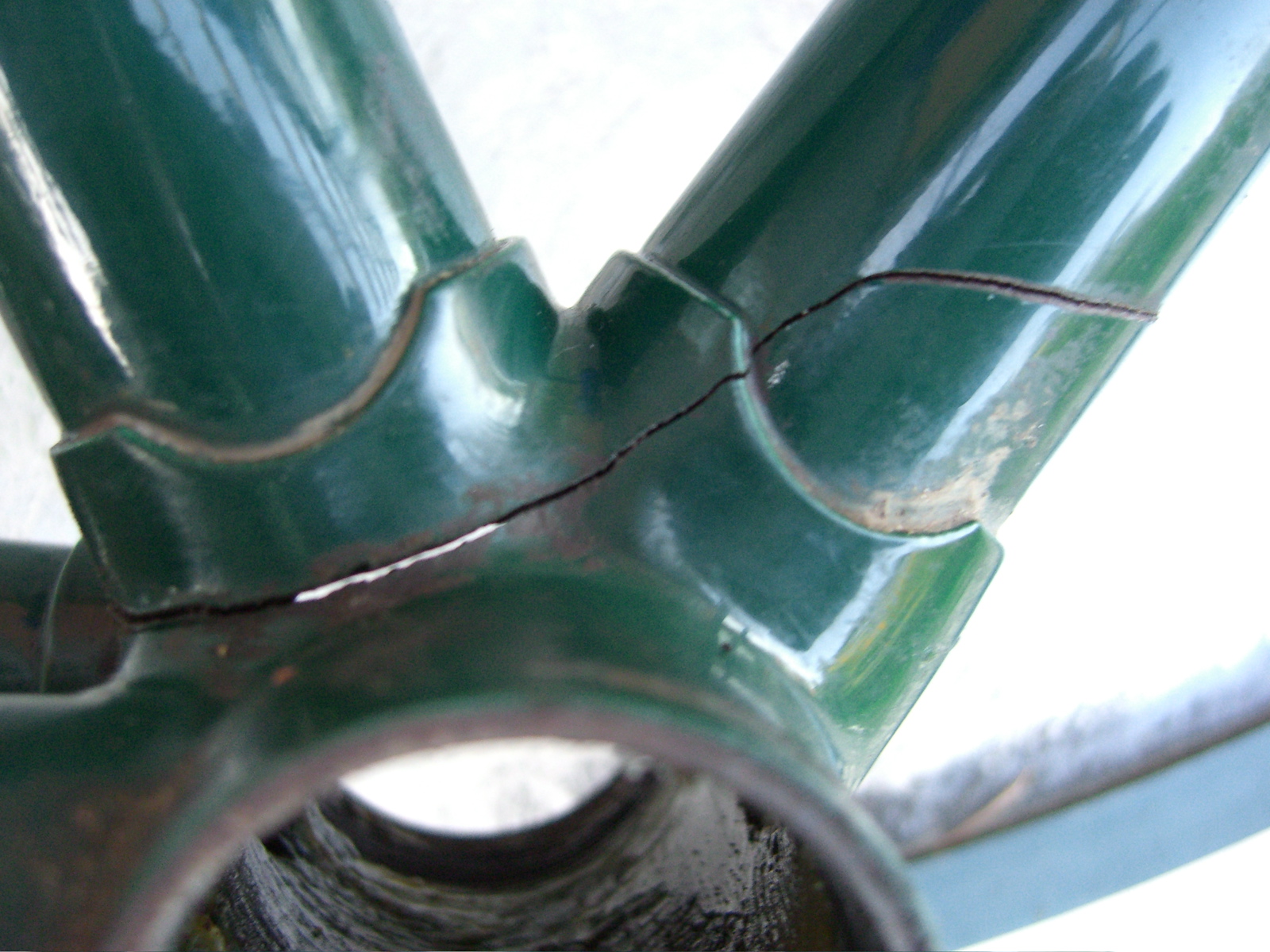
“Here’s your problem,” he said. “You’ve got a cracked frame.” He pointed to a 1-inch fissure in the down tube — the diagonal one from the bottom bracket to the head tube. I couldn’t believe I hadn’t noticed it before, but then neither had anyone in the shop. Chuck said he’d strip the frame so I could bring it to a framebuilder for repair. I went back today, and he said, “I want to show you something.” Taking the components off the bike, he had discovered the crack ran a couple inches farther than we’d seen yesterday: Through the bottom-bracket lug where it receives the seat tube. The crack was so big I could see daylight through it. “I think it might be game over for this frame,” Chuck said — though he suggested I show it to a framebuilder in Oakland just to see whether there was any chance at fixing it. In any case, that’s the end of the long rides for this bike. As it happens, I have another freshly painted RB-1 frame I bought at the end of 2003 that’s just been sitting here in our house. I’ve been hesitant to spend the money to get it built up with all new components; now I’m going to have Chuck put it together with the gear from the old bike. If ti all works out, that will be my ride for next month’s Cascade 1,200 — a 750-miile, four-day ride in Washington state.

Technorati Tags:

‘Why We Write’

While we’re back on the subject of Iraq, I need to point to a piece by Michael Yon: ‘Why We Write.’ He’s a freelance journalist (whom I see described elsewhere as a former Green Beret) who has reported from both Iraq and Afghanistan. He’s caught some flak recently for his assessment that the situation in the latter theater is deteriorating rapidly:

"… In 2007 and 2008, at this rate,we will face an extremely fierce enemy
in Afghanistan, one that we already know is courageous and tough, an
enemy left mostly unmolested while they brazenly guard the poppy fields
that will make them rich with money to buy weapons. Explosives. Rockets. …

"… No matter what anyone says, the Afghanistan I just left is easily as
dangerous as the Iraq I spent almost a year in. But whereas we are
beating back the enemies and winning in Iraq, the enemies in
Afghanistan are getting stronger as the seconds tick. We need to listen
to our military experts and to our young soldiers, too. Like Ernie Pyle
once noted, nobody is more plainspoken than combat soldiers. The ones I
met in Afghanistan call that the ‘forgotten war’ but unless things
change dramatically, 2007 will be a year everyone remembers in
Afghanistan."

Beyond his assessment of what’s happening in the war zones, he’s got some compelling things to say about the role of journalists in this war.

Beer and Miniskirts and the Non-War in Iraq

Last Monday, I posted something I’d found in my daily Iraq reading about a U.S. Army captain, John McFarlin, who had been shot in the head during a firefight with insurgents but emerged unscathed thanks to his combat helmet. I was struck by what I read as the detached, nearly clinical language McFarlin used to describe the event. The Army News Service quoted him saying, “I was suppressed for a moment and then I got back up” and returned fire. I wondered aloud, with a touch of sarcasm, whether “suppressed” was a euphemism for “stunned.” Then it was on to other business. But a couple days ago, I saw a new comment on the post:

“Stunned would be if I were disoriented and didn’t know what happened.

“Suppressed is when you get down because it seemed like the guy who was shooting at you was on target and it was a good idea to drop down for a moment. It’s a technical term and I chose it because it means “the target chooses to conceal itself instead of presenting.”

“When the gunners on the other two HMMWVs [high-mobility multipurpose wheeled vehicles] engaged him, then HE was suppressed.”

The comment was signed “John McFarlin” — the name of the man who had been shot. I was surprised, not stunned, and wrote him back, thanking him for the clarification and “for the dedication it takes to serve in such a challenging environment.”

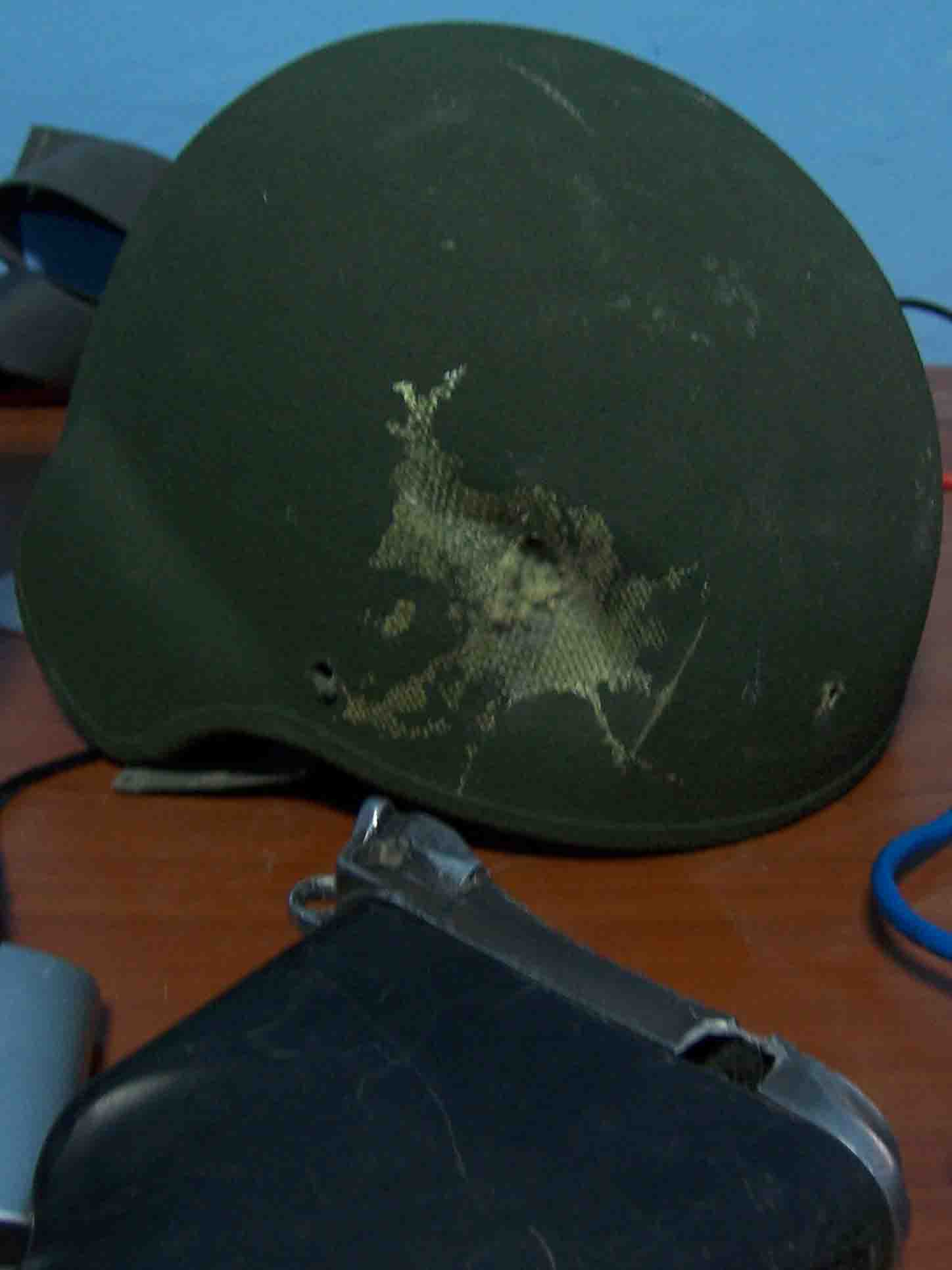
I wasn’t entirely surprised when a few hours later, an email with a photograph attached arrived.

“Dear Dan,

“No problem!

“I really don’t want to make much of it, but really it felt like an open hand slap on the head. The equipment that we have these days is pretty good–I mean this not only in relative terms, but in absolute terms, as well. Not only was my life preserved, I was able to return to the fight at hand, though I prudently remained down until my fellows engaged the AIF [anti-Iraqi forces] individual who shot me. The photograph attached shows the exit hole of a round that passed through the buttstock of the crew served weapon I was manning. Had I been up, and that butt stock been where it normally is–out against my shoulder–the round would have struck me–although in the armored plate. So, even then, I would have been protected. Anti-climactic, I know.

“By way of letting you know that I am in fact the Soldier mentioned, I send you a photograph of the helmet. I retain the helmet to this day, and will always display it as proof of our nation’s dedication to caring for our Soldiers. This is the bottom line: I was shot in the head, and not so much as a pause in duty, let alone a Purple Heart. That’s the good news to take away from this.

“You’re very welcome, by the way. Go have a beer, lay down in the grass, or do something else pleasant that you like to do, would you? That’s part of the point of what we do as Soldiers.

“Best!

John McFarlin

CPT, AR, USA”

(By the way, all of Captain McFarlin’s remarks in this post are quoted in their entirety; I’ve spelled out some of the acronyms he uses in brackets.)

That last little paragraph rankled me. To me, it’s saying, buddy, don’t you worry about what’s happening over here. Just turn over and go back to sleep. And I told McFarlin so:

“… There’s something implied there that I object to — the notion that you and the millions like you who serve and have served in the armed forces are enduring disruptions in their own lives and putting themselves in harm’s way so that the rest of us can sit on our barstools as if we have nothing to worry about. Don’t get me wrong — I like to have a beer as much as the next guy, and I’m buying if we ever find ourselves in the same neck of the woods — but frankly I don’t want anyone risking life and limb just so I can drink my microbrew unperturbed. If you spent any time perusing my now very occasional comments on the war in Iraq, you know I’m no fan of the enterprise and never have been. In short, I’ve always felt we went into the conflict with only the most casual assessment of what the true long-term costs and effects would be; the people who have paid the immediate price for that carelessness are people like you who undertake their service in good faith and the tens of thousands of Iraqis who, with no say in the matter, have died as we remake their society for them. Ultimately I don’t expect you to agree with any of the above — in fact, I expect you to tell me how short-sighted and misguided a view it is. (But the right to freely express such disagreements — that’s worth serving for). I also think that the least we owe you as citizens is to think seriously, every day, about the war and about how to resolve the conflict before it becomes something we bequeath to the next generation, or the one after that, to take care of.”

At this point, it won’t be a shock to hear that McFarlin wrote back:

“Dan,

“Absolutely you can use anything we write to one another as you wish. Be charitable to my person, even if we may have different points of view–that’s all I ask. I know you’re not a fan of the effort in Iraq (it really doesn’t rate the word “war”), not why it was engaged, nor the sausage-making that’s going on over here as it’s presented in the news. I can appreciate that.

“It takes an effort on my part to even think of how the inconvenience and risk which I take as being part of this effort in Iraq is something I should consider being upset about. I mean, I am a member of what amounts to a modern warrior-monk society. Think about it: no sex, no beer, plenty of privations, and the opportunity for bodily mortification. Many of the discussions about the deeper politics surrounding why we are here never really enter into our minds. Or if they do, they enter them quietly, sit down, read a newspaper and have a smoke, and then tiptoe out the way they came. We’re differently minded people, I guess. Maybe this is some sort of congenital blue-statism. Or maybe there’e something more to it than is easily or glibly explained.

“This thing that happened to me, getting shot. It’s great, a great success story about how a nation graced with smart people, liberty, and money has been able to defeat the weaponry of our would-be killers–a bunch of primitive screwheads without a moral leg to stand on, straight criminals, really. Not with bullets–though we have plenty of those–but with synthetics and ceramics worn by a Soldier on a hot April day in Diyala Province, Iraq. This is both remarkable and anti-climactic. Some person with a twenty-pound brain worked out the material science that permitted me to live. It had nothing to do with heroics or MY effort at all–although some Soldier before me secured the blessings of liberty so that the person with the twenty pound brain could concentrate on material science instead of how to navigate the maze of corruption and race hatred so prevalent in so many parts of the world. I want people to know that I got shot. And lived. And more than that, I wasn’t even hurt. I was right back in the fight, and I think it’s important for people to know that we live in an amazing country, and that the most misguided of adventures (for those who characterize the extraordinary effort in Iraq as such) can result in sublime moments. Moments that throw into sharp relief the difference between who we are as a people, and the peoples of the rest of the world. Even if I died for something as obscure as the right or the opportunity for a skinny, thick-glasses wearing kid to excel in material science, it would be enough. Because that’s worthy.

“But, regarding the notion that the millions who serve don’t do so to allow their countrymen to live in peace and prosperity: If I were to say to you that it is a common saying here–in reference to some idiotic celebrity news headline, or the latest imbroglio over which American Idol contestant is going to continue, or the no holds barred fight over a leather covered ball striking a player in a game where the wages are ridiculously inflated–that we fight so that people in America can live so well, that these are their concerns, rather than the horrid, inhuman concerns that people in Iraq must bear…would you believe it? We look at our countrymen living well in America, and we smile crookedly at our own privations, knowing that the terrorists are losing. BIG TIME. Every beer that is drunk. Every woman who wears a mini-skirt to a bar and goes home with a guy she picks up. Every porno mag that gets bought. Every Jew that says “Shalom” to a Muslim. Every inane television program. These are victories–we live vicariously through our countrymen–and so it’s no stretch at all to say that we enter the heart of our discontent and find solace in the fact that our sacrifices have some meaning in a greater context which, though it can be hard to comprehend day to day, makes some sense in a long view. We say, over our meals while shaking our heads over some idiotic sensationalism, “We fight, so that people can worry about that stupid crap,” and we mean it. Unbelievable, but true. I know you don’t want guys like me putting our lives on the line so you can knock back a nice cold one in comfort while watching Battlestar Galactica, but most of us in uniform are convinced that we already won the lottery, even by being born in the United States, and the least we can do is shoulder a share of the burden.

“I hope that I have presented this strange point of view that drives many Soldiers without being overly pedantic, but there’s something profound in the selflessness of many Soldiers. We talk a good game about how we’re in it for us, and about how we’re going to go buy a Harley when we get back, or blow it all on strippers, or some other misuse of our wages (I personally am getting my credit card debt paid down a bit) but in truth, we’re the workhorses of empire–an empire that every American, whatever his political stripe, shares in, just by virtue of the freedoms and luxuries which they take for granted–or even not for granted–every day. And this empire always existed, and was always secured by force: sometimes bald-faced, sometimes sublimated in some way that was not so offensive to the sensitive.

“I hope that this rambling is comprehensible, and that you understand that not once have I taken any easy path in expressing what must necessarily be a complicated web of thought. As for any differences in opinion we may have: We believe what we believe because it seems right to believe the way we believe, and not because of any fundamental difference in the quality of who we are. So much public discourse is shameful, with accusations and attempts to annhilate those of different perspective–a great waste of energy. I hope that in this case, I have expressed how what I believe provides a context for the decision to volunteer for deployment to Iraq, rather than the very much less worthwhile discussion methodology of trying to convince someone that what they believe isn’t correct.

Best,

John”

I haven’t written back, yet, beyond a small note of acknowledgment. Somehow, in the spirit of the exchange, I feel I need to let him have the last word till I write a more thoughtful response to him. Stay tuned.

Technorati Tags: