Denial, Act 2

Floyd Landis has, for the moment, a Tour de France title and two blood samples that tested positive for testosterone samples. He won’t get to keep the title if the test results stand, though; cycling officials are ready to strip him of the championship, and the Tour runner-up Oscar Pereiro is saying he wants a yellow-jersey presentation so that he feels like he’s really the Tour winner. So Landis is doing the only thing he can until his lawyers figure out who to sue: launching a media blitz to tell his story, which boils down to “I’m an honest, hard-working guy and I’m telling you I didn’t do anything wrong.” The truth is that there’s really nothing he can say that will get him off the hook. The best case, for everyone, would be the appearance of some incontrovertible evidence that he shot himself up with something, that someone tampered with his samples, or that the test was simply wrong and invalid. Landis could confess. Some lab technician could come forward and say, “I did it.” Or cycling officials could say the test is untrustworthy. Don’t hold your breath.

Instead, speculate about what might explain the positive test result that came back after Landis’s heroic win on Stage 17:

Landis needed a pick-me-up after getting thrashed in Stage 16 and knowingly took something he shouldn’t have. As I’ve said before, I doubt this because the consequences of being found out were so predictably devastating.

Landis was doping all along and just happened to get caught after Stage 17. Landis and his supporters make much of the fact he was tested eight times during the Tour and that just one of the results came back positive (in fact, the head of the International Cycling Union says only one of 300 tests administered during the Tour — Landis’s, after Stage 17 — came back positive). But what if he was taking something all through the Tour that went undetected, for whatever reason, until his incredible physical effort in the 17th stage? I suppose you could call this the BALCO scenario, after the Bay Area sports-nutrition lab that distributed performance-enhancing substances that anti-doping tests couldn’t detect. ESPN cycling correspondent Andrew Hood notes that Landis was seldom tested in past years, and also discusses known ways of defeating the current testing protocols.

Landis doped unknowingly. Maybe a well-meaning trainer gave him a little something extra in his daily dose of vitamins and supplements (not a credible possibility; the probability of detection, and the consequences from it, are just too high); or some enemy managed to slip him something (I shy away from most gunman-on-the-grassy-knoll theories, so I can’t swallow this one).

Alcohol or cortisone or something else threw off the test results. A real possibility, according to some serious sports-nutrition types, though probably very hard to prove.

Landis’s samples were deliberately contaminated. By whom? Why? It’s the gunman on the grassy knoll again. Tough sale.

Landis’ normal testosterone levels are naturally high, leading to a false positive result. If this is true, it ought to be a matter of producing the medical records that demonstrate it.

Take your pick, or come up with your own explanation. I’m still sticking with my instinct that a guy who’s been around the highest level of cycling for so long, who had apparently gotten to the elite level without doping, wouldn’t have done something as suicidal from a career perspective as drug himself with the whole world watching.

Technorati Tags: , , ,

Melissa the Loud

Columbuscircle080106

New York flashback: Her real name is Melissa Kacalanos, but she goes by Melissa the Loud (because of her voice, she says online). She was playing this instrument — the hurdy-gurdy — at Columbus Square on Tuesday night, when the temperature was about 95, and was just taking a break to tune it when I walked up and asked to take her picture. Her website: www.melissatheloud.com.

Technorati Tags:

Vacation Video Experiment

I had my camera out when our flight was taking off from New York for Oakland the other day. I’m not sure if a camera is on the list of electronic devices you’re supposed to keep shut off during takeoff and shortly after, and I don’t want to draw attention to myself by asking the flight attendants. So on Wednesday, I switched the camera to video mode and recorded the first couple of minutes as the plane rolled down the runway at JFK and climbed to 2,000 feet. The next part of the experiment was putting the takeoff video online. That turns out to be easy. I downloaded the file to a computer, then uploaded it to YouTube (it’s a 60-megabyte file, and it took a while to send over our DSL line). Check it out below.

Trying to look past the novelty of the thing — yes, I’m somewhat slackjawed that this kind of video publishing is so straightforward for someone with little technical ability — this sort of tool really does open up new possibilities for self-publishers (artists, journalists, etc.) of all kinds. [Postscript: I went back to YouTube to look for other takeoff videos. What an original idea: A search turns up 827 hits — many of which are commercial airline takeoffs shot at airports all over the world.]

Today’s Best Names

Typhoon Prapiroon. About to hit the island of Hainan, off China’s southwestern coast. Prapiroon is reported to be the Thai god of rain. When the storm hit the Philippines a couple days ago, it went by the name Henry.

David Tarwater. U.S. and University of Michigan swimmer and training partner of Michael Phelps. Tarwater? Sounds viscous.

Flying Back

There will be plenty of East Coast trip postscripts to come, but for now: We’re sitting in a terminal at Kennedy airport; outside, it’s about 100, and even people who have been working inside all day are complainng about the heat. Outside, one big difference between city dwellers and suburban folk shows itself. The urban types are out on the streets, walking to the subway, shopping, whatever they have to do. It’s not like the sidewalks were packed in my brother’s neighborhood, but people were out and about, even if lots of us looked a little wilted. Out in the suburbs: No one on the street, anywere; people out there — and "out there" is probably any suburb you can think of — live strictly a doorway to doorway existence during the worst weather. Glad the power grid is holding up for everyone so far.

This morning, getting ready to leave John and Dawn’s place, we were talking about the latest bicycle fatality in the Oakland Hills. A guy out for a ride was hit head on up there on Skyline Boulevard, within a half mile or so of where I crashed in June, by a motorcyclist; the cyclist died of his injuries, the motorcyclist apparently walked away from the wreck. Not to place blame without knowing what really happened, but one of the risks bicyclists take riding up in the hills, a risk that’s increased a lot in the last 20 years, is that we share the road with motorcycle riders and motorists who treat the twisting roads like a raceway challenge. I’ve often worried about getting hit up there.

Anyway. At one point, John said, "Hey, did you hear about that Wired editor who died during the marathon?" I hadn’t. I looked up "wired editor marathon" onlne, and found a story on Wired News. The editor who died during the marathon was a guy named Bill Goggins. I knew him from my stint at the magazine in 1998 and from my days freelancing for the magazine. Bill was 43, and the news accounts say that he collapsed at mile 24 of the San Francisco Marathon last weekend and couldn’t be revived. A friend who saw him at mile 21 said he was smiling and running strong, and a mutual friend had seen him twice in recent days and said he seemed fine. The thing about Bill, whom I never got to know well enough, was that he was brilliant and funny and charming and had a big heart that was right there for anyone to see. Forty-three. Hard to believe. See you, Bill, wherever you are.

Continue reading “Flying Back”

Forza Italia: Bath-Towel Edition


Italia

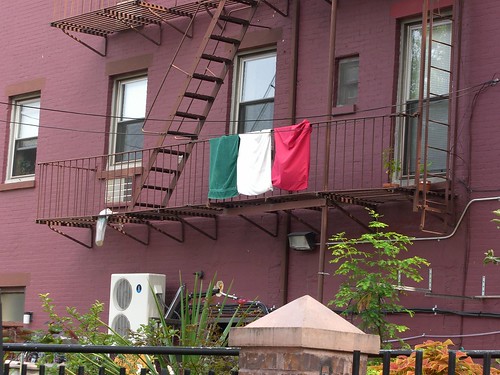
John and Dawn (my brother and sister-in-law) live in Carroll Gardens, an old Italian neighborhood southwest of downtown Brooklyn. Italy’s victory in the World Head-Butt Cup last month sparked outpourings of joy ("I’m so happy!" John recalls one guy telling him. "I’m from Italy!" To which John comments: "No, you’re not — you were born in the Bronx"). Team Italy’s success also prompted the appearance of even more than the usual generous display of Italian flags in the neighborhood. The pizzeria across the street has one on the sidewalk. My favorite is one around the corner — green, white, and red bath towels hanging from a fire-escape railing.

Heat, a Re-examination

Cimg0856

The last day of July, the first of August, it’s supposed to be hot. Today, it’s an unremarkable 90 or so here in Brooklyn. I’m sitting in my brother and sister-in-law’s unairconditioned kitchen about a mile south and east of the Brooklyn Bridge. Not suffering. But tomorrow we’ll be getting what folks to the west have been dealing with for the last couple of days (112 in Bismarck?!). The National Weather Service is warning it will get up to about 100 Tuesday and Wednesday, that it will be plenty humid, and that we’ll have high ozone levels as the air in the region stagnates. (Add rum and guns, then stir for a swell party!)

The last few days, Kate and I have been staying in a friend’s house  near the northern New Jersey shore. It’s got central air conditioning, and the system has been running ever since we arrived there last Thursday. It struck me this morning as I walked outside for the first time and shut the sliding glass door behind me that around here, the ability to cool the air in homes and cars and public places of all kinds is just as vital as the ability to heat it in the winter. In the suburbs, anyway, you don’t see homes open to the elements on a hot day any more than you’d see a place with its windows flung open when it’s zero outside. Yet, the weather’s the weather. It may be incrementally hotter on average than it was a generation or two or three ago, but everyone here endured long, stifling stretches of heat then without refrigerating every living space, just as most of the world’s people do today. (We went to France in August 2003 at the tail end of the country’s extended heat wave; I knew air conditioning was uncommon there, but I hoped against hope that somehow our little hotel would be an exception; instead, when we got to our room, we found that the windows hadn’t been opened for days and the place was like an oven — and what was worse was that for several days afterward, there wasn’t enough of a breeze to cool anything off.)

I’m not arguing for some kind of sweaty, hair-shirt virtue in living without air conditioning. Just makes me wonder sometimes what would happen if we all suddenly had to do without (which ties into my fear for the next couple of days; I’m concerned that the power demand here will cause a blackout and shut down the air-traffic-control system and keep us from flying back Wednesday to our effete little climate back in Berkeley). I do remember that before we had our first air conditioners, in 1966, the remedy for hot nights was staying up late watching movies with our mom and taking cool showers before we headed off to bed. Somehow, we slept.

(Picture: Hamilton Avenue and West 9th Street, Brooklyn. It wasn’t really 99 degrees.)

Saturday Night, Sunday Morning

After a day spent near the Delaware River, then with Kate’s cousin’s family north of Philadelphia, we decided to take an impromptu sidetrip to Gettysburg (how impromptu? We didn’t bring a change of clothes). So tonight, we’re camped out in a motel just outside Harrisburg and about 30 miles (an exhausting day’s march or a half-hour air-conditioned drive) from Gettysburg. I haven’t been here since 1971; Kate’s visiting the battlefield for the first time. Oh, and our rental car has South Carolina license plates.

More tomorrow.

Denial

First, is there a more unfortunate name in the entire world of sports than Dick Pound? He’s the head of the Orwellian-sounding World Anti-Doping Agency (known also by its goofier acronym, WADA). I only mention him because he’s always come across as a supercop-type zealot, and his comments on the current unpleasantness involving the formerly unbesmirched Tour de France champ Floyd Landis remind you of a narc who’s just caught a kid swigging Robitussin. Pound calls the Landis’s situation — it doesn’t really merit the label, yet, of "charges" or "accusations" — "a stunning indictment" of professional cycling. But the sport is in denial, he says:

“They have a huge problem, a
really serious problem, but first they have to recognize it. It’s like
an alcoholic. Unless you acknowledge you have a problem, it’s very hard
to move toward a solution.”

Huh. This is the sport that banned a whole team from the Tour a few years back because doping paraphernalia was found in a team car. It stopped two stars from riding in this year’s Tour because of allegations they were connected with a doping doctor. Many lesser but still prominent riders have been suspended from competition for years for violating doping rules. Now, the Tour winner’s team has outed its champion on the basis of a test result that looks like it’s open to interpretation. You wonder what sort of solution Pound thinks might be needed to correct this sort of denial. Capital punishment?

But back to Landis. Maybe it’s a mistake to apply plain, everyday, civilian logic, but the idea of anyone in his position deciding to shoot up (or whatever) at that stage in the race simply defies belief. The upside from doping would be uncertain at best. The downside would be clear: Disgrace and infamy — exactly what’s raining down on him now, denials and protests notwithstanding. Who would take that chance? Especially after having played by the rules up to that point?

Does it matter, really? Certainly not in the way that it matters when a nation’s leaders decide to gamble with the lives of others.  But even in the sports context, does it matter whether these guys are taking drugs or not? A friend and fellow cyclist in Berkeley, Steve, points to a pretty good essay by a former marathoner, triathlete and sports-doping enforcer who says maybe the most beneficial thing for athletes is to do away with all the drug rules and let the chips fall where they may. He argues that fair enforcement is impossible and that sports at the elite level require such extreme levels of physical punishment that they’re intrinsically unhealthy and that some banned substances could help competitors limit the damage. I’m not buying that — the example he uses aren’t convincing to me — but he challenges the gospel assumption that all sports doping is bad and that all attempts to stop it are good.

We’ll see about Floyd. If I were the betting sort, I’d put my money on him being exonerated. There will be a reasonable explanation for an anomalous test result. But the folks who say the damage is done are right. A few days ago, his story was about a heroic comeback. Now it’s about a desperate attempt to convince the world the heroism wasn’t fake. There’s no way you can make people put that aside and embrace the old story line. More’s the pity.

Summer, EDT

We landed in New York, JFK, on Wednesday evening. Remind me to relate sometime the story of the large model airplane that someone flew by remote control up to our jet’s altitude as we landed. We got our rental car and drove slowly to my bro’s place in Brooklyn and had a nice cookout with him and his wife and daughter on their rooftop patio. A true NYC experience.

Yesterday — Thursday — we drove across the ungainly mass of the Verrazano Narrows Bridge, past Staten Island’s artificial mountains, and over the Outerbridge Crossing to New Jersey. It’s summer — Bahama high summer — here. The air so humid that it looks thick; even the sunlight is muddy. We visited with Kate’s mom and sister — indoors, where one can do more than just sweat — then drove out to Atlantic Highlands for a beer at an outdoor place next to the bridge that goes over to Sandy Hook. During dinner later, at a garish, bare little Italian place whose owner wanted to know all about the wine we brought to have with our pizza, a big thunderstorm came in from the west. As I said to Kate later, "That didn’t resolve anything." The night was muggy, hot and still after the rain passed.

Today: The same. Driving on one of the jughandled New Jersey four lanes with the windows open, I asked Kate if she was too hot. She said no. "I was just thinking of what Andre Gregory said in ‘My Dinner with Andre.’ ‘If you’re cold, don’t get under an electric blanket to feel an artificial blanket. What’s wrong with really feeling cold and having that experience of being really cold?’ So now I’m just having the experience of being hot and humid."

Me, too. Summer, Eastern Daylight Time. Not bad. Different from what I’ve gotten used to.