The esteemed Writer’s Almanac mentioned Saturday that August 26 was the 86th anniversary of the ratification of the 19th Amendment, which gave women the vote throughout the United States (according to a Smithsonian Institution essay, 11 states had already enacted full or partial women’s suffrage before the federal amendment was passed). The Writer’s Almanac threw in a few details about the event — the secretary of State, Bainbridge Colby, signed the ratification proclamation, that he did it at home and virtually in private in order to stay clear of a feud between factions of the women’s suffrage movement. I hadn’t read any of that before and found it interesting. Although he apparently didn’t want any truck with the activist women, he was apparently quite expansive with reporters on the day of the signing. The Writer’s Almanac quotes him as saying, “I turn to the women of America and say: ‘You may now fire when you are ready. You have been enfranchised.’ ”
If that sounds familiar, it’s no accident: ‘Fire when ready’ is a near-verbatim lift from Commodore Dewey’s instructions to one of his officers at the 1898 battle of Manila Bay. In 1920, those words must have had a lot more immediacy than they do now, so maybe Colby spoke assuming everyone who read those words would understand just what he meant. I don’t quite get it, though: Ladies, you may fire when you are ready. Upon whom are they supposed to train their guns? Colby and his like?
I went looking for a more complete version of the quote, and found it in another blog: the complete text of the New York Times story that appears to serve as much of the source of the Writer’s Almanac account. Here’s Colby’s Dewey quote as the Times gave it:
” ‘You remember,’ he continued, ‘the simple way in which the late Admiral Dewey went about the opening of his battle at Manila Bay, how he waited until morning to enter Manila Bay, went up on deck, wiped the egg stains of breakfast from his moustache, observed the disposition of the enemy’s ships and of his own, which had crossed the mines during the night, and then taking out a cigar, turned to one of his Captains and said,”‘When you are ready, you may fire, Gridley.” So I turn to the women of America and say: ‘You may now fire when you are ready. You have been enfranchised.’ ”
Reading the whole quote, it’s clear that Colby was rather taken by the parallel between himself and Dewey. The women? They were incidental to the part he was playing. In fact, the article makes Colby sound like someone who was still working on a fully stocked and, thanks to the 18th Amendment, completely illegal liquor cabinet.
The Times account also straightfacedly reports Colby’s praise for his boss, Woodrow Wilson, as one of the great supporters of women’s suffrage: “There never was a man more deeply or profoundly convinced of the justice of the suffrage cause than Woodrow Wilson. And there never was a party leader who held his party with more stern, austere and unbending insistence to the performance of a duty dictated by high principle.”
Interesting, then, to read the Smithsonian article’s account of the president and the suffragists: that when women met with him just after he took office in 1913 and asked him to support action on an amendment, “Wilson replied–none too brilliantly–that the suffrage issue had never before been called to his attention and that he did not know where he stood.” For years afterward, Wilson refused to lift a finger to move the amendment forward and eventually ordered the arrest of militant suffragists picketing the White House (the Smithsonian piece says the president was especially sensitive to banners that quoted his own rhetoric. Alice Paul, the founder of the National Woman’s Party, was arrested carrying a sign that said, “THE TIME HAS COME TO CONQUER OR SUBMIT. FOR US THERE CAN BE BUT ONE CHOICE. WE HAVE MADE IT” — a statement Wilson made in reference to Germany in World War I.
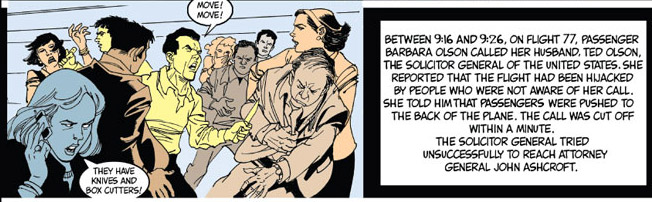
Slate is running an online version of “The 9/11 Report: A Graphic Adaptation.” Ever since I came across Art Spiegelman’s “Maus” — one of the best and most chilling Holocast narratives I’ve ever seen — I’ve been a big fan of the graphic novel format as a method for relating history (another, much quirkier example: “The Fatal Bullet,” a retelling of the James A. Garfield assassination). I don’t think such treatments are replacements for deeper reading, but they can make complex historical subjects more accessible to a wide audience.
In the case of the new 9/11 comic book, you won’t learn anything new if you paid attention to the original report and other accounts. But seeing the events in pictorial form has a way of bringing them freshly to mind. Whether a lot of people want to have that day put in front of them is another matter; I tend to think the day is worth contemplating and contemplating again. (The Washington Post, which I believe owns Slate, ran a story on the book last month. Among other things, the piece mentions that the authors’ previous credits include un-revolutionary stand-bys like “Richie Rich” and “Caspar” — you know, the friendly ghost).
Hard to believe that, yet again, I’ve let the anniversary of the Chatsworth Wreck pass with no mention. For newcomers, the wreck took place about midnight on August 10, 1887, when an excursion train to Niagara Falls plunged off a small trestle over a culvert two and a half miles east of Chatsworth, Illinois. If you’re not from the town or one nearby, or if you’re great-great-grandparents weren’t on the train, or if they didn’t just miss it, you’ve never heard of the event. But about 85 people died in the wreck, one of the deadliest train accidents in history to that point (though, thinking about it, already dwarfed by other transportation disasters, like the sinking of the steamboat Sultana on the Mississippi immediately after the Civil War).
In the past, Chatsworth marked the anniversary with gatherings of survivors and rescuers, the latter sometimes exhibiting souvenirs taken from the train. Once, about 35 or 40 years ago, a Chicago psychic named Irene Hughes was invited to the wreck site for a midnight gathering at which she tried to channel images of the event. Apparently not one to disappoint, she sat on a chair in the middle of the now little-used Toledo, Peoria & Western tracks and offered a few random images — for instance, a train crew running for help and the suffocating sensation of a victim trapped in the wreckage. She swore she hadn’t researched the event beforehand.
Next year: The disaster’s 120th anniversary. Wonder whether Chatsworth has anything special planned.
(French and English lyrics — all seven verses’ worth — here.)
The U.S. Navy Band plays it here. And the French Embassy to the United States relates the song’s story — minus the detail that the composer/lyricist, Claude Joseph Rouget de Lisle, was a moderate who supported the French monarchy and was thrown into prison after he penned the anthem — here.
There’s a word for this — when you encounter an unfamiliar word or concept someplace, then suddenly see it again, as if it’s quite common. The case in point concerns the word felon.
A couple weeks ago, on the occasion of the anniversary of George Armstrong Custer taking his command into eternity, I opened “Son of the Morning Star,” Evan Connell’s free-form history of the general and his most famous battle. In the book’s early pages is a discussion of Lonesome Charley Reynolds, reputed to be “Custer’s favorite white scout” and one of those who died at the Little Big Horn. At one point (p. 20 of my 1984 edition) Connell says:
“Charley had a seriously infected, suppurating thumb — described in contemporary journals as a ‘felon’ — which troubled him so much that one of the regimental surgeons, Dr. Henry Porter, advised him to stay behind. Nevertheless, he was determined to go, and because Dr. Porter could not cure his thumb Charley approached Custer’s orderly, John Burkman, who concocted a poultice of wet hardtack. On the morning of June 25 he still wore this bulky poultice, but when Burkman saw his body it was gone, which meant that he probably peeled it off when the shooting started.”
I read the book long ago and read this passage, but the unusual term for Lonesome Charley’s infected thumb didn’t stick with me. At some point — my guess: the late 19th century, the time of the most recent citations in the Oxford English Dictionary and earlier — this use of felon was common; a Google search demonstrates it’s still current medical parlance (and if you’re really interested in the subject of pus-producing fingertip infections, check out whitlows and paronychia).
Anyway.
In mid-June, I took a daylong drive in Central Illinois with my brother Chris and my dad, during which we visited the site of the now mostly forgotten Chatsworth train wreck of 1887. Even earlier, I had come across an online mention of a locally produced history of the wreck, which involved an excursion train headed from Peoria to Niagara Falls. After coming back to California, I found a
single copy of the 1970 book — “The Train That Never Arrived,” by Helen Louise Plaster Stoutemyer, former Chatsworth schoolteacher and part-time newspaper columnist. I ordered the book and got it a week or so ago. As books go, it’s slight: 68 pages that occasionally read like someone transcribing a shoebox full of notes. But it’s a labor of love meant to convey a small town’s experience in the only moment that ever brought it any attention.
Ms. Stoutemyer relates the account of Chatsworth businessman L.J. Haberkorn. Reading between the lines, you get the feeling Haberkorn never let the town forget what an important role he played in responding to the wreck. Fifty years after the fact, he was still spinning disaster yarns and arguing about whether he was the one who first rang the village fire bell to summon rescuers. In any case, “The Train That Never Arrived” says, the hero was not supposed to be home in bed when the wreck occurred:
“Mr. Haberkorn operated a restaurant and hotel in 1887 on thhe corner where Culkin’s Hardware Store is located today. The Haberkorns had planned to take the excursion, but were prevented from doing so because Mrs. Haberkorn had a felon on her finger which was giving her considerable pain and caused them to cancel the trip at the last moment.”
I like the parallel: Lonesome Charley went with Custer despite his felon and died. The Haberkorns stayed home to nurse the missus and her felon and lived.
A New York Times tradition: Publishing an image of the original printed version of Declaration of Independence, complete with John Hancock and others’ signatures. Always inspiring to read when you need to have your civic idealism refreshed, though yesterday I didn’t read the declaration but found myself thinking about the non-PCness of one phrase: “merciless Indian savages” (from this passage: The king “has excited domestic insurrections amongst us, and has endeavoured to bring on the inhabitants of our frontiers, the merciless Indian Savages, whose known rule of warfare, is an undistinguished destruction of all ages, sexes and conditions”).
Later, or earlier — I can’t remember which — Kate pointed out the San Francisco Chronicle’s lead editorial for the day: “Patriots, awaken.” I don’t expect much these days from the mostly tired and uninspired Chron, but its little Fourth of July essay was very good. In part:
“…Perhaps it is the lingering shock effects of Sept. 11, 2001, or maybe it is the complacency of a half-century of growing affluence, but too many Americans seem all too willing to ignore Benjamin Franklin’s admonition about the danger of sacrificing essential liberties for temporary security. The Bush administration has been adroit at invoking the war on terrorism to justify policies that should be setting off alarms in this democracy.
“At what point will Americans draw the line at these intrusions on civil liberties and usurpations of power by the White House? Revelations that the National Security Agency eavesdropped on phone calls and e-mails without getting the required warrants didn’t do it. The disclosure that the government has compiled a vast database of Americans’ phone records didn’t do it. The hundreds of examples of President Bush’s unprecedented expansion of the number and scope of “signing statements” in which he gave himself the option to ignore parts of laws he objected to — such as torture — didn’t do it.
“Just last week, the U.S. Supreme Court struck down the Bush administration’s system for military tribunals at Guantanamo Bay that openly defied congressional law and international rules on the treatment of prisoners of war. So, what was the reaction in Congress? Regrettably, but not surprisingly in this era, there were immediate moves to give the president such authorization. ”
“Crazy Horse did not behave as usual. Ordinarily he was composed, even when battle was imminent, but it is said that this morning he rode back and forth, hurried into his lodge, and quickly reappeared with his medicine bag. After moistening one hand he dipped it in maroon pigment and printed a hand on each side of his pony’s hips. On both sides of the neck he drew an arrow and a bloody scalp. All of which suggests intuitive knowledge of things to come, or else he had been talking with Oglala scouts who told him what to expect. Most Indians, however, seem to have felt secure in the belief that only a great fool would attack. …
“Rain in the Face had been invited to a feast. The guests were eating when they heard bluecoat guns, which did not sound like their own. Rain habitually carried a stone-headed war club, even to parties, but he rushed back to his lodge for a gun, his bow, and a quiver of arrows. Then … he and his friends saw troops on the eastern ridge. While riding against these troops they discovered a young woman — Tashenamini, Moving Robe — riding with them. Her brother had been killed … and now she was holding her brother’s war staff above her head. Rain declared that she looked as pretty as a bird. ‘Behold, there is among us a young woman!’ he called out, because this would make everybody brave. ‘Let no young man hide behind her garment.’
“Custer’s soldiers were almost surrounded by the time Rain got there. They had dismounted, he said, but climbed back on their horses, dismounted again, and split into several companies. They were shooting very fast. After a while some of them began riding toward Reno’s troops, but Indians followed them like blackbirds following a hawk.”
Taking up where we left off last August, my dad and I — this time with my brother Chris — drove out to southwestern Will County on Monday to see if we could see the place where the Des Plaines and Kankakee rivers meet to form the Illinois River. Why? Well, the reason to care about the rivers is that in the mid-19th century they, along with the Illinois and Michigan Canal, represented the link between Lake Michigan, the Great Lakes, and the entire eastern United States and the Mississippi, the Gulf, and the country to the west. On top of that academic-sounding justification, there’s the relative obscurity of it. Who else is driving around the Chicago area looking for this spot? (Some good Web background on the I&M Canal, by the way: from the Chicago Historical Society (including pictures of canal sites in present-day Chicago settings); the Chicago Public Library (part of its “Down the Drain” site on the city’s sewer system); the National Park Service, and Illinois Department of Natural Resources.)
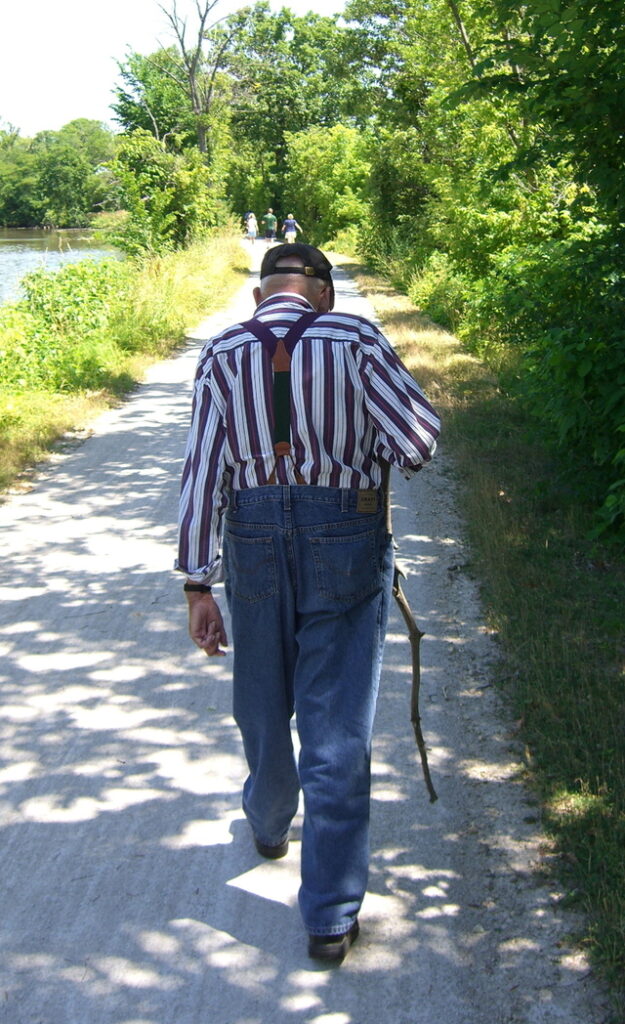
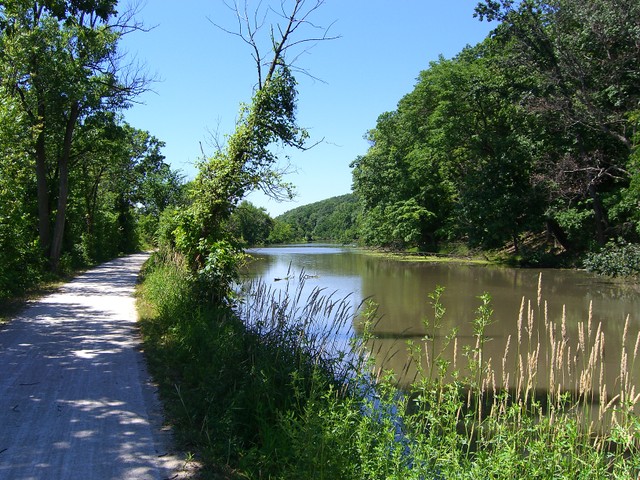
When we visited the area last summer, we hit the towpath along the canal a little too far to the west for it to be a reasonable walk, given my dad’s cantankerous knees. This time, we drove into a county park (McKinley Woods; among other things, the brief history posted at the park says it was a POW camp during World War II) and started walking east on the towpath. The canal runs to the north of the path, and the rivers to the south. About a mile from the McKinley Woods parking lot, after passing a little marina on the opposite bank, we came to a what appeared (to me) to be a spit of land that marked the separation of the Des Plaines and Kankakee rivers. Pictures were duly snapped and huzzahs sounded, and we walked back to the parking lot.
It was only in the course of writing this, though, that I discovered to what an extent I had betrayed the legacy of Louis Joliet, the 17th century French-Canadian explorer who traveled up the Illinois River to the Des Plaines and then on to the Chicago River and Lake Michigan and quickly realized the feasibility of a canal connecting the lake to the Illinois and Mississippi. The “confluence” I located was in fact just an island in the Des Plaines River. The real merger point was west of the lot where we parked, not east.
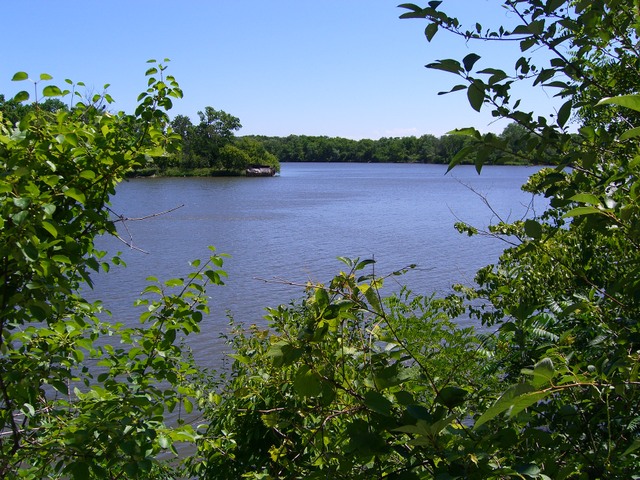
I guess we have an excuse to go back and look for the spot a third time. (Pictures, from left: Dad on the Illinois and Michigan Canal towpath; a glimpse of the false confluence; the I&M Canal, with the river bluffs in the distance.)
II. Country Cemetery
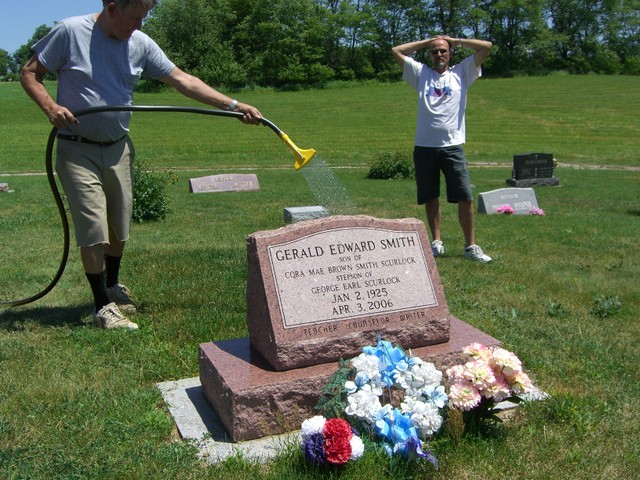
From the non-confluence of the rivers, we got on Interstate 55 south, headed for Lexington, about 70 miles away. Our destination was the cemetery in Pleasant Hill, a hamlet two or three miles outside town. My old high school English teacher, G.E. Smith, died in April and was buried there alongside his mother and stepfather. I visited Pleasant Hill once, around 1971 or ’72, when G.E. went down to check up on his family’s old home, which by then amounted to a falling-down house and a cellar with a roof on it. He was attached to the place, but it wasn’t until later that he seemed to act on the interest, writing a column in Lexington’s weekly paper about Pleasant Hill history and then becoming a serious genealogist and trying to gather all the strands of the family that had wound up out there on the prairie.
The Pleasant Hill cemetery goes back to the first half of the 19th century. The area’s first white settlers, who arrived in 1820, are buried there. The little town used to have two churches, but those are long gone. The cemetery grounds are unfenced and merge into the bordering corn and soybean fields. G.E.’s grave is on an east-facing slope; his freshly cut brown-red granite stone announces his middle name, Edward, a matter that he liked to keep to himself. It describes him as “teacher, counselor, writer,” and includes a quote from him: “My highest goal was always and still remains simply this: To be able to look back upon my life, from any point along the way, and be able to say that this little corner of the world that my life touched has been made better, not worse, because I touched it.”
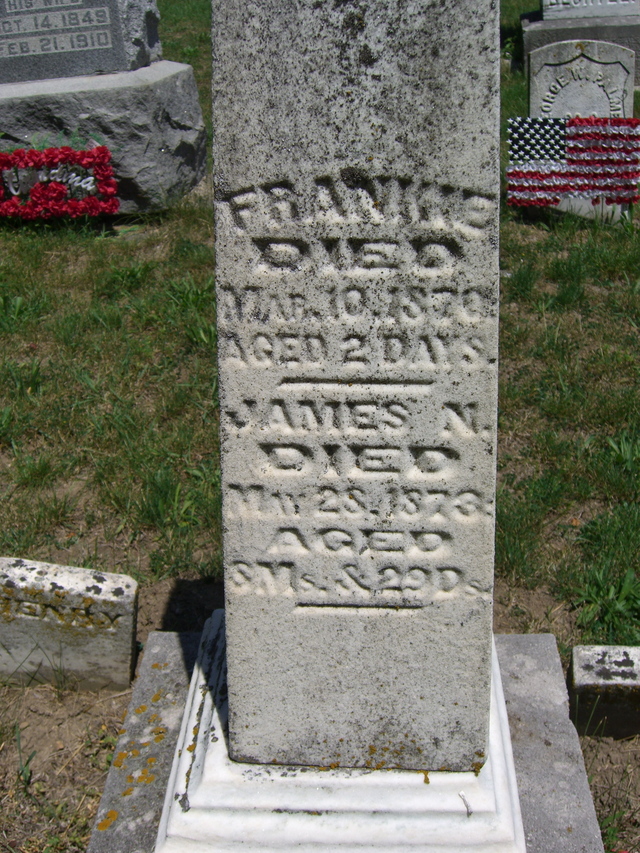
When we arrived, in early afternoon, it was clear and very warm and the caretaker, Ron Eckhart, was watering new sod on G.E.’s grave from a tank on his red pickup. He’s been the caretaker for 26 years — “That’s a lot of grass cut,” was how he put it — and long before that, his dad was pastor at both of the Pleasant Hill churches. Eventually Ron moved off to another part of the cemetery, and so did we. Up the hill from G.E.’s spot is the oldest section of the cemetery, filled with people from the days before the Illinois Central bypassed Pleasant Hill and doomed it to perpetual hamlet-hood. With only the graves to go by, you would guess life was hard. There’s the usual large complement of children who died in their first year or two; but there are also seemed to be a lot of adults who didn’t make it out of their 30s. Maybe life was just hard everywhere when these people were trying to make farms and towns. For one example, take a look at the life of another Prairie Stater, Abraham Lincoln: His sweetheart was carried off by a fever at age 20. Just one of his four children survived to adulthood.
Looking around the little cemetery, it looked like G.E., who was aged 81 years, three months and a day when he died, is one of its oldest residents.
III. Wrecked
We drove through Lexington to start the drive back toward Chicago. On the way out to Pleasant Hill, Chris had pointed out the placards on every telephone poll downtown bearing the names of local soldiers serving in Iraq, Afghanistan and elsewhere. Chris counted 19 names. The town has about 2,000 residents, so roughly 1 percent of the population is serving. We fueled up at the Freedom gas station — just $2.899 a gallon — then headed north on old U.S. 66 to Chenoa. I wanted to take U.S. 24 east to Interstate 57 both because I knew there was a Dairy Queen along the way (in Fairbury) — my dad’s favorite road-trip stop — and because I remembered a little piece of local history along the way: the Chatsworth Wreck.
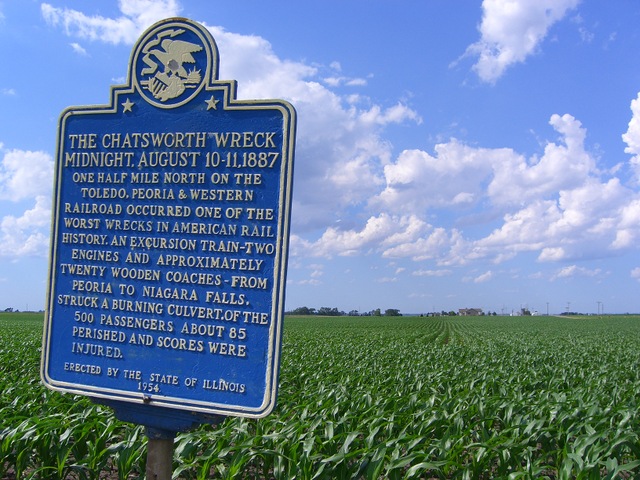
Back in the mid-70s, I stopped to read a historical marker just outside Chatsworth, one of the series of farm towns strung along U.S. 24. It reads:
THE CHATSWORTH WRECK
MIDNIGHT, AUGUST 10-11, 1887
One-half mile north on the Toledo, Peoria & Western Railroad occurred one of the worst wrecks in American rail history. An excursion train – two engines and approximately twenty wooden coaches – from Peoria to Niagara Falls, struck a burning culvert . Of the 500 passengers about 85 perished and scores were injured.
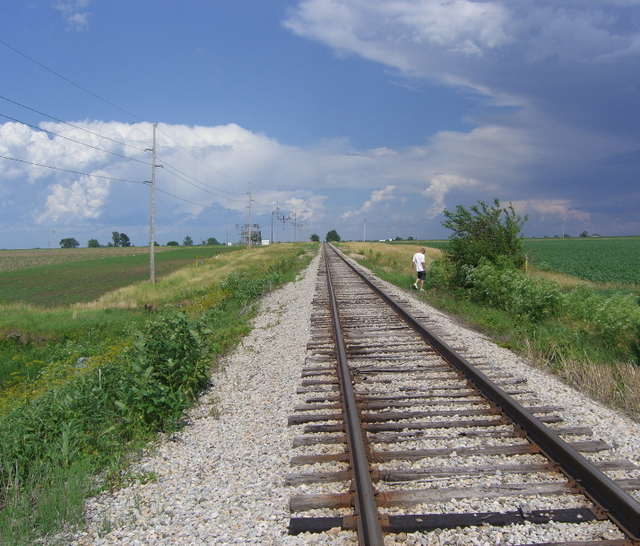
We stopped at the DQ in Fairbury, then continued on through Chatsworth to the wreck marker, which is about two and a half miles east of town, nearly on the Livingston-Ford county line. One thing that’s a little unclear when you’re at the roadside, though, is exactly where the disaster occurred. The TP&W tracks — the railroad still goes by that name — are a half mile north of the highway. I wanted to see if we could find the site of the notorious “burning culvert” — actually, a small wooden trestle. I imagined there could be a memorial or marker at the spot where the train left the tracks.
We parked at an electrical substation near the railroad’s marked but unguarded level crossing. My sense, based on the marker’s placement west of the section road that runs up the county line was that the wreck site was west of the road, too. Chris and I walked along the single track until we got to a culvert maybe a quarter-mile west of the road. It’s not deep — in fact, it’s a narrow ditch that crosses under the track through an 8- or 10-foot-diameter steel pipe. The site is unprepossessing, just like every foot of track east or west of it to the horizon, and there was nothing to suggest we were at the scene of a sensational event.
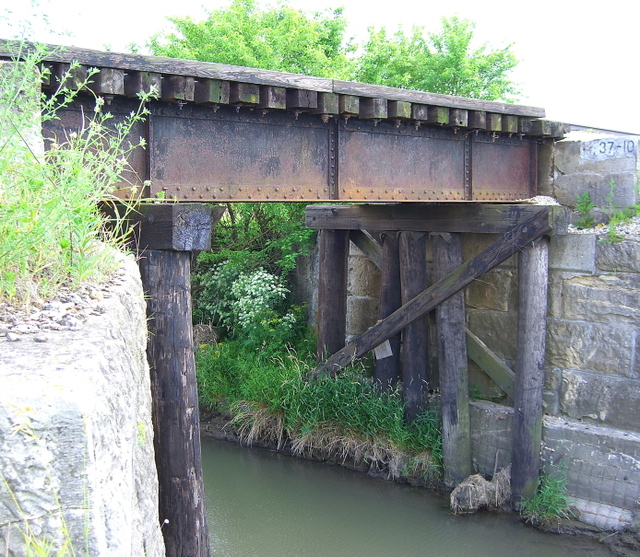
After we walked back to the car and started east again on 24, Chris and I spotted another culvert — this one an actual trestle — just east of the county line. We turned around and hiked out to it, too. It’s a much more satisfying place for a calamity: The tracks cross a bridge that’s about 75 feet long and a good 20 feet above a sluggish little creek. We agreed that between the two possible sites, this seemed the more likely.
Back at home, I poked around online to see if I could find some account that sheds light on the wreck’s precise location. Chatsworth had a newspaper, the Plaindealer, in 1887, and much more recently, a retired teacher and local historian there, Helen Louise Plaster Stoutemyer, published a book on the disaster, “The Train that Never Arrived.” Eventually, I came across a Chatsworth native’s website that includes the Plaindealer’s first account of the tragedy. The story says the train left the tracks at “the first bridge west of the county line” — the first place Chris and I looked. In addition to offering the salient facts, the writer has a lot to say about the impression the wreck left:
“The sight was most terrible. … It was too horrible to admit of description. The screams and moans of the wounded were heartrending, and the terror of the sight can not be imagined. … To add to the terror of the scene a heavy thunder and lightening storm came up, and , with heavy rain made such a scene as would appall the bravest hearts. … Even the strongest men were forced to tears as they heard and saw the anguish of the unhappy excursionists. While many displayed strong courage, grit, and heroism, others were almost frantic, and those in attendence upon them were forced to hold them to prevent acts of insanity and self-destruction.”
If you like the newspaper’s rendition, then you’ll love the song: “The Chatsworth Wreck.”
(Pictures: Left: The marker, east of Chatsworth on U.S. 24. Middle: Wreck candidate site A (west of the railroad crossing 2.5 miles east of Chatworth; north end of culvert is just visible on far left). Right: Wreck
candidate site B — east of the crossing.)
IV. Wrecked Again
After investigating the site of the 1887 trackside carnage, we turned east again on U.S. 24. The highway crosses Interstate 57 at Gilman, then crosses Highway 1, which follows an old trapper’s trail from the Wabash River up to Chicago, at a town called Watseka. I was curious to see Watseka, which I’ve passed through exactly once: In the autumn of 1966, when Dad took us on a long-weekend trip down to the Smoky Mountains and back. I remember going through there late on a Thursday night that ended at a Holiday Inn just outside Indianapolis.
As we started to get close, I asked Dad and Chris whether they remembered the big disaster that had happened in Watseka around 1970. It didn’t ring a bell with them. I recounted the big blast and fire in town — apparently some kind of gas explosion — and an image I still vividly remembered. A fireball rising far above the old-fashioned town water tower.
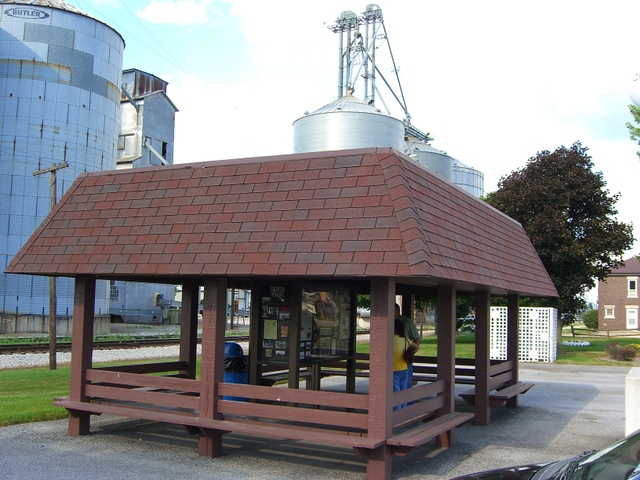
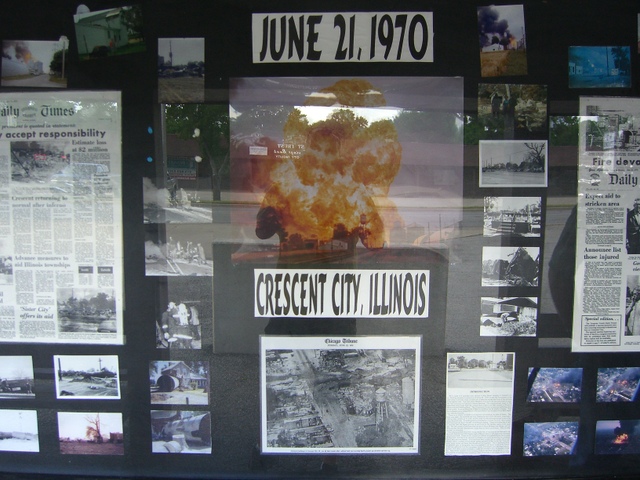
A couple minutes later, a town came into view. There was a newish water tower rising up in the middle of town. I thought I was looking at Watseka, and said something like, “See, that must be the replacement for the old water tower.” Chris was driving, and noticed the town limit sign: Crescent City. He spotted a historical marker on the left side of the road. As we passed, he asked whether we should stop. Yes, let’s. We went back, and the marker turned out to be a small pavilion with some displays. In fact, a big blowup of the picture I had described — water tower, fireball — was the centerpiece in one of the displays. Somehow I had transferred the disaster — which occurred June 21, 1970 — to the next town over.
The cataclysm involved the same railroad that ran its train off the tracks in Chatsworth in 1887, the Toledo, Peoria & Western. Several liquified propane tank cars derailed in the center of Crescent City on Father’s Day morning. The town fire department responded and fought for an hour to prevent an explosion before the first car finally went off. At that point, according to a hand-written reminiscence that’s part of the memorial, “the boys retreated and let fate take its course.” Sixty-four people were hurt (mostly firefighters who suffered second- and third-degree burns), none killed; the center of Crescent City was obliterated. The president of the TP&W issued a statement accepting responsibility for the blast and apologizing for “the inconvenience.”
“Deadwood” begins its third season tonight, a cause for division in our household. I love the show, with all its profanity and violence; for the same reasons, Kate can’t tolerate it.
It has become commonplace to equate the show’s fine scriptwriting with the work of Shakespeare (just Google shakespeare deadwood and you’ll see what I mean). We create cliches because there’s some truth in them, and that one’s no exception. I’ve been tempted to stop episodes and transcribe characters’ speeches just for the language. There’s more to the show than the writing, though: It’s beautifully acted. It’s beautifully filmed. It’s violent and tense as hell.
It’s also conventional wisdom to think of “Deadwood” and the post-modern westerns dating back to “The Wild Bunch” as a new and better breed of drama: More frank about the blood and injustice and cynicism that older westerns soft-peddled. If you think so — and I incline to that way of thinking myself — check out A.O. Scott’s long, long piece in today’s New York Times on the DVD re-release of some of the John Wayne/John Ford westerns. He touches on how thoroughly Ford’s visual sense, especially in “The Searchers,” affected later filmmakers and films. But the heart of Scott’s essay has to do with Ford’s vision of the West and its settlement:
“The Indian wars of the post-Civil War era form a tragic backdrop in most of Ford’s post-World War II westerns, much as the earlier conflicts between settlers and natives did in the novels of James Fenimore Cooper. That the Indians are defending their land, and enacting their own vengeance for earlier attacks, is widely acknowledged, even insisted upon. The real subject, though, is not how the West was conquered, but how — according to what codes, values and customs — it will be governed. The real battles are internal, and they turn on the character of the society being forged, in violence, by the settlers. Where, in this new society, will the frontier be drawn between vengeance and justice? Between loyalty to one’s kind and the more abstract obligations of human decency? Between the rule of law and the law of the jungle? Between virtue and power? Between — to paraphrase one of Ford’s best-known and most controversial formulations — truth and legend?
“Ford’s way of posing these questions seems more urgent — and more subtle — now than it may have at the time, precisely because his films are so overtly concerned with the kind of moral argument that is, or should be, at the center of American political discourse at a time of war and terrorism. He is concerned not as much with the conflict between good and evil as with contradictory notions of right, with the contradictory tensions that bedevil people who are, in the larger scheme, on the same side. When should we fight? How should we conduct ourselves when we must? In ‘Fort Apache,’ for example, the elaborate codes of military duty, without which the intricate and closely observed society of the isolated fort would fall apart, are exactly what lead it toward catastrophe. Wayne, as a savvy and moderate-tempered officer, has no choice but to obey his headstrong and vainglorious commander, played by Henry Fonda, who provokes an unnecessary and disastrous confrontation with the Apaches. In the end, Wayne, smiling mysteriously, tells a group of eager journalists that Fonda’s character was a brave and brilliant military tactician. It’s a lie, but apparently the public does not require — or can’t handle — the truth.
“In telling it, Wayne is writing himself out of history, which is also his fate in ‘The Man Who Shot Liberty Valance’ (not, unfortunately, one of the discs in the Warner box). That film — which contains the famous line ‘When legend becomes fact, print the legend!’ —throws Wayne’s man of action and James Stewart’s man of principle into a wary, rivalrous alliance. Their common enemy is an almost cartoonish thug played by Lee Marvin, but the real conflict is between Stewart’s lawyer and Wayne’s mysterious gunman, one of whom will be remembered as the man who shot Liberty Valance.
“What we learn, in the course of the film’s long flashbacks, is that the triumph of civilization over barbarism is founded on a necessary lie, and that underneath its polished procedures and high-minded institutions is a buried legacy of bloodshed. The idea that virtue can exist without violence is as untenable, as unrealistic, as the belief — central to the revisionist tradition, and advanced with particular fervor in HBO’s ‘Deadwood’ — that human society is defined by gradations of brutality, raw power, cynicism and greed.
“If only things were that simple. But everywhere you look in Ford’s world — certainly in ‘Fort Apache,’ in ‘The Searchers,’ in ‘The Man Who Shot Liberty Valance’ — you see truth shading into lie, righteousness into brutality, high honor into blind obedience. You also see, in the boisterous emoting of the secondary characters, the society that these confused ideals and complicated heroes exist to preserve: a place where people can dance (frequently), drink (constantly), flirt (occasionally) and act silly.
I don’t have the exact statistics at the ready, but something like 35 or 40 percent of San Francisco Bay has been filled since the region was settled in the 19th century. About 95 percent of the wetlands surrounding the bay have been diked, drained and developed. Berkeley’s most visible modern contribution to the great, undeclared bay transformation project is its old garbage dump, part of a complex of old fill projects that stretch more than a mile along the waterfront and extend more than three-quarters of a mile into the water from the old shoreline (which itself is at least one-third of a mile west of where the European interlopers found the water’s edge).
The dump was a great place. Noisy, smelly, full of garbage and construction debris, seagulls and big graders. I worked as a construction laborer for a while after I moved out here, and every once in a while was sent on a dump run to unload a pile of old shingles or lumber or fractured plaster and splintered lath. A cashier took your fee, then sent you on your way, out the potholed road to the mountain of discards. A worker out there directed you to the edge of a live pit, and you added your stuff to all the household garbage, old tires, unwanted furniture, lawn clippings and miscellaneous unidentifiable sweepings from all over the city. I would always feel a little exhilarated to see it all and to throw mine, whatever it was, in on top. The graders and other heavy equipment were constantly at work crushing the trash, packing it down, making room for more; once a pit was full, it would be covered with dirt and the garbage would go to a new one. The old pits would settle over time and be reopened to take on more refuse. This went on for years.
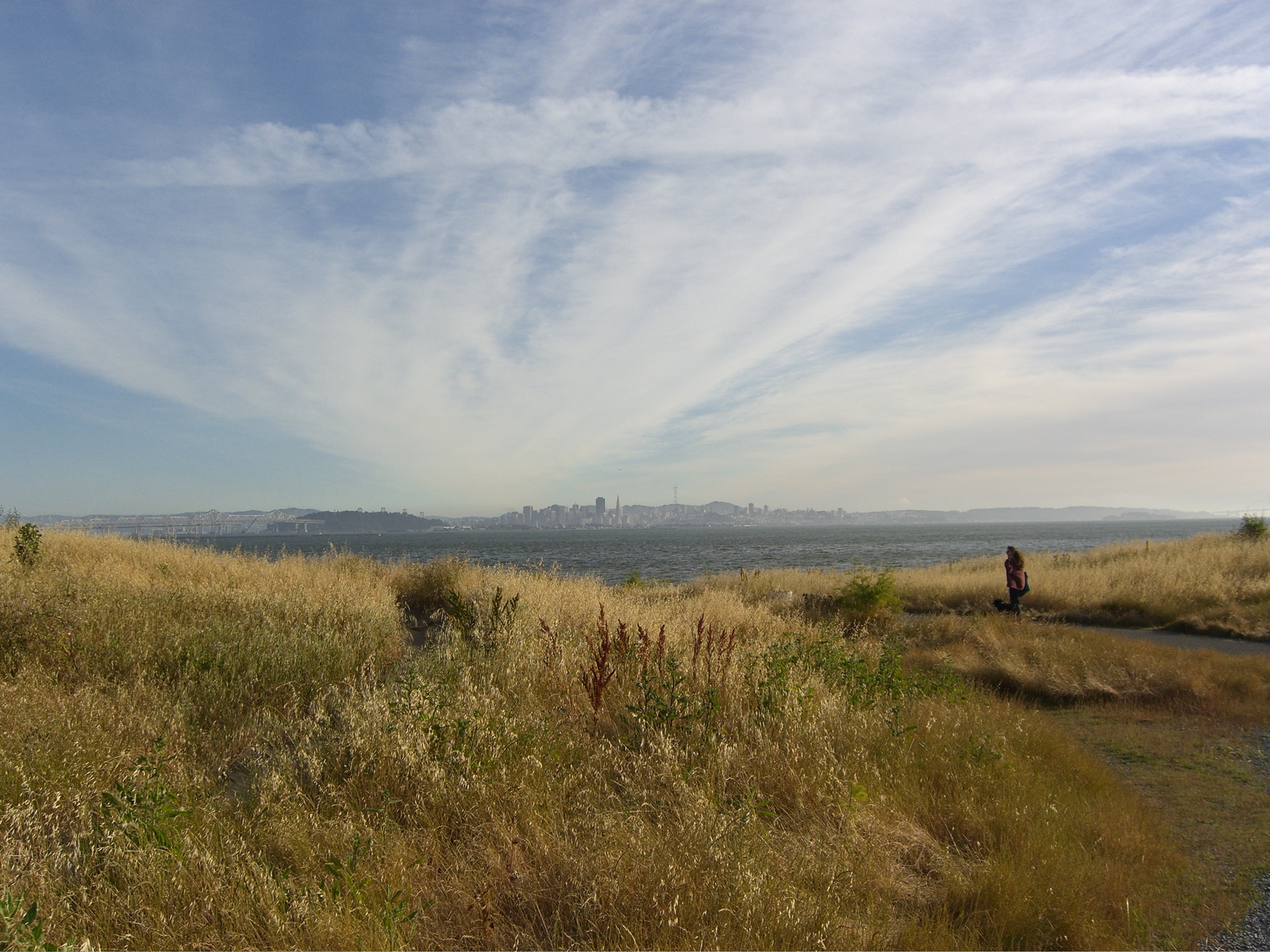
About two decades ago, the dump reached capacity. So much garbage had been packed in that at one point it had been squeezed out in the Bay under the dikes built to contain the fill. The city built a “transfer station,” a big open warehouse-like structure where all the trash would go to be sorted and re-transported, if it wasn’t recyclable or compostable. The old dump was covered with dirt, lots of dirt. Part of it was landscaped and turned into a manicured city park and named after Cesar Chavez, the late farmworkers’ labor leader. Most of the fill was planted with native flora and studded with pipes to vent the methane and other gases from the old buried trash. Roads and trails were built. Part of the semi-wild-looking area at the center of the old dump has been opened up as a park for off-leash canines.
So, at the end of this environmentally unfriendly epic (a story line shared with many great city parks, like Grant Park in Chicago), we’ve got a beautiful piece of waterfront property with staggering views across the bay and back toward the hills, filled with bike riders, hikers, dog-walkers, picnickers and kite-flyers. Our garbage? It’s headed someplace else, where it’s unlikely to grow into something similar.