I recently heard a story on NPR about how Berliners use lampposts as “virtual totem poles of information.” In some parts of the city, the posts are covered by layer after layer of flyers and personal announcements. One that attracted the reporter’s attention said, “A HORRIBLE ACCIDENT HAS HAPPENED.” It turned out a woman had lost one of her favorite stiletto shoes. A guy who collects samples of the Berlin notices describes them as affording “a deep insight of the soul of the city. These are real treasures that need to be documented, because it’s part of our everyday life culture.”
There are places in Berkeley (and elsewhere nearby) where lampposts and telephone poles and have been converted into conduits of information (or requests for information). Notices reporting yard sales and lost pets are the most common. Sometimes the inquiries are more unusual: a guy looking for a lost belt buckle, a neighbor berating the thief who broke into their car. Occasionally the postings become more elaborate. The person who lectured the break-in artist, for instance, augmented the note with the charger for a flashlight that had been stolen.
Pictured here is a uniquely elaborate example of the Berkeley street notice, over on Sonoma Avenue. The sign reads: “Bentley, our cat, loves to hunt, and brings us garden gloves he finds. Please take those you own with our apologies.” The best part is the improvised mini-clothesline with the stray gloves pinned to it.
One of the Tweet-worthy current events items I’ve come across in the last couple of days is news that climate scientists say the Arctic ice pack has reached its lowest extent since the satellite records began in 1979. The National Snow and Ice Data Center at the University of Colorado says the Arctic sea ice appears to have reached a season minimum this past Sunday, September 16, of 3.41 million square kilometers (1.32 million square miles). That’s half the average seen in the years 1979-2000 (and above, that’s a graphic from the NSIDC showing the sea ice extent for September 19).
What does it mean? Here’s a decent summary of the basic thinking from today’s PBS NewsHour:
The ice is younger and thinner than it was in the 1980s. Of the ice surveyed this summer, the majority was one to two years old and three to five feet thick on average. That’s down from 10 to 13 feet thick in 1985.
Losing sea ice also has immediate impacts on Arctic wildlife. Walruses that normally rest on the ice while hunting ocean fish moved ashore by the thousands last year. Arctic seal populations have already declined as a result of disappearing ice. And a 2009 United States Geological Survey estimated that by 2050, the world could lose two-thirds of its polar bears as their ice-dwelling food sources disappear. The ice is also home to delicate microorganisms, which, if lost, could upset the entire Arctic food chain, Meier said.
Ted Scambos, senior research scientist at NSIDC, said that changes in the Arctic’s ice and snow are making the Arctic warmer, which may mean major weather and climate changes for the rest of the planet. Sea ice reflects the sun’s rays, which helps regulate the planet’s temperatures, especially during the summer. Losing the reflective ice surface causes temperatures to rise. If the North Pole is not as cold as it used to be, that has the potential to change wind and weather patterns throughout the Northern Hemisphere.
“But a wider impact may come from the increased heat and moisture that the Arctic is adding to the climate system,” Scambos said in a press release yesterday. “This will gradually affect climate in the areas where we live…We have a less polar pole–and so there will be more variations and extremes.”
Having read some of the accounts of the sea ice retreat yesterday, I went looking for images of what the Arctic looks like. A favorite resource: NASA, which publishes a bunch of cool images of various Earth features every day. One of the services, called MODIS(MODerate Resolution Imaging Spectroradiometer), includes daily mosaics of the Arctic snapped by NASA satellites. Every time I see these images of Earth from space, the thought that seizes me–or maybe it’s more of an emotion–is what an incredibly beautiful place this planet is.
Looking at the Arctic day to day, I wondered whether I could turn the images into a “movie.” Well, I could, sort of. I downloaded 185 days worth–from March 20 through September 20–then turned them into a slideshow, saved that as a movie, and uploaded it to YouTube. Here it is:
I will say up front that while the view is breathtaking, the Arctic weather screens the view of precisely what’s happening with the ice. It’s not as stark as you might expect (and of course, this is just one season we’re looking at; there’s nothing here to give a comparison to how this scene unfolded 30 years ago).
One note of orientation and explanation: The North Pole is near dead center in the images. Greenland is clearly recognizable at the lower left; Iceland is at the lower center, and Scandinavia and the northern coast of Russia are at the lower right. Siberia dominates the right side of the map (these images show weeks of heavy smoke from fires there). At the top margin, the Bering Strait, where Siberia nearly meets Alaska, is just left of center. Alaska appears inverted at the left, with the Gulf of Alaska at the top left corner.
One thing you notice when you spend hours staring out an airliner window in flight is other airliners streaking past. Sometimes you’ll see them headed in the same direction, flying roughly parallel to your path. Mostly, you see them go flashing by in the opposite direction (last week, we saw four in the space of about 30 seconds).
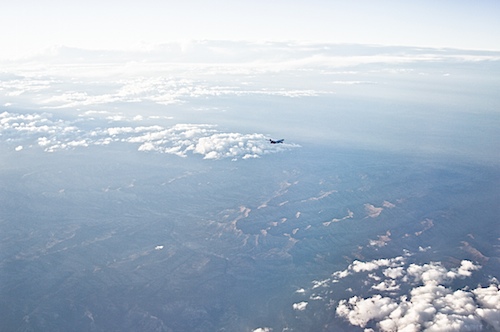
In the shot above, taken July 26, I was on an American Airlines flight headed west from Chicago to San Francisco. The local time, somewhere over Utah, was about 8:20 p.m. Suddenly, I spotted a jet heading north/northeast that appeared to have crossed below and ahead of us. It was there and gone in a few seconds, but I had my camera in hand and shot several frames before it disappeared.
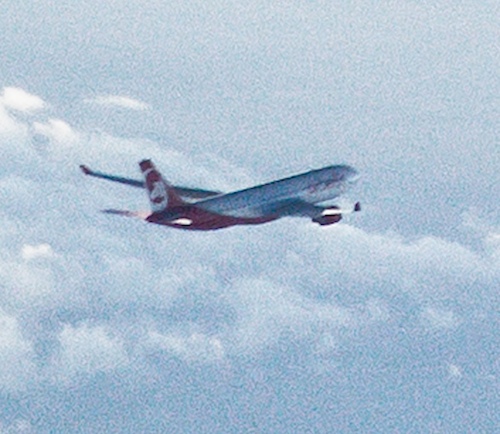
Looking at the pictures afterward, I tried to make out the words and logo pained on the aircraft. After searching for a few minutes, I came up with an answer: Air Berlin. My educated guess, thanks to the airline site and looking for records on FlightAware.com, is that this was Air Berlin Flight 7499, about 46 minutes into a direct from from Las Vegas to Duesseldorf, and that our position at this moment was about 50 miles northeast of Price, Utah.
Below is a cropped image of the airliner, an Airbus 330. And below that is the original image–which among other things makes it clear how late in the day it was–before I started fiddling with it digitally to identify the plane.
As noted often before, my Number 1 favorite activity during a plane flight is staring out the window at what’s below. My Number 2 favorite activity is taking pictures of whatever it is. Above is a shot from Tuesday evening, as we approached San Francisco International Airport on our flight home from Chicago. This shot looks north across Sunol Regional Wilderness to San Antonio Reservoir (one of the many reservoirs in the San Francisco water system). I love the light on the contours of this landscape. (The air? I believe it was smoky from fires we’ve been having in Northern California, though I never followed up on that to figure out where the closes fires were.)
Above, it’s the California Sister (Adelpha californica). We spent the weekend with our friends Jill and Piero in that part of Calaveras County where the foothills turn to the mountains, on a ridge south of the Middle Fork of the Mokelumne River. On Sunday, we walked down to Blue Creek, then walked up the stream a short way. This butterfly was hanging out and posed while I tried to get a picture.
Back at base camp, also known as Casa Della Montagna, a construction project was under way. Piero and Jill were building a small deck for a wood-fired hot tub. The underlying framework was a beautiful, asymmetrical web of beams and joists. I commented on the workmanship, which I always find impressive. Piero seemed to see it as more of a rough-and-ready carpentry job. He said, putting a new spin on an old proverb, “Don’t let the perfect be the enemy of the done!”
Kate and I spent the afternoon watching and occasionally lending our hands as Jill and Piero measured angles, cut planks, and screwed them into place. They were done by dinnertime.
Helicopters circling over a local news event: That’s just one of those noises you get used to in our modern urban soundscape. When you hear the sound of choppers orbiting over some downtown or campus or some random intersection, you know a protest is going on or maybe a fire or maybe someone’s spotted a picturesque car crash.
This morning’s helicopter visit is different. Starting sometime in the groggy hour before 8 a.m., I started to hear a helicopter nearby. It would pass, then return. It sounded like it was flying low. Once I was up and attending to the morning’s first ritual, making coffee, I heard the helicopter coming back and went out and took a look. It looked like it was only about 500 feet up, if that, and it was not orbiting or following anything at that height.
I remembered seeing an article somewhere about some government agency taking radiation measurements over parts of the Bay Area. This helicopter must be part of that whole thing, I thought. After the chopper passed, I went in and tried to find some information.
The summary, by way of the excellent Oakland North blog: “Some government agency” is the Department of Homeland Security’s Nuclear Detection Office and the National Nuclear Security Administration. Despite what I say in the video above, the helicopter is a Bell 412, and it’s outfitted with equipment to measure background radiation levels in the area. The stated purpose: to assist research and development on airborne radiation detection systems. (More on the chopper(s) at Berkeleyside: Low-flying helicopters over Berkeley.)
Yes, that up there is common deer poop, left right next to a manzanita bush in our front yard. Or so I believe from previous experience in wilder parts of the country. I can’t think of another animal in our parts that would leave scat that looks quite like this. More circumstantial evidence: a deer hoof print in our next-door neighbor’s front-yard garden, which contains lots of roses, reputedly a favorite food of our semi-urban deer.
Joking aside: the deer have moved in. There’s not enough cover in our yard for them to stay full time, but I’ve heard of places within three or four blocks where deer families have taken up residence. I don’t object, though they are larger than our average wild neighbor and the thing that sometimes worries me about them is scaring one at night and getting run over. Hasn’t happened yet, though.
If you’re interested in how content is produced in our socially connected media world, David Carr had a nice piece in Monday’s New York Times (“Journalists Dancing on the Edge of Truth“). He was focusing on the lessons inherent in the case of Jonah Lehrer, the Wired and New Yorker science writer who was caught inventing and retooling quotes from Bob Dylan in a book published this summer and then lying about it.
Lehrer isn’t the first to be caught creating nonfiction from a fertile imagination, and he won’t be the last. Carr and others argue that a lot of this kind of behavior is the product of a news/entertainment industry landscape in which journalists, reporters, columnists, and analysts–maybe the best catch-all description would be “media performers”–are slaves to a nonstop, multi-platform demand for their brilliance.
Carr also suggests that part of the problem lies in what’s missing from Jonah Lehrer’s journalistic resume:
“Mr. Lehrer, now 31, became famous before he had a grasp of the fundamentals. …
“The now ancient routes to credibility at small magazines and newspapers—toiling in menial jobs while learning the business—have been wiped out, replaced by an algorithm of social media heat and blog traction. Every reporter who came up in legacy media can tell you about a come-to-Jesus moment, when an editor put them up against a wall and tattooed a message deep into their skull: show respect for the fundamentals of the craft, or you would soon not be part of it.
“I once lost a job I dearly wanted because I had misspelled the name of the publisher of the publication I was about to go to work for. Not very smart, but I learned a brutal lesson that has stayed with me. Nobody ever did that for Mr. Lehrer, even after repeated questions were raised about his work.”
“Tattooed a message deep into their skull.” I like that. Though I can testify that the tattooing these days needs to be done with a certain modicum of sensitivity that was scarce in those Old School days Carr speaks of.
With my dad’s recent passing, and having made several (unrelated, except for my mood) recent visits to Chicago cemeteries, I’ve been thinking about epitaphs. Webster’s defines epitaph as “1. an inscription on or at a tomb or a grave in memory of the one buried there. 2.: a brief statement commemorating or epitomizing a deceased person or something past.”
Most of what’s carved on graveyard monuments is pretty simple: names, dates, and relationships. Beyond that, most of the common people buy at most a brief fragment of a sentiment. In Catholic cemeteries, I’ve seen a lot of “My Jesus Mercy.” On my dad’s parents’ grave, In largely Scandinavian-American (and Lutheran) ground, the message is “Christ My Hope.”
But except for the expense involved–I think we’re paying $150 to have “2012” carved on my dad’s headstone–I think a secular message might be reflect more the concerns of today’s future deceased Americans. I’m thinking of phrases that reflect the preoccupations of most of us for most of our waking life: Phrases like:
My brief stay in Chicago has included a couple of Summer of 2012 heat spikes, interspersed with less radical summer weather, as a frontal boundary oscillates across this part of the Midwest. Today’s National Weather Service forecast map for the Chicago region is orange in every direction, indicating a heat advisory. Temperatures in the city are expected to hit 100. Outside the city, up to 105. (I note that the forecast high in San Francisco today is … 63.)
Tom Skilling, the dean of Chicagoland TV weather forecasters, and a meteorologist who is unfailingly informative first and entertaining second, sums up today’s torrid conditions on the WGN/Tribune Chicago Weather Center blog:
“The blisteringly hot air mass responsible for 100-degree or hotter temperatures across sections of 19 states Tuesday re-expands into the Chicago area Wednesday. It’s on track to bring Chicago its fifth triple-digit high temperature of 2012—the most official 100+degree readings here of any year since 1988.
“Temperatures surge past 90-degrees for a 34th time this year at O’Hare and 35th time at Midway—extraordinary when you consider the average since weather records began in 1871 has been only 17 such days at O’Hare and 23 at Midway!
“…This summer’s warmth has been nothing if not persistent. If you needed any additional evidence this weather pattern has been unusual, WGN weather producer Bill Snyder, in surveying the city’s official temperature records, finds Chicago is to log an unprecedented 29th consecutive day of above normal temperatures—making this the most back-to-back days to post a surplus in the 5.5 years since a Dec. 10, 2006 through Jan. 14, 2007 mild spell in which above normal temperatures were recorded over 36 consecutive days.”