The ’77 Bulgemobiles Are Here!

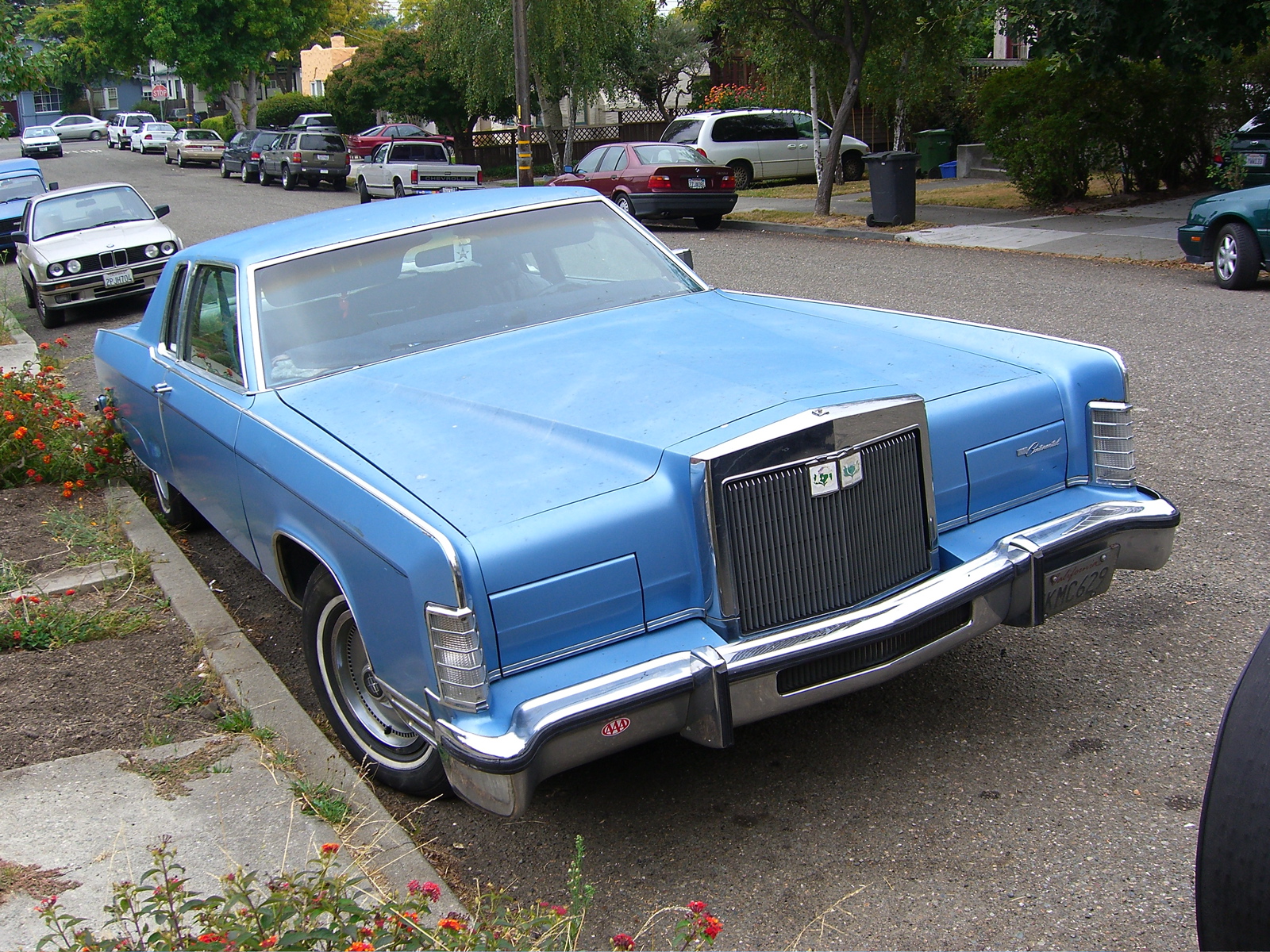
1977 Lincoln Town Coupe

This showed up on the curb in front of our house yesterday afternoon: a ’70s vintage (1977 is the closest match I can make) Lincoln Town Coupe, outfitted with The Club to foil joyriders and a variety of bedding, personal-care items and plastic utensils that suggested that this is someone’s rolling domicile. I was more than half-expecting someone to show up to sleep in it last night. Around 10:30 or so, we came back from a movie and there were a couple of pairs of shoes placed neatly outside the driver’s-side door; across the street, someone was puttering around a van I hadn’t seen before, which also looked like a live-in vehicle. I guessed that the two vehicles were related and went to talk to the van person. He told me he owned the Lincoln and intended to leave it in front of our house for a couple days but wouldn’t be sleeping in it. I asked him about the shoes , and he said he’d left those by mistake and went to pick them up. He left a few minutes later. The Lincoln remains on the curb this morning.

Technorati Tags: ,

Today’s Time Waster

Via YouTube, a 3-minute video of a trolley ride in North Berkeley, circa 1906. The route is northbound on Oxford Street, eastbound on Hearst, then north on Euclid). The split-level portion of Hearst looks much the same today in terms of the road configuration. Virtually all of the buildings shown in the picture — some big, gorgeous Victorian homes, mostly — burned down during a wildfire in 1923 (and JB, midway through the clip, look for what looks like a Norfolk pine on a hillside to the left; its presence interests me just because that area of Berkeley was settled probably no more than 40 years before the date of the image — 50 tops — and the size of the tree suggests it might have been one of the first Norfolk pines transplanted to the Bay Area).

Technorati Tags: , ,

Eugene, Late

Up Interstate 5 again today for our unofficial first visit of the 2006-07 University of Oregon school year. Gas is three bucks and up everywhere you go, and if there are fewer people on the road than during the late cheap gas days, or if the ones who are out there are really driving smaller cars than they were before, I still need convincing (I’m the one to talk, driving a ’98 Dodge Grand Caravan — Grand, mind you — that at its most economical got about 26 miles to the gallon. One hundred and forty thousand miles into its career, it does well to get 23 miles per gallon, though the way we tend to drive on I-5 and like roads — 75 or 80 if people will let us by — doesn’t help matters).

Anyway. Thom and I are up here for a couple nights. Our mission: Find an off-campus place for him and two of his buddies to stay for the coming year. So tomorrow and Thursday, we’ll be looking at places and saying to each other, “Can’t believe they think they can get $1,500 a month for that dump.” Hopefully, we won’t be the payers of that $1,500. Wish us luck, wherever you are.

Technorati Tags: , ,

Potato Man

Calbee's Mr. Potato

Eamon and Sakura — our son and his wife — are staying with us for a few weeks in transit from their two-year stay in Japan to their permanent digs over in San Francisco. They went shopping the other day at the Tokyo Fish Market here in Berkeley. Among other things they brought back from their expedition: an 80-gram bag of Calbee Seaweed & Salt potato chips (“Every time fresh Calbee Potato Chips now have the irresistible full flavor of Seaweed and Salt,” the package says. “Try it and add to your favorite shopping list today”). Calbee’s a Japanese snack food firm that the company history says started in Hiroshima after the war. In 1970, it opened up Calbee America and started marketing its products here; mostly, I imagine, in ethnic food stores like the Tokyo Fish Market.

For the record: The chips are great. Light. Not too greasy or salty. The seaweed flavor: subtle. Give me more than 80 grams next time.

But the arresting part of the Calbee chips experience for me: The appearance on their label of a cartoon character wearing a sash labeled “Potato.” He’s got an “uh-oh!” sort of expression on his face that seems less confident than you might wish for from a brand spokesman; he bears a cousin-ish relationship to Mr. Peanut, but without the monocular elegance or cane-inspired suggestion of swagger.

I’ve given this way too much thought.

Technorati Tags:

Pedestrian Matters

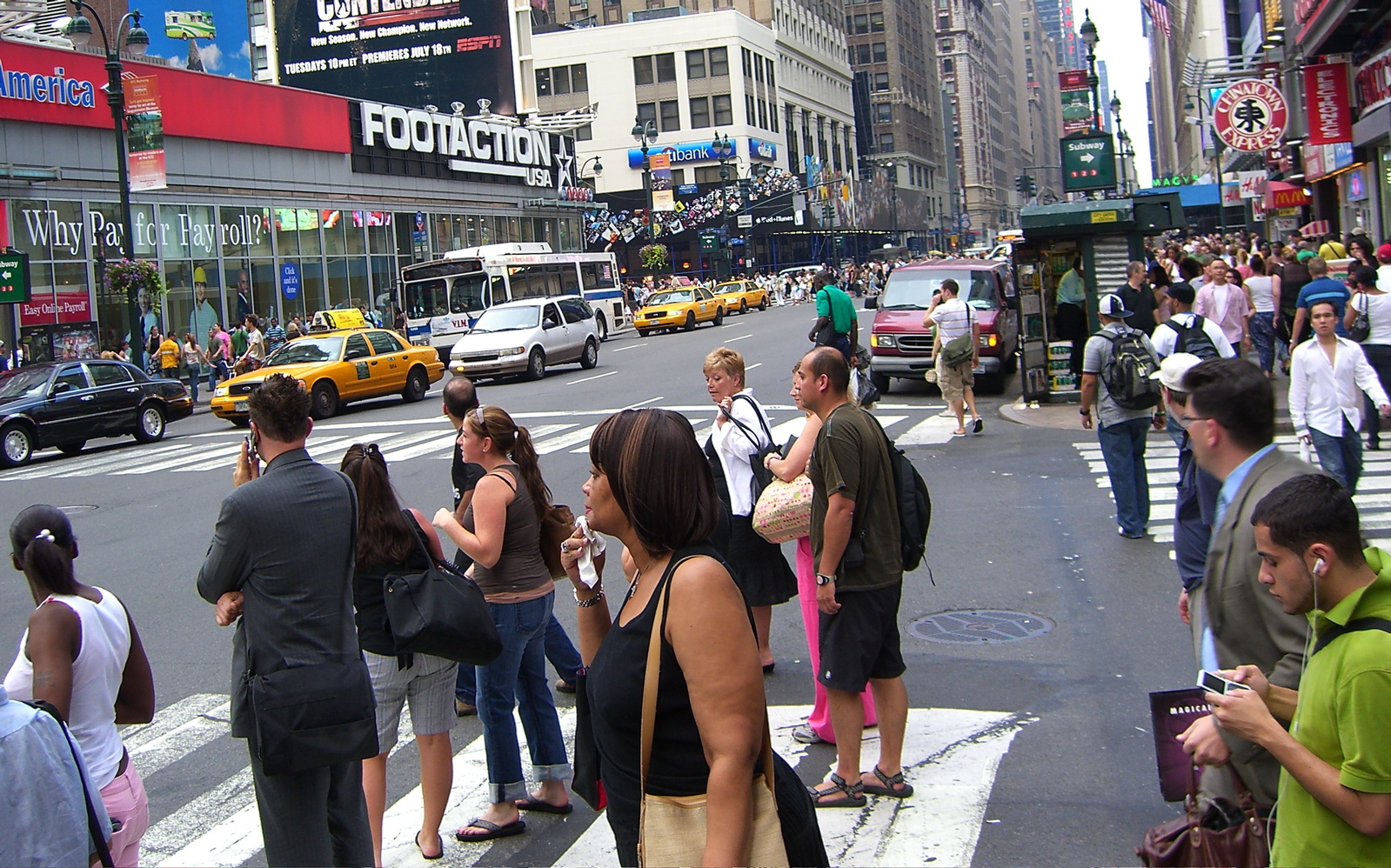
7th Avenue and W. 34th Street

Early last week, we were in New York. I spent most of one hot afternoon at the American Museum of Natural History, on the Upper West Side, and afterward decided to walk down to Penn Station — nearly three miles on the wandering out-of-towner’s course I took — to meet Kate, who was coming in on a commuter train from New Jersey.

Always striking about New York: the number of people on the street, at all hours; and of course, the effect is magnified at the end of the work day as you go from the placid precincts of Central Park West toward Midtown. A commuter crowd mobbed the area around 7th Avenue and West 34th Street, a block up from the station, all going home to the suburbs.

Standing at that corner (above), I was conscious of something I’d been seeing all along my walk: The New York pedestrian’s habit of stepping off the curb when waiting for the lights to change, crowding right up to the traffic lane in some cases getting ready to hustle across against the light if there was an opening in traffic — unlikely on 7th Avenue, not so unusual on less-busy side streets. For a visitor, the New York walking style seems aggressive, disorderly and even dangerous. But it is fast: The only places I got stopped along the way were major intersections. The key is keeping your eyes open and remembering that the drivers you’re looking at are aggressive, too, and that the laws of physics are against you in a collision, even if you think you have the right of way.

It’s a fundamentally different way of street thinking from the prevalent attitude in the Bay Area. In California, state law gives pedestrians virtually universal right of way (with the obvious exceptions: against red lights, for instance). The law aims to make it safer for pedestrians to cross the street, but its effect actually goes well beyond that: It has created a sense of righteous entitlement among pedestrians, who by their behavior apparently believe that all considerations — courtesy, common sense, drivers’ reaction times, night-time visibility, the aforementioned laws of physics — have been suspended by statute.

Yeah, a less car-centric world would be a much better place in many ways. And we ought to make the streets safe for everyone who uses them. But planting the idea in people’s heads that they can step off the curb into the path of a speeding car — and that the car will stop, damn it — promotes naivete and selfishness more than safety.

Some suggestive stats: According to National Highway Traffic Safety Administration numbers, in eight of the 10 years between 1995 and 2004, the most recent statistical year available, New York state had a lower pedestrian fatality rate than California. On the other hand, New York appears to have a much higher percentage of pedestrians killed at intersections — consistently on the order of 40 to 50 percent of the state total compared to California’s 25 percent or so. For the past several reported years, “improper crossing of roadway or intersection” is the top listed factor in pedestrian fatalities in New York; in California, that factor is in a dead heat for No. 1 with “failure to yield right of way” (which I take to mean pedestrians’ failure to yield).

Technorati Tags: , ,

Vacation Video Experiment

I had my camera out when our flight was taking off from New York for Oakland the other day. I’m not sure if a camera is on the list of electronic devices you’re supposed to keep shut off during takeoff and shortly after, and I don’t want to draw attention to myself by asking the flight attendants. So on Wednesday, I switched the camera to video mode and recorded the first couple of minutes as the plane rolled down the runway at JFK and climbed to 2,000 feet. The next part of the experiment was putting the takeoff video online. That turns out to be easy. I downloaded the file to a computer, then uploaded it to YouTube (it’s a 60-megabyte file, and it took a while to send over our DSL line). Check it out below.

Trying to look past the novelty of the thing — yes, I’m somewhat slackjawed that this kind of video publishing is so straightforward for someone with little technical ability — this sort of tool really does open up new possibilities for self-publishers (artists, journalists, etc.) of all kinds. [Postscript: I went back to YouTube to look for other takeoff videos. What an original idea: A search turns up 827 hits — many of which are commercial airline takeoffs shot at airports all over the world.]

Flying Back

There will be plenty of East Coast trip postscripts to come, but for now: We’re sitting in a terminal at Kennedy airport; outside, it’s about 100, and even people who have been working inside all day are complainng about the heat. Outside, one big difference between city dwellers and suburban folk shows itself. The urban types are out on the streets, walking to the subway, shopping, whatever they have to do. It’s not like the sidewalks were packed in my brother’s neighborhood, but people were out and about, even if lots of us looked a little wilted. Out in the suburbs: No one on the street, anywere; people out there — and "out there" is probably any suburb you can think of — live strictly a doorway to doorway existence during the worst weather. Glad the power grid is holding up for everyone so far.

This morning, getting ready to leave John and Dawn’s place, we were talking about the latest bicycle fatality in the Oakland Hills. A guy out for a ride was hit head on up there on Skyline Boulevard, within a half mile or so of where I crashed in June, by a motorcyclist; the cyclist died of his injuries, the motorcyclist apparently walked away from the wreck. Not to place blame without knowing what really happened, but one of the risks bicyclists take riding up in the hills, a risk that’s increased a lot in the last 20 years, is that we share the road with motorcycle riders and motorists who treat the twisting roads like a raceway challenge. I’ve often worried about getting hit up there.

Anyway. At one point, John said, "Hey, did you hear about that Wired editor who died during the marathon?" I hadn’t. I looked up "wired editor marathon" onlne, and found a story on Wired News. The editor who died during the marathon was a guy named Bill Goggins. I knew him from my stint at the magazine in 1998 and from my days freelancing for the magazine. Bill was 43, and the news accounts say that he collapsed at mile 24 of the San Francisco Marathon last weekend and couldn’t be revived. A friend who saw him at mile 21 said he was smiling and running strong, and a mutual friend had seen him twice in recent days and said he seemed fine. The thing about Bill, whom I never got to know well enough, was that he was brilliant and funny and charming and had a big heart that was right there for anyone to see. Forty-three. Hard to believe. See you, Bill, wherever you are.

Continue reading “Flying Back”

Hell on Wheels

It’s late, and we’re getting up early to fly to New York to visit Kate’s family (and see my brother John). So the telling of this tale might be a little truncated. But:

One of my cycling goals this year was to ride three double centuries — 200 miles in a day — because there’s a sort of prize for that feat called the California Triple Crown. I rode my three doubles in April and May — two very tough rides (the Devil Mountain Double and the Central Coast Double, both featuring lots and lots of steepish uphill riding) and one that the cognoscenti have come to sniff at as "easy" (the Davis Double Century, one of the oldest doubles anywhere). I don’t subscribe to the notion that riding 200 miles in a day, no matter what the course, is easy.

A couple weeks ago, I was kicking around riding plans with a friend, Bruce. He suggested doing a local double called Bay in a Day, first run last year. Its unique feature: It circles the whole of San Francisco Bay, which is a neat idea in itself; though it’s a challenge, too, because to keep the ride close to 200 miles and make it all the way around means spending a lot of time in heavily populated areas on heavily traveled roads. Despite the fact the ride’s not yet recognized for Triple Crown credit, Bruce and I signed up — though it developed after we’d paid our non-refundable fees that Bruce had a social engagement he couldn’t break and could only do half the ride.

Then the heat came. By last Friday, the Bay Area and most of California was in the same red zone as the East and Midwest had been earlier in the week. Friday night, the National Weather Service put out a Heat Advisory warning of triple-digit temperatures on Saturday. Among other things, the weather service and local TV weather forecasters warned against outdoor exercise on Saturday. I heard the warning and thought about calling Bruce and bailing on the ride. Then I thought about The Terrible Two, an epic double that starts up in Santa Rosa, in Sonoma County, and is famous for two things: the combination of brutal climbs (present every year) and brutal heat (present most years, including this one). I know plenty of people, including Bruce, who rode The Terrible Two a few weeks ago, or tried to, and I told myself if they could do it, I could, too.

Saturday morning: We rolled out of Novato, in Marin County, at 5:35 a.m. It was beautiful, clear, and too warm, even for a midsummer morning. The water in San Pablo Bay — the northeasternmost extension of San Francisco Bay — was glassy in the calm. We sped along for the first couple of hours and covered a lot of ground; it wasn’t until about 10 that it started to feel hot; within another hour, the air felt overheated and oppressive. Bruce left the route about 11:30 to catch BART back to Berkeley, and I and a couple of other riders I know kept on to Palo Alto, the lunch stop, at mile 108. By then, the temperature was close to 100 and the heat on the road was more like 105 to 110.

So far, I wasn’t feeling too taxed. I stopped for about 45 minutes at lunch and drank lots — several V8s and a couple of Cokes and plenty of water. I knew things were going to get worse. They did: Heading back into the hills east of the Stanford campus and away from the Bay was like going into an oven. I was carrying two one-liter water bottles and a Camelbak that carries another two liters; the water in the bottles quickly became hot and unpleasant to drink; the water from the Camelbak was better, though water in the tube coming out of the reservoir was also very warm. On downhill stretches, the wind was just a solid, unrefreshing blast of heat.

It was 25 miles from lunch to the next rest stop. Luckily, it never entered my mind to have a timetable for that stretch. Whenever the heat started to feel overwhelming, I stopped — at a store in Woodside, where it was 105 in the shade, at a parking lot alongside a big reservoir, once more at an impromptu water stop set up by the ride organizers. It probably took me a good two and a half hours to cover the 25 miles, but the heat wasn’t quite over. Riding up the Peninsula toward San Francisco, I started to plot where I’d quit. Finally, though, about 5:30 in the afternoon, I felt the first trace of a breeze off the Pacific. The temperature dropped into the low 90s, the high 80s, the mid 70s. I imagined I’d feel better if I could cool off, but I was surprised at how much better I felt. Crossing the Golden Gate Bridge, I recorded the low temperature for the day — 63. On the north end of the bridge, the temperature rose 25 degrees, but I was through the worst of it and managed to get back to Novato, the starting point, after 10 o’clock. It was a lot later than I figured on finishing, but I’d made it.

(I wrote a little report for the ride organizers, which I’ll post as a continuation if you’re curious).

Continue reading “Hell on Wheels”

Genius

A couple years ago I needed a new computer. I tried to avoid past mistakes and get the smallest, simplest machine I could. I wound up with a 12-inch Apple iBook; the operating system and user interface seemed more straightforward than the latest version of Windows, and I was pretty tired of computer crashes as a daily fact of life. I’ve liked the iBook and have never regretted paying the premium that goes along with buying an Apple product (working on a Windows XP laptop now, which is so damned helpful you just want to slap it, reinforces the feeling). I don’t do anything complicated on it — glorified word processing and a ton of Web research mostly, along with some photo processing. Until the past few weeks, it worked flawlessly.

Then it started hiccupping a little, at one point simply not responding to any keyboard commands any more. It came back to life, went weird again once or twice, and then late last week really stopped working. No big deal; we’re not talking about a person here. But the computer is just two years old, and if I’d paid an equal amount for a bicycle or a used car — not necessarily less complicated machines — I’d have been disappointed to have them go dead after so short a time. In a rare example of foresight, though, I bought a three-year product guarantee when I got the iBook. That meant I could call Apple’s customer support phone line and bend their ear as long about the problem for as long as I wanted and maybe even get it fixed for free.

I phoned and got a very patient and helpful guy somewhere in Canada who walked me through the problem and all the troubleshooting stuff he could, most of which I had tried already. After about an hour, he said he’d done what he could and that I ought to bring the computer into an Apple Store. We’ve got one of the outlets just a few miles away, so that wasn’t a problem. On Monday morning, I went online — on Kate’s Windows PC — and booked a 10:50 a.m. appointment at the Emeryville store.

If you’ve experienced an Apple Store, you know the deal: You’re not going into a retail store, you’re entering a boutique. And instead of dealing with a customer service desk or repair department, you’re dealing with a Genius Bar. Fine. I suppose I don’t care what they call it as long as I can get my problem taken care of — and I did, sort of. When I walked into the store at 10:48, my name was first up on the Genius Bar monitor. At 10:56, the harried Genius working the bar, a guy named Carlos, called my name, then asked what my problem was. Within about 15 minutes, he’d determined my hard drive was failing. Since I had the three-year "AppleCare" plan, I won’t have to pay for it. Of course, since I resolutely ignored common sense and hardly ever backed up the machine, I may lose everything on the drive; some writing, but worse, two years’ worth of pictures.

So: No backup — that’s my bad. The hard drive dying after two years — well, that’s digital life, I guess. It’s just a little hard to swallow from a company that insists on telling me how much smarter they are than everyone else.

Where I’ve Been

What with one thing and the other — one thing being the near-death of my two-year-old Apple iBook (the hard drive crapped out), the other a voluntarily embarked upon near-death experience on my bicycle over the weekend (the Bay in a Day double century, held during a triple-digit heat spell)  — I haven’t done much in the way of sitting down to post in the last few days. But I’ll make amends, as early as later this evening.

Until that time …