Ming’s

Mings081308

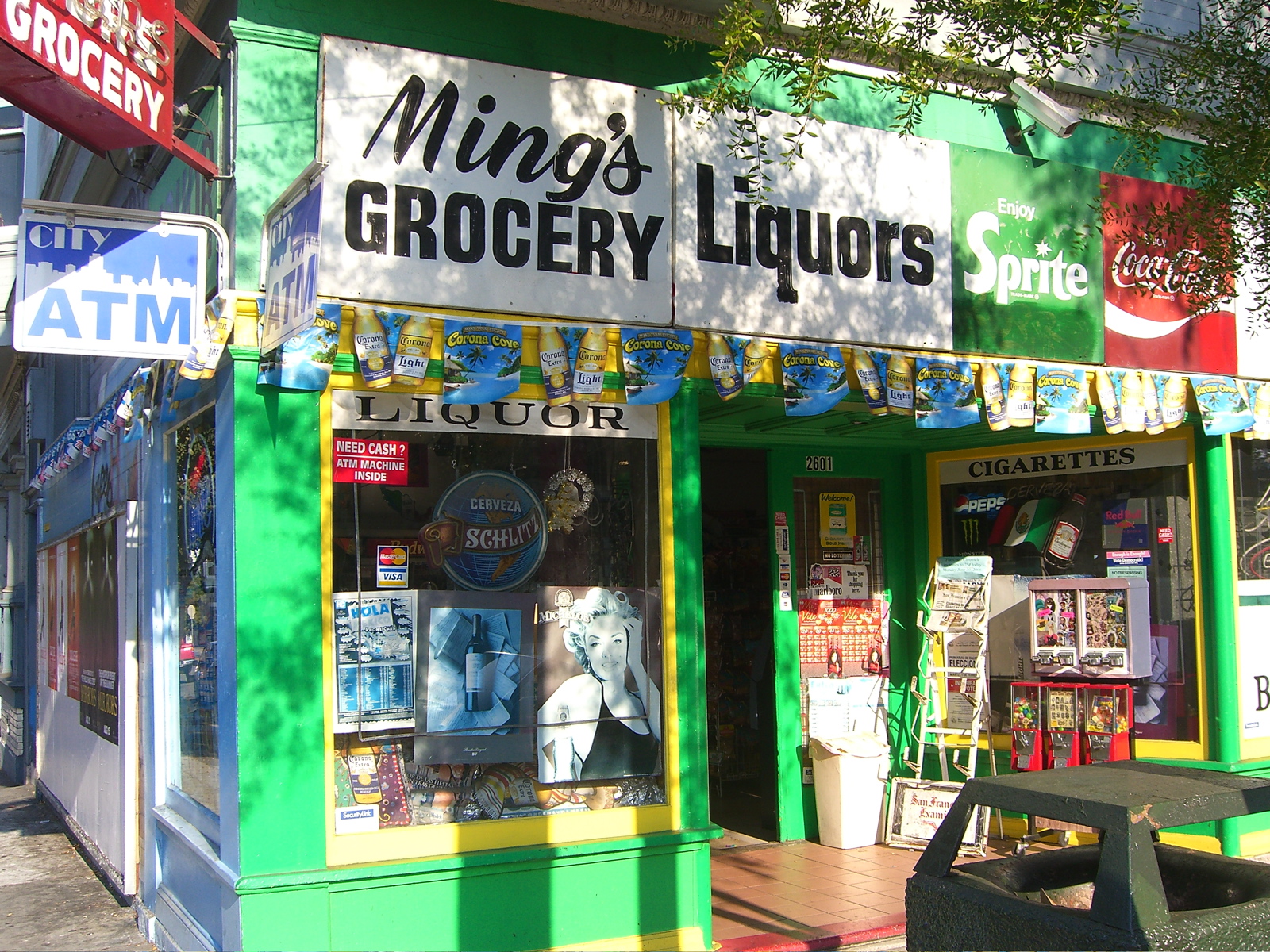
23rd 22nd and South Van Ness (I think), in San Francisco’s Mission District. After work, I looped up over Potrero Hill, crossed the 101 on the pedestrian overpasses up there, and ended up at the 24th and Mission BART station. It’s a great place to walk.

Technorati Tags:

Yes, He Did

The Berkeley Police Department puts out a daily bulletin summarizing each day’s large and small crimes. The bulletin comes out a few days after the fact, but if you’re concerned about what’s going on in your neighborhood–and we’ve had a series of sexual assaults in the area recently–it’s a good way to catch up.

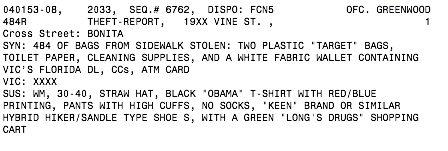
So here’s an item from last week: a sidewalk grocery snatch that also netted the victim’s wallet, credit cards, and ID. What caught my eye is the thoroughness of the description of the suspect. He, and his declared political leanings, made quite an impression:

200808111519

In case that graphic doesn’t show up clearly, the suspect description is: “White male, 30-40 years old, straw hat, black ‘Obama’ T-shirt with red/blue printing, pants with high cuffs, no socks, ‘Keen’ brand or similar hybrid hiker/sandle [sic] type shoes, with a green ‘Long’s Drugs’ shopping cart.

Chicago’s on the cornhole map

Technorati Tags: ,

United States Air Blog

Mono080108

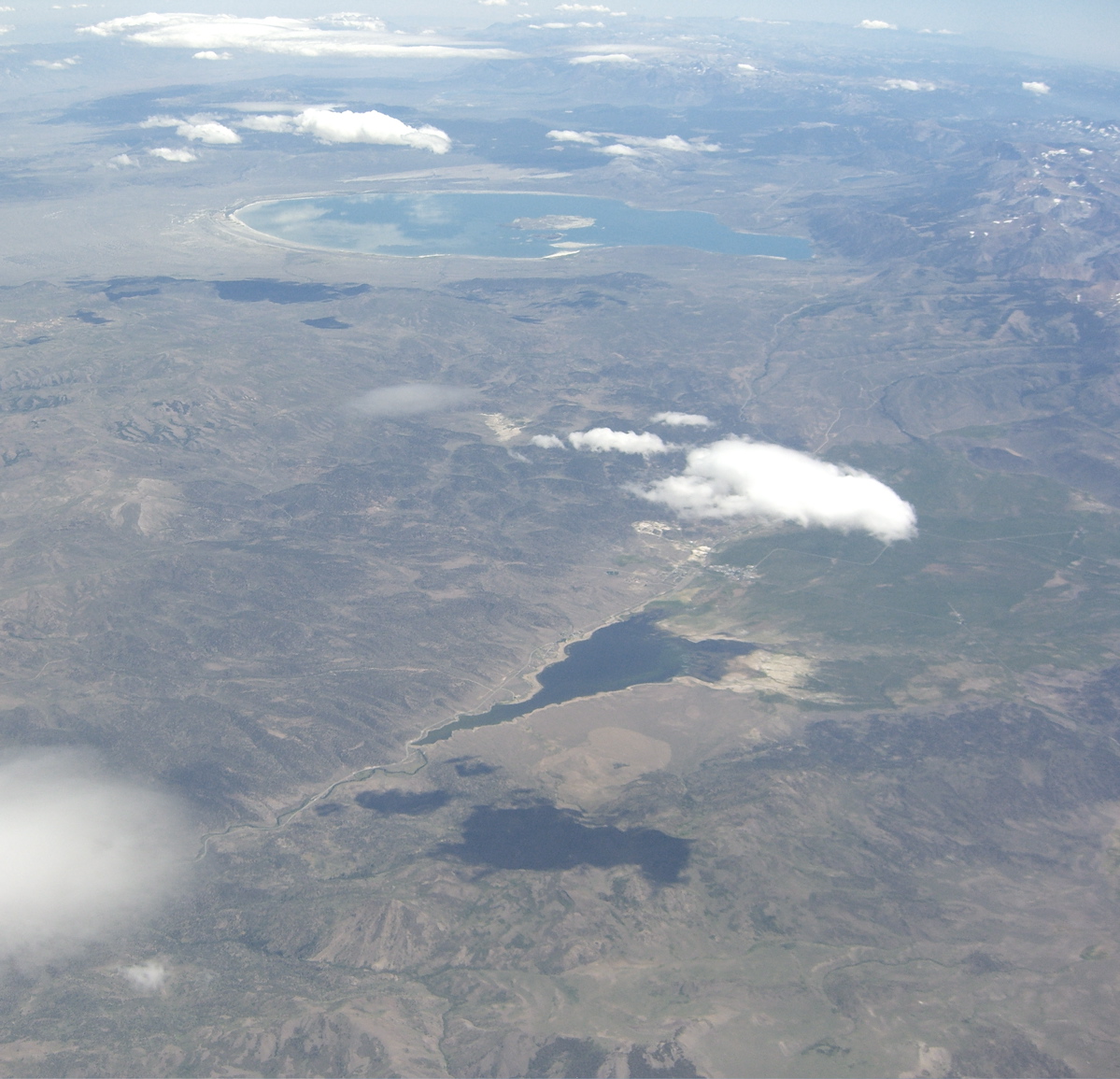
Mono Lake, with some clouds reflected in the surface, about 2:30 this afternoon. Flying to Denver–where I’m sitting right now, and where it’s 100 outside–and then on to Chicago for a family expotition. More later.

Technorati Tags: ,

Orphan Vacuum

Vacuum073108

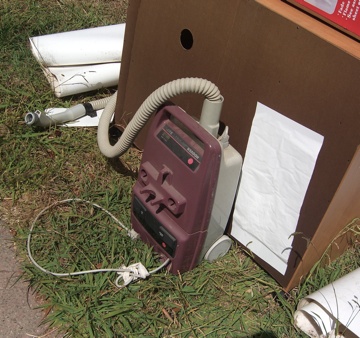
Another in an occasional series on the orphan vacuums of Berkeley. In these parts, this seems to be the most often abandoned home appliance. Every so often you encounter a microwave oven or iron left out on the street, and unwanted computer monitors are regular curbside finds, too. But vacuums keep turning up. This one graced the streetside lawn strip along Monterey Avenue not too long ago.

As with some previous finds, this specimen hails from the Hoover clan of fine vacuums. Hoover, hailing from the days when the United States was, no doubt, a world center of vacuum cleaner manufacturing. Cogitating on the picture, I wondered whether anyone keeps statistics on cast-off appliances–how many household machines and helpers large and small wind up in landfills every year? I looked briefly and found nothing. My mind then turned to vacuum cleaner production. Someone must keep track of vacuum cleaner manufacturing here and abroad.

Oh, do they.

“Household Vacuum Cleaner Manufacturing” has its own category number in the U.S. Census Bureau’s North American Industry Classification System (it’s 335212, if you want a truly arcane fact to trot out over cocktails). The category includes manufacturers of regular old electric vacuum cleaners (canister, upright, or handheld) as well as central vacuuming systems, floor scrubbing and shampooing machines, floor waxers and polishers, and electric sweepers. Unfortunately, the most current public Census numbers on U.S. vacuum cleaner manufacturing are from 2002. Back then, there were 10,400 workers engaged in the industry, and total vacuum cleaner shipments that year were $2.6 billion. (Be patient–I’m going somewhere with this.) The industry was essentially flat from the previous year for which a snapshot is given, 1997.

It won’t surprise you too much to find out that vacuum cleaners are also made outside the United States. The U.N. actually maintains an online database of worldwide vacuum cleaner manufacturing for the years 1995-2005, featuring such powerhouse producers as Belarus (which put out 6,600 units in 1995 and just 2,200 in 2005), Bulgaria (which apparently hasn’t produced a vacuum cleaner since 2000), and Chile (production in 1995: 257,000; production in 2005: 0). Iran made 257.000 vacuums in 1997 and just 200 in ’04 (wouldn’t you like to see the inside of that factory?).

So who makes all the vacuums? In no particular order, Japan, Korea, Germany, Italy and France make millions of machines a year. Having mostly apples and oranges statistics, it’s hard to rank those against the United States, though the value of U.S. vacuum shipments appears to be far higher than those of any country in that group; 10 times as much as Italy’s, for instance, and five times as much as Germany’s. Based on how many vacuums those countries, shipped, one might guess that the U.S. was producing 30-35 million vacuums in 2002. Just a guess.

One country I haven’t mentioned is the one that looms largest in our modern industrial world: China. According to the U.N. numbers, China produced 10 million vacuums in 2000; that looks to be far behind where the United States was. In 2004, the number was 50 million, almost certainly far ahead of the U.S., at least in unit volume. So the takeaway for this edition of the Vacuum Chronicles is that while those discards on the street today have a pretty good chance of having been made in the U.S.A., the next generation or orphan vacuums will likely have begun life far, far away.

Technorati Tags: ,

Sunday

You know how it is: late to rise, to meet friends and to tackle the day’s chores, late to eat and late to bed.

Late, and still not done with whatever it was we thought we had to get done.

To bed anyway, and tomorrow, we’ll see.

Carpooling, Casually

OK — the demands of a real, honest-to-goodness 9-to-5 week (at KQED-FM, where I’ve been working in the news department on and off since last December) and of my recent Tour de France blogging have kept me away from my posts here. Here’s a sliver of an update

.

During the past week, I’ve become reacquainted with the casual carpool. For the uninitiated, the casual carpool is a completely spontaneous system of catching a commute hour ride across the Bay Bridge into San Francisco. It started back in the 1970s or ’80s (I’m sure someone has written a history). A single simple element of our regional A.M. commute regime seems to make the system go: the free lane that permits carpools and other “high-occupancy vehicles” like buses to skip the long backup at the Bay Bridge toll plaza. At first, the lane ran parallel to just the final half-mile or so of freeway lanes to the toll plaza; now it’s connected to an HOV lane that stretches all the way to Vallejo, about 20 miles north of the bridge.

But way back when, just that first little segment of carpool lane and its promise of a way around the backup created the incentive for people to pick up a couple of riders on the Berkeley and Oakland side of the bridge and drive them to downtown San Francisco. It was easy for drivers to figure out where to pick up riders: at BART stations and at AC Transit bus stops. In fact, AC Transit hated the casual carpool when it appeared because it was siphoning away morning ridership (for a variety of practical reasons, casual carpooling has not caught for the eastbound, evening commute). At one point, the agency prevailed upon the city of Oakland to put up “no stopping” signs at its bus stops, and police were on hand to ticket violators.

The most often commented upon aspects of the casual carpool are, first, the willingness of total strangers to pick up or ride with each other to work and, second, the typical silence of the casual commute vehicle. I don’t think there’s a lot of mystery about the willingness to cooperate with strangers. Everyone gets something out of the deal. Perhaps the level of trust people display is surprising–I’m guessing that very few people who casual carpool would pick up a random hitchhiker or thumb a ride themselves. But in the quarter-century or more this has been going on, I, at least, have never heard about a crime connected with the casual carpool (the much bigger risk is getting into an accident with some nutso driver). And as far as the silence goes, it is typical but not absolute. I’ve had a conversation with a federal appeals court judge and listened as a fellow rider told the driver, a doctor, all about his prostate condition. Every once in a while I still see that guy around the neighborhood and sometimes call out to him, “How’s your prostate?”

We live a couple blocks from the North Berkeley BART station, a long-time casual carpooling hotspot. Commuters and drivers start appearing at the Sacramento Street curb about 6 a.m. Carpooling hours last until 10 a.m., and it’s not unusual to see diehard drivers or riders waiting as late as 9:55 in hopes of a free ride. Every day is a study in the shifting sands of supply and demand. Many days, two or three hopeful riders will be lined up on the curb with not a car in sight. A sudden flurry of drivers can clear the backlog in 10 minutes or less. Other days, a dozen cars will be queued up around the nearest corner–maybe because potential riders have heard that there’s a monstrous backup over the bridge and BART is a better bet for the day.

The system hasn’t changed much since I first used it in 1990. The one refinement I’ve noticed happened in the late ’90s, when drivers started soliciting riders going further west than the usual drop-off location at Fremont and Howard streets. Soon, two lines of riders started forming: one for downtown, one for Civic Center. During my last stint of employment in the city, I took a Civic Center ride nearly every day. My dropoff point, at Eighth and Harrison streets, was a five-minute walk from work (it’s about 15 or 20 minutes from KQED).

Last week, I found the system as quirky but reliable as ever. Still two lines. Still no telling how long one might wait for a ride. Stiil nearly no conversation among those going in to work together, not even about prostates.

Technorati Tags: ,

Dog Geography

Scout, a.k.a. The Dog, is full of surprises, especially when it comes to what we think of as him memory and awareness of where he is when we’re out on walks.

Since he’s a border collie/retriever mix of some kind, our program has been to walk him three or four times every day. But these are not long walks. Most of his world lies within a radius of about a mile and a half of our house. Still, that’s an area of about seven square miles.

When we bipeds traverse an area that size, we notice and remember remarkable or useful features: Peet’s Coffee, the house with the unusual water fountain in the front yard, the parking lot that offers a shortcut, the beautiful tall Norfolk pine.

The Dog has some of the same thing going on. There are certain places on our walks where he loves and expects to stop: outside the chicken coop in the garden at the local middle school and a certain Monterey pine where squirrels are always eating sunflower seeds after a dish on the ground.

How do we know The Dog remembers these places? He stops when we get to the nearest corner and more or less points in the desired direction. The fact he does this after many repetitions doesn’t surprise me.

But here’s something that does: About a month or six weeks ago, we had Scout out for a walk. We got a corner I don’t remember having walked past with him before. He stopped and stared into the yard of the house at the corner. There were a couple of pet rabbits loose out there, and he was transfixed. In fact, we’d still be out there if we hadn’t compelled him to leave after about 10 minutes.

The next day, we approached the corner from a completely different direction; in fact, no part of the path we took repeated the way we had come the day before. But when we got close to the rabbit house, he headed directly for it. OK, maybe not shocking. Still, I was impressed that he made the connection–maybe he smelled the place–when we were coming from a different direction.

We didn’t return to that block for a couple weeks. When I did, we were taking another route that didn’t come closer than about 100 yards to the rabbit place. But as soon as The Dog got to the closest point, he stopped and looked up the street toward his desired destination. Yesterday, needing to take him on a quick walk and wanting to keep him away from the rabbits, I took yet another route, but had the same result. When we got to within a block of the rabbit house, he stopped and pointed for it.

I’m not sure how he’s doing it. But I think it must be a combination of visual and olfactory recognition (though he knows we’re close even when the rabbits are downwind) and some sort of ability to guess the relationship of one location to his target even if he hasn’t walked the precise path before. In other words, he’s using something more than rote memory.

I’m not suggesting The Dog is capable of planning out his own trip itinerary. But en route he’s got the capability of connecting a remote location with where he happens to be and heading there.

Technorati Tags: ,

Pastime Moment

Cubs063008

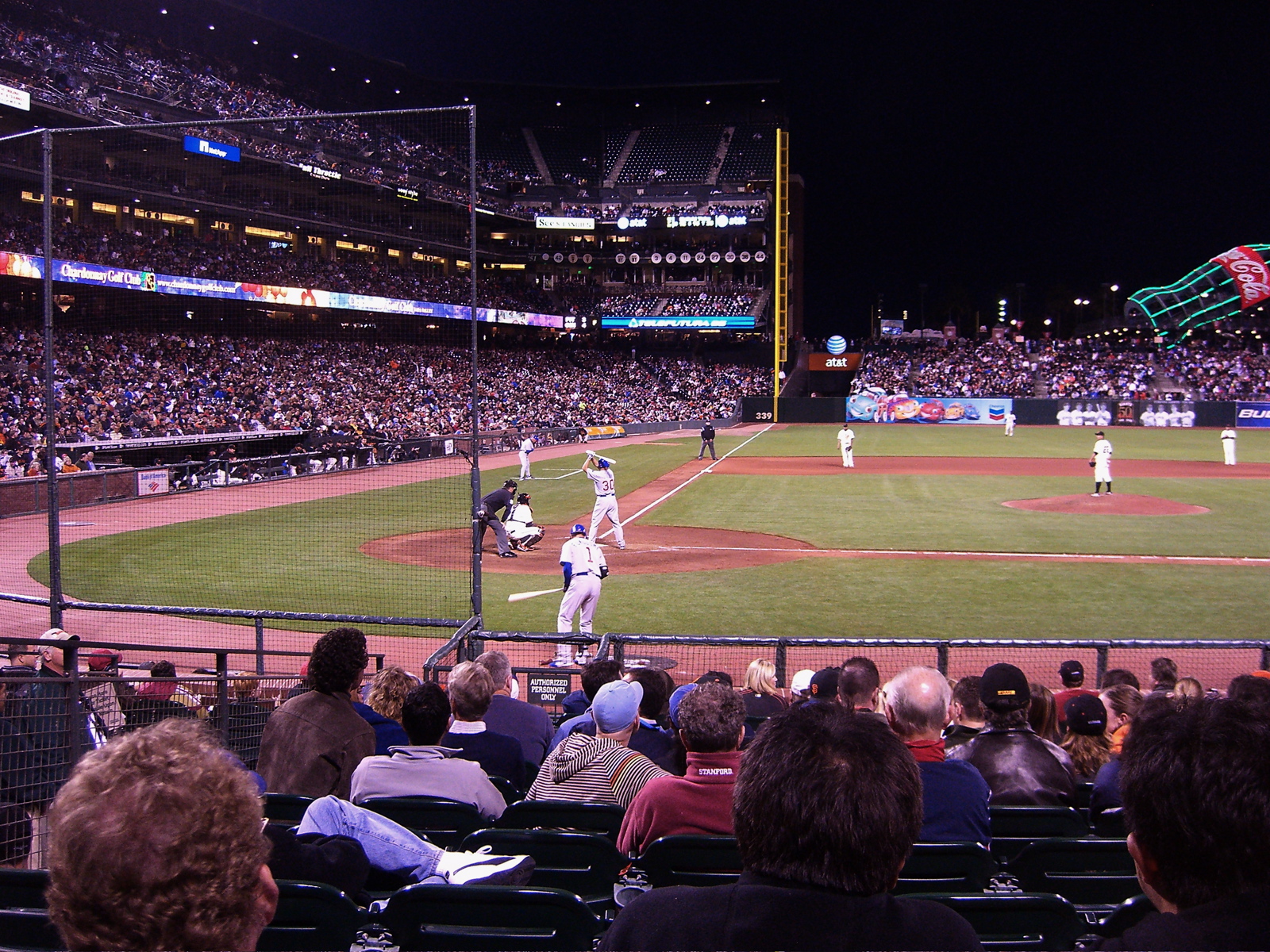
Not a great picture, but here it is just because we were there. Monday, Kate’s old boss called to offer us his pair of very good box seats for that night’s game between the Cubs and Giants. It was a nice evening at Phone Company Park if you were partial to the efforts of the Chicago squad. They won 9-2, and the crowd was sparse enough overall and the proportion of Cubs fans was large enough that you might have mistaken which team was playing at home: every time something went right for Chicago, a loud cheer erupted. The Giants fans concentrated their attention and vocalizing on their starting pitcher, Barry Zito. The latest effort from the $17 million a year lefthander featured five walks and five runs in five innings of work. His record at the end of the night: 3-12. The journalist and sports fan in me feels like there’s a great story to be told about how this guy’s career has imploded.

We didn’t go to the second game of the series last night. The Giants won. No connection implied. (In the picture, that’s the Cubs pitcher Ted Lilly at bat and rightfielder Kosuke Fukudome on deck. Oh, and the seats that provided this view? $71.40 a pop, which makes me marvel at the family of five sitting next to us and grateful for Kate’s boss’s generosity.)

Technorati Tags: , , ,

More Smoke

Smoke062708

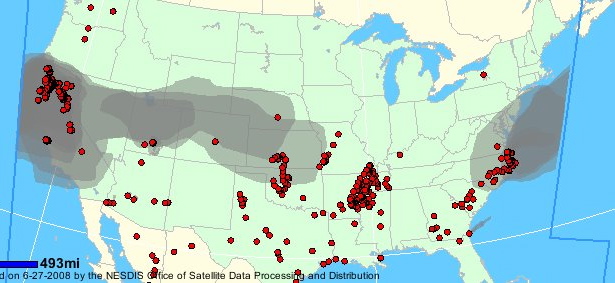
Around the Bay tonight–my part of the Bay, anyway, San Francisco, Berkeley and environs–it looks like we’ve gotten a little break from the smoke. It was cloudy at dusk, and you could actually tell there were clouds in the sky instead of it being a big flat mass of gauze. Out in the Central Valley, and particularly north, in the Sacramento Valley, the smoke is a real issue. The air is so full of particulates–fine, fine ash ejected from the fires burning in every direction–that it’s rated “very unhealthful” to “hazardous” to breathe (for anyone, not just people who have higher health risks because of heart and lung conditions). Hospitals and medical equipment suppliers gave away as many as 2,400 respirator masks in Redding and Chico. The number of fires said to be burning in California tonight: abour 1,200. The National Weather Service says that the mountains in Northern California may have another spate of dry lightning storms over the weekend.

But California being California, we like to share. The image above (click for larger version) is from the National Oceanic and Atmospheric Administration’s Fire Detection Program page. The red dots are hot spots detected by NOAA satellites. The gray areas are smoke plumes. Here’s a snippet of the text that goes with the image:

California:

Several large wildfires and numerous smaller wildfires in northern

California continue to emit large amounts of moderately dense to dense

smoke which covers much of California, north of 35N, and extends to the

west over the Pacific Ocean.

Central US:

Light smoke remnant from the California fires … can

be seen extending across much of the central United States. States over

which the light smoke can be seen include: central Nevada, northern

Utah, southern Wyoming, northern Colorado, southern Nebraska, most of

Kansas and western Missouri.

Technorati Tags: , ,

The Smoke of Ought-Eight

Smoke062608

Firefighting agencies say there are over 1,000 wildfires burning in California right now. About 800 of them started last Saturday and Sunday as dry thunderstorms swept over the northern two-thirds of the state. We’re a long way from any fires here. There’s a big one burning about 125 miles north of us, near Clear Lake, and two very large blazes in the mountains that rise up from the Big Sur coast–maybe 150 miles south-southwest of here. Still, the smoke is everywhere. Morning, noon, and evening, the sun shines with a filtered light, and the acrid smell of scorched brush hangs in the air. The picture above is out in front of our house at 7 a.m., after the sun had been up nearly two hours. I’ve been here long enough that I can spin graybeard yarns, but still it’s true: There’s been nothing quite like this here–this pall of smoke that just hangs here day after day–in the 30-some years I’ve lived here.

Technorati Tags: , , ,