A fence I pass every day. On 16th Street in San Francisco, between South Van Ness and Capp, and right next to Theatre Rhinoceros. The fence surrounds a parking lot, site of a defunct AM/PM minimart and a dead car-tuneup place. Nearby is an empty Jeep/Chrysler dealership. The fence, though–it’s doing fine.
Working for the news department of a local radio station, I’ve been paying close attention since Saturday night to the incident in which a paroled armed robber shot and killed four police officers. One observation, in the age of disappearing media sources and shrinking newsrooms: lots of good coverage from the journalism dinosaurs, little or none from our next-generation darlings, the blogs. The former have been swarming the story; the latter offer rehashes of what the dinosaurs report. Not to say that new-type media have not been useful: the Twitter stream on Oakland has been a good source for both news links and to sometimes disturbing online reactions (“disturbiing” defined: rationalizations/justifications for the killing of the police officers; more on that later). If one is looking for an object lesson in what news organizations do well that independents and bloggers do not do well–yet, anyway–the reporting in this case over the last several days is a decent example. Below are some notable examples of local coverage from the last day. I’m starting with a story that we at KQED produced yesterday evening. Reporter/anchor Cy Musiker, who began hustling after the story as soon as he heard about it Saturday afternoon, did a great job at capturing the city’s mood. The rest of the links are to stories that appeared sometime Monday.
Chronicle reports, and OPD confirms, that on Friday (day before shootings) the OPD had learned of a DNA match linking Mixon to a rape earlier this year. OPD reportedly investigating link between Mixon and second rape, too. The Chron did a good job with court records and turned up details of the crime (attempted carjacking) that sent Mixon to prison. Good details on his background as known at the time of his trial and conviction. The story also expands on earlier reports that Mixon was suspected of an earlier murder.
More details on shooting, per OPD sources. Mixon is said to have disabled both motorcycle officers, then fired again at close range to finish them off. Also, the story names the type of rifle Mixon is supposed to have used in his shootout with SWAT officers, an SKS (Soviet origin; see: http://www.sks-rifles.com/ or http://www.hk94.com/sks-rifle.php and prepare to be charmed).
Anonymous first-person account from woman who says she hesitated before telling an officer where suspect was hiding. Also note the Monday details of neighbors prying plywood from apartment door to inspect shootout scene.
A little more detail from family on Mixon’s background, and other reaction across the city. Interesting detail from one resident of shootout neighborhood: “One woman, hosing down her driveway two doors down from the apartment where Mixon was killed, said some of those lives could have been saved. She said neighbors knew immediately where Mixon had run, but they didn’t tell police — who combed the neighborhood — until nearly an hour later. But in East Oakland, lamented the woman, Elaine, who didn’t give her last name, that cooperation doesn’t easily happen. “It makes you feel bad. But you just don’t want to be a snitch. The word, ‘snitch,’ it’s almost worse than murderer.”
Corner of Vine and Walnut (in front of the Friends meetinghouse, across the street from a Mormon church, diagonally across from the being-refurbished original location of Peet’s Coffee–home of Berkeley’s one true religion).
The nailed-up candy heart got our attention first. Then the “long train of usurpations and abuses” flyer.
On the side of an auto body shop, adjacent to a mostly razed building at Potrero and Mariposa. I love the boldness and scale. Looking at the picture, someone’s been at work in the cellar below the mural wall, too. (Click for larger image.)
A bus shelter at 17th and Bryant in San Francisco. The ad has been there for gee, at least six months. I like the image and the legend “Patrocinador de tu sonrisa.” Spanish-challenged as I am, I imagined that “patrocinador de tu sonrisa” had something to do with “sunrise.” Naturally, it doesn’t. It translates as, “Sponsor of your smile.”
And the text below?
¿Qué hace una rata en una esquina? Esperando un rato.
It’s a joke (Nesquik sponsors your smile), but one that relies on a pun, one that I can’t fathom, so can’t translate well:
Occasionally, we respond to questions. As in the following case:
Dear Dr. Info:
Why does my pee smell like that?
Signed, Concerned
Dear Concerned:
Without more detail, it’s hard to know for sure. But my guess is that you ate asparagus recently. That’s because studies by the Urine Institute have found that more than 90 percent of questions about micturation odors are related to asparagus consumption. And indeed, these observations appear in literature from ancient times. Achilles complains about the smell of Agamemnon’s “offensive green stream” after a feast of braised asparagus (“The Iliad,” Book XIV) and retires to his tent until the air clears. Much later, Voltaire called the liquid aftermath of asparagus consumption one of the delights of life, deeming the attendant aroma le grand phunque.
Knowing you, you want more than just my guess that asparagus is involved. OK, then–let’s assume it’s asparagus. Now that we’ve done that, we can ask, “why does asparagus make your pee smell like that?”
The answer is surprising (to me, anyway): Although research has zeroed in on certain chemicals and metabolic processes that apparently play a role in producing the funk, there is no universal agreement about the source or the cause; about whether everyone produces smelly urine after an asparagus party or only some people; or whether the real issue is whether everyone has the olfactory equipment needed to smell asparagus pee.
Went down to Santa Clara last night to see our local men’s professional soccer team, the San Jose Earthquakes, play an exhibition against what amounts to a farm team, the Portland Timbers (the home side won, 1-0; thanks, Eamon and Sakura).
The Quakes play in Buck Shaw Stadium at Santa Clara University. Saint Clare, I dimly recall from the Nikos Kazantzakis novel and maybe a Hollywood movie starring someone like Bradford Dillman, was Saint Francis’s one-time squeeze from Assisi (at least that’s how I think the story goes). When he gave up the life of the feckless, dissipating hedge-fund operator (or medieval equivalent) for one of impoverished contemplation and ethical treatment of animals, Clare did likewise.
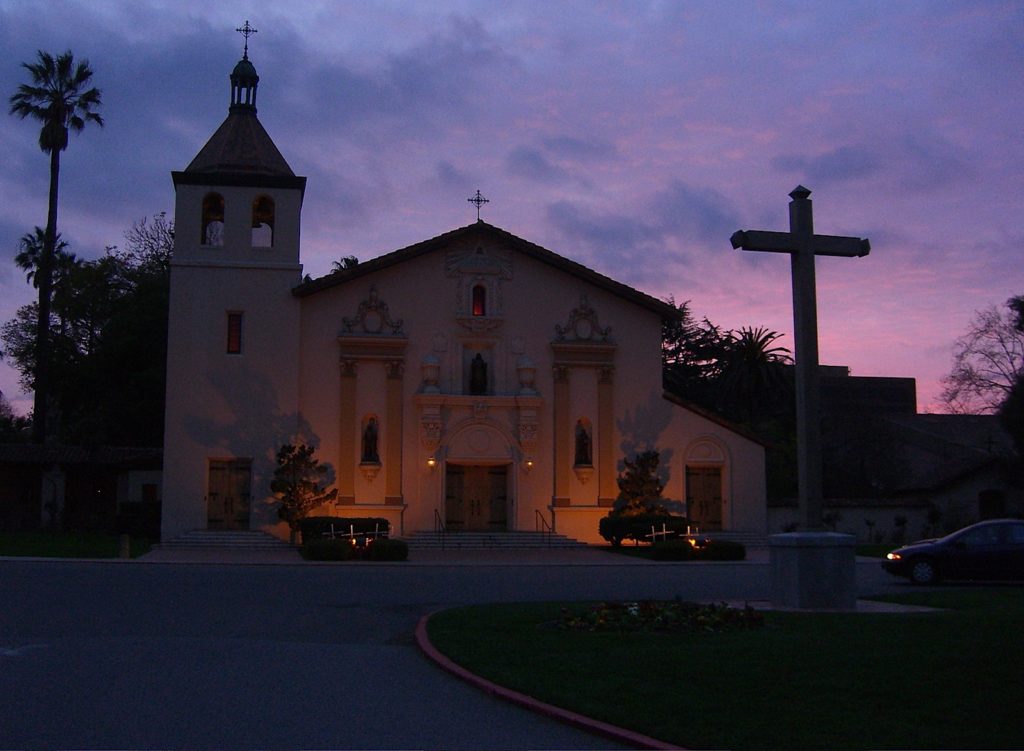
Fast-forward to the Spanish colonization of California: Both saints wound up having California missions named after them. The one memorializing Saint Francis was part of the settlement that eventually turned into a town full of dissipation and hedge-fund shenanigans and only occasional world-renouncing introspection. The mission celebrating Saint Clare burned down, I’m told, and was replaced by the building you see here, which is on the campus of Santa Clara University–a place that I expect veers constantly between partying and deep reflection.
A weekend morning ritual has evolved since The Dog’s arrival in 2006: On Saturdays, we walk up to Fatapple’s, a restaurant with a take-out shop, and pick up coffee and a pastry, walk over to the local school garden for the four-legged family member to scope out the chicken coop and the squirrels, then sit in the little amphitheater next to the playground (it’s got a view out to the bay) and eat. Sunday, we’ve started walking the other direction, to a place called Fellini, on University Avenue, that has a take-out window. We buy coffee and skip the pastries, then walk down to the old Santa Fe right -of-way and circle back home. All of the above is habit-forming.
Across the street from Fellini is Ledger’s Liquor, one of the few remaining liquor stores on University. In olden times, city ordinances forbade alcohol sales within a mile of the Berkeley campus. You know the reason: the pernicious effect of drink on youth and so forth. Those laws were scrapped long ago, but their legacy — a dearth of taverns and liquor outlets and a subdued night life — remains. The big liquor market on the street, Jay-Vee, closed about a decade ago and is now a synagogue. Another place a few blocks away, B&W, which was attached to a bar and seemed to have a corner on the down-and-outer crowd, has been a vacant lot for two or three years. The stores have gone out of business mostly because surrounding neighborhoods, and the city, have become unfriendly: University Avenue liquor stores are seen as magnets for crime and trash.
Ledger’s had been around awhile when I got here in the ’70s. It was known for stocking exotic beers, which back then only meant brews free of the taint of St. Louis, Milwaukee, or Golden, Colorado. I can’t remember the last time I was in there; I’ll bet it was in the ’80s. But it’s still kicking along, though what draws my attention now is the assortment of goods advertised and the slick way they’re presented.
The message on the marquee is semi-permanent and perhaps immortal. Anyone know a source for that?
An acre foot is the amount of water it would take to flood an acre to a depth of one foot. An acre is, ballpark number only, a patch of land 100 feet by 400 feet. If you were standing on that patch of land with water about halfway up to your knees — well, you’d be having a direct experience of the acre foot.
An acre foot is 325,000 gallons. If you pay a water bill that shows how much you use, you can figure how long that much water would last you. The rule of thumb, that we journalists borrowed from “water experts” here in California was that an acre foot was enough to supply two average households for a year. That’s for use inside and outside the home for three or four people say, and it comes out to about 460 gallons a day for each household. Of course, there’s a lot of variation. An inner city apartment dweller uses a lot less than someone whose lawn looks like a fairway at Augusta National. Someone in a cool coastal area — Berkeley, for instance — uses less than someone in a much hotter area on the other side of the hills, lawn or no lawn.
The acre foot is a basic unit of life in California. Yes, weather people and water management officials count inches of rain and snow in the winter. But those units are incidental in a place that needs to capture and store an immense amount of water to irrigate roughly 15,000 square miles of crops and to supply 36 million people. The acre foot is the fundamental currency of reservoir storage and water delivery.
Up and down California, the federal government, the state government, electric utilities, county and city water companies, and irrigation districts have built reservoirs. They’re big bathtubs that together hold something like 42 million acre feet; that would be enough to submerge the entire state of Wisconsin under a foot of water. They reservoirs are expected to fill up in the winter and spring with runoff from the rains and melting snow running down from the Sierra Nevada. Then the water is pumped out during the dry season to help the fields and orchards thrive and to keep the showers and garden hoses flowing. Some water is even set aside for the fish that swim in dwindling numbers through the maze of waterways between reservoir, farm, and town.
A wet winter here–what people like to think of as normal, with nature’s tap switched on when we get into the middle of autumn–keeps our big bathtubs full and the water running where it’s needed. But there are other kinds of winters, too. Very wet ones, where the system simply can’t hold all the water coming down the rivers. And dry and very dry ones, where the water level in the reservoirs falls and keeps falling if two dry years come back to back.
We’re in what appears to be our third dry–or drier than “normal”–year in a row. Three of the biggest federal reservoirs in Northern California– Shasta, Oroville, and Folsom–all fell to critically low levels in December and January. Together, the three reservoirs can hold about 9 million acre feet; that’s about enough to supply a year’s worth of household water for New York, Pennsylvania, New Jersey, Massachusetts, Connecticut, Rhode Island, New Hampshire, Vermont, and Maine. That’s every U.S. resident east of the Great Lakes and north of the Mason-Dixon Line.
Remember,: that’s the capacity of just three reservoirs. There are dozens of others. During the last five weeks, copious rains have fallen and the water has started to rise in some of those big bathtubs. More about that later.
Early this morning, just after the sun was up, it started to rain. That meant there was a rainbow somewhere in the west. And yes, somewhere up there beyond all those wires, a rainbow appeared — actually a double, but the second, outer arc is pretty faint.