Ageless Stranger

I’ve lived in Berkeley long enough–more than 30 years, more than half my life–that I’ve become familiar with a whole cast of characters who are actually total, or nearly total, strangers. Store clerks, panhandlers, fellow passengers on the train, commuters who stroll through the neighborhood. There have always been a few of these unknown ones who don’t fit into any of those predictable slots. Just people I’ve seen over and over during my walks. Most memorable is a man with whom I happened to ride to San Francisco one day in the casual carpool from North Berkeley BART. I had seen this guy before and never had any occasion to interact. But on this particular morning, we wound up in the same car with a man driving over the Bay Bridge into the city. Somehow, the driver’s occupation came up. He was a doctor at San Francisco General Hospital. That information prompted my fellow passenger to disclose that he was on the way to see a doctor. He was being examined for prostate trouble, which he proceeded to describe in generous detail. Quite a performance, and for years afterward, whenever I chanced to pass this guy on the street, I’d ask, “How’s your prostate?” Coming from a complete stranger, the query always got a startled look.

There’s another guy I’ve been seeing on the street for decades. The reason I first noticed him was his hair: blond, waist length, and very lank and straight. He walks with an almost unnaturally erect posture and always seems to have a serious expression and to keep his eyes straight ahead. He walks a lot, I think, and walks a little faster than I do. I’ve encountered him dozens of times in different neighborhoods and even up in the hills. We’ve lived in our neighborhood since the late ’80s, which is probably when I started seeing this guy. I know I’ve aged in those years. He hasn’t aged much. We’ve never spoken in all those times we’ve passed each other, and I’ve wondered who this severe-looking hard-walking stranger is.

A few months ago, Kate and I were out on a Saturday morning walking The Dog. We made one of our regular turns, and up ahead I saw the long-haired stranger. He was wearing a white bathrobe and was picking up something from his lawn; I think he was dealing with a leaky sprinkler or something. We said something as we passed–“Good morning,” I guess–and he responded with a friendly “good morning” of his own. That’s all that happened. But it was enough to make me feel like I had some connection to this stranger after all these years. And for all I know, he (and how many others?) have been wondering about me, too.

You’ve Been Warned

vaccine100309.jpg

This was posted adjacent to the campus of Santa Clara University. We spotted it Saturday night when we were down there to watch soccer with Eamon and Sakura.

Let’s not even talk about what the reaction a poster like this is trying to elicit. Let’s focus on the wording. If prompted, my slogan might be, “Vaccines save lives.” Clearly this local leafleteer is of another mind. Fine–let’s resolve this disagreement in the marketplace of ideas. But here, the pitch isn’t “vaccines may be dangerous” or “Vaccines: use at your own risk”–statements that would probably be attention-getting and may not stray across factual lines. That’s not enough for this broadside, which says flatly “vaccines are poison.” In a world where apparently no one can be trusted to think–hey, which vaccines are we talking about here?–nothing but the most alarmist message will do.

[Update: NPR’s “Morning Edition” did a segment this morning addressing questions about the safety of the new swine flu vaccine. ]

‘To Be, To Do, or To Suffer’

So I tried out a presidential quote on my Facebook friends to see if they could guess who said it. The person in question described himself at one stage in his life as “a strange, friendless, uneducated, penniless boy.” I was a little surprised how quickly–immediately–someone came back with the correct answer: Lincoln.

So I brainstormed another favorite presidential quote: “The fact is I think I am a verb instead of a personal pronoun. A verb is anything that signifies to be; to do; or to suffer. I signify all three.” That’s another well-known one: U.S. Grant near the end of his struggle with throat cancer.

On one hand, I’ve always thought Grant was saying that illness and suffering were sublimating his presence as a person into something else: a verb, an action, an energized presence. And I think it’s natural to focus on the last part of the formulation: “to suffer.” By all accounts he was in a lot of pain as his cancer progressed. But there’s something else there that perhaps shouldn’t be surprising for someone who was as careful a writer as Grant was. In part, he’s quoting what may have been a childhood grammar lesson.

Here’s a passage from an 1831 volume by John March Putnam, “English Grammar: with an improved syntax.” It’s a pretty standard late 18th-early 19th century description of verbs and their function.

I think Grant’s sublimation is still there. But his “suffering” has another dimension to it–simultaneously, he exists still, he continues to act, and he is at the mercy of the forces ending his life.

Berkeley Crime Notes

We in our little middle-class Berkeley enclave do not feel we live in a big, bad, dangerous city. Yeah, we see stuff happens. Our house was broken into seven years ago, and we’ve had a car vandalized on the street in front of our place. Offhand, I can think of more than a half-dozen burglaries on our block since we moved here 20-some years ago, including a couple that happened within the last six months. Unbeknownst to anyone here, last week there were several burglaries on the street just west of us. As it happened, one of the homes that was broken into had security cameras installed. According to the Berkeley police, here are the images captured:

burglar1.png

burglar2.png If nothing else, these two look prepared: the bags. The baggy, anonymous white T-shirts that can be taken off and thrown away (“Officer, I saw someone wearing a white shirt. …”). I’d also note that the blocks where the burglaries occurred are within a four-minute walk of the BART station. Lots of students go in and out of there, and a couple of young people carrying big bags would attract no attention at all.
Wish I had a picture of the people who got away with my two laptops back in 2002.

‘Fight the Anti-Worker Capitalist Agenda’

socialism1.jpgsocialism2.jpg A couple of days ago, a young woman came down the aisle of my car on BART as we neared the Civic Center station. She was dropping postcards on empty seats. Strangely, she wasn’t handing them to any passengers. Maybe this is why: One of my fellow passengers picked up one of the cards, scanned it, and started to laugh. His companion said, “What’s so funny?” “Nothing,” he said. “Crap.” Then he tore up the card and discarded the scraps on the floor. Even here, the region some people would unhesitatingly dub the furthest left in all America, it’s hard to win people over to the fight against the anti-worker capitalist agenda.

Guest Observation: Henry Reed

From “Naming of Parts“:

“They call it easing the Spring: it is perfectly easy
If you have any strength in your thumb: like the bolt,
And the breech, and the cocking-piece, and the point of balance,
Which in our case we have not got; and the almond-blossom
Silent in all of the gardens and the bees going backwards and forwards,
          For to-day we have naming of parts.”

Wonderful poem, which I encountered in a junior college composition class I needed to take to get into Berkeley. Wonderful class, too: the instructor was a poet who lived up in the Richmond hills. I groped, as I often do, for what this poem was saying. Seems pretty obvious now. (And if one wants to read more on Henry Reed, who seems worth the time, here’s a wonderful website dedicated to his work. That’s three “wonderfuls” in the same paragraph. I’m out.)

John Muir: ‘I Asked the Boulders Where They Had Been’

We’ve watched most of the first two installments of the new Ken Burns public TV extravaganza, “The National Parks: America’s Best Idea.” The beauty of the show is exhilarating and the history is fascinating (Theodore Roosevelt–what a guy).

The first two episodes are closely entwined with the story of John Muir, and part two focuses first on his fight to complete the preservation of Yosemite and then on his unsuccessful battle to stop San Francisco from flooding Hetch Hetchy valley. Muir’s voiceovers are done in a soft Scots burr. Occasionally, you hear about Muir from Lee Stetson, who has portrayed him for decades and who has even adopted the Muir look. But when Stetson appears on camera, he speaks in a plain old General American accent. At the very end of the second episode, though, he briefly introduces a Muir quote, then instantly transitions to the gentle and compelling Muir voice, then appears on camera to finish the quote. It’s a moving performance. Here’s what he recites:

“Muir said, ‘As long as I live I’ll hear the birds and the winds and the waterfalls sing. I’ll interpret the rocks and learn the language of flood and storm and avalanche. I’ll make the acquaintance of the wild gardens and the glaciers and get as near to the heart of this world as I could. And so I did. I sauntered about from rock to rock, from grove to grove, from stream to stream, and whenever I met a new plant I would sit down beside it for a minute or a day, to make its acquaintance, hear what it had to tell. I asked the boulders where they had been and whither they were going, and when night found me, there I camped. I took no more heed to save time or to make haste than did the trees or the stars. This is true freedom, a good, practical sort of immortality.”

Short Sunday Ride: Quotes from the Road

Three things people said to me while I was out riding yesterday (a 1.5-hour loop from North Berkeley, up Tunnel Road, down Grizzly Peak):

*”Hi.” (One of four cyclist who passed while I was dropping off something at a friend’s house).

*Be careful!” (Another cyclist on Tunnel Road warning me about a car approaching from behind. I was in an awkward spot on a curve, trying to turn left. Everything turned out fine.)

*F— you! You punk!” (A driver on Euclid Avenue in Berkeley. He had pulled his aged white Mazda in front of me when I was doing about 30 down the hill. It was an oblivious move, but didn’t result in too close a call. Within a block or two, he put on his turn signal to go right, and was staring at me as I passed him (I knew because I looked over at him). I said, “Honest to God …” in a sort of resigned way, and he responded with the above. It came out in an enraged scream that made me realize 1) he probably didn’t hear what I said and 2) he had worse problems than careless driving. I was relieved he didn’t follow me.)

Oasis

fountain092709.jpg

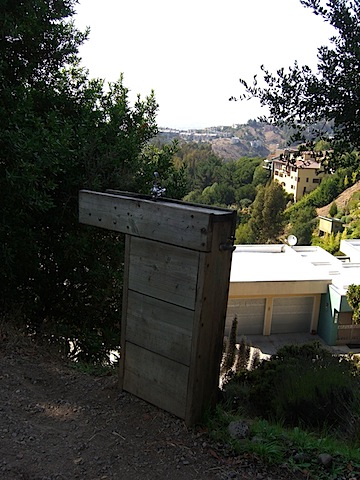
Not a great picture, but this is a drinking fountain up along Skyline Drive, just above Tunnel Road, in the Oakland Hills. Here’s what’s unique about the fountain: It’s set up on the shoulder of the road in a place that seems meant to be of maximum use for cyclists. The road is one of the most popular climbs in the East Bay Hills, an almost leisurely ascent that invites you to spin your way up and then gets a little more serious about halfway up the roughly four-mile climb. I’d guess that hundreds of cyclists ride past this fountain on their way up every day; a few locals may stroll here, too, but the road and shoulders are narrow and you certainly don’t see many of them as you pedal through here.  

I went up here about 2 p.m. or so. A nearby weather station recorded the temperature as 95 degrees. I’ve ridden so little of late that even a relatively relaxed climb like this one has become an index of my lack of fitness. Didn’t hurt too much, though, and the reward came on the fun descent from the top of Grizzly Peak Boulevard back into Berkeley.

Anyway, the fountain: I passed it, then remembered a nice little New York Times feature from a month or so back that talked about public drinking fountains and what they represent. I turned around to use this one, and noticed many sets of bike-tire tracks in the dirt at its base. An oasis on a hot day.

Oasis

Tunnel Road: The fountain.

Not a great picture, but this is a drinking fountain up along Skyline Drive, just above Tunnel Road, in the Oakland Hills. Here’s what’s unique about the fountain: It’s set up on the shoulder of the road in a place that seems meant to be of maximum use for cyclists. The road is one of the most popular climbs in the East Bay Hills, an almost leisurely ascent that invites you to spin your way up and then gets a little more serious about halfway up the roughly four-mile climb. I’d guess that hundreds of cyclists ride past this fountain on their way up every day; a few locals may stroll here, too, but the road and shoulders are narrow and you certainly don’t see many of them as you pedal through here.  

I went up here about 2 p.m. or so. A nearby weather station recorded the temperature as 95 degrees. I’ve ridden so little of late that even a relatively relaxed climb like this one has become an index of my lack of fitness. Didn’t hurt too much, though, and the reward came on the fun descent from the top of Grizzly Peak Boulevard back into Berkeley.

Anyway, the fountain: I passed it, then remembered a nice little New York Times feature from a month or so back that talked about public drinking fountains and what they represent. I turned around to use this one, and noticed many sets of bike-tire tracks in the dirt at its base. An oasis on a hot day.