
If the world of intermodal transportation entrances you–and few among us can resist the charms of cargo containers on ship, rail, and truck–then the area around the port of Oakland is for you. Upon disembarking from the ferry at Jack London Square on Friday night, we encountered a freight train stopped at the corner of Second and Clay streets. The crossing gates were down, but the train was at a dead stop, so it was safe to cross. Picture-taking ensued. After five minutes or so, the locomotive horn sounded, and the freight began to roll. Amazing to contemplate the power and energy required to get so much weight moving in such short order. One minor drama: As the train rolled across the intersection, a pedestrian decided to run across the street in front of it (see if you can spot that moment in the slide show below). It wasn’t really a close call, but you kind of wonder what (beyond pure ignorance of the consequences of stumbling and falling) would prompt somebody to try that.
Live at North Berkeley BART

Probably a feature of every big-city transit system: the itinerant musician who shows up to play at the stops along the way. The North Berkeley BART station a couple blocks from where we has a cast of folks who show up semi-regularly. There are three guitar players I can think of whom I’ve seen out there: a middle-aged guy who plays a nice classical guitar and always seems to land a decent pile of bills from the from passersby; a young guy who has sung himself hoarse thrashing out folk-rock tunes and looks ragged, like he’s barely hanging on; and the woman above.
Her name is Lily, and she plays slide steel guitar. I’m not a music critic, but I heard some nice touches in amid some scrambling to find the next logical note or chord. (Disclosure: I’m not sure I could find a single chord, logical or otherwise, on any kind of instrument.) I had my sound kit with me and recorded a little bit and talked to her briefly. The audio is below:
First They Ignore You
A mural from last fall, when all the world was Occupied. On 16th Street and Harrison, in what I describe as the seam between the Mission and Potrero Hill. The building houses a book bindery (to the left) and a club (to the right) that just reopened as a joint called Dear Mom.
If the Gandhi quote strikes you as a little too glib, well, you might be on to something. No less a source that Wikiquote lists the attribution to M.K. as disputed (the quote, or misquote, also won the attention of the Christian Science Monitor). Instead, they point to a 1918 quote by someone named Nicholas Klein: “And, my friends, in this story you have a history of this entire movement. First they ignore you. Then they ridicule you. And then they attack you and want to burn you. And then they build monuments to you. And that, is what is going to happen to the Amalgamated Clothing Workers of America.”
And who was Nicholas Klein? As near I can tell, a liberal (or further left) lawyer who hailed from Cincinnati. Besides the quote above, delivered to a labor convention, he turns up a couple other times in 1918 in letters to the editor of The New York Times, decrying German aggression against revolutionary Russia. I find Klein making a brief re-appearance in 1930 as a friend and benefactor of James Eads How, a well-to-do St. Louis man who was an advocate for homeless migrant workers (a.k.a. hobos). But that’s another story.

Winter While We’re Not Looking
It’s raining tonight here in Berkeley. It rained a liittle here on Friday, too, and some more a few days before that. Except for the fact the rain has only added up to a large thimbleful so far, it’s almost like a real winter has snuck in to Northern California. A couple more little storms might shuffle through this week, but the forecasters seem to be competing with each other to display the most pronounced lack of enthusiasm about the prospects for any appreciable rain falling. One can understand why they’re a little out of sorts. February is a time when storms have made history in California, when meteorology is a matter of life and death. This year, the weather scientists here are keeping their eyes peeled for computer models that might portend a tenth of an inch of rain.
But we had a beautiful day waiting for this evening’s rain to move in. Low cumulus type clouds beating their way to the east and in the spaces between them you could see high clouds and condensation trails. Kate, Thom and I went to Wheeler Hall at UC Berkeley to see storyteller/country picker David Holt. Afterward, we drove down to Oakland’s Pill Hill neighborhood for lunch (non-East Bay types: Pill Hill is the site of hospitals and medical centers, thus the name). On the way down Telegraph I looked up through the roof window and thought it would make a swell cellphone camera shot. So that’s where that picture up there came from. (It was processed in an iPhone app called Instagram, so the contrast is much higher than the original scene, which was shot in color). I did not even notice the bird when I shot the picture, and even if I had I could never have placed it so nicely at the convergence of those two contrails on the right. (No Photoshopping here–unlike this guy.)
And the picture below is from yesterday. I wrote a little something last week about the profusion of blossoms in these parts, winter or no winter. Here’s more evidence:

The Other Side of Winter

The Bay Area winter is notable for its lack of snow drifts and subzero (Fahrenheit) temperatures; though, from what I hear, that’s true of virtually the entire country this this winter. But here’s something that doesn’t happen everywhere: in late January and early February, buds begin to flower. I’ve taken a picture of this particular bush before; it’s a flowering quince just up the street from us. Elsewhere in the neighborhood, plums trees are big, showy piles of pink. It’s almost enough to make you forget this year’s non-winter.
Eight Days of Oakland Violence
[Update, 2/27/12: I’ve updated the map below with reported shootings for the rest of February 2012. An explanatory post is here: A Month-Plus of Oakland Violence.]
Twenty-eight people shot, and seven of them killed, since last Sunday. That’s the toll in Oakland, as far as I can glean from news reports (detailed below; those numbers exclude about 45 other episodes, mostly robberies, in which guns were used in Oakland).
Maybe it’s just me, but that seems like a lot, though the Oakland Police Department’s latest weekly crime report, with preliminary numbers through last Sunday, actually suggests an overall drop in violent crimes so far this year compared to the year-ago period and the three-year running average. Anyway, the thing that made me do this was the report of seven people shot on a West Oakland street earlier today. News reports of the past week are listed below, and below them is a quick Google Map I put together.
Sunday, Feb. 5: Seven shot Sunday afternoon in West Oakland and North Oakland: Victims said to be in stable condition after a possible shoot out between two groups in 3300 block of Adeline Street.
Saturday, Feb. 4: One killed in East Oakland shooting Saturday: “About 2:40 p.m., officers responded to a report of a shooting in the 400 block of 105th Avenue, near Knight Street, in the Sobrante Park neighborhood, police said. The victim was pronounced dead at the scene, authorities said. Police said they have no motive and nobody in custody.”
Friday, Feb. 3: Four wounded in Oakland shooting Friday night: “About 10 p.m., officers responded to a call reporting multiple gun shots fired in the intersection of 45th Avenue and International Boulevard, Officer Kevin McDonald said. The victims were taken by ambulance to an East Bay hospital, police said.”
Friday, Feb. 3: Murder report: Oakland Police Department tabular data (the department’s running summary of serious crimes in the city) includes a report of a murder in the 9800 block of C Street (East Oakland) at 12:20 p.m. I haven’t found a media account of this case.
Thursday-Friday, Feb. 2-3: Two killed, three wounded in spate of shootings in Oakland: “Two men were killed and three others wounded in five separate shootings between Thursday morning and Friday afternoon.”
Thursday, Feb. 2: Murder report: Oakland Police Department tabular data (the department’s running summary of serious crimes in the city) includes a report of a murder in the 400 block of 19th Street (downtown, close to the 19th Street BART station) at 7:42 p.m. I have found no media account of this case.
Thursday, Feb. 2: Oakland taco truck shootout wounds two: “A robbery attempt at an Oakland taco truck ended in a shootout early Thursday that wounded the taco vendor and an assailant, the latest in a spate of holdups involving food trucks in the city, police said.”
Sunday, Jan. 29: Two injured in East Oakland shooting: “The shooting was reported at around 7:50 p.m. in the 8900 block of Macarthur Boulevard, an Oakland police officer said. The two victims drove away from the scene on Interstate Highway 580. California Highway Patrol officers stopped to assist the victims, and they were transported by ambulance to a local hospital.”
Sunday, Jan. 29: Two dead four injured in three Oakland shootings: “The most violent shooting happened in the central part of the city, in the 1700 block of 20th Avenue at 1:48 a.m., where four people were fired on. One died at the scene, and a second was in critical condition. The remaining two are in stable condition. Police had just come from the 3400 block of Ettie Street in West Oakland, where another person had been shot and killed.” (The Oakland Police Department tabular data shows the murder on Ettie Street, in the northwest corner of West Oakland near the MacArthur Maze, as occurring in the 3200 block.
<iframe src=”https://www.google.com/maps/d/embed?mid=1CwhDgKdt04yGLZ1x4koylrcojw4&ehbc=2E312F” width=”640″ height=”480″></iframe>
California Water Geek-Out, Maps Edition
A couple years ago, I made up what I don’t mind saying is a pretty cool Google Maps map outlining where the proceeds of a planned $11 billion California water bond would go (here’s the link). Not to shortchange the amazing capacity of Google Maps, but once you’d played with them for awhile you want to do more. And if you’re adept with code, you can muck around and do something more sophisticated with Google Maps. I am not allergic or adverse to code, but neither am I adept and it would probably take me a while to learn even the basics. But I am impatient and want to find a shortcut.
So, searching around for online mapping tools today, I happened across the National Atlas. There is no such thing as a map that’s not cool (or at least interesting in some way), but the site and basic outline map on the Map Maker page are a little plain vanilla. But then I started to play with it a little: I drilled in on California, then selected some data layers–highways, lakes and rivers, average precipitation. OK–the result was both useful, if I had a use for it, and kind of pretty (precipitation data will do that every time). Then I saw a layer for dams, and added that. Instantaneously, I had a view of the region that both answered and provoked my curiosity (there are at least 1,200 dams under state jurisdiction here–meaning they’re at least 25 feet or store at least 50 acre feet of water). That is a lot of dams, and when you click on individual structures on the map, you realize how few of them you know anything about. I can’t find a way to embed the map here, but here’s the link. Below is a screen shot (click for larger version); every inverted triangle is a dam.

Another layer you could add to the map: A grid that depicts an index of aerial maps. I superimposed the grid to take a look at an aerial photograph of the area of Lake Berryessa, the large elongated body of water at lower center, just west of Interstate 505. The lake (the state’s seventh largest reservoir, with a capacity of 1.6 million acre feet) is formed by Monticello Dam, which impounds a stream called Putah Creek about seven miles as the crow flies west of the town of Winters. I know the dam and the road that passes it from many bike rides from Davis, and one outstanding feature of the little visitors area at the top of the dam is the Glory Hole. It’s a circular intake for the reservoir’s spillway, which empties into Putah Creek.
So, once I found the aerial image (you need to superimpose the aerial photograph grid from the map layers, click on the “Identify” tab above the map, then click again on the spot you want to take a look at; the link to the image is in the “Identify” pop-up window; and as I write this I see how complicated it might seem to the ordinary user), I drilled down to Monticello Dam. Here’s the image (click for a larger version):
See that round thing to the left of the lower edge of the dam? That’s the Glory Hole. What’s remarkable here is that it’s high and dry. It does not overflow every year, but here it looks like it’s unusually exposed. It turns out the picture is dated June 16, 1993, and though the reservoir level had bounced back from the effects of a string of dry years that had shrunk it to just a third of capacity in 1991 and 1992, on this date the lake was little more than half full.
For a contrast, here’s a New Age-y slideshow on the Glory Hole in wet and dry times:
The Dog on Ground-Hog’s Day
We're out the front door.
The sky is clear.
He sees his shadow,
But reads nothing into that,
No early spring, no late winter,
Sees only his place in the day
And the stretch of sidewalk to the corner.
Part boarder,
Part collie,
Part astute sharp-nosed observer of the passing scene
And whatever's been left behind,
He trots ahead, stopping to inhale every scent and aroma,
To partake of every stink,
Every unspeakably eloquent stench
"Come on, now. Come on, let's go."
The acute feeling coursing through my being–
"I said let's go."–
Comes not from the coupling of senses
With the low-down odors
Rising from lawn, flowerbed, shrub, and verge.
No. Time is wasting.
The walk is punctuated by full stops.
The dog pauses, lowers his frosted muzzle, inhales, inhales some more.
Taking in the bouquet of a medley of canine urines,
Finely balanced, well aged.
He considers his response,
Offered with precision to a tuft of winter grass,
Shifts so he can raise his right leg–
No–now turns to spray from his left.
Or maybe right is better.
No–left!
He's done, and we move on.
The dog shambles on,
Rounding the next-to-last corner home.
Ah–a favorite patch of dirt.
He delicately lifts a chunk,
Trots on, briefly peruses a half-eaten apple,
The only piece of sidewalk fruit I see him pass up.
I wonder what sense of refinement or secret knowledge of produce
Causes him to forego this treat.
(Did it not pass his smell test?)
We round that last corner.
He sees his shadow and maybe indoor shade ahead.
I see my afternoon stretching before me,
Time, seasonless, before me,
And look for my place in it,
Time wasting.
Oncorhynchus Kisutch
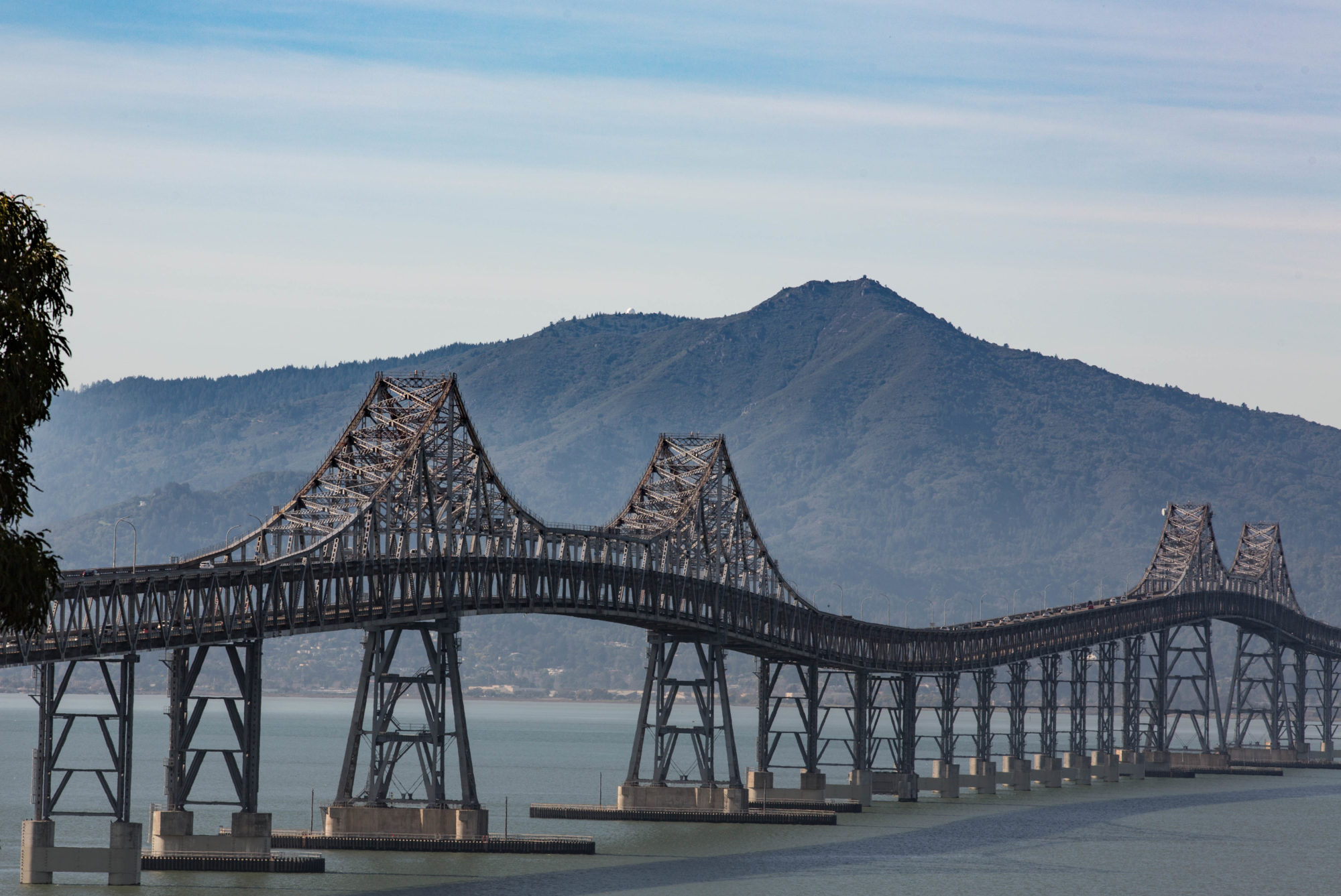
I used to have a route across Marin County when we were going up there from Berkeley. Most of the time, we’d be headed toward Point Reyes. I had an impression of Sir Francis Drake Boulevard, formed by long-ago holiday weekend drives, of a long, slow winding slog that involved a big slice of suburbia. So I quit taking that way and instead would head north on U.S. 101 after crossing the Richmond-San Rafael Bridge and go up to Lucas Valley Road. Plenty of windy pavement up there, but a lot less suburbia, and pretty soon you’d be on the road through Nicasio and well on your way to Point Reyes Station.
In my era of long bike rides, which went on indefinite hiatus a few years ago, I was back on Sir Francis Drake from the point the nice Marin bike route peters out in Fairfax out to Olema. This gave me a new look at the road, an especially intimate look in dry and wet, in daylight and dark, to the badly chopped up concrete pavement one must endure while traveling through Samuel P. Taylor State Park. (What sort of state are we, by the way, that we’d close this place?) Riding through here, I would be conscious of the next threatening patch of pavement, other cyclists, and approaching cars in that order. I would be dimly aware I was riding through a forest, dimly aware of the occasional bridge and perhaps the proximity of a creek. But those were peripheral visions to the matter at hand, which was keeping my bicycle upright.
Then a couple years ago, I drove out Sir Francis Drake Boulevard to do a little reporting on the coho salmon run in Lagunitas Creek, the stream that runs along the road on and off as it goes through the state park. That gave me another frame of reference for the road, a byway hugging the banks of a stream that holds one of the last wild runs of coho salmon on this part of the west coast. I’ve been back maybe a dozen times since to go walking out there and get a feel for the area. And I’d look for fish, too. But until yesterday, I never saw one.
If you’re out here in California, you know how dry it’s been. Dry is an unfriendly condition for fish that need to migrate up freshwater streams to spawn, and for most of the coho spawning season this year, coho have been relatively few and far between. Then the week before last, a series of storms broke through the high pressure wall that had been pushing wet Pacific storms to the north, and we got rain. In what we persist in thinking of as a “normal” winter, the three storms that came through–pop! pop! pop!–wouldn’t have been especially remarkable. But they seemed something like deliverance to a region that had gone without an appreciable rainfall for nearly two months. And for the coho salmon lingering somewhere near the mouth of their native streams along the coast, the rains were real deliverance. The storms triggered high flows, and the fish burst into the freshets heading downstream to make their way to up, up to find stretches of the creeks where they might spawn.
We were fashionably late getting out to the creek yesterday, not making it until after 3 o’clock. The parking lot at a viewing area along Sir Francis Drake was nearly full, a sign that there was something to see in the water. We walked along a half-mile stretch of Lagunitas Creek , up to where Peters Dam blocks the stream’s progress to its old headwaters. What did we see? A dozen fish, maybe 15. They were born in this creek and survived the cruel numbers game that salmon have always faced–I’ve read that 99 percent of the fish that swim out of their home streams into the ocean don’t make it–to plant the next generation of their kind in the streambed. This looks like a better-than-average year for a run that has declined from thousands of adult fish returning each year to 150 or so the past few years. They are officially designated as an endangered species, and at this point it would not take an earth-shaking cataclysm to sweep them into extinction. So to be able to drive from our place in Berkeley, out through the suburbs, over a hill into the woods, and see them in the company of a lot of other curious souls–well, it’s the most ordinary and subtle of spectacles.
And bespeaking the ordinariness of it, here’s a bad video I shot while we were out there (and a better one, taken by someone else on a nearby stretch of creek the day before, is below that):
Further Adventures in News and Media
So, although I haven’t been posting much the past little while; or at least I haven’t been posting much here. I’ve been doing some blogging and chatting and other social media stuff, both officially and unofficially, for my employer, a public radio station in San Francisco.
The two weekends before this, I did a live blog for the San Francisco 49ers NFL playoff game against the New Orleans Saints and then a sort of hybrid live blog/chat for the 49ers game against the New York Giants last week (along with a couple other posts before and after each game).
Then this weekend, when our newsroom was unstaffed, things started to happen in Oakland. The Occupy Oakland movement, which had been evicted from the plaza outside City Hall after repeated clashed with police and other authorities, had announced its intention to go out and seize a vacant building in the city. Its target was a shuttered convention center near downtown. Yesterday was “move-in day,” and a crowd I’ve heard estimated at 1,000 to 2,000 showed up for a march across downtown to take over the, building, which they said they wanted for a meeting space and social center. The police were ready for the move and blocked the takeover. All they had to do then was deal with the crowd of demonstrators. When push came to shove, as seems inevitable in Oakland, protesters threw stuff at police, police fired tear gas and rubber bullets, etc., and before the dust settled, 400 people had been arrested.
I sat down early in the story and started following what was happening through online sources and writing it up on yet another live blog. Along the way, I decided to try an experiment with Storify, a platform that essentially allows you to build a running narrative of an event or subject using online media–Twitter and Facebook posts, blog entries, video, audio and photos from whatever online source you can find. The result is embedded below. One surprise: It actually kind of took off in a minor way, traffic-wise. It became the featured post on the Storify home page and was also picked up by an Oakland community news blog. Anyway, here’s to experimenting (and yes, many questions of journalistic practice are raised by all these tools and the ability to become a one-person newsroom. I’m thinking about all that):