Lest We Forget …

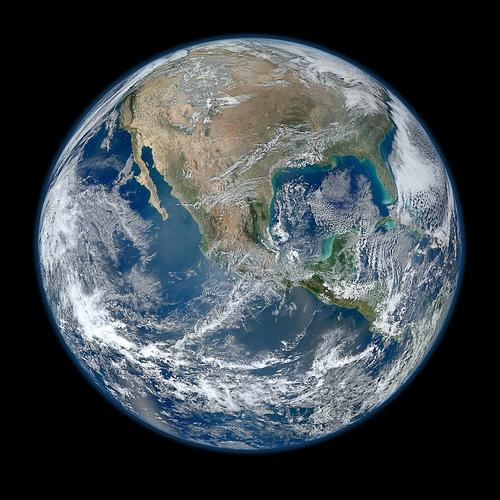
Most Amazing High Definition Image of Earth - Blue Marble 2012

… What a beautiful place.

Was just thinking about whether there might be some interesting satellite pictures of the fires in Colorado. I'm sure there are. On my way to finding them, I encountered the shot above, which is a NASA mosaic of our planet taken this past January 4. See the really big version of the image here: Blue Marble .


Compost Community News

compost062712.jpgWe have a compost bin in our backyard. It's had its ups and downs over the years. Sometimes it has actually supplied organic-fertilizer-type material that we have used here on our extensive North Berkeley estate. More often, it has been a way of dealing with food scraps that we and the rest of enlightened civilization are trying to keep out of the landfill.

The principal visible engine of decomposition in our compost is red worms. When there's a steady supply of food and water, they seem to thrive. At some times of year, I'll actually see balls of them working on some hors d'oeuvre we've dumped out there.

But other critters are at work, too. I recently came across a piece of compost literature that talked about "FBI" as the components of a healthy waste pile–fungi, bacteria, and invertebrates. I'll take it for granted that fungi and bacteria are doing their thing out there and are perfectly happy with their lot.

That leaves the invertebrates. I've mentioned the worms. We get a few flies out there, and close inspection discloses some in larval form (maggots by another name). Another population that seems to enjoy the decompositional milieu is what I believe is a form of mite. When I pull the cover off the bin in the daylight, you see them as a shiny mass shifting minutely over unidentifiable food bits and everything else. I don't know whether they're a sign that things are just fine in the compost community or a little off. They've never invited themselves inside, so they're welcome to just do what they do. (Above: the "mites" in question, feasting on a stale bread crust as nearby smallish potatoes look on. Click for larger versions of the image.)

Live at 16th Street BART

guitar062212.jpg

Here’s Dennis Blackwell, a guy who was playing at the 16th and Mission BART station on Friday. It does not look like a nice spot. The crowd’s hustling by, you have a little pigeon dung to deal with, and station agents who take in the whole thing with a cold eye.

Blackwell says he’s been playing for spare change for about a year. “I’ve been messing around with a guitar for 20 years. I’m 60 now.” He said he “came into manhood” on the streets of Berkeley, that his target audience is “aging hippies like me,” that he worked most of his adult life as a cook, and is on a fixed income now.

He played a little U2 medley, talked to me for a couple minutes, then launched into “Just Like Tom Thumb’s Blues,” by Bob Dylan. I didn’t bring him any luck–I didn’t see a single person stop and give him anything while I was hanging around with my camera and recorder. Hope he did better afterward.

guitar062212a.jpg guitar062212b.jpg

Weeping in My Cappuccino

krispies.jpg

The other adult in our household teaches school. She happens to work in a community where many families are intimate with poverty and some of its associated experiences, including a poor diet, lack of access to regular medical care, limited opportunities for exercise because of generally dangerous surroundings, and the health consequences that come along with all that. But thank goodness someone is looking out for these people. Scholastic, the publisher of youth literature, is distributing child-rearing advice from a beloved and widely respected source:

“Rice Krispies Treats® is pleased to offer a few practical tips for fostering those moments with your child when he or she has a flash of brilliance, laughs out loud (LOL), or creates something new and original while relaxing and enjoying the warm and comforting feeling of time with family.”

LOL? I’m so touched at the generosity of Rice Krispies Treats® and so tickled by its warm yet cool concern for family togetherness that I’m WIMC (weeping in my cappuccino). One hardly notices all the reminders that Rice Krispies Treats® is sponsoring the message (my favorite subtle reference: the “you’re the best” message written on the Rice Krispies Treats® package).

Elsewhere this morning, I encountered this:

‘The Smallest Minds … The Cowardliest Hearts’

Current reading: “Beyond the Hundredth Meridian,” by Wallace Stegner. It’s a biography of John Wesley Powell, known popularly for making the first boat trip through the Grand Canyon (in 1869), for being among the founders of the U.S. Geological Survey, for his thorough and sympathetic study of Native Americans and their culture, and for promoting a rational approach to the settlement of the arid West. (Among other details I didn’t know, Powell was also a faculty member at the college that became Illinois State University, in Normal, and lived in Bloomington).

Anyway, at one juncture, Stegner stops to contemplate federal government policy on the West. He quotes Mark Twain’s “portrait of the Congressman: ‘the smallest mind and the selfishest soul and the cowardliest heart that God makes.’ ” Harsh, but apt for our time, I thought (and sure, there are some who would say it’s a description with eternal currency).

I wanted to know the source of the quote. One’s first Google search turns up the fact it’s widely cited (to express disgust with today’s crop of solons) though the source is hard to come by. The closest you can get is along the lines of “an 1891 letter to an unknown correspondent.”

Twain died in 1910, and in 1912, someone named Albert Bigelow Paine came out with a massive biography that reprints the letter in full (or nearly full–there’s no salutation, thus the name of the recipient, if any, is unknown, and it begins with an ellipsis). The letter appeared five years later in a collection of Twain’s letters. The subject is the Twain’s real-life experience and how it has fitted him for the profession of novelist. Here’s the paragraph that’s the source of Stegner’s quote:

So, the quote was more expansive and changed somewhat as it passed through the many hands between Twain, Paine, and Stegner. Or maybe not. Stegner cites an edition of “The Portable Mark Twain” edited by his friend and mentor, the historian Bernard De Voto, as his source, and De Voto’s quote was identical to those printed earlier. Stegner appears to have cleaned it up and narrowed the context to fit his needs.

In any case, the original message was: Those lawmaker-government types–they’re all bums.

Journal of Self-Promotion: Water and Power

A long, long time ago (sometime last fall), one of my fellow editors at KQED radio asked if I’d be interested in doing a story for a series on water and power in California. The series would look at the close relationship between water and energy in the state: on one California needs to move immense quantities of a very heavy substance over very long distances, and that requires a lot of power; and on the other, a lot of water is needed to help generate power.

To go back to last fall: Yes, I was interested. And today, a mere seven or eight months later, we have the first part of the series. If you wonder what I sound like climbing a steep hill with 60-some pounds on my back, it’s a must-listen.

Front-Porch Visitor

walkingstick060912-2.jpg

This specimen, an Indian Walking Stick, showed up on the front porch this past Tuesday (Election Day). Or maybe it was there earlier and we took no notice. It’s certainly unobtrusive. In fact, we didn’t try to identify it until today. And when we did, we found out that this is an exotic and not entirely welcome transplant to California. Here’ s an excerpt from a UC Davis writeup:

“Walking stick insects, order Phasmatodea, are mostly tropical insects that are considered an entomological curiosity because of their remarkable mimicry of twigs and leaves. Several species are popular in the pet trade and for grade school demonstrations and thus get moved extensively with some, such as the Indian walking stick insect, Carausius morosus, becoming established in many parts of the world. The Indian walking stick is native to southern India, but the precise time of its establishment in California is unknown; the first official finding occurred in San Diego County in 1991 and shortly thereafter in San Luis Obispo County. There has been an increase in homeowner reports of walking stick damage in the last 10 years along the Central and Southern coasts of the state.”

Kate has, in a science-teacherly way, captured the Walking Stick, put it in a small terrarium with some fresh leaves. It appeared to have deposited about a dozen eggs on the porch floor, immediately below where it was just hanging out on the wall. She scooped up those, too. Now we’ll wait and see nature take its course.”

Hill Climb

Yesterday, to demonstrate a point–water is heavy and it takes a lot of energy to move it–I walked with a cubic foot of water on my back up Marin Avenue, a well-known hill here in Berkeley. A cubic foot of water is 62.4 pounds. To get it into a relatively manageable state–water has a mind of its own and is the ultimate shape-shifter when you try to confine it–I poured a couple gallons of water into several reasonably leak-proof plastic bags, double-bagged those bags, then put the bags into a single-compartment backpack. In the event, I had some leakage, but I’m pretty confident from weighing things out the gross mass of what I was hauling was pretty close to 62 pounds.

I chose Marin and a single cubic foot of water as a humble analog for a famous section of California’s State Water Project. Down below Bakersfield, the SWP has a facility called the Edmonston Pumping Plant. It’s job: Move water that’s been pumped uphill from the San Joaquin Valley up and over the Tehachapi Mountains. “Move water” is a bit of an understatement. Edmonston’s big lift blasts water from a battery of 14 pumps up 1,920 feet, over the top of the Tehachapis, through several miles of underground pipelines. It’s a waterfall in reverse–4,450 cubic feet per second, 2 million gallons a minute–made to defy gravity. Once it’s over the top, the water flows into a network of aqueducts and reservoirs for mostly residential customers throughout Southern California.

So, my single cubic foot of water, going up 650 vertical feet over three-quarters of a linear mile in about 20 minutes–my power output was probably several hundred watts (I’m trying to work out a calculation, but so far I don’t believe what I see). In human terms, I was breathing hard and sweating freely before I was halfway up. I wonder if those Edmonston pumps, which each operate at 60 million watts, ever get tired.

Anyway: Above is a little bit of what the effort looked like, shot with my iPhone as I headed up Marin; below is “the top”:

Midday Deer Encounter

deer060112.jpg

About 1 this afternoon, walking south on the north end of Shattuck Avenue (the end that turns into a narrow residential street in the lower hills after coursing six-lane style across downtown). The Dog was off the leash after we crossed Los Angeles Avenue, and out of nowhere (a yard, actually), this young deer landed in the middle of the street. I don’t think he (I think it’s a he) had seen the dog, because he immediately froze.

The Dog froze, too. At one point in his life I think he would have lit out after anything on four legs. But I think he gets it that if this is a squirrel, it’s a very tall, long-legged one, and he needs to watch for a while to see if a strategy suggests itself. A few seconds after the deer appeared in the street, a car arrived, too; the driver stopped to watch the show, then pulled up close to the animal to take some pictures after it had bounded up into a yard across the way. We moved on after a few minutes. Last I saw, the deer was contemplating the action on the street from a deck on top of someone’s garage.

(And yes, there was a time not too long ago when encountering a deer in the middle of the day here would have been very surprising; at dusk and after dark, not a shock. But this is the second time in the last couple of weeks I’ve happened across a young deer right around noontime. Not sure what accounts for it beyond the apparent large number of deer in the hills moving down into the city and maybe young ones out there learning the urban ropes.)

deer060112a.jpg

Posted in Berkeley: Lost Key

toyotakey1.jpg toyotakey2.jpg

I saw the posting at left about two weeks ago on Grant Street near Ohlone Park. As part of my ongoing interest in Berkeley flier culture, it piqued my interest. I especially like the handwriting and the attempt to attach the sign to a tree with packing tape. I also noted that somebody had come by and written “thanks” on the sign, which I thought might have been an acknowledgment from he or she who lost the key. I didn’t notice when I snapped the picture that I had not captured the whole phone number.

I saw the sign at right, one of several posted in the same neighborhood, maybe a week later. I thought, “Wow, I saw those signs they’re talking about.” I took a picture, but didn’t download it from my phone right away and forgot about it. Until yesterday, when I looked at the “Lost Toyota Key” picture and went back and located the “Found Toyota Key” picture. Too bad I captured only six of 10 phone digits. I decided to call the guy who was looking for the key anyway to see if he had found it.

He had not. In fact, he was waiting for the locksmith to come and make him a new key. I told him about the (not totally amazing) coincidence of having pictures of both signs. He was excited until I told him that all I had of the phone number was “510 277.” That meant he had 10,000 possible numbers to call to find his key. I went back out to the place where I took the “found key” picture. The tape is still on the tree, but there’s no sign of the sign.

Lesson: Get the whole phone number next time.