Yes, that up there is common deer poop, left right next to a manzanita bush in our front yard. Or so I believe from previous experience in wilder parts of the country. I can’t think of another animal in our parts that would leave scat that looks quite like this. More circumstantial evidence: a deer hoof print in our next-door neighbor’s front-yard garden, which contains lots of roses, reputedly a favorite food of our semi-urban deer.
Joking aside: the deer have moved in. There’s not enough cover in our yard for them to stay full time, but I’ve heard of places within three or four blocks where deer families have taken up residence. I don’t object, though they are larger than our average wild neighbor and the thing that sometimes worries me about them is scaring one at night and getting run over. Hasn’t happened yet, though.
If you’re interested in how content is produced in our socially connected media world, David Carr had a nice piece in Monday’s New York Times (“Journalists Dancing on the Edge of Truth“). He was focusing on the lessons inherent in the case of Jonah Lehrer, the Wired and New Yorker science writer who was caught inventing and retooling quotes from Bob Dylan in a book published this summer and then lying about it.
Lehrer isn’t the first to be caught creating nonfiction from a fertile imagination, and he won’t be the last. Carr and others argue that a lot of this kind of behavior is the product of a news/entertainment industry landscape in which journalists, reporters, columnists, and analysts–maybe the best catch-all description would be “media performers”–are slaves to a nonstop, multi-platform demand for their brilliance.
Carr also suggests that part of the problem lies in what’s missing from Jonah Lehrer’s journalistic resume:
“Mr. Lehrer, now 31, became famous before he had a grasp of the fundamentals. …
“The now ancient routes to credibility at small magazines and newspapers—toiling in menial jobs while learning the business—have been wiped out, replaced by an algorithm of social media heat and blog traction. Every reporter who came up in legacy media can tell you about a come-to-Jesus moment, when an editor put them up against a wall and tattooed a message deep into their skull: show respect for the fundamentals of the craft, or you would soon not be part of it.
“I once lost a job I dearly wanted because I had misspelled the name of the publisher of the publication I was about to go to work for. Not very smart, but I learned a brutal lesson that has stayed with me. Nobody ever did that for Mr. Lehrer, even after repeated questions were raised about his work.”
“Tattooed a message deep into their skull.” I like that. Though I can testify that the tattooing these days needs to be done with a certain modicum of sensitivity that was scarce in those Old School days Carr speaks of.
With my dad’s recent passing, and having made several (unrelated, except for my mood) recent visits to Chicago cemeteries, I’ve been thinking about epitaphs. Webster’s defines epitaph as “1. an inscription on or at a tomb or a grave in memory of the one buried there. 2.: a brief statement commemorating or epitomizing a deceased person or something past.”
Most of what’s carved on graveyard monuments is pretty simple: names, dates, and relationships. Beyond that, most of the common people buy at most a brief fragment of a sentiment. In Catholic cemeteries, I’ve seen a lot of “My Jesus Mercy.” On my dad’s parents’ grave, In largely Scandinavian-American (and Lutheran) ground, the message is “Christ My Hope.”
But except for the expense involved–I think we’re paying $150 to have “2012” carved on my dad’s headstone–I think a secular message might be reflect more the concerns of today’s future deceased Americans. I’m thinking of phrases that reflect the preoccupations of most of us for most of our waking life: Phrases like:
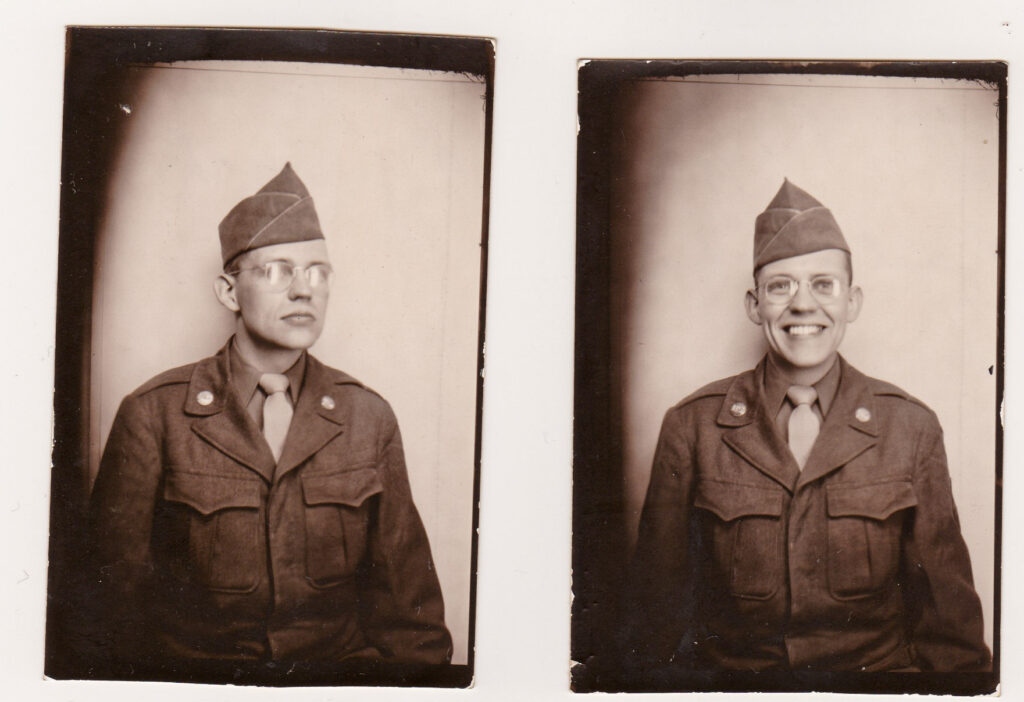
It’s my last night in Chicago for a while — now early morning, actually. I’ve stayed up way too late looking through a collection of letters Dad wrote when he was in Army basic training. That was in 1946, after World War II ended. The story we heard growing up, and I’ve got no reason to doubt it, is that he tried to enlist at the outset of the war but was rejected and rated “4F” because he had a punctured eardrum. That condition gradually healed, and he was rated fit to serve and drafted in late 1945 and inducted into the Army in January 1946.
Part of his parents’ legacy that I heard about growing up was a collection of more than 100 letters my grandfather, Sjur Brekke, wrote my grandmother, Otilia Sieverson, during their courtship and early marriage in the first decade of the last century. (The courtship started at a Lutheran parish in Chicago, where he was a visiting minister in training and my grandmother’s family were charter members. Sjur was a smooth operator. We have a note he wrote to Otilia on the back of a business card; the subject was a couple of volumes of commentary on scripture he had “taken the liberty” of loaning her. He also offered to hook her up with more such volumes if she liked the first two.)
Sjur died in 1932, when Dad was 10, and he said his mother not only hung onto all those letters, but read and re-read them. She numbered them and kept each one in its original envelope; she wrote key phrases from each letter on the envelopes, apparently her way of prompting herself as to the contents. When she died in 1975, the letters passed on to my dad. They’re among the papers he left behind. (If you’re wondering about my grandmother’s letters to my grandfather, well, so do we. She destroyed them at some point after he died.)
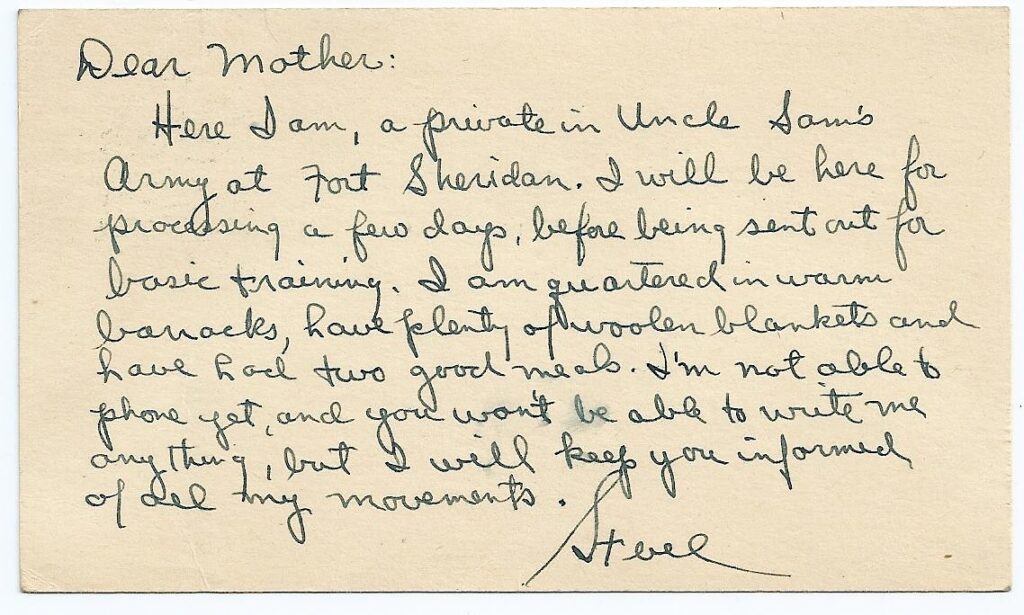
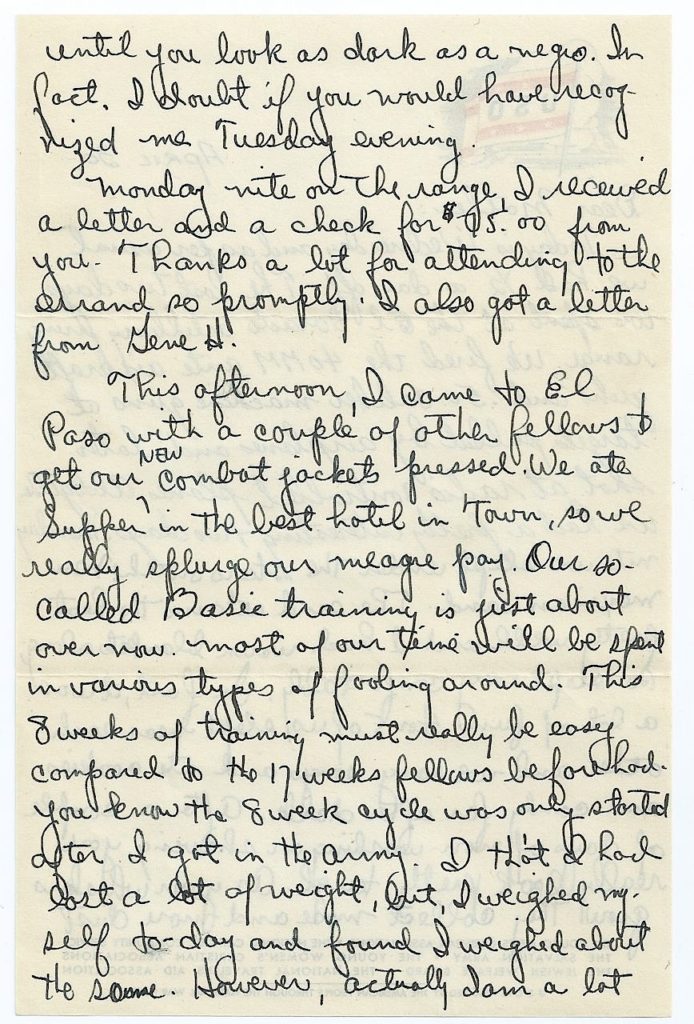
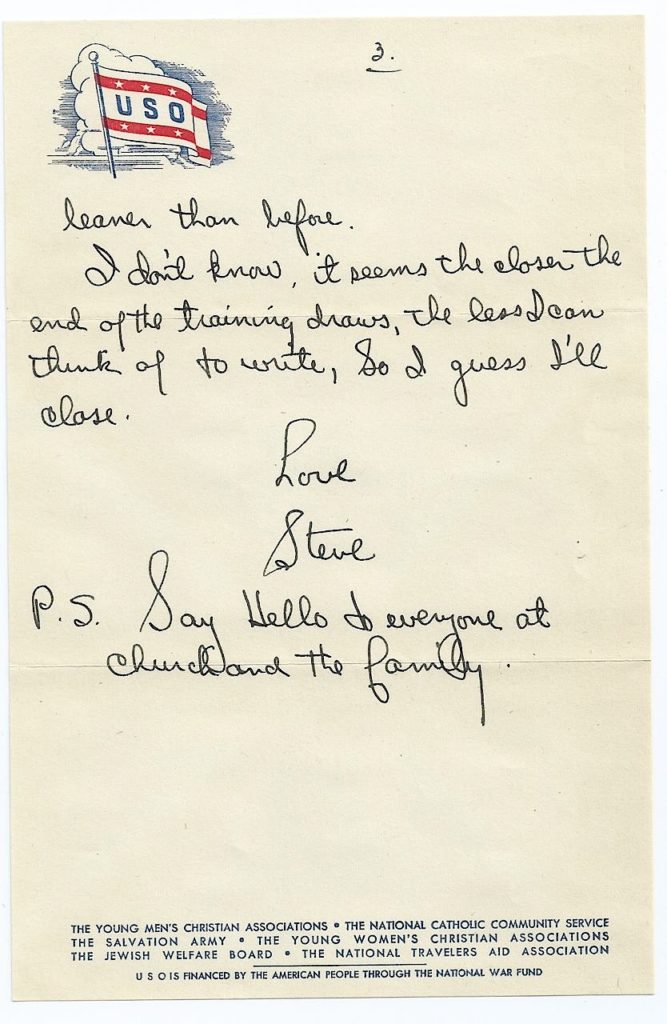
What I didn’t know, though, was that my grandmother kept a second letter archive. She saved all the correspondence Dad wrote during his year-plus in the Army, starting with a postcard from Fort Sheridan, north of Chicago, the day he arrived for processing.
“Dear Mother: Here I am, a private in Uncle Sam’s Army,” he began. I’m guessing the postcard was something the Army had its new inductees do to reassure the home folks they were OK.
There are about 75 of these letters in all — 20 or so from his time in basic training, which took him to Fort Bliss, near El Paso, Texas, and another 50 or so from his time serving in the occupation of Germany.
Leafing through the basic-training letters the other day, I felt like I was getting to know a person about whom I had only heard vague accounts. One thing comes through very clearly: the Army wasn’t really for him. He was interested in learning what he could in the ranks — he was being trained in a field anti-aircraft battery — but he had his own agenda, which always seemed to come back to music and whether he could finagle a way into an Army band (he couldn’t and didn’t). He also loved the opportunity to see a part of the country, dry, desolate West Texas, that was completely new to him.
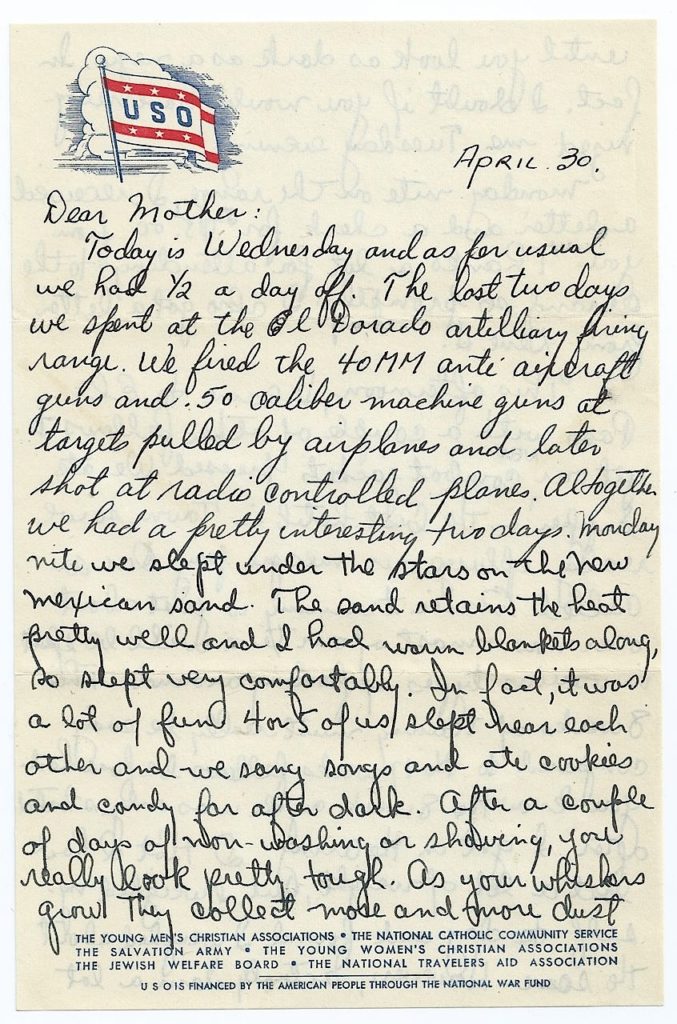
I read a few of the letters aloud the other day to my siblings. One in particular delighted us. Dad describes a trip up to an artillery range to fire anti-aircraft and machine guns at aerial targets. It sounds like he enjoyed that somewhat. But he also liked the chance to camp out:
“Monday nite we slept under the stars on the New Mexican sand. The sand retains the heat pretty well and I had warm blankets along, so slept very comfortably. In fact it was a lot of fun. 4 or 5 of us slept near each other and sang songs and ate cookies and candy far after dark.”
Sounds like a kid at camp. He was also thrilled to go without shaving or bathing and said the grime made him “look as dark as a negro” (of whom there were none in his unit, of course). I’m not sure he ever really had any significant outdoors adventures before this. His parents were older and given to recreations like attending revival meetings. During an extended stay in Los Angeles in the early ’30s, their idea of a Sunday outing was to take Dad to see Amy Semple McPherson preach at her Church of the Foursquare Gospel.
We will be some time going through the archive of pictures and other effects our dad left behind. There’s a lot there I don’t remember having seen before. For instance, my brother Chris brought out a binder of transparencies last night that included some stunning shots of our mom during their engagement and of my dad in the years before that. I’m posting a couple of my favorites from other times here.
Above is a shot that surfaced in the last decade or so. That’s Dad, at almost four months old, on December 26, 1921, which happened to be his saint’s day. His parents lived in Alvarado, Minnesota, a village just up the Red River of the North from Grand Forks, North Dakota. There’s something in the way my grandmother is bent over him, showing him that little ball, that seems almost profoundly gentle, attentive, and caring. (I think this is partly because she’s the one in focus here, not my dad). That short northern Minnesota winter daylight that just barely plays across her forehead also gives a feeling of a fleeting moment captured.
The picture below is one of Dad with my son Eamon, his first grandchild. I think Eamon was about eight months old when my brother Chris took this during a brief visit. I’ve always been struck by how serious they both look. It’s a beautiful picture of the two of them.
“…When I look behind,
as I am compelled to look
before I can gather strength
to proceed on my journey,
I see the milestones dwindling
toward the horizon
and the slow fires trailing
from the abandoned camp-sites,
over which scavenger angels
wheel on heavy wings.
Oh, I have made myself a tribe
out of my true affections,
and my tribe is scattered!
How shall the heart be reconciled
to its feast of losses?
In a rising wind
the manic dust of my friends,
those who fell along the way,
bitterly stings my face.
Yet I turn, I turn,
exulting somewhat,
with my will intact to go
wherever I need to go,
and every stone on the road
precious to me. …”
“I sauntered about from rock to rock, from grove to grove, from stream to stream, and whenever I met a new plant I would sit down beside it for a minute or a day, to make its acquaintance, hear what it had to tell. I asked the boulders where they had been and whither they were going, and when night found me, there I camped. I took no more heed to save time or to make haste than did the trees or the stars. This is true freedom, a good, practical sort of immortality.”
* * *
“The spotted hawk swoops by and accuses me—he complains of my gab and my loitering.
I too am not a bit tamed—I too am untranslatable;
I sound my barbaric yawp over the roofs of the world.
The last scud of day holds back for me;
It flings my likeness after the rest, and true as any, on the shadow’d wilds;
It coaxes me to the vapor and the dusk.
I depart as air—I shake my white locks at the runaway sun;
I effuse my flesh in eddies, and drift it in lacy jags.
I bequeathe myself to the dirt, to grow from the grass I love;
If you want me again, look for me under your boot-soles.
You will hardly know who I am, or what I mean;
But I shall be good health to you nevertheless,
And filter and fibre your blood.
Failing to fetch me at first, keep encouraged;
Missing me one place, search another;
I stop somewhere, waiting for you.”
Stephen D. Brekke and Stephen D. Brekke, Jr., 1955.
That’s me and my dad and namesake, Stephen Daniel Brekke, back in 1955, when I was about a year or so old and he was 33 or 34. He was not a bad-looking guy, and he could rock a bow tie, as the young people say today. When my parents had this picture developed, they saw something they hadn’t noticed before — that something was amiss with my eyes. They took me to an ophthalmologist, and I was in glasses by the age of 18 months. But that’s another story.
Today’s story is that Dad died about 5 this afternoon, Chicago time. My sister, Ann, and my brothers, John and Chris, were with him when he went. Some of his grandkids had just visited. Chris’s wife, Patty, was there. A Lutheran minister, a fellow Norwegian-American, came in to say a prayer. John says his passing was as quiet, as peaceful, and as gentle as it could have been.
If this were a news story, we’d want to be getting to the cause of death. I think I hit upon the right description the other day: the weight of his ninety-plus years finally bore down on him. He’d had pneumonia. And emphysema. And crippling arthritis that virtually froze his knee joints and robbed him of his mobility. And a form of dementia that denied him the ability to communicate freely. And finally, congestive heart failure. Ann’s husband, Dan–the two of them were my dad’s primary caretakers for the last three years or so of his life and his main lifeline since our mom died nine years ago–reminded me that my dad never complained.
And he didn’t. If you asked him if he was in pain or uncomfortable, he’d come out with some formulation like, “I can’t say that I am.” It wasn’t until a month or so ago that Ann asked him if he was hurting after suffering an arm abrasion and he said, “I hurt all over.”
Bye, Pop. We miss you already. But we’re glad you’re not hurting any longer.
My brief stay in Chicago has included a couple of Summer of 2012 heat spikes, interspersed with less radical summer weather, as a frontal boundary oscillates across this part of the Midwest. Today’s National Weather Service forecast map for the Chicago region is orange in every direction, indicating a heat advisory. Temperatures in the city are expected to hit 100. Outside the city, up to 105. (I note that the forecast high in San Francisco today is … 63.)
Tom Skilling, the dean of Chicagoland TV weather forecasters, and a meteorologist who is unfailingly informative first and entertaining second, sums up today’s torrid conditions on the WGN/Tribune Chicago Weather Center blog:
“The blisteringly hot air mass responsible for 100-degree or hotter temperatures across sections of 19 states Tuesday re-expands into the Chicago area Wednesday. It’s on track to bring Chicago its fifth triple-digit high temperature of 2012—the most official 100+degree readings here of any year since 1988.
“Temperatures surge past 90-degrees for a 34th time this year at O’Hare and 35th time at Midway—extraordinary when you consider the average since weather records began in 1871 has been only 17 such days at O’Hare and 23 at Midway!
“…This summer’s warmth has been nothing if not persistent. If you needed any additional evidence this weather pattern has been unusual, WGN weather producer Bill Snyder, in surveying the city’s official temperature records, finds Chicago is to log an unprecedented 29th consecutive day of above normal temperatures—making this the most back-to-back days to post a surplus in the 5.5 years since a Dec. 10, 2006 through Jan. 14, 2007 mild spell in which above normal temperatures were recorded over 36 consecutive days.”
A subject I haven’t broached much in the past and one that’s become central part of my daily consciousness over the last couple of years: my dad’s decline and dire condition as the weight of ninety-plus years settles upon him. He’s up in a hospital in Evanston fighting his third bout with pneumonia in about four months. That’s just the current crisis. I could run through the full list of conditions besieging him and the disasters and indignities that have grown from them, but I know I’m only discovering what many, many other children of aged parents have already learned. The truth is that the poor guy is dying and beyond the power of science to heal or restore. But he is not beyond the power of love and caring, and the best thing that has happened during the last couple days is that my brothers and sister and I have been together to remember Dad, to talk about what we need to do for him, to talk to him, to let him know we’re here.
That’s all, for now. It’s a lot to take in. I’ll be reporting back. In the meantime, I’m thinking of this line:
“I depart as air–I shake my white locks at the runaway sun.”
We went for an afternoon hike up on the Seaview Trail in the Berkeley Hills. It was hot up there for the dog, but it was apparently perfect flying weather for red-tailed hawks. We saw a couple of them as we got up onto the ridge, apparently young one without the darker adult plumage. At the top of the ridge, another one appeared–that’s the picture above. And when we were lower down, returning to the car on the Quarry Trail, what appeared to me to be an adult began circling close by. The pictures aren’t National Geographic quality, but they give an idea of the intricacy of the plumage, and I love the translucence of the feathers. What beautiful birds.