Man, I’m a Genius

Language history was made right here, or several posts below this one, on Sunday afternoon. That’s when I published
the first known (to me) use of the term "torturegate" to describe the
current furor and recriminations over the U.S. Army abuse of prisoners
in Iraq. I know it’s a big claim. But earlier today, I noticed that
someone had visited the blog from a Google listing for "torturegate."
At that point — it was about 2 in the afternoon, Pacific time, that
was the only indexed reference to that word. Now, about eight hours later, the Google search
on "torturegate" shows two more references, both more recent than mine.
Also, a search of Nexis for the last couple of months shows zero
instances of "torturegate."

Before you use the word, just remember this blog is copyrighted, and
words invented here can only be used by the express written consent of
myself and the commissioner of Major League Baseball. Royalties for
using this new word will be set at rates affordable to all. And stay
tuned for our full line of Torturegate (marca registrada; patent
pending) products (and if there’s a particular Torturegate product
you’d like to see, please write the management).

Haymarket Square

Haymarket5

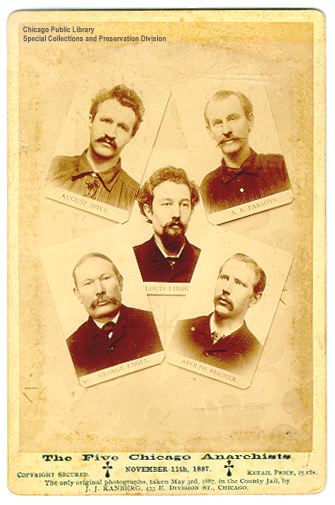
May 4, 1886: A bomb kills 12 people (including eight police officers) during a labor rally on Chicago’s near West Side. The bomber was never caught, but police arrested eight leaders of the rally, who were subsequently convicted despite the lack of evidence tying them to the attack. A year and a half after the bombing, despite a worldwide outcry at the miscarriage of justice, four of the organizers were hanged, and one committed suicide.

Actually, I wasn’t thinking of the anniversary at all, but I saw it in a list of events for May 4 (for me, May 4 is mostly the day in 1864 U.S. Grant launched his bloody but ultimately successful campaign against Robert E. Lee’s Army of Northern Virginia). Taking a very short look around, I found a couple of great online resources about Haymarket (which resonated through Illinois and national politics for years afterward and played a role in one of my favorite historical novels, Howard Fast’s "The American," about the life of Governor John P. Altgeld). Check out the Chicago Historical Society’s  detailed history of the case. Also good: The Chicago Public Library’s online Haymarket collections (from which the picture above is taken), which includes a brief writeup on the history of the famous (in Chicago) Haymarket statue memorializing the police victims of the bombing and was still attracting bombing attempts as late as 1970.

Iraq Numbers

Sources for following the casualty count in Iraq.
There are a couple very good sources on U.S. and allied casualties.
Sources on Iraqi casualties are speculative and unclear by comparison.
That’s because the United States got out of what’s been termed "the
body-count business" (an allusion to the weekly totals provided during
most of
the Vietnam War) during the Gulf War. I guess that’s because it was
politically tricky to report the magnitude of the casualties we were
inflicting. But enough of memory lane, and on to the casualty
counts:

Iraq
Coalition Casualties
:
A very reliable and up-to-date summary
of U.S. and allied casualties, backed up by press and military reports
of killed and wounded. Includes a list of every U.S./allied soldier
killed in action since the war started.

GlobalSecurity.org
gives a slightly different count.
Its totals vary slightly from those on the previous site. Maybe the
best feature of the list is the longish explanatory
essay
, with some historical perspective, on the numbers and
how they’re derived.

Iraq Body Count:
An explicitly antiwar site that attempts to do what the governments
involved will not do and what the media cannot do (or haven’t gotten
around to doing): tally civilian deaths in Iraq since the beginning of
the war (the current estimated range is 9,018 to 10,873).

Good News — from Iraq!

The Bush people, from the president to Rummy on down, insist the U.S. media just aren’t relaying all the good news happening outside the shooting zones in Iraq. To help do my small part, here’s a tidbit gleaned from the press office of the Coalition Provisional Authority:

“In support of the national holiday honoring the birthday of The Prophet Muhammad (PBUH), the Coalition Provisional Authority is giving more than 950 soccer balls to Iraqi children, schools, and sports clubs in South Central Iraq.” [That soccer pitch in Fallujah that the natives have turned into a cemetery for people killed during the current siege is probably off-limits to games right now, though.]

I checked to see whether any of the naysaying mainstream media have picked up on the prophet’s birthday balls. None have, so far as I can see. But The New York Times was actually ahead of the curve, with a piece from sports columnist George Vecsey on a Long Island soldier who’s gotten a kid’s soccer league together. Vecsey even alludes to the kill-joy media:

“The smiles. You rarely see smiles like these on the 6 o’clock news or on the front page. Alex Fyfe gets to see Iraqi children with a happy look on their faces, as they kick soccer balls on the dust and rocks.”

Happy Anniversary

BushfliightsuitI missed it yesterday — National Mission Accomplished Day. Iraq’s collection of ne’er-do-wells — former regime elements, noncompliant elements, Saddam loyalists, Baathist bums, foreign fighters and what have you (don’t worry, there are only about two dozen of them in the whole country, and there’s nothing we could do to make them happy ) — celebrated by killing at least 11 more U.S. troops over the weekend. Meanwhile, the rest of Iraq has suspended its continuous strewing of flowers in our soldiers’ paths to tune in Al Jazeera’s coverage (sorry about all the squiggly writing) of Torturegate.

Diary of a Commuter Jerk

Bartplatform

Tuesday: I walk up Eighth Street to the Civic Center BART station after work. Nightmare scenario: I need to buy a ticket, which means I have to stand in line behind other patrons trying to figure out how the ticket machines work or who have decided to buy a five-buck ticket by feeding in nickels. Sure enough, I wind up behind three or four other people. The first person deliberates over the bewildering array of two or three choices before purchasing a ticket. Then the next guy approaches the machine. He feeds in one dollar bill, then another. The machine won’t take the third one. Instead of just buying a $2 ticket and paying whatever he owes at the other end, he hits cancel, gets his dollar bills back, then repeats the process. His third bill still won’t go in; exasperated, he looks first to the right, then to the left, for help that’s not there. Then he hits cancel again, gets his bills back, and feeds them in again. One. Two. No go with the third. He looks right, then left, hits cancel, and starts to try again. At this point — I want to get home, man! — I lean around the woman waiting in front of me and say, "Dude, what’s the problem?" Except, I don’t say "dude" in the friendly "hey, dude" way; "dude" comes out in a tone that clearly signals it’s a substitute for "moron." He turns toward me. He’s a short guy, maybe 5-6, with neatly trimmed brown hair and beard; he’s wearing a short-sleeved yellow button-down shirt; he’s wearing olive green shorts and dark street shoes and socks that he should wear with long pants. I recognize him from somewhere. He says, "It won’t take my goddamned dollar." Simultaneously, the woman in front of me — tall, 5-10, and kind of lumpy in a Joan Cusack way but younger than Joan Cusack — turns around and looks at me and says something. I hear, "Shut up." So I tell the guy he’s holding up everyone in line and I ask the woman, "Who the fuck are you telling to shut up? You shut up." She says, "I said, ‘Chill out.’ And you need to." I sputter something winning; perhaps it was "you chill the fuck out."

Meantime, beard guy has given up his place at the ticket machine and says angrily, "You guys go ahead." I already have a twenty in my hand and say, "You held up the line for 10 minutes." "It won’t take my money!" "Here’s a twenty — it’ll work. Take it and buy yourself a ticket." But he doesn’t take it; he goes to the back of the ticket line while the "shut up/chill out" woman is at the machine. She’s buying something like a $5.85 ticket, exact change. She dawdles. I resist the temptation to say, "Hey, look, another rocket scientist." Then it’s my turn. Luckily, the machine takes my twenty on the first try and I get my ticket without holding anyone else up. Then I go down to the platform, wondering who among the people on the platform and the train home just witnessed my little display. I also realize that I recognized the beard guy from about 20 years ago; his name was John something and he was Kate’s roommate’s boyfriend when Kate and I first went out. Same beard and haircut and everything, though Kate’s roommate, Beth, moved on a long
time ago.

Wednesday (pictured): Back to Civic Center BART after work. I’ve left work a little early thinking maybe I can get a short bike ride in before dark. Armed with my dramatically procured ticket from the day before, I head down to the platform. There’s a train waiting — headed out to Bay Point, not my line. The Richmond train, to Berkeley, is due in 7 minutes. But the train at the platform doesn’t move, and within a couple of minutes, there’s an announcement that "smoke is emanating
from a train at Embarcadero Station" and all the East Bay-bound trains are halted for a few minutes. It’s about 5:10. More announcements. The train at Embarcadero has been taken out of service. The train at Embarcadero had an electrical overload. Or it might have hit something on the tracks. BART workers are walking the track to see if there’s a problem. The delay lengthens — 10 minutes, 15, 20, then 30. Finally, the packed train at Civic Center moves, slowly. Then a Fremont train, headed south toward San Jose from Oakland, pulls in. Then the Richmond train I had been waiting for. The operator announces that there’s another train with a problem at Embarcadero; but by 5:45, we get going, too. I managed to get a seat and fall asleep during a stop-and-go trip through the Transbay tube. We halt for awhile outside West Oakland station. The problem is that another train ahead of us has broken down at the platform there, meaning we have to cross over to the opposite tracks to get through the station. When we get to West Oakland, I’m surprised to see that the platform there (that’s the picture above) is filled with nearly no room to stand — people taken off a train waiting for another to come in; of course, their problem is that all the arriving trains are either already filled or using the opposite platform until everything is straightened out. So those people over there are as good as stranded. Anyway, my train makes it through, and after we turn north from downtown Oakland, we get to Berkeley with no more problems. I get home about 6:50 p.m., so the trip took about three times as long as usual. Surprisingly, no one complained. People even laughed when the train operator apologized for "this less than stellar commute. I guess that’s an understatement." This gives me, the commuting jerk, food for thought.

Friday: On my way into work by way of the casual carpool. Waiting in the Civic Center line at the North Berkeley BART station with three people ahead of me, one behind me. The three in front all get into a Toyota Avalon. So the next car will take me and the other person. One pulls up to the curb and honks. It looks like there are already two people in the car (you need three to take the carpool lane, so they would only need one more rider), and I’m confused when the woman who’s been second in line walks very confidently to the car, opens the rear passenger door and gets in. Just a minute! She’s the third person. She’s taking my spot! I say,"Hey, I’m sorry, I was ahead of you in line. You need to get out." She looks up at me, very puzzled, and says, "Yes?" "Yes," I answer. And she gets out. Then she gets in the front passenger seat, where no one had been sitting. Um — I didn’t see the front seat was empty! Really I didn’t. Did I feel kind of stupid? No — very. And also like I must be cracking up to get into these um, misunderstandings. My trip home was altercation-free, though.
Koppel on the Dead List

The Poynter Institute, the world center for journalistic navel-gazing, has an interview with Ted Koppel about his reading of
the dead list tonight. Koppel expresses surprise at the reaction to the
show, and insists there’s nothing political about it: "I don’t want it
to make a political statement. Quite the contrary." Later he goes on to
contradict himself, apparently unconsciously:

"Why, in heaven’s name, should one not be able to look at the faces and
hear the names and see the ages of those young people who are not
coming back alive and feel somehow ennobled by the fact that they were
willing to give up their lives for something that is in the national
interest of all of us
?" (Emphasis added.)

OK — so he’s on board that the whole deal is in the national interest.
That’s an improvement on the insistence that there’s nothing political
in this and that the show is just acting as a means of venerating the
dead because, well, they died. Although it would be a lot more fitting
to have an open discussion on the merits of the idea that the operation
really has been in the interest of all of us.

The War Dead

So, Ted Koppel’s going to read the names of all the U.S. combat

fatalities in Iraq on “Nightline” Friday night. My first reaction was

that his show’s ripping off the famous feature Life magazine did (on June 27,  1969) that pictured all, or nearly all, 242 U.S. servicemen killed in action during a single week. (The show’s producer acknowledges that Life was the inspiration.) My second reaction is that it’s a ripoff without the smarts or courage that marked what Life did. Here’s what the “Nightline” producers have to say about their

inspiration in their daily email:

“…We realized that we seemed to just be giving numbers. So many killed in

this incident, so many more in that attack. Whether you agree with the war or

not, these men and women are serving, are putting their lives on the line, in

our names. We think it is important to remember that those who have paid the

ultimate price all have faces, and names, and loved ones. We thought about doing

this on Memorial Day, but that’s a time when most media outlets do stories about

the military, and they are generally lost in the holiday crush of picnics and

all. We didn’t want this broadcast to get lost. Honestly, I don’t know if people

will watch this for thirty seconds, or ten minutes, or at all. That’s not the

point. We think this is important. These men and women have earned nothing

less.

An excerpt from Life’s introduction to “One Week’s Dead” made it clear that the editors were trying to refrain from making an explicit antiwar statement:

“It is not the intention of this article to speak for the dead. We cannot

tell with any precision what they thought of the political currents which drew

them across the world. From the letters of some, it is possible to tell they

felt strongly that they should be in Vietnam, that they had great sympathy for

the Vietnamese people and were appalled at their enormous suffering. Some had

voluntarily extended their tours of combat duty; some were desperate to come

home. Their families provided most of these photographs, and many expressed

their own feelings that their sons and husbands died in a necessary cause. Yet

in a time when the numbers of Americans killed in this war – 36,000 – though far

less than the Vietnamese losses,  have exceeded the dead in the Korean War, when

the nation continues week after week to be numbed by a three-digit statistic

which is translated to direct anguish in hundreds of homes all over the country,

we must pause to look into the faces. More than we must know how many, we must

know who. The faces of one week’s dead, unknown but to families and friends, are

suddenly recognized by all in this gallery of young American eyes….”

“We must pause to look into the faces.” Four years into the major combat phase of the war — and with a

long way and 22,000 more deaths to go — it was clear everywhere the price was appalling. The editors went on to note the division of opinion, even among the troops, about the war and what it was about. “The mother of one of the dead, whose son was the third of four to serve in the Army, insists with deep pride, ‘We are a patriotic family willing to pay that price.’ An aunt who had raised her nephew said of him, ‘He was really and truly a conscientious objector. He told me it was a terrible thought going into the Army and winding up in Vietnam and shooting people who hadn’t done anything to him…. Such a waste. Such a shame.’ “The overall effect of Life’s issue was to invite a deep consideration of the war and the price; not such a radical notion — this was nearly a year after the Democratic Convention in Chicago and just a few months before the huge Vietnam Moratorium marches; it was an issue everyone had to consider.

But what “Nightline” promises is something quite different. On one level, another solemn paean to our fighting men and women who have — the producers even use the cliche — “paid the ultimate price.” And

whether you’re for the war or agin it, you have to bow your head respectfully for that. But what we don’t get is a real appraisal of the cost or an invitation to consider it or a sober discussion of the future.

The “Nightline” reading sounds like a stunt — it’s funny that the right-wingers are already jumping on the idea because they think it’s an anti-war statement — because it repe ts the same mistake most major media have made since it became evident our semi-elected executive branch was determined to start this war: they’re behaving as if it’s fundamentally disloyal in our post-9/11 world to strenuously scrutinize the rationale for going to war or the motives of the people promoting it.

Where’s Your Flag Amendment Now?

A shocker from flag police at the, ahem, New Hampshire Gazette (hey — they’re looking for a free part-time copy editor; maybe that’s my next gig):
 

"The CBS Television Network and MTV collaborated on a Super Bowl half-time ‘entertainment’ featuring repeated crotch-grabbings and a gratuitous display of a mammary gland, but for the Flag Police, the true horror was watching this talent-challenged individual [Kid Rock]  use an American flag as an article of clothing."

Hot

Record heat
in the Bay Area today; 90 in San Francisco, in the low 90s in the East
Bay; several places in the region set their all-time record for the
month (and most of the records broken were set in 1935 or 1965, long
before the phrase global warmiing was coined). But the real thing the
heat makes you think about is whether the lights will go out. So far —
with Enron and Calpine and the rest of the energy criminals sidelined
— things look OK. Even with temperatures in the hundreds in some
locations today, the state’s energy network operator said demand never approached the available supply.