Yellow Friendly Merry Cab

Yellowcab_2

Once upon a time, the cab business here in the East Bay was pretty much like it was in other large-ish urban areas. There were a few large taxi companies whose owners leased cabs to drivers. Most drivers paid "gates and gas" — they bought their own fuel and paid a daily (or nightly) rental fee (hereabouts called the "gate"), and they got to keep whatever they earned in fares and tips above those expenses. Some had a simpler arrangement, splitting both the fares and the fuel expenses with the cab owner. That’s the deal I had when I worked for the late, forgotten St. Francis Taxicab Company, which plied the streets of East Oakland in the early 1980s. That arrangement worked out better for the driver on a bad night and better for the owner on a good night.

Merry_2
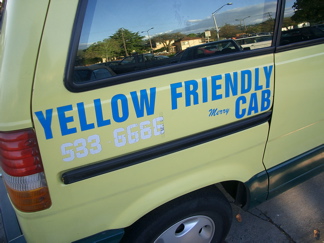
Over in San Francisco, always viewed as cabbie Shangri La by often-idle East Bay drivers, big companies or co-ops are still the rule. The East Bay business has evolved, or degenerated, into a sort of free-for-all, with a bunch of independent operators scrambling for an individual share of the crumbs. One result is a proliferation of taxis with similar-sounding names, many involving the word "yellow." (Like all the best ideas, the original Yellow Cab appears to have been one of Chicago’s gifts to the world.) The Berkeley telephone book has nearly three pages of agate-type listings, many undoubtedly redundant, for various permutations of "Yellow Cab."

I loved the version spotted above, parked in a long queue at the North Berkeley BART station. It’s not just Yellow. It’s Friendly. And Merry.

Dead in Iraq

I didn’t pay much attention to the news last weekend about the death in an insurgent attack of Marla Ruzicka in Iraq. Ruzicka came from Lakeport, one of the towns on Clear Lake, about 75 miles northeast of San Francisco. She had dedicated herself over the last couple of years to a campaign that aims to make the United States account for civilian casualties in the wars in Iraq and Afghanistan. She would have turned 29 this year.

What finally made me pay attention to her story was a column this morning by Bob Herbert in The New York Times. He talks about Ruzicka’s organization, The Campaign for Innocent Victims in Conflict and its aims.

“Tim Rieser, [an aide to Senator Patrick Leahy], said: ‘She came here as a very sort of naïve antiwar protestor, really, and became someone who was extraordinarily effective at putting politics aside – not trying to cast blame, but rather working with everyone from U.S. military officers to the Congress and others on how to actually help people. She was out there doing something that all of us knew was really needed, but that was too dangerous for most people to want to do, or be willing to do.’

What she was doing was stunningly simple and modest, in a way. She died trying to lift the veil that’s been drawn — that we’ve allowed to be drawn — across the reality of the war we’re fighting. The human price among our own troops is largely hidden — photographing the caskets of the slain is prohibited, and the awful injuries suffered in battle are largely invisible to us. There’s virtually no discussion of the ongoing toll among the people of Iraq. On one hand, Ruzicka was trying to get the government to acknowledge information she knew existed: statistics on civilian casualties; and on the other, she was trying to get help for victims and survivors.

On the accountability side, Ruzicka was making some headway. In an op-ed piece on the USA Today site, written just before she died, Ruzicka said:

“Recently, I obtained statistics on civilian casualties from a high-ranking U.S. military official. The numbers were for Baghdad only, for a short period, during a relatively quiet time. Other hot spots, such as the Ramadi and Mosul areas, could prove worse. The statistics showed that 29 civilians were killed by small-arms fire during firefights between U.S. troops and insurgents between Feb. 28 and April 5 — four times the number of Iraqi police killed in the same period. It is not clear whether the bullets that killed these civilians were fired by U.S. troops or insurgents. …

“… These statistics demonstrate that the U.S. military can and does track civilian casualties. Troops on the ground keep these records because they recognize they have a responsibility to review each action taken and that it is in their interest to minimize mistakes, especially since winning the hearts and minds of Iraqis is a key component of their strategy. The military should also want to release this information for the purposes of comparison with reports such as the Lancet study published late last year. It suggested that since the U.S.-led invasion there had been 100,000 deaths in Iraq.

“A further step should be taken. In my dealings with U.S. military officials here, they have shown regret and remorse for the deaths and injuries of civilians. Systematically recording and publicly releasing civilian casualty numbers would assist in helping the victims who survive to piece their lives back together.

A number is important not only to quantify the cost of war, but as a reminder of those whose dreams will never be realized in a free and democratic Iraq.

Jubel in Petersplassen

Jubel for ny pave

“Taktfaste rop på ‘Benedetto!’ runget over Petersplassen i går kveld da den nye paven steg frem for hundretusener på balkongen og ga sin første velsignelse som den katolske kirkens overhode.”

You have to hand it to the gang at Oslo’s Aftenbladet — reading their coverage of Pope Ratzo’s election celebration, you almost feel like you’re there in the crowd in Petersplassen. Of course, leave it to the Dagbladet crew to get in a dig at the new pontiff. They’re calling him the “Panzer-pave.” The paper’s story on the new pope includes a picture of Ratzinger in his Hitlerjugend days. Say three “Our Fathers” and three “Hail Marys,” you guys.

Thus concludes our exclusive coverage of Norwegian press reaction to the election of the new pope. In other news, here’s the pope’s name as rendered in various European capitals:

Paris: Pape Benoit

Rome: Papa Benedetto

Berlin: Papst Benedikt

Oslo: Pave Benedikt

Warsaw: Papiez Benedykt

Athens: Πάπας Βενέδικτος ο 16ος

Good night.

’24’: Week in Review

Earlier in the season, “24” was getting some heat for its depiction of Middle Eastern Muslims as remorseless though very clever killers. The show, and the Fox network, responded with some public-service announcements informing viewers that not every Muslim is bad. And one episode portrayed a pair of young Arab-American sporting-goods store owners fighting alongside the show’s hero against a team of bad guys deployed by a ruthless U.S. defense contractor.

Last night’s episode introduced a new group of cartoonish evil-abetters.

The terrorists hijack a nuclear weapon in an ambush described as happening variously “in Iowa,” “in mountainous terrain” and at latitude 37 degrees north and longitude 115 degrees west, a point that happens to be a scrubby patch of desert about 60 miles north of Las Vegas. The geographic niceties aside, the bad guys have a bomb and appear to be heading for a big city — Chicago? — to set it off. The U.S. counterterrorism force has one chance of finding the mastermind and stopping the attack, though — a bad guy they’ve captured at an L.A.-area marina. To get the information they need to avert the attack, it’s clear they’re going to torture the suspect.

But the terrorist leader is one step ahead of them. He actually has one of his henchmen call a liberal civil-liberties lawyer (working for a group called Amnesty Global). The lawyer manages to wake up a federal judge, present his case that the government is about to abuse an upstanding U.S. citizen, get an injunction, and hightail it down to counterterrorism HQ to stop the torture session — all in 10 minutes on the show’s real-time clock. Of course, none of that process happens on camera. All we know is that, just as the interrogators are about to do their stuff, they’re halted by an insufferably smug attorney spouting some Bill of Rights crap. Of course, no one, including the president of the United States, is willing to contravene the court order halting the interrogation, even though millions of lives are at stake; and though the civil-liberties lawyer managed to get a judge to turn handsprings in the middle of the night and get an order in a millisecond, the script explains the government is powerless to appeal the order until the following day.

Luckily, it turns out that there’s one man willing to defy the misguided application of constitutional protections: Jack Bauer, who gets hold of the suspect and, after an agonizing couple of minutes and several shattered suspect fingers, finds out everything he wants to know.

Like I said — the civil-liberties lawyer is just a cartoonish dupe. Just as the greedy, amoral defense-firm execs were earlier in the show. But you have to wonder how many people are watching this, saying, “Goddamn liberals!” and cheering for the torture. Lots and lots, I bet.

One Thousand and One Vacuum Nights

Vacuum2

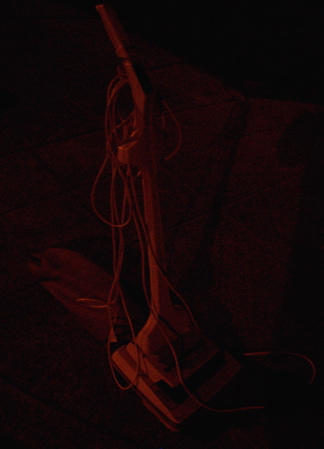
The vacuum’s still there.

Kate and I walked past its corner this evening, this time as empty-nesters-in-training going out to get a sandwich (Tom was out rowing with the Sea Scouts). I was kind of surprised that the kids from the nearby middle school hadn’t taken matters into their own hands, but maybe they’re trying to fit the vacuum cleaner into their own little universes, too.

Tonight’s appliance-centric reverie — this time mine — revolved around rewriting "The Velveteen Rabbit" (I recommend the Meryl Streep-George Winston version) with the vacuum cleaner standing in for the story’s title hare. It almost works:

Much-loved and overused object of attention falls by the wayside as newer appliances appear on the domestic scene. The owner is taken ill — instead of scarlet fever, I see him going off his meds and getting involuntarily committed as bipolar. His hard-hearted landlord puts his belongings out on the street. Everything is snatched up but the forlorn vacuum cleaner, which has learned from a Miele HEPA-vac, a NordicTrac home treadmill, and a KitchenAid mixer that it’s of no use to anyone. Alone on the street and coming apart at the seams, the little vacuum hopes one of the kindly passing pedestrians will put it out in the middle of the intersection, or throw it in a Dumpster, anything to put it out of its ownerless misery. Instead, a magic fairy appears, restores it to like-new condition, and whisks it to a local flea market. There, its former owner, on a day pass from the ward, sees the little vacuum and is struck with an overwhelming sense of fondness for it. He assumes it’s a sign that he still has issues to deal with, and walks quickly away, leaving the little vacuum with all the other refurbished appliances. 

Pope Ratzo the Temporary

I haven’t been following the ins and outs, but suddenly Joseph Ratzinger, the ultra-orthodox-sounding German cardinal who under JP2 was officially in charge of putting the fear of (G)god into the faithful, is suddenly looking like a serious pope candidate. In fact, he’s moved up to the No. 2 position on the PaddyPower betting site, listed at 9-2 to become next pope after Nigeria’s Francis Arinze, the persistent favorite at 3-1. That’s great news for church onlookers because no matter what name Ratzinger might take as pope, he’ll be known as Pope Ratzo the First (or maybe it should be “Ratso,” to conform with the name of the Dustin Hoffman character in “Midnight Cowboy”; that’s a matter for higher religious authorities than myself).

What I like about Ratzinger is his return to an old way of Roman Catholic thinking: If you want to be drinking Slurpees and playing videogames and driving Boxsters in the afterlife — or doing anything besides wading eternally in a lake of molten lead, for that matter — The Church is your only choice. It reminds me of the nun who told me in second grade that it would be a sin for me, as a Catholic, to attend services at a Lutheran church — the church in which my dad was raised and in which my grandfather was a minister. That’s one way to keep your customer base: Tell your customers they’ll go to hell if they switch brands and warn them they’re at risk if they even look at the label.

Ratzinger gave the homily at this morning’s pre-conclave Mass at St. Peter’s. Here’s how The New York Times summarizes it:

“In his writings and public statements, he has often sought to uphold the primacy of Catholicism, saying no other religion offered a path to salvation. ‘Relativism,’ he has said, implies that other faiths are equally – and wrongly – valid. The idea was strongly expressed in a document the congregation issued in 2000, Dominus Iesus, which provoked angry responses from other religious leaders.

In his homily, Cardinal Ratzinger said that Christians were tossed on the waves of Marxism, liberalism and even ‘libertinism;’ of radical individualism, atheism and vague mysticism. He also decried the creation of ‘sects’ and how people are seduced into them, using a term church leaders often employ to refer to Protestant evangelical movements.

” ‘Having a clear faith, according to the Credo of the Church, is often labeled as fundamentalism,’ he said. ‘Yet relativism, that is, letting oneself being carried “here and there by any wind of doctrine,” appears as the sole attitude good enough for modern times.’

“Many of the cardinals, draped in bright-red vestments and wearing white mitres, watched intently as Cardinal Ratzinger spoke on a platform underneath Bernini’s bronze baldacchino. Several others among them – two thirds of the cardinals voting for pope are septuagenarians – appeared to doze.”

The Times notes one other aspect of the performance that might suggest Ratzinger is not the shoo-in some think:

“Cardinal Ratzinger spoke Italian in heavily accented German, his voice creaky at times and interrupted by coughs. Several church officials said he has been suffering from a cold.”

The Catholic world just got done watching a pope go through a long, painful decline. Are the cardinals really going to elect somebody who sounds like he’s hacking up a lung at his coming-out party? (The bettors are asking this question, too: Ratzinger’s post-homily odds have dropped to 5-1).

Lonely Vacuum

Vacuum

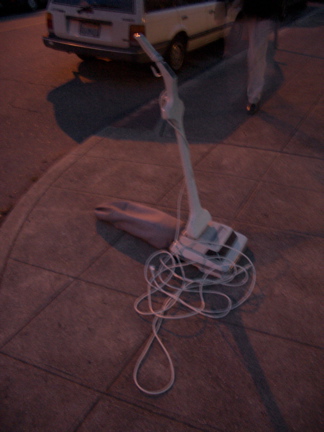
Kate and I went for a walk after dark. A few blocks from home, we passed an abandoned upright vacuum cleaner, standing forlorn on the corner. Cord unraveled, bag flaccid, partially detached and flopped on the sidewalk. You could almost read its life history: from youthful vigor as a partner in the war on household grit, leaving behind no donut crumb or sinsemilla seed; through wheezing middle age that saw it sometimes leave flecks of granola embedded in the living room carpet, even after half a dozen passes; to tired, inefficient old age in which even wayward Cheetos and carelessly sprinkled Baco-Bits scoffed at its feeble sucking powers.

I saw the discarded appliance and my first impulse was to take it and stand it up in the middle of the intersection. It’s not a busy corner, and I don’t think it would be a significant safety hazard. But I just liked the idea of drivers encountering this thing in the middle of the street. The one flaw I could see in my idea was that I’d have to hang around for a while to watch the fun begin. I didn’t have the patience to wait around for my brainstorm’s possibly Letterman-esque consequences. Also, Kate didn’t wholly approve of the concept.

Her response was to imagine posing the vacuum cleaner on different corners in town; sort of an instant interactive “found art” piece. She thought about hanging a sign on it, asking passersby to pick it up and take it someplace interesting, take a picture of it, and send it to us; then we could publish the pictures online. She spun the whole idea out in about half a block, to the point we were imagining the vacuum cleaner riding BART for the day, appearing in a grocery line, getting set up at a public phone.

We didn’t do it, though. Later, I did manage to go back to the corner and snap the vacuum’s picture.

Saturday Agenda

Away from the keyboard, riding a 300-kilometer (188 mile) brevet as part of my qualifying for this summer’s Gold Rush Randonee. If I’m back in time Saturday night, I’ll post something about it. Later. (And yes, I’m cheating with the dates on this post, writing late Friday night and putting a Saturday tag on it).

Tax Day

Well, it’s here. And for once, I can say — not as complaint, just as an observation of the bottom line — I’m really getting murdered. Where is all that dough going? Don’t want to delve into it at this late hour.

I will commend today’s Writer’s Almanac, though: It’s got a nice short history of taxes, introduced by a lovely and appropriate poem about depression, which starts:

“When in a deep depression of the self,

I see on every side, on every hill,

like the lit mansions of the rich, success

of others, hear the echoes loudly praise

my rivals, feel my plodding soles sink deeper

in the cold ashes of hope, and feel

the tepid drizzle of self-pity stain

my cheeks …”

Double Zero, Double Ought

The topic was ear gauging. The Resident Teen was telling me he intends to gauge his ears. What that means, in brief, is stretching out an ear piercing so that you can fit a piece of jewelry into the enlarged hole; one piece of jewelry inserted into a gauged ear is a colored plug. It’s a modest piece of body modification, really, and one that the Teen’s mom and dad can live with a little more easily at this point than a tattoo, say, or rings or spikes of various descriptions inserted into various vicariously painful body locales.

In talking about the size of earlobe hole that he desired to produce through gauging, the Teen described the largest diameter typically done as “double zero” and held up his fingers to indicate about a quarter-inch. Hearing “double zero,” I immediately thought of “double ought,” one of the largest sizes of buck shot (it turns out there is a larger size — “triple ought”). I wondered if the double-zero gauge for ear piercing was the same diameter as double-ought shot.

Not to keep anyone in suspense, I still don’t know. But I started looking for information on the size of double-ought shot. The non-precise answers I came up with suggested a range equivalent to .30-caliber to .38-caliber bullets — that is, .3 to .38 inches.

I didn’t hunt long, because one of the first references I consulted, with a page title of “Firearms Tutorial,” was a discourse on wound ballistics — the study of damage caused to human tissue by different types of gunshots. I was slow to realize the subject, because I was focusing on finding the diameter of buckshot. The Google entry for the page suggested I’d find the information there. When I hit the link, I searched forward to “double-ought,” and found the statement, “A 00 or ‘double ought’ pellet is essentially equivalent to a low velocity .38 handgun projectile.”

Then I considered the context. In the next paragraph, I encountered this:

“At close range, the pellets essentially act as one mass, and a typical shell would give the mass of pellets a muzzle velocity of 1300 fps (feet per second) and KE (kinetic energy) of 2100 ft/lb. At close range (less than 4 feet) an entrance wound would be about 1 inch diameter, and the wound cavity would contain wadding. At intermediate range (4 to 12 feet) the entrance wound is up to 2 inches diameter, but the borders may show individual pellet markings. Wadding may be found near the surface of the wound. Beyond 12 feet, choke, barrel length, and pellet size determine the wounding.”

It turns out the “Firearms Tutorial” is a resource for forensic pathologists, giving an introduction to the world of guns and everything they can do to the body, with special attention, it seems, on close-range effects. Living in a place where the number of people who die each year of gunshot wounds rivals the total of deaths during the entire Iraq war*, it’s good to have such a resource at the ready.

(*On the statistics: The U.S. Centers for Disease Control report, “Deaths: Final Data for 2002,” (PDF file) puts the total number of U.S. firearms deaths for the year — the most recent the CDC has covered — at 30,242. (I was surprised to see that more than half of those deaths — 17,108 — were suicides.) It’s hard to know the real toll in Iraq since our war began in March 2003, but the Iraq Body Count site, which bases its estimates on an analysis of press accounts, puts the number of Iraqi dead so far at a maximum of about 20,000. The Iraq Coalition Casualties site puts the number of U.S. and allied troops killed so far at 1,726, and notes that at least 210 foreign contract workers have died, too). The big unknown in the total Iraq numbers is how many Iraqi troops and insurgent fighters have died since the fighting started. Ten thousand? Twenty thousand?)