My Anonymous Gifts to the Universe

Oakleys

When I’m not procrastinating, interviewing for jobs, asking past bosses and colleagues for references, watching TV, riding my bike, writing clever furniture descriptions for a furniture catalogue that will remain nameless, mowing the lawn, pulling weeds, prioritizing creditors, and whatnot (under which heading blogging comes) — when I’m not doing any of those things, I can usually be found losing an expensive pair of sunglasses.

Just this morning, I regarded a pair of Oakley cycling glasses that I wore on a walk up to the University of California and back. I thought with pride how I’d had them nearly two years — an uncommonly long association between me and a pair of shades. Somehow, while I’ve lost pair after pair of similarly pricey specs — Ray-Bans by the seeming bushelful; and last year, particularly troublesome, a pair of clear-lensed Rudy Project glasses that I bought especially for riding at night, a pair that vanished without leaving even a vaporous thought about when, where or how they might have gone astray — those Oakleys have stayed defiantly in my possession.

"I guess I’m just extra-careful about them," I thought to myself in a satisfied way as I walked home.. Me and my Oakleys — I wore them across France (i.e., to hell) and back during my epic accomplishment of 2003. We’re pals for life.

A couple hours later, I was on BART, headed to the furniture catalogue place in far-off Marin County. I fell asleep on the train and hurried off the car at the first San Francisco stop with my bike and backpack. It wasn’t until I’d climbed three flights of stairs to the exit gate, then another long flight up to the glare of Market Street that I reached for my sunglasses. Gone. Just gone. I might have dropped them — but no, I would have noticed that or, more likely, stepped on them and broken them. Someone might have lifted them while I was on the train — but daring ne’er-do-wells would probably be on the lookout for something more valuable, like my false teeth. I decided maybe I had left them at home, but I couldn’t find them when I returned from furniture catalogue land.

No, I think what actually happened is that I laid them down on the train seat beside me, nodded off, then just got up and walked away from them in my semi-wakeful state. So, unless they turn up beneath a pile of paper here at the Infospigot & Co. domicile, I think I’ve donated those glasses to someone who has no way of knowing what a nice little memento of blood, sweat and cycling fatigue they have. Wear them well. And whatever you do, don’t lose them.

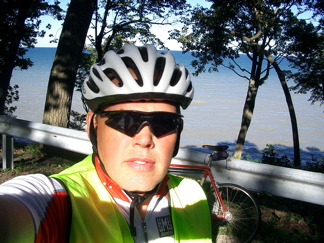
[Pictured above: Me, the PBP Oakleys, a Bridgestone RB-1, and wind-tossed Lake Michigan. Highland Park, Illinois; September 2004.]
Making America Safe — for ’24’

Another season of doltish, action-packed fun is over. America’s soap-operatically inclined counterterrorism force managed to hunt down its generic Muslim nemesis (turned out he was linked to a hot and totally un-hejabbed American hitwoman who was practically right out of an “Austin Powers” fantasy), foil a nuclear cruise missile strike on Los Angeles, and, after all that was done, fake the hero’s death so that he could escape … well, never mind. The final episode with Jack Bauer — Kiefer Sutherland to his dad — heading for Mexico to avoid the consequences of his no-holds-barred approach to defending our way of life.

The important thing is that it’s clear that there will be another season of bad writing, bad acting, and incredibly strained political, military, and romantic scenarios. All that’s certain is that there’s only one man in the America of ’24’ who can get anything done right — and the last we saw of him, he was walking into the sunrise in an L.A. train yard.

In Bicycle Land

Long bike rides are an exercise in sensory overload. There’s so much to take in over the course of a day. The landscape, of course. Socializing with other riders. Monitoring the way you’re feeling, gauging your effort, measuring what you’re putting out now against how much work you have ahead. Watching everything that happens on the road, knowing that a momentary lapse of attention, an unseen crinkle in the pavement, an unremarkable pebble, could interrupt your ride or end it if you’re unlucky. Keeping an eye on other riders when you’re riding in a pack, taking pains to make sure you ride steadily and predictably while watching everyone else to make sure they’re doing the same. It’s hard to believe how absorbing the sight of a rear wheel spinning 12 inches in front of your front wheel can be until you’ve spent an hour or two or three watching one while trying to stay aware of the road ahead and what other riders are doing; it’s active, rolling meditation.

Beyond the pure physical effort, the factor I identify most with cycling is landscape. I think more than any other reason, that’s why I’m motivated to get on my bike and go. Just thinking about yesterday, when I rode the Davis Double Century, the sight memories all by themselves are overwhelming. A golden eagle. A hundred-foot high dike of lava. Creeks and streams running hard and full. But instead of trying to paint the whole day, just one brief impression: Rolling back toward Davis across the westernmost stretch of the Sacramento Valley an hour or so before sunset, passing acre after acre of newly flooded rice paddies near Interstate 505. The day had been warm, the Valley is just above sea level, and there it felt humid as midsummer in the Midwest. The sky was flawless, the not-quite-full moon well up over the long eastern horizon. The wind was down, and the paddy water held perfect casts of every detail of the world around and the heavens above. In the distance: egrets, night herons, terns, working the edges of the inundated fields; me and all the others rolling past, opening and closing circles, feeling for perfect rhythm.

Infospigot Word Challenge

Word challenge! Sound like a game. But it’s not. It’s just an opportunity to say (write) the word “hooplehead.”

What’s that?

I encountered it watching the DVDs of the first season of HBO’s “Deadwood.” Highly recommended for its fine writing and acting, though it features extreme violence and a variety of vile behavior — the profanity is the least of it — that makes it unsuitable for family viewing (unless you want the kids to turn out like me). But I digress.

Hoopleheads: It’s the term the evil (or perhaps just ultra-misunderstood) Deadwood saloonkeeper and master manipulator Al Swearengen uses for rubes, yahoos, and general riffraff. It’s a fine, descriptive word — it could find employment describing many of our red-state brothers and sisters who voted to keep our incumbent president in office for another four years, for instance; or for the incumbent himself, for that matter.

Hoopleheads.

Fugue State

It’s getting into the warm season again in Iraq. And, if military commanders The New York Times cites are to be believed, it’s far from the last summer our troops will spend chasing insurgents, building Mesopotamian democracy, and cleaning up after our Great Architect of World Liberty:

“In interviews and briefings this week, some of the generals pulled back from recent suggestions, some by the same officers, that positive trends in Iraq could allow a major drawdown in the 138,000 American troops late this year or early in 2006. One officer suggested Wednesday that American military involvement could last ‘many years.’ ”

“Many years.” Profoundly sad. Profoundly depressing. But not really surprising.

I remember Israel’s victory in the Six-Day War of 1967, how glorious that was, what a thorough vindication of its boldness and military superiority. I don’t recall anyone talking in the immediate aftermath about “Palestinians” or “occupied territories. That came later, and it came to stay. Thirty-eight years after its triumph, Israel is walling itself off from its conquest.

Thirty-eight years. I wonder how long it will take us to get home from Iraq, or whether we ever really will?

’24’: Bumblefest Nears Climax

MK emails a link to a very serious piece of prose on Salon that tries to answer the not-very-tough question: “How real is ’24’?” It’s an over-serious piece that seemingly misses what’s in plain sight: That ’24’ is a prime-time soap with high-explosive props and a main character with major anger-management issues. The writer refers to the show’s Counterterrorism Unit (CTU) and its “ridiculously capable agents.” No! Most of the agents, walk-on types who never get names, are on screen only to provide targets for terrorists. Faithful viewers know they can count on CTU (and everyone else in the U.S. government) to make the wrong choice every time: “Lunch break or try to figure out where that nuclear warhead is?” “Lunch — I could use a bellyful of Wendy’s chili right about now.”

The lone exception is the anger-management-problem guy, Jack Bauer, who has a faultless ability to overcome the bumblers and see through all terrorist machinations. He even died and came back to life one season in his quest to see the bad guys get theirs. But what can one man do against all those evil-doers? Plenty. But Jack’s personal life is much more difficult. As his Cubs-fan sidekick, Tony Almeida, said last night of Jack and his current love interest: “Funny … Yesterday Jack and Audrey were talking about their future together. Now he’s responsible for her husband’s death, and he might have to torture her brother.”

This season’s ending in the next week or two. Last night’s episode ended with a nuclear-armed cruise missile headed for some big city from Iowa. It’s been in the air for more than an hour, so I think Chicago is safe. The rest of the country — watch out.

Retractions

By all means, let’s pillory Newsweek for muffing its “Koran in the toilet” revelation, a bit of one-source journalism that’s somehow led millions of people to think most Americans are less than reverent toward Islam. It’s good to know that those who lead us still have some capacity for outrage when the truth of a complex situation is served less than perfectly and lives are needlessly lost. And perhaps Rumsfeld, Rice, their many minions — and, who knows, maybe even the president — can take a lesson from Newsweek and come clean about the untruths they’ve promoted that led to bloodshed. You know what I’m talking about: Iraq’s weapons of mass destruction, Saddam Hussein’s role as international terrorist overlord, and the imminent threat they posed to the United States. There are other matters to say “We’re sorry” for, too — the criminally poor planning for our attack’s aftermath, for instance — but it would be nice to start with a heartfelt retraction and apology to the 20-some thousand who have died because of everything those first untruths set in motion.

Berkeleyana II

Waving1

Berkeley’s got something of a tradition of sidewalk personalities. It’s a small place, about five miles west to east, if you start at the furthest corner of the old garbage dump in the Bay (now a park) and head to the top of the Berkeley Hills, and about four miles north to south. (In Chicago terms, the whole thing would fit between North Avenue and Lawrence Avenue in the south-north axis and between Halsted and Cicero east to west; Berkeley’s land area would fit in about half that space — North to Belmont and Halsted to California.)

Partly because of the city’s size, partly because it seems to attract characters or engender character-type behavior on the part of normally sane, sedate citizens, you quickly get familiar with the cast members: Pink Man, the flamboyant unicyclist (and Jeremy, a more serious one-wheeled type); the morose or perhaps disturbed Orange Man, who wore orange parka, sweatpants and backpack and was often seen pondering oranges he’d hold at arm’s length and eye level; William, the Polka-Dot Man; Stoney Burke, a somewhat nasty comic/political street performer who has been around town since the late ’70s; and, best known of all, the Waving Man, whose passing in 2002 merited obits from The New York Times and Associated Press among others:

“Joseph Charles, who became famous by being very, very friendly, died on

Thursday in Oakland, Calif. He was 91.

“Every weekday morning for three decades, Mr. Charles stood on a street

corner in adjacent Berkeley and waved to each passing motorist. It made him

a local legend, indeed, something of a national wonder, and attracted

coverage from Charles Kuralt and People magazine.”

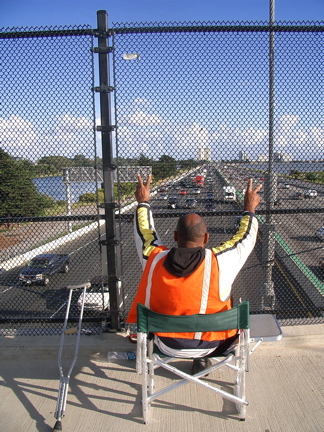
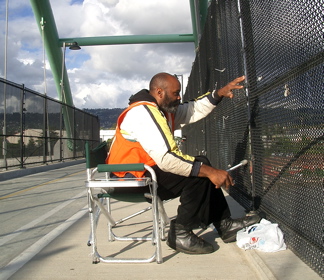
Sometime in the past couple of months, I discovered there’s a new Waving Man in town. I don’t know his name or whether he’s generated any media coverage. But I see him every time I go across the bike bridge over I-80: He sets up a camp chair above the northbound (OK, officially eastbound) lanes in the afternoon and waves and gestures to the commuters. I brought my camera on a ride one day last week and saw him on the bridge. At first I rode by — I’ve said hi to him before, but he’s so absorbed in what he’s doing that he didnt’ seem to notice. Then I decided to stop and take his picture.

What surprised me once I stopped was how much response he was getting from the drivers below. Lots of them honked. For his part — I didn’t ask his name — he kept up a continuous litany as he waved and gave the peace sign: “God bless you … peace … peace … peace … God bless you … God bless you … peace.” After I’d taken a few shots, I walked by him and said, “God bless you, too.” He looked up, as if he hadn’t known I was there. He looked surprised and maybe ecstatic and turned back to the road.

Waving2

Berkeleyana I

Cimg3789

Several years ago, the city of Berkeley built a pedestrian-bicycle bridge over Interstate 80, which runs along the shore of San Francisco Bay. The bridge links the town, to the east of the freeway, with waterfront trails and parks to the west, and you have to give the city and the engineers/designers it hired high marks for doing the project right, both practically and aesthetically.

Before the bridge was built, getting to the west side of the freeway involved riding industrial back streets to a narrow asphalt path beneath the University Avenue overpass, crossing a dark high-speed ramp exiting the highway, climbing a long flight of stairs to a narrow sidewalk across the overpass, scurrying across another exit ramp, and negotiating a busy intersection. You had to be really determined and somewhat foolhardy to make the trip.

The new bridge eliminates all the climbing, crossing, and scurrying. Aside from its beauty, it does something I like about other over-freeway pedestrian bridges, too: It creates a seat to look out over this rushing no-man’s land that’s so much a part of how we live and who we are. All that traffic. All those cars. All those lives tied up in their trip home, or to work, or off across the country somewhere. It’s impressive, amazing, and even a little horrifying to be a spectator to what you’re usually engrossed in yourself, what you take for granted, and watch the surge of activity that’s got a life all its own.