The Bike Gig

Regular readers of this space — if it is a space, but I won’t wander into that corner of linguo-journalistic inquiry for now — know I’m fond of mentioning my exploits in the world of road cycling. One of the things I’ve been aiming for this year is a Paris-Brest-Paris-length endurance event — 1,200 kilometers (750 miles) in 90 hours — to be held next month here in California. A large part of the challenge is the preparation and training involved, especially a series of four shorter (but still long) rides (called brevets) that qualify you for the ride. The qualifying distances are 200 kilometers (125 miles) in 13.5 hours; 300 kilometers (187 miles) in 20 hours; 400 kilometers (250 miles) in 27 hours; and 600 kilometers (375 miles) in 40 hours.

All in all, I had no problem doing the rides to qualify for PBP in 2003 or in doing PBP itself. By that I mean my body held up well and my motivation only flagged once, during the cold, rainy, dark middle of the 600-kilometer qualifier as I ground very, very slowly up a steep mountain road in Mendocino County. The only other significant breakdowns — I didn’t get a flat tire all year — involved my ass and my good humor, though not necessarily in that order.

But this year it’s been a different story.

Continue reading “The Bike Gig”

The Law School Gig

Lawbook

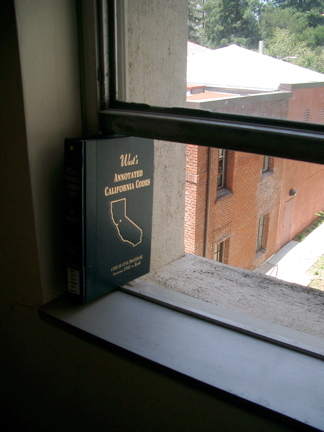
I’ve only been at my new job at Boalt Hall (UC-Berkeley’s law school) for three days, but already I’m gaining insights into the profession and how future practitioners are trained. For instance, on the hike up to my temporary office, which is in an annex to Boalt’s main building, I pass an open window in the stairwell. What’s eye-catching is how the window is held open. A fresh-air lover in the greater Boalt community, showing laudable imagination in finding new uses for the law, has pressed a volume of "West’s Annotated California Codes" into service as a prop.

Whatever Happened to …

… Infospigot?

Well, I started this new job, and that’s been absorbing my attention. And a few other things have been going on. And for reasons currently beyond my understanding and/or technical ability, our DSL connection is down right now. So I’m sitting on our front porch, listening to the traffic half a block away on Cedar Street, watching the cat watch the night come down on the neighborhood out of the corner of my eye. If everything works, I’ll post this using an unknown neighbors open Wi-Fi connection (their network is called “Martha,” but that doesn’t ring a bell).

Anyway, so that’s where I’ve been. More on the first few ays working for the University of California, and on other stuff, a bit later.

Whitman’s War, Our War

As I was saying — May 31 is Walt Whitman’s birthday. I’ve always been struck by his Civil War poems, their brevity and power, the immediacy of them, the empathy in them, the unflinching way he conveyed the suffering he saw and the suffering he took in. For instance, this scene from “A March in the Ranks Hard-Prest, and the Road Unknown“:

“We come to an open space in the woods, and halt by the dim-lighted building;

’Tis a large old church at the crossing roads—’tis now an impromptu hospital;

—Entering but for a minute, I see a sight beyond all the pictures and poems ever made:

Shadows of deepest, deepest black, just lit by moving candles and lamps,

And by one great pitchy torch, stationary, with wild red flame, and clouds of smoke;

By these, crowds, groups of forms, vaguely I see, on the floor, some in the pews laid down;

At my feet more distinctly, a soldier, a mere lad, in danger of bleeding to death, (he is shot in the abdomen;)

I staunch the blood temporarily, (the youngster’s face is white as a lily;)

Then before I depart I sweep my eyes o’er the scene, fain to absorb it all;

Faces, varieties, postures beyond description, most in obscurity, some of them dead;

Surgeons operating, attendants holding lights, the smell of ether, the odor of blood;

The crowd, O the crowd of the bloody forms of soldiers—the yard outside also fill’d;

Some on the bare ground, some on planks or stretchers, some in the death-spasm sweating;

An occasional scream or cry, the doctor’s shouted orders or calls;

The glisten of the little steel instruments catching the glint of the torches. …”

Whitman was writing for an audience for whom this kind of loss was familiar. When the Civil War ended, every American knew someone who had been killed or wounded (rough arithmetic: 4 percent of the male population counted in the 1860 census died as a result of the war; that’s one in 25 men in the entire country; that ratio in today’s U.S. population would equal 6 million deaths). When Whitman wrote about the horror and tragedy of a field hospital, he was describing a scene that involved his readers in a very personal way.

The Whitman war poem — especially his picture of the field hospital — came to mind in part because, in the midst of my Memorial Day reading, I just happened across a piece from an American military doctor working in a combat hospital in Iraq. It’s immediate and moving in its own way:

“They wheeled the soldier into the ER on a NATO gurney shortly after the chopper touched down. One look at the PJs’ [pararescuemen’s] faces told me that the situation was grim. Their young faces were drawn and tight, and they moved with a sense of directed urgency. They did not even need to speak because the look in their eyes was pleading with us – hurry. And hurry we did.”

The piece isn’t Whitman. For one thing, a lot of the it’s given over to marked pro-war rhetoric and a sort of “Top Gun” meets “ER” attitude that seems a little foreign to the humanity of the situation. And the author is writing about a scene that most of us aren’t personally connected to and probably don’t want to think too much about. That in itself makes it worth the time to read and ponder.

‘Birthday, Walt

It’s Walt Whitman‘s birthday. Born on Long Island, citizen of New York and Brooklyn, people’s poet, war poet, entombed in Camden, N.J. Someday when we’re back east and doing one of our trips up or down the Delaware River (Washington Crossing, Frenchtown, Water Gap), we’ll visit that cemetery. For now, just these few lines, a birthday remembrance.

Memorial Day …

… Is almost over. I whiled away part of the patriotic three-day weekend watching some of the Turner Classic Movies “all war flicks, all the time” marathon. Saw almost all of “A Bridge Too Far,” which is extraordinary for its overuse of big-name actors and big-time pyrotechnics in the service of perhaps the last romantic World War II feature. Saw parts of “M*A*S*H,” which has aged amazingly well. Saw parts of “Patton,” which seems ludicrous to me now. Beyond my personal political leanings, I think the war-themed movies just look different in the post-“Saving Private Ryan”/”Band of Brothers” era, when there’s been an effort to bring something like combat verity into the movies and television.

For a film about such a famously hard-nosed character, “Patton” comes off as little more than a romantic caricature in which one great man spends a couple hours strutting around in front of a bunch of cardboard cutouts. That’s the way it looks now. Then — it came out the same year as “M*A*S*H,” 1970 — it was enormously popular and a big winner at the 1971 Oscars. It’s hard to say why looking at it now, though of course the period is suggestive: Vietnam was unpopular but not yet recorded in the “not-won” column, and the movie features a hero who built a reputation for driving tanks through any opposition, damn subtlety or consequences. “M*A*S*H” spoke a lot more directly to the anti-war audience then, and because of its grim humor, frankness about the business at a combat hospital, and Robert Altman’s handling of a great ensemble of actors, it still seems fresh.

That leaves “A Bridge Too Far,” which is almost embarrassing to watch. The stock upbeat theme music. The star-studded cast. The stiff upper lip in the face of insuperable odds. The impassive, smugly superior Nazis (this time with a reason to be smug and superior). The nobility of defeat and massive casualties. It’s good that Hollywood has almost quit making this movie, or this kind of movie (from the trailers, Mel Gibson’s “We Were Soldiers Once,” looks like an attempt to give Vietnam the same heroic treatment).

But it makes you wonder, a little, how Iraq will be turned into a big-screen treat. (The best clue: Go rent “Three Kings.” More pleasingly flashy entertainment, less reality — but we’re OK with that.)

Mileage Scoreboard: 05.28.05

Posting from our friends Larry and Ursula’s place in Fair Oaks, California, after a long evening, a very fine dinner Larry cooked for all of us, and another long ride: It’s about 93 miles up here by car from Berkeley. It’s longer by bike, and longer still the way I do it: about 130 miles. Not the hardest ride — lots of flat, and a good wind most of the day. But the thing is, even if it’s flat and tail-windy, you’ve still got to ride the distance. More about the ride tomorrow. We’re going to clear out of here soon (somehow, it’s become 11:30 p.m.) and drive back to Berkeley.

RIP, Oliver Wendell Douglas

The most amazing thing about watching the DVD of the first season of “Green Acres” last year was to discover that Eddie Albert, who in 1969 began playing the big shot New York attorney who relocates to Someplace Rural, USA, was still alive and in his late ’90s; and not only that, but that he’d been working into the middle of the last decade, when he was pushing 90.

Now comes news that he has died — age 99 — in the Los Angeles area. Not sure how well “Green Acres” translates to today’s audience, but watching the first-season episodes last year, the humor still looked bent and slightly subversive to me. Sort of an odd thing to have as your major life achievement, for sure, but then the obits say the show made Albert (who was born Edward Albert Heimberger) wealthy, and that he turned around and used his money for environmental and social causes. Not a bad legacy.

Employment Notes

In an unexpected turn of events, I’ve just been hired for a public-affairs position at the University of California’s law school, Boalt Hall. What’s unexpected is that two weeks ago, I didn’t even know this job was out there. But taking a look at the university’s job listings the Saturday before last, I noticed an opening for a senior writer doing media relations and development (fund-raising) work at Boalt. I posted my resume online and heard back pretty much immediately. A couple of interviews and several reference calls later, I got the job. I’m both excited and a little amazed; not that I was hired, because I’m not a complete bum; but because it happened so fast. Anyway, it’s going to be an intellectually challenging experience — the school’s dean, Christopher Edley Jr., is a recent Harvard transplant who has big plans on every front (expanding the school, for instance, hiring more faculty, and launching initiatives like the new Berkeley Civil Rights Project (a cousin of the project he started at Harvard in 1996). It ought to be pretty interesting to be close to the middle of all that. I start next Wednesday, and I’m going to walk to work.

Unfocused Group

I got a call last week asking whether I’d submit to a brief interview to see whether I was qualified for some focus group or other. I said yes, replied to a some questions about my age and health, then got invited to participate in a group that had something to do with flu vaccine.

The group met tonight in downtown Oakland. Eight guys between 50 and 64 years old, all with some sort of chronic health issue that put us at higher risk for complications if we get the flu (mine is asthma; someone else in the group mentioned they had diabetes, which is also a risk factor).

One guy drew everyone’s attention when he came into the research office before the group met. He was wearing what looked like pajama bottoms — or maybe they were some sort of high-fashion lounge pants — and slippers. The guy — let’s call him Larry — began to listen to his cellphone messages with the speaker volume turned all the way up and couldn’t figure how to make it stop. He kind of laughed about it. Innocuous stuff.

Then we went into the room where the group would be observed from behind a two-way mirror. The first thing Larry says to the moderator after she explained we’d be observed and videorecorded is, “Is it OK if I sit on the floor?” The moderator reluctantly went along with that, even though it meant it would be a little harder for everyone else to talk to him. Then she asked us all to introduce ourselves and say what sorts of things we like to do. Larry was first and said he likes to travel and go to the theater. In fact, he said he’d just been to New York and saw a fabulous play on Broadway that’s certain to win a bunch of Tonys. “What’s the name of the play?” the moderator asked. Larry struggled for a while and couldn’t come up with the title, then said it was about a priest abusing a child (looking that much up suggests it’s John Patrick Shanley’s “Doubt,” which has gotten great reviews).

Then the rest of us spoke, then started to discuss influenza. Hardly a peep out of Larry, who was still sitting on the floor. About 15 minutes into the proceedings, the door to the room opened and one of the research firm’s staff members said, “Larry, would you step out here please?” Larry said something like, “What?” in an alarmed kind of way, and she repeated her request. He stood up and walked out. It looked like he had an erection (yes, I looked). There were raised voices out in the hall for a couple of minutes, and a few minutes later, another staff member came in and gathered his belongings. What was remarkable, and added to the impression that Larry had been sitting on the floor, you know, entertaining himself, was the fact the moderator ignored his departure completely. Didn’t bat an eye. Just kept up with the flu talk.

For that gratuitous slice of life, and for spending a couple hours critiquing a few Centers for Disease Control “get your flu shots” posters, we each got 75 bucks. Wonder if Larry got his.