Can’t We All Just Get Along?

By “we,” of course I’m talking about Cubs and White Sox fans. My friend Randy, a former lad of the Chicago suburbs, now a judge in the wilds of western Idaho, called after Game 2 of the World Series last night. At first I thought he was just getting in touch after a very long time to say hi. But he had something else on his mind. As a Sox fan, he wanted to gloat to a Cubs fan about his team’s victory. I disappointed him, I hope, because 1) I’d never root against Chicago (unless the Sox are playing the A’s, my adopted hometown team) and 2) Houston, as the putative hometown of the Bush dynasty, must not prevail.

But even without Houston’s involvement, it’s never been an article of my Cubs faith that I need to hate the Sox; it’s also not part of that faith that I have to like the Cubs, either, though I find myself pulling for them on the rare occasion they play games to care about.

Randy says that he became a convinced Sox fan at age 7, when they went to the World Series. He says he knows all the stats from the team that year, and sleeps with a Sherm Lollar replica athletic supporter under his pillow. Randy’s account made me think about when it was I decided I was a Cubs fan.

Growing up, we rooted for both teams and went to games at both ballparks, and I never heard that my Cubs fan dad had any trepidation walking through the turnstiles at Comiskey Park. I followed the Sox and liked them. They were my mom’s family’s team. They had good-bordering-on-great years in the early and mid-’60s, finishing second in ’63, ’64 and ’65 and going into the last five games of the ’67 season tied for the lead in a close race with Boston, Minnesota, and Detroit. They didn’t manage to win even one despite playing the the last five against the ninth- and tenth-place teams.

The same year, 1967, was the year that the Cubs awoke from a 20-year nap. They’d lost more than 100 games the previous year. They had some mature talent in their lineup (Banks, Williams, and Santo) and had added some good younger players (Kessinger, Beckert, Hundley) along with some decent pitching (Jenkins, Holtzman, Hands and Niekro). Suddenly they were contending. They had an incredible run in June, winning 23 of 27 or something, and went into the All-Star break tied with the Cardinals for first. They faded, but people had started to expect things from them.

I was 13. Impressionable. And maybe I’m a front-runner, too, because after that I was a Cubs fan; 1969, the year of their huge fold and the Mets’ huge run, was just over the horizon; but by then it was too late to back out — I actually cared. And besides, the Sox also-ran dynasty had run its course after ’67, and the folks down at 35th and Shields got a chance to see up close what Cubs fans already instinctively recognized: a loser.

So: Cubs fan, but not overly proud to say it. Hate the Sox? No. To the extent I work up that kind of bile over sports any more, I reserve my bitterness and revulsion for the preciousness surrounding the San Francisco Giants. Used to sort of like them, though.

Obligatory White Sox Post 2

Faithful Correspondent Lydell yesterday pointed out some interesting online mercantile activity involving White Sox tickets. The team’s Web ticket exchange had a bunch of Game 2 seats for sale. Top price, when I looked: Just under $10,000 per seat. There’s a lot more serious cash out there — heirloom jewelry being sold off, ancient mattresses getting raided for Grandpa’s rainy-day savings, big lines of credit getting tapped — than I ever imagined. The Sox ticket exchange says all the listed tickets are gone. But check out Chicago Craigslist: Someone offering tickets for the Houston games at anywhere from $1,900 to $2,300 a seat. (And on the other end of the spectrum: A buyer offering to pick up tickets for face value — the range is $125 to $185, which sounds almost modest — generously pointing out that tonight’s predicted rain would kill the scalpers’ market.)

By way of perspective, the eight Sox players indicted for throwing the 1919 Series were reportedly bribed something like $5,000 to $10,000 each.

Technorati Tags:

Obligatory White Sox Post

One sort of obvious statistical things I haven’t heard the broadcast guys talk about is the long roll the White Sox are on. Going back to the last week of the regular season, they’re now 13 out of 14, the only loss coming at home to the Angels in the first game of the second round. The run includes a sweep of the Indians, who had looked like they might be ready to overtake the Sox; a sweep of the Red Sox in the first round; and the 4-1 rout of the Angels. All this from a team that had gone into free fall after the first week of September (losing 10 of 14 at one point and with a record of 7-12 for the 19 games before they learned how to win again).

Technorati Tags:

Come Back, Bill King

One more Bill King story. A friend writes:

My all-time Bill King story was from last summer on a slow day while the team was in Kansas City. (Are there ever any “fast” days there?). The Royals brought out an obscure relief pitcher named Burgos. Bill King’s comment was “Well, he may be the only Burgos in baseball…the only Burgos I recall was Raphael Frübeck de Burgos, a Spanish conductor who used to appear frequently with orchestras around the country.”

Not likely to hear a comment like that from Ken Korach, as much as we like him.

Bloggers on the Storm

What I said about the best weather reading in that last post? I want to amend it: Weather Underground is publishing a couple of hurricane blogs that are great fun for storm geeks.

One is from meteorologist Jeff Masters — actually, Dr. Jeff Masters to you and me. The other is from Steve Gregory, identified as a weather forecaster.

Both blogs are discursive and have lots of good show and tell (maps, charts and other graphics) that you don’t encounter on the National Hurricane site without a lot of drilling down, if then.

Masters has a comparatively sober and reserved tone to his description of the weather. Gregory is a bit on the overmodulated “you won’t believe this!” end of the spectrum. Tonight, he’s predicting what the next hurricane hunter mission will encounter before it gets there based on what he’s seeing in satellite pictures. He sounds very confident even though his last prediction turned out wrong.

Stick with Masters for the facts. Gregory’s good for the wild speculatin’ we expect on the Net.

Technorati Tags: , ,

The Discussion

Wilma

The best weather reading out there — and I know one person in Napa who will back me up on this — is the forecast discussion produced several times a day by regional offices of the National Weather Service (for the San Francisco Bay Area, you can find it here). What’s good about it is that, even if it gets a little technical, you’re reading a real forecaster (as opposed to the TV kind) explain all the factors that go into the weather outlook.

The most striking revelation in the discussions is the degree to which forecasters rely on global models to come up with their picture of the weather over the next week. The models aren’t a secret, of course. But a large part of the discussion in any period of complex weather deals with how to resolve the disagreements among the many models, each with its own prediction about conditions 12 and 24 and 48 hours and (much) more from now, that are used to develop the public forecast. The resolution is often done by balancing a model’s behavior in various circumstances with the forecaster’s hunch about which of several outcomes might be true. It’s funny to see the TV weather folks deliver a "this is the way I see it" prediction knowing that a lot of their brow-furrowing is borrowed directly from the forecast discussion.

Now, among weather discussions, the best reading has to be the National Hurricane Center‘s tropical storm discussion. I think the reason is obvious: A lot more is at stake in a hurricane forecast, and the meteorologists wring their hands even more than usual about getting things right. But there’s another factor that makes the hurricane discussions fascinating: Tropical storm systems are so complex, with so many unknowns, that sometimes the models begin to diverge wildly on the forecast. The more powerful the storm — or the more variables to account for, such as adjacent weather systems, in figuring out where the storm is going — the more the models. At the mercy of what a computer is spitting out, the person whose name appears at the bottom of the discussion — another reason I like these writeups — sometimes is compelled to come out and say, you know, we can only guess what might happen two or three days from now with this thing.

I’ve read this kind of concession maybe half a dozen times this hurricane season, and three times in just the last couple of days in discussions of Hurricane Wilma. The statement issued at 5 p.m. EDT today was a classic — it started right into the problems with the models:

"HURRICANE WILMA DISCUSSION NUMBER  18

NWS TPC/NATIONAL HURRICANE CENTER MIAMI FL

5 PM EDT WED OCT 19 2005

"AGREEMENT AMONG THE TRACK GUIDANCE MODELS…WHICH HAD BEEN VERY GOOD OVER THE PAST COUPLE OF DAYS…HAS COMPLETELY COLLAPSED TODAY. THE 06Z RUNS OF THE GFS…GFDL…AND NOGAPS MODELS ACCELERATED WILMA RAPIDLY TOWARD NEW ENGLAND UNDER THE INFLUENCE OF A LARGE LOW PRESSURE SYSTEM IN THE GREAT LAKES REGION. ALL THREE OF THESE MODELS HAVE BACKED OFF OF THIS SOLUTION…WITH THE GFDL SHOWING AN EXTREME CHANGE…WITH ITS 5-DAY POSITION SHIFTING A MERE 1650 NMI FROM ITS PREVIOUS POSITION IN MAINE TO THE WESTERN TIP OF CUBA. THERE IS ALMOST AS MUCH SPREAD IN THE 5-DAY POSITIONS OF THE 12Z GFS ENSEMBLE MEMBERS…WHICH RANGE FROM THE YUCATAN TO WELL EAST OF THE DELMARVA PENINSULA. WHAT THIS ILLUSTRATES IS THE EXTREME SENSITIVITY OF WILMA’S FUTURE TRACK TO ITS INTERACTION WITH THE GREAT LAKES LOW. OVER THE PAST COUPLE OF DAYS…WILMA HAS BEEN MOVING SLIGHTLY TO THE LEFT OR SOUTH OF THE MODEL GUIDANCE…AND THE LEFT-MOST OF THE GUIDANCE SOLUTIONS ARE NOW SHOWING WILMA DELAYING OR MISSING THE CONNECTION WITH THE LOW. I HAVE SLOWED THE OFFICIAL FORECAST JUST A LITTLE BIT AT THIS TIME…BUT IF WILMA

CONTINUES TO MOVE MORE TO THE LEFT THAN EXPECTED…SUBSTANTIAL CHANGES TO THE OFFICIAL FORECAST MAY HAVE TO BE MADE DOWN THE LINE. NEEDLESS TO SAY…CONFIDENCE IN THE FORECAST TRACK…ESPECIALLY THE TIMING…HAS DECREASED CONSIDERABLY. …

FORECASTER FRANKLIN"

There it is: actual bitter irony; from a hurricane forecaster. "With the GFDL [Geophysical Fluid Dynamics Laboratory model] showing an extreme change … with its 5-day position shifting a mere 1650 NMI [nautical miles] from its previous position in Maine to the western tip of Cuba."

Technorati Tags: ,

Play by Play

Pete called me this afternoon to say he’d heard something on the news he found sad and shocking: Bill King, who did play-by-play for the Oakland A’s for the past 25 seasons, had died suddenly after undergoing surgery. Strange to say, I was actually shaken.

A couple weeks ago, I was listening to him broadcast on the next-to-last day of the season. It was a nothing game from Seattle, and I can’t say I remember anything about it. But I do remember hearing Bill mention Pat Piper, the legendary and long-gone field announcer at Wrigley Field, and thinking how the one thing I’d really miss about the season would be not hearing him again until springtime.

(I just discovered, though, that if you’re willing to pay $7.95 to MLB.com, you can get the full online archive of A’s radio games (and every other team’s, too) for 2005. Not sure how long the access will last, but I paid.)

I wrote a little something about King a couple months ago, about how he’d casually, and humorously, tossed off a reference to Trotsky while communicating his distaste of interleague play. His obituaries mention something I remember hearing a long time ago but had forgotten — that King was fascinated with Russian history and read avidly on the subject. So Trotsky was right in his ballpark.

King was an institution here not just for his A’s work, but for his phenomenal overlapping tenure with the Golden State Warriors (from ’62-’83) and Oakland/Los Angeles Raiders (’66-’92). Perhaps it was just that I enjoyed his style so much — his panache with language, his knowledge, his energy, his humor, his nearly unfailing sense of dramatic shifts in the contest he was describing — but I really believe he called a different kind of game than most of us are accustomed to hearing.

The mean streak Harry Caray showed in his best years and the mawkish sloppiness that marked his work later (nearly his entire Cubs tenure, from what I can tell, when he became first icon, then caricature) was absent in King. He didn’t indulge in the raw homer-ism and smug know-it-all-ism that makes Giants games so hard to listen to (Krukow and Kuiper, worst offenders; Jon Miller ain’t half bad, though). You would know who he was pulling for, but you never got the sense that he believed his team deserved to win.

A King broadcast was like listening to one of your smartest, most entertaining friends unwinding an elaborate yarn. He was someone you could imagine having over to dinner, maybe, and know you’d be in for an evening you’d never forget. Kate and I actually talked about inviting him, knowing that kind of thing never happens.

Pop: The Legend Continues

My sister Ann called from Chicago this morning, and just hearing her so early meant there was news, maybe bad news, about my dad.

In the middle of the night, he had chest pains. Not wanting to disturb anyone — neither Ann, who lives three blocks away and would have been at his place in a split second if he called; nor neighbors; nor paramedics — he climbed the stairs from his apartment, walked out to his car, and drove himself halfway across the city to the hospital where his doctor practices and presented himself at the emergency room. Ann was quick to say he was OK and reminded me that a few years ago he had chest pains and they turned out to be unrelated to any heart problem. So I was relieved and resigned myself to waiting to hear what the hospital tests showed.

Ann called back late in the afternoon. She and my brother Chris had spent the day at the hospital with Dad. The tests showed a 75 percent blockage in one heart artery, and the cardiac people did an immediate angioplasty (ran a little balloon through a blood vessel in his groin up to the heart to clear out the blockage). “Technically, they say he did have a minor heart attack,” Ann said. The procedure he had was not pain free, and he was pretty much immobilized afterwards and put on what sounded like a host of drugs — blood thinners and sedatives and godknowswhatall.

So let’s roll the tape back to this morning. Here’s my dad, six weeks after his 84th birthday. He sits up in the middle of the night with chest pains. And does what, again? Drives himself to the hospital. Halfway across the city. And not to be dismissive of fine Illinois metropoli like Rockford, Springfield and Rantoul, but this is not Rockford, Springfield or Rantoul he was driving halfway across, but Chicago, city of broad shoulders and big dimensions. What an adventure. I wish I’d been there to see the looks in the ER when he strolled in.

“He’s getting no end of grief from everyone who hears about the drive,” Ann said. He’s probably loving it, too. It just proves it’s never too late to add to the legend. If Mom was taking this in from some after-life bleacher seats — she’d prefer those to the boxes, though she’d like the boxes just fine — I’m sure she got a kick out out of my dad’s pluck.

Hurricane Compulsion: Wilma

The National Hurricane Center has the story: the 21st named storm of the 2005 hurricane season is at large in the western Caribbean. That both ties the record for storms observed in a season (set in 1933) and exhausts the list of storm names. The next storm this year, if there is one, will be called Alpha.

As we wait to see whether Wilma develops into a major hurricane, as some models predict, let’s revisit famous Wilmas in history. Without objection, so ordered.

Wilma Rudolph: Track champion

Wilma Mankiller: Cherokee chief

Wilma Flintstone: Cartoon wife homemaker

Wilma, Arkansas: One-horse town

Wilma Township, Minnesota: One-horse township

Wilmer Cook: Hapless wild-eyed gunman in “The Maltese Falcon”

Technorati Tags:

Rally

Pujols

At the end of a truly crummy day, Kate and I watched the finish of the Cardinals-Astros game. The Cards were down two runs with two out in the ninth and no one on when Fox flashed a graphic for Game 1 of the World Series on Saturday in Chicago. Looking out at the TV from the kitchen, I thought the graphic depicted the Astros logo alongside the White Sox logo.

“Jinx,” I said. “They jinxed it. The Cardinals are going to win this one now.”

David Eckstein, the Cards’ shortstop and Little League lookalike, fought off a pitch from Astros’ closer Brad Lidge and rolled a single into left.

“See,” I said. I was thinking of Game 6 of the ’86 World Series, when Gary Carter came up for the Mets in top of the 9th and the Red Sox an out away from their first title since 1918. Kate was a Mets fan and was sad to see her team about to lose. We were watching at our friends Larry and Ursula’s house in the Sacramento suburbs. “Not over,” I told Kate. Carter lined a single to center, and the game and the Series turned out not to be over.

Jim Edmonds batted for the Cards and walked. Two on. Albert Pujols coming up. But still, the odds for the Astros: Their nearly unhittable closer on the mound. An out away from winning. The run that could kill them in the batter’s box. A threat, but more potential than imminent.

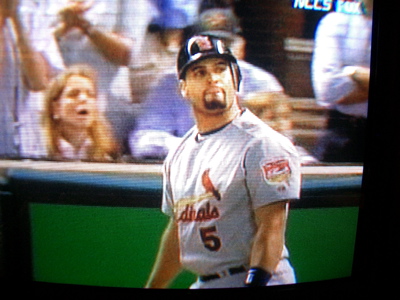
Pujols swung and missed a breaking ball low and outside. The next pitch stayed up and over the middle of the plate. When Pujols hit it, everyone knew. A replay showed Astros’ starter Andy Pettite jerking his head to follow the flight of the ball. You could read his lips: “Oh, my gosh.”

What I like best about crowd photography — sporting events, political rallies, concerts — is to search the faces of the extras, the people watching people launch the winning shot or make the speech or sing the aria, for the hopes and expectations and foreknowledge and fears there. During a replay of the Pujols home run, which turned out to win the game, Kate pointed out the woman in left of the frame. She’d had two or three seconds to take in what just happened. In an instant, she gets more dramatic and puts her hands on her head. For now, she’s just shocked.