The War List

Semi-obsessively perusing the death reports on Iraq Coalition Casualties, I thought about where the Iraq war ranks statistically among U.S. wars. Without going into the peculiarities of the numbers I’ve come across, here’s a list of total killed and wounded derived from the current "America’s Wars Fact Sheet" from the Veterans Administration. The VA actually folds the Iraq casualty figures into a total number for the Global War on Terrorism, which apparently combines casualty figures for operations in both the Afghanistan and Iraq theaters. The one change I’ve made to the list is to use today’s sum of killed and wounded in both theaters from numbers available through Iraq Coalition Casualties.

War  Deaths  Wounded  Total 
Civil War 529,332 420,000* 949,332
World War II 405,399 671,846 1,077,245
World War I 116,516 204,002 320,518
Vietnam War 58,209 153,303 211,512
Korean War 36,574 103,284 139,858
Mexican War 13,283 4,152 17,435
American Rev. 4,435 6,188 10,617
Spanish-Am. War 2,446 1,662 4,108
War on Terrorism 2,330 16,356 18,681
War of 1812 2,260 4,505 6,765
Indian Wars 1,000 (Not reported) 1,000
Gulf War 382 467 849

*Number of Civil War wounded an estimate based on non-VA sources; the VA lists Confederate wounded simply unknown.

One other note about the casualty numbers: The VA lists non-combat deaths for the American Revolutions as unknown, so the total who died in both wars is likely much higher. Also, the VA lists about 87 percent of the U.S. deaths in the Mexican War and 83 percent of those in the Spanish-American War as "other deaths in service" — which includes deaths from wounds that weren’t immediately fatal, disease, accidents, and other non-combat causes. In fact, the VA’s listed "battle deaths" comprise a majority of war dead in only World War II, Korea, Vietnam, and the current war.

Open-Source Intelligence

One of the ways in which the United States was and is woefully unprepared for a war anywhere in the Middle East is its lack of Arabic linguists in the ranks of the intelligence and military services. (What I know about Arabic: You read it from right to left. And by the way, salaam aleikum.)

When we invaded Iraq, we came into possession of what’s technically known as a boatload of government papers. Thirty-five thousand boxes’ worth. Millions of pages. And all classified. There may be some amazing stuff in those papers. But having so few people on our side who both read Arabic and have security clearances, there’s no way we’ll ever find out what’s in all those boxes. So instead of an archive that if nothing else might document how Iraq was run in the Saddam era, we have a mountain of worthless paper warehoused in Qatar.

Now, a congressman from Michigan has had a sort of intelligent idea about how to find out what’s in the papers. Open up the entire collection, declassify everything, and put the whole mess online so that all comers — or at least the Arabic readers — can tell what’s in there.

It has the potential to be untidy, but it’s worth a try.

Spidermania

Spider

Two classes of beings frequenting our neighborhood in atypical numbers these days: Mormon missionaries and spiders. The Mormons are less interesting to look at, but they do leave postcards offering to explain the meaning of life. The spiders don’t have much to say on existential and spiritual matters — unless you buy into “Charlotte’s Web,” which I doubt is a true story — but they’re endlessly fascinating to watch if you’re not likely prey. We’ve got at least three big ones that have spun webs outside the house; this one’s next to the front porch (click for full-size image).

[Further research — for instance here and here and here and here — suggests our arachnid visitors are variously called pumpkin spiders, garden spiders and cross orb weavers, aka Araneus diadematus. They’re orb weavers, their venom is of low toxicity to humans, and they’re found throughout Western Europe and North America.]

Happy Holidays, from FEMA

Wonderful news from FEMA to the tens of thousands of people displaced by hurricanes Katrina and Rita and still living in subsidized motel rooms: The agency will stop paying for most of the 53,000 rooms (all except 12,000 in Louisiana and Mississippi) on December 1. Evacuees, get ready to pay your own motel bill or go find another place to stay.

FEMA delivered the news in a press release on Tuesday that opens with five paragraphs recounting everything the agency has done and all it intends to do for the 150,000 unfortunates still in motels. Not only has it paid out hundreds of millions already just to get roofs over the evacuees’ heads, it wants to do more. R. David Paulison, FEMA’s acting director, is quoted as saying that the agency wants to get people out of hotels and motels and “into longer-term homes before the holidays.”

But FEMA disclosed it has a deeper interest, too: It wants to help people get back in touch with core American values like fending for themselves. “Those affected by these storms should have the opportunity to become self-reliant again and reclaim some normalcy in their lives.”

Only after all that, does the release get to the news: “On December 1, 2005 — the previously announced conclusion for FEMA’s direct payment hotel/motel program — direct federal emergency assistance reimbursements for hotel and motel rooms occupied by evacuees will end. FEMA has an aggressive plan to help place these families in longer-term housing prior to December 1.”

Note that FEMA goes out of its way to say the cutoff shouldn’t be news, because it was “previously announced.” And yes, check the FEMA website and there it is: An October 24 releaseheadlined “FEMA Continues Short-Term Lodging Program for Evacuees.” There, in the third paragraph, is the statement that the motel program would run through December 1. Someone ought to tell these folks what it means to bury the lead.

So, now that it has managed to make its intentions clear, how will the policy work in the real world?

Here’s one sign: In its statement three weeks ago, FEMA said it was paying for about 65,000 motel and hotel rooms. The number is down to 53,000 today, presumably thanks to state and local and volunteer efforts to find longer-term housing for people. That works out to 4,000 rooms cleared a week. Now, the agency wants to clear out 41,000 rooms (the 53,000 total less the 12,000 exempt rooms in Louisiana and Mississippi) in two weeks. Impossible? Perhaps not, despite FEMA’s involvement. Is it likely?

Here’s another sign. FEMA acknowledged a couple days ago that it would be a challenge to even get the word out. The agency had people going around slipping notices under evacuees’ motel-room doors, and it has produced radio public-service announcements to let people know what’s about to happen. If people weren’t even aware of what’s happening in the motel program two days, what’s the chance that FEMA is going to get everyone into the “readily available” longer-term housing (Paulison’s phrase) in the next two weeks?

Here’s one last sign: Look at what’s happening in Texas, where 19,000 motel rooms are occupied by hurricane refugees in Houston alone. The mayor there, Bill White, said given the city’s experience with the issue, FEMA should be seeking its advice: “We have moved more evacuees out of hotels than any other city has ever had in hotels. So we encourage those new to it to ask us, not tell us, how to do it.” Rick Perry, the Republican governor of Texas, said, “My great concern is that there is still no long-term housing plan for the hundreds of thousands of Katrina victims who lost everything.”

What’s going to happen? If FEMA follows through, the problem will be dumped on the states and cities across the country where evacuees wound up. Tens of thousands of people will wind up in shelters again or be put out on the street. More likely, FEMA will take such a horrendous PR pummeling over every aspect of its decision that it will be forced to back off until someone — likely someone outside FEMA — actually figures out a workable plan for getting people into real housing.

Technorati Tags: , , ,

Where We Come From

A tour of cultural history in the arts section of today’s New York Times:

–“My Lobotomy”: A story about Howard Dully, who as a 12-year-old in 1960 underwent a prefrontal lobotomy at the hands of Dr. Walter Freeman, the pioneer and champion of the procedure intended to pacify “disturbed” patients. The story says Dully “was lobotomized … for no other reason than that he didn’t get along with his stepmother, whose long list of complaints about him included sullenness, a reluctance to bathe and that he turned on the lights during daytime.” Dully has produced a radio documentary for NPR, “My Lobotomy,” which will air on “All Things Considered” this afternoon.

–A Critic’s Notebook offering from Margo Jefferson on Constance Rourke and Zora Neale Hurston and their use of “creative nonfiction” to unearth the cultural traditions of white and black America: “They were out to remap the cultural territories; shift the boundaries that separated folk, popular and high art; explore the American character (what we now call the national psyche). … They began in what I’ll call separate but equal neighborhoods. Rourke wrote about white cultural myths and traditions, iconic figures from Paul Bunyan to Harriet Beecher Stowe. Hurston wrote about the roots and characteristics of black American culture: language, folklore, music and dance, the will to improvise.”

–By way of my brother John, a writeup on a $9 million restoration (your tax dollars at work) of a gigantic (27 feet high, 365 feet in circumference) “cyclorama” painting of Pickett’s Charge at Gettysburg. The painting was one of four identical works made in the 1880s as tourist attractions to be viewed in the round, complete with foreground props designed to make the viewing hall merge into the action. One guy in the story refers to the cyclorama (and others like it) as “the Imax of their day.” Like most old art, the Gettysburg painting has been abominably treated — handled roughly, cut up, stored and displayed in wet, leaky rooms.

Sunset, November 14

Ringmountain

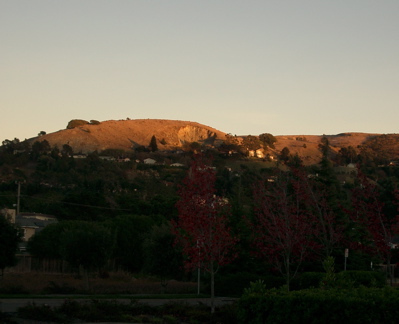
Spent the day working in Marin County at the high-end home furnishings retailers that shall remain nameless. I go into the company’s underwhelming suburban headquarters complex, which sits in a little valley between Mount Tamalpais to the west (about 2,500 feet at the peak) and Ring Mountain, an 800-foot ridge to the south and east.

Cimg4484
Cimg4501

Cimg4495
Cimg4522

When I came out of the office, the sun had already sunk behind Mount Tam’s long, high ridge; but it was still lighting up the top of Ring Mountain. I’ve taken to exploring the neighborhood, and found a way to walk up to a trail that goes up to the top of Ring Mountain. Since the light was going fast, I took a picture from the company parking lot, then drove up to the trailhead. Wonderful views in every direction —  south, across the top of the Tiburon Peninsula to San Francisco, north and west to the long silhouette of Mount Tam, north and east across San Quentin, the world’s most picturesque prison setting, into San Pablo Bay.

Sunset, November 13

Sunset in a neighbor’s window. It was beautiful out here today. Probably close to 70. Clear and dry and except for the short daylight, no clue what time of year it might be, except a nice one. Thanks to the fact the 49ers were playing the Bears today in Chicago, I got to see the contrast with back-there weather. In the first quarter, the temperature was 49 and falling, and it was blowing so hard (gusting over 50 mph, I think)  it seemed hard for the players to predict what would happen to the ball from second to second as it sailed through the air. The wind turned a game between two pretty bad teams into a decent entertainment. Important from the native Chicagoan’s point of view: The Bears won.

Sunset

Look Ma, No Pedals

I was out riding late yesterday afternoon — a short loop out a flat route to San Pablo Dam Road, north of Berkeley, then south along the far side of the Berkeley Hills, then back up Wildcat Canyon Road through the hills and home to the flatlands below. Near the top of the 2.7-mile Wildcat climb, I thought I felt a little looseness in my right pedal, but when I really focused on it, nothing really seemed amiss. This put me in mind of an April ride out to the Point Reyes LIghthouse, when my left pedal sheared off as I stood up to climb a little hill, and I had a low-speed crash. I started to ponder whether I could have ridden on one pedal back to the nearest town, Point Reyes Station, in time to find a bike shop, get new pedals, and ride the second half of the 188-mile ride I had started. That western end of Sir Francis Drake Boulevard, where my pedal disintegrated, is severely rolling. Obviously I could have walked up the steeper stretches on the way back to town, then coasted the downhills, and propelled myself one-legged on the reasonably level stretches. I’m guessing it’s about 15 miles back into Point Reyes Station from the lighthouse. Just idle speculation: It was just after 1 in the afternoon when my bike broke. I’m sure I could have limped back to town in say, three hours. So maybe I could have done it; I probably would have finished the ride at about midnight. Of course, then I wouldn’t have seen the two gray whales that cruised by the lighthouse as I waited for Kate to pick me up. And I’m leaving out of the equation the fact my front wheel was trashed when I went down and pretty much unrideable.

Anyway. I stopped at Inspiration Point at the top of Wildcat Canyon to take a look at Mount Diablo and the hills to the north and east in the dusk. The moon was a few nights short of full last night, but very bright, and Mars was rising. Just a beautiful evening. After a couple minutes, I clipped in and started riding back to town; the view of Mount Tam against the still-red sky was striking. After a quarter-mile or so, the road bends to the left and starts descending; as I picked up speed, suddenly my right foot seemed to come unclipped. Weird. I couldn’t seem to feel the pedal to clip in again, so I stopped. As soon as I put my right foot down, I could feel that I the pedal body was still clipped to my cleat and shoe. My first thought was that somehow the pedal had worked loose from the crank arm. But when I shone my light on the crank, I could see that the right spindle had sheared off, just the way the left one did in April.

Another cyclist — no lights, no helmet; “Maybe I have a death wish,” he said — appeared out of the dark and asked if I needed any help. He took a look at my pedals and said, “Those are shit. Get yourself some Dura-Ace or some Speedplay.” “What?” I exclaimed. “Those are Look pedals.” It wasn’t until later it struck me what a lame response that was. My guess is that, absent some sort of impact that would cause a fracture, this kind of failure should happen approximately never. And I’m not aware of ever having crashed my bike hard enough to damage either of the two pedals that have broken this year.

Pedals

[My intact left pedal and the broken right one.]

Anyway. Five miles from home. One pedal. I had to walk up one little bump of a hill on the way back to Berkeley. The rest was a cruise. But: It hadn’t really occurred to me how tough it might be to ride one-legged. There was no way to get up out of the seat for bumps, for instance. And since I was a little out of balance on the bike — I rode most of the way with my right foot on top of my seat post water-bottle cage and my right knee pointing way out to the side — I really didn’t feel safe letting myself go too fast; in fact, at speed it seemed unsafe to take my hands off the bars at all. So, to get back to Point Reyes: With a working front wheel I could have made it, probably. But it would have been a different kind of workout, and not much fun.

Candidate on a Hill

Ron Dellums, who used to represent Berkeley and parts of Oakland and other East Bay locales in Congress, announced last month he’s coming out of political retirement to run for mayor of Oakland. Dellums says the decision surprised even him: He arrived at the event where he declared his candidacy uncertain whether he would run. He said he made up his mind when he took the podium and saw the yearning in the audience’s eyes. “If Ron Dellums running for mayor gives you hope, then let’s get on with it,” he said. The Chronicle quoted a supporter as saying that Oakland was “finally getting the progressive leadership it deserves.”

The campaign issues Dellums talked about in his announcement sermon were universal health care, ending poverty, and inspiring young people. About more mundane problems — the kind a mayor might actually be expected to do something about — he told reporters later: “Potholes are important, but that’s not why people asked Ron Dellums to run.”

Leaving aside the question of why he referred to himself in the third person — maybe it’s just important to keep repeating the brand name — I don’t fault him for reaching above the gritty concerns of urban life to project a lofty vision for his followers. But at some point, governing a city comes back to potholes, or at least what’s happening on the streets.

Yesterday, Dellums gave another talk, to Oakland’s African American Chamber of Commerce. He spent some time ridiculing suggestions that his experience in Congress has not prepared him to lead a city. He talked some more about universal health care, but mentioned that as mayor he’d also be concerned with education, public safety and economic matters. “We can become a model city and grapple with every problem,” Dellums said. And: “I come not to tinker at the margins, but to ask you to join me in an effort to do big things — great things.”

From the stories and TV pictures, the crowd loved what they were hearing (with the possible exception of Ignacio De La Fuente, a City Council member who was the front-runner in the mayor’s race until Dellums’ experienced his podium impulse). And what’s not to like. He’s an extraordiinary speaker. Still, the specifics?

One of the local TV stations, KTVU, ran a clip in which one of its reporters asked Dellums what distinguishes him from the other candidates in the race. Dellums called the question “grossly premature.”

OK, maybe a guy just needs time to think. But five weeks after he declared his candidacy, and just seven months before the election, it’s fair to wonder what Dellums has in mind for the city he wants to lead. Oakland’s a real place with real needs and problems, not a city on a hill. It’s wonderful to expound on ideals and possibilities, but no amount of impassioned oratory will fix them without a plan that grapples with the city as it is.

I’ve never been a big fan of Jerry Brown during his tenure in Oakland. I’ve always felt that his approach to governing the city was a little imperious and arrogant. He took office as a major leaguer who came to show the bushers a thing or two about how to get things done; he was a big thinker who was going to broaden the horizons of poor, petty Oakland; and if the locals didn’t understand how smart and wise his vision was, he’d just run over them until they got it.

But if you listen to Brown now, he at least suggests he’s learned something about the real nature of leading a city. Last month, he described being mayor as a “much more in-your-face, concrete, down-to-earth reality than what you’re faced with at the level of governor or congressman, where you’re dealing with the great issues of the day, but dealing with them at a high level of abstraction. … Instead of an omnibus crime bill, you have to deal with shootings in Ghosttown in West Oakland and sideshows in East Oakland.”

So maybe Dellums can start out by learning something from his fellow superstar and talk about what he’d actually try to do, aside from being a symbol of uplifting ideals, if he becomes mayor. In fact, the most inspirational thing he could do for the city would be to lay out a pragmatic plan for turning his progressive faith into on-the-street reality.

L, for Lydell

If Lydell’s birthday were the Super Bowl, today’s edition would be the one played between numbers XLIX and LI. Not sure what the line is on the game, or what the over/under is, or even what I mean exactly by slinging that football-betting terminology, but: Happy 50th, Lydell. Back in Normal, who woulda thunk it?