Enough Already

Umbrellabike

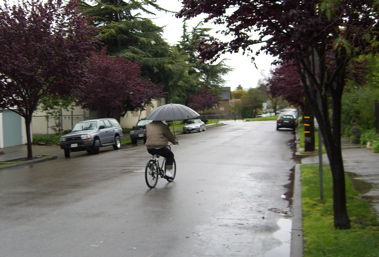
I admit it: At some point, you just want to say, “Basta!” Today makes it 28 or 29 days out of the last 35 that we’ve had measurable rain. Everything’s sodden, and the curbs along every street have turned into permanent streams. But people adapt, like the guy on the bike. Spotted him while walking to work this morning and barely managed to get a shot.

Technorati Tags: , , , ,

Marvin and Me

So today: Marvin Gaye’s birthday. And mine. The theme this year: 52-Card Pickup.

Got up late because of prolonged April Fool’s Day cycling activities. Began the day with conscious effort to deal gracefully with the fact my day got shortchanged a full 4-point-something percent through the loss of this morning’s spring-ahead hour. Kate and Thom and I had breakfast and opened presents, then Thom and I hit the road for Eugene, where classes start tomorrow after spring break.

The only driving worry was weather, but after seeing the first showers of the latest storm to sweep into the Bay Area, we didn’t have to drive in the rain until we got into the northern Sacramento Valley and along the drive up into the mountains north of Redding. But things cleared up after Mount Shasta, and the weather was dry across the higher passes into Oregon; for the first time on a trip up to Oregon, I carried snow chains today; I figured it was insurance against having to use them. We had some showers on I-5 through Oregon. Along the way,we listened to Thom’s entire iPod library of Marvin Gaye songs:”Let’s Get It On” and “I Heard It Through the Grapevine.” The pictures? They could be titled, “Hey, I got a new camera.”

Cimg0035Cimg0038

Technorati Tags: , , , ,

March

Parkinglot

The end of our rainiest March just about ever, as seen in the Kragen Auto Parts parking lot at Martin Luther King Jr. Way and University Avenue, where by city ordinance no one’s ever supposed to work on their car.

April Fool’s is next, and I’ll be out on my bike from sunup to sundown. More about that later.

Technorati Tags: , ,

Rain, Rain

Heard on the street on my walk to work as clouds rolled in from the west and swallowed up our brief morning sunshine: “Rain, rain, g–d–n m—–f—–‘ rain.” Except my fellow stroller didn’t use the dashes.

Although I’m coming perilously close to a weather whine, our March rain has mounted into wetness of historic magnitude: We’ve had 23 days of measurable rain this month. If it rains today or tomorrow — and that’s almost certain — that will set a new record for most rainy days here in March. As my friend Pete pointed out the other day, forecasters say some large-scale global weather patterns have kept it wet here for weeks (and will for at least the next week, it looks like).

Technorati Tags: , , ,

Today’s Favorite Toy

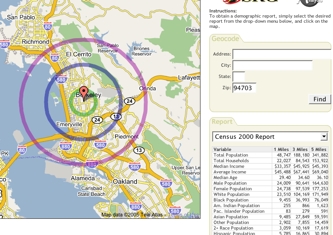
Another Google Map application: Google Census. This one combines Google Maps with 2000 U.S. Census data. It’s simple and has its limits. The demographic information that’s available on the site is somewhat limited, and the ability to refine the area you want to search is, too. But the ability to click just about any point on a map of the United States and get both a quick profile of the population and housing stock is pretty impressive.

Googlecensus

The site looks like it’s a demonstration by an outfit called AnalyGIS (GIS is the acronym for “geographic information systems”) that seems focused on providing mapping products to a variety of commercial customers.

Rambunctious, Rumbustious, Rumbustical

One spends a semi-absurd amount to subscribe to a resource like the Oxford English Dictionary — more precisely, subscribes to the OED, because there is no resource like it — because one wants answers, if not certitude. For instance, when the word “rambunctious” happens into your mind. Wait a minute. Where did it come from? Surely it’s an invented word from Edward Lear or Lewis Carroll.

The OED produces a fine definition: “Of a person: … exuberant; boisterous, unruly; flamboyant; of an animal: wild, high-spirited.” The earliest citation it offers is from 1830, from a publication called the Boston Transcript: “If they are ‘rumbunctious’ at the prospect, they will be ‘riprorious’ when they get a taste, for a ‘copious acquaintance’ with Vinegar.”

But as to how the word came to be, only this: “Origin unknown.” A pointer is offered to another entry, rumbustious (“boisterous, turbulent, unruly, uproarious”; a related form is rumbustical; the words are probably alterations of robustious). Robustious in turn is merely a combination of “robust” with the adjective ending “-ious” (robust is from the Latin word robur, for strength).

So there: No Lear or Carroll or any other sole practitioner shows up in the story.

The Conscientious Objector

Blackfive, one of the military blogs I follow to try to understand that perspective on the war in Iraq, mentions today the passing of Desmond Doss, 87, who won theMedal of Honor for his World War II service in the Pacific. What was unique about Desmond Doss and his recognition for bravery: He was a noncombatant, having enlisted in the Army as what he called a “conscientious cooperator” because of his pacifist beliefs. He served as a medic.

Before Doss ever saw a battlefield, he had to overcome the hostility of his officers and fellow recruits. He was a Seventh-Day Adventist, and refused to train on Saturdays. He declined to carry weapons. He was a vegetarian. Accounts of his service note that he was ridiculed and harassed by other soldiers; the brass, meantime, tried to throw him out of the Army as unfit for service, a move he resisted.

Eventually, Doss’s unit shipped out to the Pacific and wound up fighting on Guam, in the Philippines, and finally, in April and May 1945, on Okinawa. His Medal of Honor citation tells the story:

DOSS, DESMOND T.

“Rank and organization: Private First Class, U.S. Army, Medical Detachment, 307th Infantry, 77th Infantry Division. Place and date: Near Urasoe Mura, Okinawa, Ryukyu Islands, 29 April-21 May 1945. Entered service at: Lynchburg, Va. Birth: Lynchburg, Va. G.O. No.: 97, 1 November 1945. Citation: He was a company aid man when the 1st Battalion assaulted a jagged escarpment 400 feet high As our troops gained the summit, a heavy concentration of artillery, mortar and machinegun fire crashed into them, inflicting approximately 75 casualties and driving the others back. Pfc. Doss refused to seek cover and remained in the fire-swept area with the many stricken, carrying them 1 by 1 to the edge of the escarpment and there lowering them on a rope-supported litter down the face of a cliff to friendly hands. On 2 May, he exposed himself to heavy rifle and mortar fire in rescuing a wounded man 200 yards forward of the lines on the same escarpment; and 2 days later he treated 4 men who had been cut down while assaulting a strongly defended cave, advancing through a shower of grenades to within 8 yards of enemy forces in a cave’s mouth, where he dressed his comrades’ wounds before making 4 separate trips under fire to evacuate them to safety. On 5 May, he unhesitatingly braved enemy shelling and small arms fire to assist an artillery officer. He applied bandages, moved his patient to a spot that offered protection from small arms fire and, while artillery and mortar shells fell close by, painstakingly administered plasma. Later that day, when an American was severely wounded by fire from a cave, Pfc. Doss crawled to him where he had fallen 25 feet from the enemy position, rendered aid, and carried him 100 yards to safety while continually exposed to enemy fire. …”

There’s more, actually, about his own wounding. Doss’s tale is told in a book (“Unlikeliest Hero,” 1967) and a documentary (“The Conscientious Objector,” 2004). The Seventh-Day Adventists have reported a theatrical film based on his story is in production.

The religious component to the tale is not to be downplayed. This guy had a lifelong conviction that taking life, of any kind, was wrong; it was a belief intertwinted with his view of the Ten Commandments and his living relationship with his god. One of the stories about Doss on Okinawa has him calling his unit together and praying before the assault on a cliff; his unit was said to have suffered no casualties in the ensuing attack — and the believers hold that fact out as proof of a god extending a hand of protection over those devoutly seeking aid. Of course, I’ve got no problem believing Doss was devout, that his faith was sincere and suffused his whole being; on the other hand I have a little problem conceiving of a god who extends a hand of protection in the midst of a rain of violence, chaos, cruelty and death in which many, many other prayers go unanswered; unless, of course, the god is Zeus, Poseidson, Apollo, or Athena.

Technorati Tags:

‘Most Americans Believe Iran Is Building a Nuclear Weapon’

WSJ.com: Most Americans Believe Iran Is Building a Nuclear Weapon.

My headline for the story might be, “So what do you expect?” The Wall Street Journal reports the results of a Harris Interactive poll finding that “a large majority of Americans believe Iran is using its uranium research program to build a nuclear weapon.” Is that belief a surprise, considering the fact this is precisely the message that government and media are giving citizens, readers, viewers and listeners every time the subject of Iran comes up?

Let’s take a look at what Harris Interactive said Americans believed about Iraq in March 2003: Among other findings reported on March 6 of that year — 13 days before the war began — Harris reported 80 percent of Americans “believe Iraq has or is making nuclear, chemical or biological weapons”; 78 percent believed “believe there is at least some link between Saddam Hussein and Al Qaeda.” Lost in the mists of time is the finding that, even with those beliefs about Saddam and Iraq, only a plurality of Americans (45-36 percent) said they favored an attack at the time.

The point of all the above being: If people are bombarded day and night by the same set of “facts,” that’s bound to affect their thinking.

Down the Path to Democracy

By way of Volokh and the Chicago Tribune:

KABUL, Afghanistan — Abdul Rahman told his family he was a Christian. He told the neighbors, bringing shame upon his home. But then he told the police, and he could no longer be ignored.

Now, in a major test of Afghanistan’s fledgling court system, Rahman, 42, faces the death penalty for abandoning Islam for Christianity. Prosecutors say he should die. So do his family, his jailers, even the judge. Rahman has no lawyer. Jail officials refused to let anyone see Rahman on Monday, despite permission granted by the country’s justice minister.

The issue came up in the State Department’s daily briefing yesterday — a great opportunity for the administration that has decided to make its mark by spreading the light of freedom around the world to make a statement on the extreme intolerance and anti-democratic nature of our Afghan allies’ behavior. Here’s what spokesperson Sean McCormack had to say, in part:

“… We are watching this case closely and we urge the Afghani Government to conduct any legal proceedings in a transparent and a fair manner. Certainly we underscored — we have underscored many times and we underscored also to Foreign Minister Abdullah that we believe that tolerance and freedom of worship are important elements of any democracy. And certainly as Afghanistan continues down the pathway to democracy these are issues that they are going to have to deal with. These are not things that they have had to deal with in the past. Previously under the Taliban, anybody considered an apostate was subject to torture and death. Right now you have a legal proceeding that’s underway in Afghanistan and we urge that that legal proceeding take place in a transparent matter and we’re going to watch the case closely. ”

Down the path to democracy? At least he has the direction right. That summary reminds me of the old National Lampoon take on a high school U.S. history book (“The American Spectacle: 1492 to the Present”), with chapters titled (something like), “World War I: Pothole in the Road to World Peace.”

Reporters pressed McCormack to say why the administration isn’t simply calling for an end to the trial instead of merely insisting on judicial transparency; they even asked asked whether he would term the trial troubling. McCormack parried all questions with the response that this is a matter for the Afghans to work out under their constitution and that the administration has made its feelings known — in private — to the government. It’s just not the kind of restraint we’ve come to expect from a group that has dedicated itself to putting all the world’s ne’er-do-wells on notice.

[The update: Bush today says he is “deeply troubled” by the trial. And the Afghan government is having second thoughts about prosecuting Rahman. Not because its law is an expression of religious extremism, but because Rahman may be crazy. From the AP: “… Prosecutor Sarinwal Zamari said questions have been raised about [Rahman’s] mental fitness. ‘We think he could be mad. He is not a normal person. He doesn’t talk like a normal person.’ Moayuddin Baluch, a religious adviser to President Hamid Karzai, said Rahman would undergo a psychological examination. ‘Doctors must examine him,’ he said. ‘If he is mentally unfit, definitely Islam has no claim to punish him. He must be forgiven. The case must be dropped.’ “]

Technorati Tags: ,

Vice President Colbath, Part I

Consider for a moment — there’s no reason it must be this moment, but here it is anyway — the life of U.S. Vice President Jeremiah Jones Colbath. No — not a household name. In fact, if you look at a list of all the men who have served as No. 2, from John Adams to the current incumbent, you won’t find him. But he did serve.

When I was tapping out those president and vice president posts last month, I mentioned at one point being surprised at the number of vice presidents who had died in office. One of those was Henry Wilson, who was the second of Grant’s vice presidents. He suffered a stroke while in the Capitol in November 1875. Wilson was taken to the vice president’s suite, near the Senate floor, and died nearly two weeks later, on November 22.

The official biography includes a wonderful quote from one of Wilson’s eulogizers: “He was not learned, he was not eloquent, he was not logical in a high sense, he was not always consistent in his political actions, and yet he gained the confidence of the people, and he retained it to the end of his life.” The trust of the people, the Senate writeup suggests, came from his tireless habit of sounding out everyone he encountered about the issues of the day. “Confidence of the people” might be a little bit of a stretch, considering candidates for the U.S. Senate were elected by legislatures rather than popular vote until well into the 20th century. Reading about Wilson, you get the picture of someone who rose above the station that lack of learning, eloquence and logic “in a high sense” might have reserved for him — perhaps that of a modestly successful political hack. He had more than enough ambition, drive and smarts to play the game and become a master operator. A 1964 journal article on him was titled, “Henry Wilson: Unprincipled Know-Nothing,” a reference to Wilson’s abandonment of his stated anti-slavery stance in the early 1850s to secretly join the nativist, racist Know-Nothings in order to win support in an election.

Henrywilson
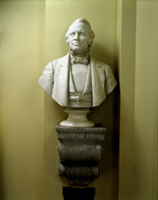
That started him on the path to prominence in Republican politics — he became a leader of the party’s radical wing during the Civil War and unsuccessfully campaigned for measures that would ensure racial equality after the war. When he died, the Senate was moved enough by his passing that it commissioned a bust eventually executed by Daniel Chester French, better known for sculpting the statue in the Lincoln Memorial, The Republic, a centerpiece of the 1893 World’s Columbian Exposition in Chicago. and the Concord Minuteman in Massachusetts. Among others.

[It’s late; to be continued.]