
Election Takes

The most interesting read I see out there right now is a collection of voting day accounts posted on the BBC’s site. They’re just short takes on the scene from both Iraqis who voted and at least one who stayed away from the polls. Elsewhere:

The New York Times — criticized always from the right as the bible of leftist traitors and from the left as a cryptofascist propaganda mill — paints a striking portrait of the election scene in Baghdad:

“If the insurgents wanted to stop people in Baghdad from voting, they failed. If they wanted to cause chaos, they failed. The voters were completely defiant, and there was a feeling that the people of Baghdad, showing a new, positive attitude, had turned a corner.

“No one was claiming that the insurgency was over or that the deadly attacks would end. But the atmosphere in this usually grim capital, a city at war and an ethnic microcosm of the country, had changed, with people dressed in their finest clothes to go to the polls in what was generally a convivial mood.”

The Washington Post’s exhaustively reported mainbar is much more restrained, noting the nearly festive atmosphere around some Baghdad polling places and a muted response to the vote elsewhere in the country:

“In Najaf, the Shiite holy city that embodies Shiite Muslim hopes for the elections, a light early turnout meant several dozen people at one station in the first hour. Among the first out was Najaha Hassan Rahadi, 58, who broke into tears when asked why she was voting.

” ‘Six of my brothers were executed, and I spent two years in jail’ under Saddam Hussein, she said from her wheelchair. ‘I want to elect a government that represents me.’ ”

“In Ramadi, the capital of Anbar province, Iraqi National Guard assumed the role of election workers inside one school, as more than 100 U.S. forces took up positions outside. Loudspeakers mounted on Humvees urged people to come and vote, but the streets were empty of all but soldiers.”
Now They Vote

You’d have to have a very hard heart not to be moved at least a little by the pictures of Iraqis going to the polls; going to the polls, moreover, with little idea what their votes will bring; just clear that whatever happens, it’s different from the past.

As to what the vote means, let’s wait a while and see. I’m amused/bemused to read Andrew Sullivan, who on Friday asked how we might judge the vote’s "success."

The amusement/bemusement is twofold. First, Sullivan throws out a set of blind metrics in his post: He suggests "over 50 percent turnout among the Shia and Kurds, and over 30 percent turnout for the Sunnis. No massive disruption of voting places; no theft of ballots. Fewer than 500 murdered." (I find that death figure appalling and outrageous on so many levels it’s hard to sit still and sort them out. Yes, that will be a great success if you’re not one of the 499 or one of their daughters, sons, wives, husbands, mothers or fathers. And: What’s 500 more lives on top of the tens of thousands spent already? And: The nerve of us Yanks, whether we support this war or not, to talk about these lives so casually).

But the thing that really kills me about Sullivan’s success metrics is the way they bounce around. Last week, Chris Matthew asked him to define success, and he said, "Success is 80 percent turnout in–in most of the regions, extremely enthusiastic voting among the Kurds and the Shias, and better than expected among the Sunnis." And today, after letting reality, or whatever it is, sink in a little, he offered this: "My revised criteria: 45 percent turnout for Kurds and Shia, 25 percent turnout for the Sunnis, under 200 murdered. No immediate call for U.S. withdrawal. Reasonable?"

No, not reasonable. But not because the numbers are off. Because they’re a sort of game we’ve all gotten used to watching the media and our leaders play. That game is both a cause and a symptom of the trouble we’re having understanding what’s happening in Iraq (and much of the rest of the world, including the United States, but that’s another post for another time). We’re so impatient for results that we have to know even before we’ve covered over the seed whether it’s growing yet.

When the media plays this way, it’s a game that’s nearly childish in its antsiness to be first to say what it all means. That’s a trait that leads to quick acceptance of announcements like "Iraq’s about to unleash weapons of mass destruction on the United States" or "the Iraqis will love us when we get there" to "major combat is over." Let’s just have a decent respect, for once, what we don’t know about all the dimensions of Iraqi reality and admit that some percentage figure won’t tell you a thing, by itself, about where this is all headed.

Of course, I do have my own opinion. I can’t imagine this working. I just don’t see how an alien power, especially one with as little credibility as we appear to have among Muslims in the Mideast, can both violently overthrow a government and impose a democratic replacement (much less one capable of creating the oasis of stability that Bush talks about).

‘Exciting Times’ in Baghdad

As noted yesterday, Bush (countdown: 1,453 days) summed up the situation in Iraq going into the weekend of the vote this way: “It’s exciting times for the Iraqi people.”

The New York Times today carries a story from John Burns in Baghdad that captures the sense of excitement:

“… Daily life here has become a deadly lottery, a place so fraught with danger that one senior American military officer acknowledged at a briefing last month that nowhere in the area assigned to his troops could be considered safe.

‘I would definitely say it’s enemy territory,’ said Col. Stephen R. Lanza, the commander of the Fifth Brigade Combat Team, a unit of the First Cavalry Division that is responsible for patrolling a wide area of southern Baghdad with a population of 1.3 million people.

“In the week that ended Sunday, according to figures kept by Western security companies with access to data compiled by the American command, Baghdad was hit by 7 suicide car bombings, 37 roadside bombs and 52 insurgent attacks involving automatic rifles or rocket-propelled grenades. The suicide bombs alone killed at least 60 people and injured 150 others.”

Killed In Iraq Today

Thirty-seven U.S. troops. The report at icasualties.org is stark and telling.

Among Iraqis, dozens more killed and wounded. A daily occurrence.

Four days until the vote. Bush: “It’s exciting times for the Iraqi people.”

I Agree with Bush!

I agree with Bush! And on any subject other than the danger of swallowing pretzels whole, I think that statement demands an exclamation point. During his press conference today, he said Iraq’s insurgents (he called them terrorists “do not have the best interests of the Iraqi people in mind. They have no positive agenda. They have no clear view of a better future. They’re afraid of a free society.”

I agree with part of this, anyway. Beyond wanting to thwart the will of Bush and the United States no matter what, beyond wanting to force the occupiers out, I don’t really get what the insurgents’ political program is. But that’s enough to keep them going. On the other hand — “having the best interests of the Iraqi people in mind” — that’s another breathtaking Bush conceit. As if he launched the war with the best interest of Iraqis (beyond Ahmad Chalabi) in mind. As if they were given a choice. And now that their country has been torn to pieces for their own good, what a choice we’ve given them. On one side, the insurgents. And on the other, a government that’s a sort of alien life form planted in the desert, one that owes its existence entirely to external life support (our cost, for 2005 alone, $105 billion).

Dick Day

In its role as national arbiter of decency, the Federal Communications Commission declared Monday that it’s mostly all right to describe someone as “a dick” during primetime (it spells out its thinking on dick and other raw broadcast vocabulary in two opinions — here and here as PDF files).

The case, as reported by the Washington Post, is delightful for two reasons. First, it sheds more light on the kind of protests the Parents Television Council — the main engine for broadcast decency complaints to the FCC — is filing. For instance, among the 36 instances of smutty utterings the council pointed to are gems like this:

“ ‘Everwood,’ September 16, 2002, 9 p.m. EST: a character remarks to another: ‘I got this black eye because of you, dick.’

” ‘Fastlane,’ September 18, 2002, 9 p.m. EST: one character threatens another by stating: “…in my next life I’m coming back as a pair of pliers and pull off your nutsack.’ ”

What’s equally amusing, and ironic, is the length to which the Post goes to avoid printing the words that were in the FCC documents. Here’s how the Post gets around saying “dick.”

“It’s generally okay to use a common nickname for “Richard” as an insult on network television, the Federal Communications Commission ruled yesterday, in a denial of several indecency complaints brought to the agency. …

“… A number of the denials focused on the nickname — also a slang term for the male sexual organ — which increasingly is working its way into television scripts.

“For instance, the agency ruled that it was not indecent when, during an Oct. 30, 2002, episode of the WB’s ‘Dawson’s Creek,’ one character says to another: ‘Listen, I know that you’re [upset] at your dad for flaking on you. It doesn’t mean he’s a bad dad, and it doesn’t mean he doesn’t love you.’ Prompting another character to say, ‘No, it just means he’s a [nickname/slang term for male sexual organ].’ ”

(Just for the record, the FCC’s opinion shows that the “Dawson’s Creek” character above said “I know that you’re pissed,” not “I know that you’re upset.”)

I’ve been on the other side of this question, editing copy for a daily newspaper audience, enforcing and agreeing with a policy that pretty much kept all vulgar expression out of our copy. But in this instance you have to ask what’s the point?

In this story, the whole point is how a government commission that has been turned into a tribunal on cuss words and risque imagery is arriving at and justifying its decisions to the public and a pressure group. The words involved here — the actual words that prompted complaints, not cutesy/clumsy euphemisms — are of the essence. So why in the world would you keep them out of the story? How can a reader judge whether the parents group is being plain silly or the commission is turning the country over to the porn lords without using the words at issue?

Learning to Love MARSEC

Ferrygate

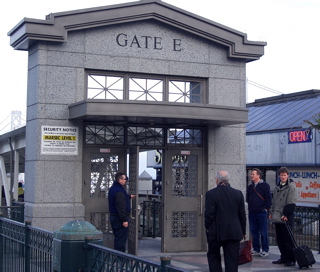
The war on terror: It’s as far away as some country you can’t even pronounce or find on the map, and as close as your local ferry terminal.

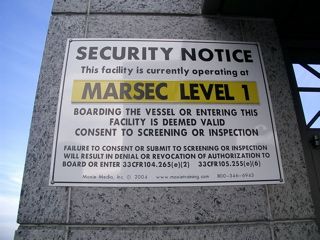
I was over in San Francisco today and decided to take the ferry home. No matter how many times I ride the boat, the trip is fun and the scene on the bay is always engrossing. But getting on the ferry isn’t the same as it used to be. Until sometime in the last year or so, when you wanted to take the ferry, you just walked onto the dock and waited for the boat to come in. Now, as part of our new anti-terror reality, the company that runs the ferry keeps the access doors to the dock locked until the boats are moored and ready to board. Not a big deal, I guess. But here’s something else: There’s an official posting at the dock entrance announcing the current Coast Guard "MARSEC" (Maritime Security) level. Right now, we’re at MARSEC Level 1, "the level for which minimum appropriate security measures shall be maintained at all times. MARSEC 1 generally applies when HSAS Threat Condition Green, Blue, or Yellow are set" (that seems to mean that we’re always at MARSEC 1;  just like the global war on terrorism, the threat never ends).

Beyond conveying the news we’re at MARSEC 1, the sign also advises that "boarding the vessel or entering this area is deemed valid consent to screening or inspection …. failure to consent or submit to screening or inspection will in denial or revocation of authorization to board or enter." That declaration is followed by a couple of citations from the Code of Federal Regulations, including: 33CFR104.265 (e)(2), that specify security measures to be taken under various threat levels..

It’s true that these security precautions, as implemented, are quite mild; I’ve never seen anybody searched on the Oakland ferry, and as far as I know, no one ever has been. It’s also true I have no desire to see someone set off a bomb on a ferry or in any other public place. Still, there it is: If someone else says so, you have to submit to a search to ride the boat. It’s just another place where we surrender just a little bit of our right to be left alone, where the presumption about citizens in public spaces is that they’re potential threats until they show otherwise.

If the ride wasn’t so beautiful, I’d probably find another way to get home.
Marseclevel1


Our Torture Problem

Andrew Sullivan, of Andrew Sullivan fame, has a huge and absorbing piece in The New York Times Sunday Book Review on Abu Ghraib, Guantanamo, the Bush administration (along with the rest of us) and torture. He’s reviewing a couple of newly published books that document the administration’s policy on and practice of torture (“Torture and Truth,” by Mark Danner, and “The Abu Ghraib Investigations,” edited by Steven Strasser),

Sullivan’s take is thoughtful. He supported going to war in Iraq, still supports it, but has become a forceful critic of the Bush administration’s handling of it. His critique of the administration’s rationalization of torture and abusive tactics is pretty devastating. Although I’ll never agree with him on going to war in Iraq, I respect his willingness to look at his own, and other citizens’, complicity in what has taken place:

“Did those of us who fought so passionately for a ruthless war against terrorists give an unwitting green light to these abuses? Were we naïve in believing that characterizing complex conflicts from Afghanistan to Iraq as a single simple war against ”evil” might not filter down and lead to decisions that could dehumanize the enemy and lead to abuse? Did our conviction of our own rightness in this struggle make it hard for us to acknowledge when that good cause had become endangered? I fear the answer to each of these questions is yes. …

“I’m not saying that those who unwittingly made this torture possible are as guilty as those who inflicted it. I am saying that when the results are this horrifying, it’s worth a thorough reassessment of rhetoric and war methods. Perhaps the saddest evidence of our communal denial in this respect was the election campaign. The fact that American soldiers were guilty of torturing inmates to death barely came up. It went unmentioned in every one of the three presidential debates. John F. Kerry, the ”heroic” protester of Vietnam, ducked the issue out of what? Fear? Ignorance? Or a belief that the American public ultimately did not care, that the consequences of seeming to criticize the conduct of troops would be more of an electoral liability than holding a president accountable for enabling the torture of innocents? I fear it was the last of these. Worse, I fear he may have been right.”

Revolutions

Finally got around to watching the History Channel’s “French Revolution” documentary. As a general outline of the events, it’s an OK hour and 28 minutes of programming. Yes, it’s history that’s been tarted up with lame live-action voice-over sequences, hundreds of scenes of the guillotine falling (most accompanied by a shot of a blood-like substance spreading on the pavement beneath) and a sometimes ponderous and breathless script (“And then, the sans culottes really got their croissants in an uproar and treated the royal family very rudely” or, “If there was one thing Robespierre couldn’t stand, it was moderates — especially moderates who had bad table manners”).

There was one little detail when the documentary is dealing with the years leading to the revolution (usually with scenes of peasants scrabbling in the snow for branches to gnaw on) that I wonder about. The script says that Louis No. 16 wanted to support the American Revolution largely to settle scores with the British. And to do so, he approved spending 2 billion livres (the scripts says two thousand million, which is the same thing), enough to feed about 7 million of his subjects for a year. The claim is made that the deficit incurred in supporting the Americans eventually bankrupted the French government and threw the national economy into a state of collapse. On one level, what an irony. On another — and I know before I say it the parallel is superficial — what an interesting analogy for our leaders’ apparent willingness to spend whatever it takes in Iraq. You wonder what the ruinous consequences for us could be,

Friday Reading

Supporting the troops: Getting an education is one reason people enlist in the military, whether as active duty or in the National Guard. The Mountain Times of Boone, North Carolina, has an inspiring story about what happened when a young woman named Jordan Byrd finished her commitment to the Guard — her originally agreed-upon six years plus a full year in Afghanistan plus a full year in Iraq. Sounds like she did her part and then some. When she got out of the service with an honorable discharge, she went to her local college to sign up for classes. Long story short, the Army’s reneging on its commitment. The apparent reason: Byrd didn’t enroll in school soon enough to collect her educational benefits. The reason she didn’t was that the Army sent her to Afghanistan and Iraq. Thanks, soldier!

From the home of Björk: Sometimes a New York Times subscription pays for itself just in the issues ads that show up in the paper. Today, for instance, there’s a full-page ad bannered, “War Ends Today,” pushing a new book by Deepak Chopra, “Peace Is the Way.” There’s another full-pager from a San Francisco group called ForestEthics that blasts Victoria’s Secret for cutting down swaths of Canada’s boreal forests for paper for its catalogs (which have been declared “a world cultural resource” by the U.N. High Commission on Reading Matter for Men). On the next page (in my edition) Christians for Middle East Peace asks our president to do something meaningful about peace between Israel and the Palestinians (specifically: a solution with two viable states and Jerusalem as the shared capital).

But the ad that caught my eye was a statement from The Movement for Active Democracy in Iceland. It denounces the government’s support for the war in Iraq, noting in passing 1) that parliamentary approval for support was never sought, 2) that Iceland refused to declare war on Japan and Germany in 1945 as a condition of joining the United Nations as a charter member, 3) that even when it joined NATO in 1949, it was with the understanding that Iceland would never declare war on another nation, and 4) that the most recent polls show that 84 percent of Icelanders oppose the government’s support for the war.