Re: September 11th

A day late: From a brilliant abridgment of Walt Whitman’s "Song of Myself" that Scott Simon read on NPR the weekend after September 11, 2001:

"I understand the large hearts of heroes,

The courage of present times and all times;

How the skipper saw the crowded and rudderless wreck of the steam-ship, and Death chasing it up and down the storm;

How he knuckled tight, and gave not back one inch, and was faithful of days and faithful of nights,

And chalk’d in large letters, on a board, Be of good cheer, we will not desert you:

How he follow’d with them, and tack’d with them—and would not give it up;

How he saved the drifting company at last:

How the lank loose-gown’d women look’d when boated from the side of their prepared graves;

How the silent old-faced infants, and the lifted sick, and the sharp-lipp’d unshaved men:

All this I swallow—it tastes good—I like it well—it becomes mine;

I am the man—I suffer’d—I was there. …

I am the mash’d fireman with breast-bone broken;

Tumbling walls buried me in their debris;

Heat and smoke I inspired—I heard the yelling shouts of my comrades;

I heard the distant click of their picks and shovels;

They have clear’d the beams away—they tenderly lift me forth. 

I lie in the night air in my red shirt—the pervading hush is for my sake;

Painless after all I lie, exhausted but not so unhappy;

White and beautiful are the faces around me—the heads are bared of their fire-caps;

The kneeling crowd fades with the light of the torches. …

I take part—I see and hear the whole;

The cries, curses, roar—the plaudits …

Workmen searching after damages, making indispensable repairs … the rent roof—the fan-shaped explosion;

The whizz of limbs, heads, stone, wood, iron, high in the air. …

Failing to fetch me at first, keep encouraged;

Missing me one place, search another;

I stop somewhere, waiting for you."


Technorati Tags:

Post-Katrina Reading

Highly recommended: The New Yorker’s extensive collection of current and historical storm pieces from the September 12 issue, including a clutch of Talk of the Town mini-essays and two classic pieces: One by James B. Stewart on the flooding upriver in 1993, and John McPhee’s 1987 history of the Army Corps of Engineers projects designed to keep New Orleans and other parts of the lower delta dry. on the history of the Army Corps and its effects:

“The river goes through New Orleans like an elevated highway. Jackson Square, in the French Quarter, is on high ground with respect to the rest of New Orleans, but even from the benches of Jackson Square one looks up across the levee at the hulls of passing ships. Their keels are higher than the AstroTurf in the Superdome, and if somehow the ships could turn and move at river level into the city and into the stadium they would hover above the playing field like blimps.

“In the early nineteen-eighties, the U.S. Army Corps of Engineers built a new large district headquarters in New Orleans. It is a tetragon, several stories high, and it is right beside the river. Its foundation was dug in the mainline levee. That, to a fare-thee-well, is putting your money where your mouth is.”

Technorati Tags: ,

Bonobo Talk

Me (reading item in the Chronicle): Have you ever heard of a primate called the bonobo?

Kate: No.

Me: This says it’s called ” ‘the hippie of the forest’ because of its preference for resolving conflict through sex rather than violence.”

Kate: How do they resolve conflict through sex?

Me: I need to find more information about that.

Kate: Make love, not war.

(Beyond our charming chit-chat and the lightweight item in the paper, the un-cute context for the story.)

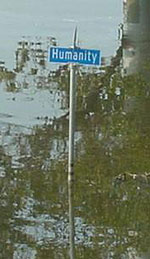
Humanity Street

Katrina_1

It’s in New Orleans. Just saw the picture at the “This American Life” site. And Google Maps supplies the cartographic representation. Next: Amour, Pleasure, Desire, Piety, Hope, and Abundance streets.

Technorati Tags: ,

Emergency Response

The San Francisco Chronicle’s Chip Johnson writes one of the more consistently leaden columns I’ve ever come across. But the decade or so of waiting for him to produce a decent piece is finally over: This morning, he recaps the experience of two San Francisco paramedics, Larry Bradshaw and Lorrie Beth Slonsky, who were in New Orleans the weekend Hurricane Katrina approached. They became part of the trapped throng:

“{New Orleans police] officers told them they couldn’t stay, they had no water for them, and they needed to get up on Highway 90, a bridge that spans the Mississippi River, and walk until they saw the rescue buses they promised would be waiting for them.

“So late Wednesday afternoon, the group set out for a bridge called the Crescent City Connection, where they would find the help they so desperately needed. But when they arrived atop the highway, the paramedics said, they were met by more police officers, this time from neighboring Gretna, La., who weren’t letting anyone pass.

” ‘If I weren’t there, and hadn’t witnessed it for myself, I don’t think I would have ever believed this,’ Bradshaw said.

The officers fired warning shots into the air and then leveled their weapons at members of the crowd, Bradshaw said. He approached, hands in the air, displaying his paramedic’s badge.

” ‘They told us that there would be no Superdomes in their city,’ the couple wrote. ‘These were code words that if you are poor and black, you are not crossing the Mississippi River — and you weren’t getting out of New Orleans.’ ”

Things only got worse from there. The couple’s own account has been making the Web rounds for several days. [And later: WBEZ Chicago’s “This American Life” has a great show this week that features the Bradshaw/Slonsky story and includes a first-person account from someone else who was there. Harrowing.]

Technorati Tags:

Technorati Tags:

Prayer — Why the Hell Not?

President Bush says:

“Throughout our history in times of testing, Americans have come together in prayer to heal and ask for strength for the tasks ahead. So I’ve declared Friday, September the 16th, as a National Day of Prayer and Remembrance. I ask that we pray — as Americans have always prayed in times of trial — with confidence in His purpose, with hope for a brighter future, and with the humility to ask God to keep us strong so that we can better serve our brothers and sisters in need.”

“Pray … with hope for a brighter future. …” That sounds pretty open-ended. Maybe we can pray for this guy and his whole entourage to go on vacation, permanently.

Interesting about Bush and national days of prayer — he’s proclaimed a whole bunch of them, starting the day after he was inaugurated in 2001; maybe he knew something. But we also have the National Day of Prayer the first week of May each year, National Days of Prayer and Remembrance to mark the 9/11 anniversary every year; and now a day of post-Katrina prayer. Good to see someone so willing to share his faith with the people; but I wonder whether he ought to declare some pre-emptive prayer days so that maybe we can skip some of the after-tragedy prayer.

Technorati Tags:

Trapped

Lieutenant Governor Mitch Landrieu appeared on “All Things Considered” tonight. He tried to make nice, like everybody else who might be implicated in the post-Katrina atrocity (amazing to see Bush and crew turn into statesmen so sudden-like: Please! Let’s not play the blame game!), but he made one point that I haven’t heard from other mainstream politicos: A lot of what happened with the people who couldn’t make it out of New Orleans is a much deeper issue than just finding buses and shelters for them, and one most of us have been content to more or less ignore:

“One of the things that troubled America so much was, you know, we didn’t really have to see the poor, because they were dispersed. And everybody got a pretty good glimpse of what all a lot of poor people look like standing together, and I think it made America very uncomfortable. We looked in the mirror and we didn’t like what we saw. Now people are going to talk a lot about, as you have already started, who’s got the blame for not moving people out of where they are. There’s a much bigger question, because poor people get trapped, but they get trapped in poor education, they get trapped without transportation, they get trapped without technology, they get trapped without the things that many other people have. And that trap puts them in front of the Convention Center and in the Superdome. And so the country has to ask itself, what are we going to do relating to poor people, and what public policies are we going to put in place now that they’re standing right in front of us and we can’t ignore it any more?”

Technorati Tags:

Selective Service

Just filling out a student aid application (late!) for our son, Tom, who is about to go off to the University of Oregon. One of the questions: “Is the student male? (Most male students must register with the Selective Service to get federal aid.)”

OK: I’m not going to take on the subject of Selective Service right now. But: Just the guys have to sign up? Come on. There’s talk about reinstating the draft, something I have mixed feelings about. But one of the conditions I think would be basic if we come to that is conscripting both women and men. (Among other conditions: allow for alternative national service — such as undergoing disaster relief training so that we’d have a ready, nonmilitary force to respond to situations such as we have in the hurricane zone right now).

But even short of a draft, girls ought to be registered at their 18th birthdays the same as the boys.

Louisiana 1927

NPR just played Aaron Neville’s beautiful cover of the Randy Newman song (lyrics as they appear on the original (1974) cover of Newman’s album “Good Old Boys,” which Kate pulled out of her stack of old records while we debated whether the words I found online were correct. Oh, for the record: She was right.):

“What has happened down here is the winds have changed

Clouds roll in from the north and it starts to rain

Rained real hard and it rained for a real long time

Six feet of water in the streets of Evangeline

“The river rose all day

The river rose all night

Some people got lost in the flood

Some people got away alright

The river has busted through clear down to Plaquemines

Six feet of water in the streets of Evangeline

“Louisiana, Louisiana

They’re tryin’ to wash us away

They’re tryin’ to wash us away

Louisiana, Louisiana

They’re tryin’ to wash us away

They’re tryin’ to wash us away

“President Coolidge come down in a railroad train

With a little fat man with a note-pad in his hand

The President say, ‘Little fat man isn’t it a shame what the river has done

to this poor cracker’s land’

“Louisiana, Louisiana

They’re tryin’ to wash us away

They’re tryin’ to wash us away

Louisiana, Louisiana

They’re tryin’ to wash us away

They’re tryin’ to wash us away

They’re tryin’ to wash us away

They’re tryin’ to wash us away”

(I note that Neville says “farmer’s” instead of “cracker’s.”)

A couple days ago, CNN published a little somewhat drippy backgrounder on the song and the events it’s based on. The occasion for NPR playing “Louisiana” was an interview with John Barry, author of “Rising Tide: The Great Mississippi Flood of 1927 and How It Changed America.” The Wikipedia has the bare-bones facts about the disaster, which was a big topic during the 1993 flood.

‘Rebellion of the Talking Heads’

Sunday night — a long, long time ago in the Hurricane Katrina era — I offered an obligatory scoff for the predictably breathless TV news coverage of the storm’s imminent landfall. I suggested that there might be a better way — turn coverage of such events over to the people who make reality TV. But it turns out that all it took for the TV news people to get past their trademark melodrama and cheap showmanship was to subject them to a genuine crisis for several days, with no hope of relief, right in the middle of the United States of America. Slate’s Jack Shafer had a great writeup Friday on how those covering the hurricane aftermath for CNN, MSNBC, NBC, and yes, even NPR, finally got to the point this week that they actually started demanding answers from the pols and bureaucrats they usually let smile and say nothing.

A former deputy chief of FEMA told Knight Ridder Newspapers yesterday (Sept. 1) that there “are two kinds of levees—the ones that breached and the ones that will be breached.” A similar aphorism applies to broadcasters: They come in two varieties, the ones that have gone stark, raving mad on air and the ones who will.

In the last couple of days, many of the broadcasters reporting from the bowl-shaped toxic waste dump that was once the city of New Orleans have stopped playing the role of wind-swept wet men facing down a big storm to become public advocates for the poor, the displaced, the starving, the dying, and the dead.

It’s about friggin’ time.