Three Years

Unless our current Bush gets the Supreme Court to throw out the 22nd Amendment — he’s the president, and he ought to have whatever he wants, right? — he’s got three years left in office as of noon EST today (12 minutes from now, if you’re counting). Unless the impeachers get him, of course.

Technorati Tags: ,

’24’: The Drinking Game

Redoubtable Chicagoan (or is that redundant?) MK points out a Slate feature on “24.” It’s an interview with one of the show’s writers on the many TV story-telling envelopes the series is pushing. All fine. The show’s central conceit, that the story is taking place in real time during the course of a single day (divided into two dozen advertiser-friendly weekly episodes) is unique. But that’s not news. What is noteworthy, Slate writer James Surowiecki suggests, is the staying power of “24” long after the audience has gotten used to the show’s terrorist spectaculars and remorselessly pounding clock. The explanation, Surowiecki says, lies in factors like the “political and even moral depth” that world events have lent the production. And of course we shouldn’t overlook “Kiefer Sutherland’s exceptional work as Jack Bauer.”

It’s perplexing. On one hand, you wonder if Surowiecki’s ever watched the show. If he has, where did he spot all the excellent acting and writing he’s talking about? But he has watched the show — the interview he conducts comes off as the work of a “24” junkie. He asks the writer Michael Loceff, with an apparently straight face, “How much work do you put into making the show realistic? There seem to be times when realism and drama inevitably come into conflict.”

There seem to be times? Yes, whenever a character says or does just anything more complex than start a car. The only reason I can imagine that anyone would suggest that “24” has anything serious to say about the world we live in is that produces high ratings. But the Nielsen numbers don’t make the show deep or serious any more than Bush getting re-elected transforms him smart or wise.

As for Kiefer Sutherland’s “exceptional” acting — if you’re looking for an unregenerate hard-ass, I’ll take R. Lee Ermey any day — here’s a Jack Bauer drinking game (don’t blame me for the cirrhosis): Down a shot (whatever you prefer to guzzle) every time Jack screams, “No-o-o-o-o!” A shot every time he shouts. “Do it!” or some variation on that. A shot every time he threatens to rough up someone who’s not fully cooperatng with him; a double-shot every time he follows through on the threat.

Technorati Tags:

Jabbavision

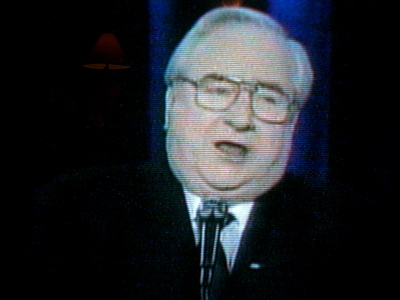
Here’s the trouble you can get into idly flipping through the channels. The Playboy Channel? A “South Park” marathon? A Howard Stern-dubbed replay of the Alito hearings? No. More frightening still, you might see this: Jerry Falwell, in all his glory, holding forth on his own cable outlet, the Liberty Channel (“Enjoy liberty’s greatest gift — the freedom to think just like me!”)

Actually, when I tuned in, he was sermonizing benignly on the Psalms. He’s got a nice reading voice.

Falwell

Our Daily Dead

Doing some research on RSS readers — applications that let you compile feeds from blogs and news sites and any other online source that cares to one up — I came across a site I had long ago noted and then forgotten about: Our Daily Dead. Wow. It’s a sort of super-blog that traffics in notable obituaries and sometimes the miscellaneous arcana of death.

In looking at the site just now, I came across the following literary obit, published last week in the Los Angeles Times:

Sanora Babb, 98; Writer Whose Masterpiece Rivaled Steinbeck’s

If there were lessons to be learned from Sanora Babb’s hardscrabble years as a child on the Colorado frontier, one of them must have been perseverance.

Babb waited 65 years in the shadow of a literary giant for her first completed novel to be published. Upstaged in 1939 by John Steinbeck’s bestselling “The Grapes of Wrath,” Babb’s tale about the travails of a Depression-era farm family was shelved by the venerable Random House, which feared that the market would not support two novels on the same theme. Bitterly disappointed, Babb stuck her manuscript in a drawer, and there it remained until 2004, when it was rescued by the University of Oklahoma Press.

At 97, Babb earned long-overdue praise for the novel, “Whose Names Are Unknown,” an acutely observed chronicle of one family’s flight from the drought and dust storms of the high plains to the migrant camps of California during the 1930s.

Reviewers called it a “long-forgotten masterpiece” and “an American classic both literary and historical,” as compelling as Steinbeck’s epic work and in some ways more authentic.

The widow of Oscar-winning cinematographer James Wong Howe, whom she dated in the 1940s in defiance of California’s anti-miscegenation laws, Babb died of natural causes Dec. 31 at her Hollywood Hills home, said Joanne Dearcopp, her longtime agent and literary executor. She was 98.

The obit goes on to note that Babb’s editor at Random House, the legendary Bennett Cerf, both praised “Whose Names Are Unknown” to the heavens and declared it couldn’t be published. “What rotten luck,” the obit quotes him as writing to Babb in reference to “The Grapes of Wrath.” “Obviously, another book at this time about exactly the same subject would be a sad anticlimax!”

The obit is a wonderful read. I want the book in my hands right now.

Visiting Iraq

I search for the word “Iraq” on Technorati, the blog-content indexing and search service. I view the results in Technorati’s “Mini” applet, a neat little pop-up window, updated every 60 seconds, showing the latest blog posts related to Iraq. At the bottom of the Mini window is a perky little ad that’s supposed to be relevant to my search:

Visiting Iraq?

Find cheap flights and hotel rates for Iraq from over 100

top travel sites at Kayak.com. Book direct and save.

www.kayak.com

Clicking on that link takes you to a Kayak page that invites you to choose one of seven Baghdad hotels for your upcoming trip. Top of the list: The Ishtar, on Saadoun Street. Amenities include free parking, car rental, a multilingual staff, an outdoor pool, and jogging (with all that going for it, the joint still rates only 5.0 out of 10 based on 32 Kayak users).

When you try to book a week at the Ishtar, though, Kayak returns a screen saying that if you want a reservation at any of the listed Baghdad hotels, you need to call them. If you try to book a flight, you hit another roadblock: a browser window pops up saying that no one Kayak does business with is flying to Baghdad. Just out of curiosity, I checked two other big online travel agents, Orbitz and Expedia, and they won’t get you to Baghdad, either. Curious, eventually I found the booking site for Iraqi Airways, which flies three round trips a week between Baghdad and Dubai in United Arab Emirates for 1600 AED (Emirati dirham), about $450.

Real Money

Outside Illinois, the late Senator Everett McKinley Dirksen is probably best remembered for an ironic (and, it turns out, probably apocryphal) comment on federal spending. It went something like, “A billion here, a billion there, and pretty soon you’re talking real money.”

The quote, real or not, needs to be updated. A couple of economists — Columbia’s Joseph Stiglitz, a Nobel laureate and son of Gary, Indiana; and Harvard’s Linda Bilmes — are getting some attention for a new estimate of the Iraq War and its effects: $1 trillion to $2 trillion or more. When you include that with Bush’s other trillion-dollar-plus brainstorms — tax cuts for the rich, the new Medicare prescription benefits, Social Security semi-privatization — pretty soon you’re talking real money.

The up-front costs for Iraq, Afghanistan and the rest of the war that will never stop are staggering enough: something like $325 billion already. The amount spent on Iraq is about three-fourths of that number, about $230 billion; that works out to just under $7 billion a month since we decided to buy Iraqis their freedom from Saddam Hussein (oh — and remove the deadly threat to our future existence, too). We’ll spend another $50 billion to $100 billion in Iraq this year, depending on who you believe. After that — who knows. In a New York Times op-ed piece last August, Bilmes tallied the direct costs of the war at $1.3 trillion if the U.S. military presence is required for another five years.

Stiglitz’s and Bilmes’s reported analysis, which is supposed to be presented in Boston on Sunday at the annual meeting of the American Economic Association, tries to assess the war’s indirect costs, too. From an apparent press release posted Thursday on TPMCafe:

“The study expands on traditional budgetary estimates by including costs such as lifetime disability and health care for the over 16,000 injured, one-fifth of whom have serious brain or spinal injuries. It then goes on to analyze the costs to the economy, including the economic value of lives lost and the impact of factors such as higher oil prices that can be partly attributed to the conflict in Iraq. The paper also calculates the impact on the economy if a proportion of the money spent on the Iraq war were spent in other ways, including on investments in the United States

” ‘Shortly before the war, when Administration economist Larry Lindsey suggested that the costs might range between $100 and $200 billion, Administration spokesmen quickly distanced themselves from those numbers,’ points out Professor Stiglitz. ‘But in retrospect, it appears that Lindsey’s numbers represented a gross underestimate of the actual costs.’ ”

Of course, by themselves, these numbers don’t carry any moral weight. It’s just money, and we’ll get someone to float us a loan for the kids and grandkids to pay off. But as an example of the dishonesty, irresponsibility and self-delusion behind the war, the figures are staggering. A recent Brookings Institution paper that tries to come to grips with the war’s cost notes, “Government policies are routinely subjected to rigorous cost analyses. Yet one of today’s most controversial and expensive policies—the ongoing war in Iraq—has not been.” In other words, while spending commitments for education and social welfare have to survive the equivalent of a budgetary Inquisition, Congress has been happy so far to fund Iraq based on any wild-ass guess the White House feels like making.

Not that everyone was as casual about the war’s cost as those who launched it: Yale economist William Nordhaus published an analysis of potential costs two months before the war started that concluded the direct and indirect expense might total nearly $2 trillion if the conflict were “protracted and unfavorable.”

Getting It Straight

The New York Times ran a nice little commentary Tuesday on the factual reliability of Wikipedia, the collaborative online reference to everything, and the Encyclopaedia Britannica, the hoary compendium of everything worth knowing. The Times mostly recapitulates the findings of a study published last month in Nature that compared science entries in the Wikipedia, which depends on community writing and editing, and Britannica, which relies on subject experts for its authority. An encyclopedia open to all comers to add to and alter at will would seem fraught with risk and likely to be rife with errors compared to a work created under strict editorial control. But the Nature study sampled 42 entries in both works and found that Wikipedia articles contained four errors per article on average; Britannica articles contained an average of three errors.

I’ve made my living in a media culture that believes in the importance of accuracy and quality and refinement — qualities best obtained, it is widely believed, by employing someone like me. At the same time, I’ve lived in terror of the blind, witless blunder that makes it into print; either under my name or worse, by my hand under someone else’s name. The fear comes from having learned that editorial perfection is a moving target: The state of knowledge on most subjects is ever evolving and changing. One minute someone has never had sex with that woman, Miss What’s-Her-Name; the next they’re apologizing for the sex they had with her. Follow that? It’s not so different, really, from trying to keep your facts straight on politics, history, religion, science, or theories of modern marketing. The best you can do is aim to be correct at a given moment and be ready to reassess your work the minute you see it out in the world.

So it’s not surprising to find the Encyclopaedia Britannica isn’t the unassailable tower of knowledge some of us might like to believe it is. What’s more surprising, to me, is that the masses, turned loose on a universal encyclopedia project, don’t do so badly. The Times’s commentary has a nice simile for how it works:

“It may seem foolish to trust Wikipedia knowing I could jump right in and change the order of the planets or give the electron a positive charge. But with a worldwide web of readers looking over my shoulder, the error would quickly be corrected. Like the swarms of proofreading enzymes that monitor DNA for mutations, some tens of thousands of regular Wikipedians constantly revise and polish the growing repository of information.”

“Thousands of regular Wikipedians” is the key. Editors are important. It’s just that they don’t need a special license or a paycheck from a publisher to do the work passably well.

The News from Equality

By way of Lydell, the Chicago Tribune, and the Associated Press, news from Little Egypt:

“EQUALITY, Ill. — No major damage was reported after a minor earthquake shook areas around this small town in southern Illinois on Monday.

“The quake struck at 3:48 p.m. and registered magnitude 3.6, according to Rafael Abreu, a geologist at the National Earthquake Information Center in Denver. It was centered near Equality, which is about 120 miles southeast of St. Louis.

“Abreu said calls from people who felt tremors came from Illinois, Indiana and Kentucky, but the quake was unlikely to have caused any damage.

” ‘There might have been some rattling of objects, but not much more,’ Abreu said.

An earthquake in Southern Illinois? Not too shocking, if for no other reason than the greater Equality area is only 100 miles or so as the crow flies from New Madrid, Missouri, near the center of some of the most powerful earthquakes in U.S. history.

But Equality‘s another matter. Just the name: There’s got to be a story behind that. If a local school district page is to be believed, the town was known as Saline Lick. In the 1820s, the name was changed to honor the settlement’s French heritage; Equality refers to the Egalité of the French revolutionary motto. But neither the name nor the school’s Web page hints at the town’s historical notoriety: A local landowner, John Crenshaw (said in one article to be a grandson of one of the signers of the Declaration of Independence), is remembered for his part in a sort of reverse Underground Railroad. He and his many cohorts kidnapped free blacks in the north and sell them into slavery. Crenshaw also made a fortune from salt processing, an operation that depended on hundreds of “leased” slaves. (Yes — slavery in the Land of Lincoln; in fact, Lincoln is reported to have been Crenshaw’s guest during a visit to the area in 1840). A tangible piece of this legacy survives: Crenshaw’s place, now called the Old Slave House, still stands a few miles from Equality.

About Average

It’s late. I’ve been otherwise occupied. But I knew this was out there, a haiku by the Japanese poet Issa, translated by Robert Hass.

“New Year’s Day–

everything is in blossom!

I feel about average.”

BioWillie

My friend Ted is something of an evangelist for the benefits of biodiesel: usually vegetable-based oil — for instance, filtered fryer oil from the In-n-Out — that will burn in modified diesel engines either by itself or in combination with regular diesel. The arguments for biodiesel, to boil them down: It burns (mostly) cleaner than regular diesel. It’s cheaper than petroleum-based fuel. And it comes from recycling used vegetable oil or from natural sources. Berkeley’s one of the cities that has put part of its municipal truck fleet on biodiesel; it’s a little odd when one of the recycling trucks in town passes by and you get a whiff of something like overheated Mazola oil. So biodiesel is real. It’s practical where people have gotten into it to the point where they’ve set up fuel processing and filling stations; which is to say it’s not yet very practical.

But The New York Times on Friday features a story that shows how that’s changing: “His Car Smelling Like French Fries, Willie Nelson Sells Biodiesel.” The story talks about how Nelson is opening biodiesel fuel stations in several states, about his political reasons for undertaking the effort, and about how much he loves biodiesel:

“My wife came to me and said ‘I want to buy this car that runs on biodiesel, and I said, ‘What’s that?’ And so she told me, and I thought it was a scam or joke or something. So I said, ‘Go ahead, it’s your money.’ ”

She bought a Volkswagen Jetta with a diesel engine and started filling it with fuel made from restaurant grease. This is not uncommon. Home hobbyists make their own biodiesel by collecting used grease from restaurants and chemically treating it to turn it into usable fuel, or by outfitting their car or truck with equipment to re-form the grease.

“I drove the car, loved the way it drove,” Mr. Nelson said. “The tailpipe smells like French fries. I bought me a Mercedes, and the Mercedes people were a little nervous when I took a brand new Mercedes over and filled it up with 100 percent vegetable oil coming from the grease traps of Maui. I figured I’d be getting notices about the warranty and that stuff. However, nobody said anything.”

“I get better gas mileage, it runs better, the motor runs cleaner, so I swear by it,” he added.

The story touches on one downside of biodiesel, too: It could prove expensive and energy-intensive to produce.