Defining Moment

The Times worked up a bogus take on our president’s image and poll tribulations a year after Hurricane Katrina caught his administration, and just about everybody else who might have known better, flat-footed. In The Times’s telling, our president’s famous post-Katrina flight over New Orleans, gazing down on the blur of floodwaters and the invisible drama of people losing their grip on life, was a defining and damning moment. In the words of Senator Susan Collins, a Maine Republican:

“Unfortunately, it may be hard to erase the regrettable photo of him on Air Force One looking down at the destruction and devastation below. That’s a searing and very unfortunate image that doesn’t reflect the president’s compassion.”

Maybe the image is as bad as all that. But you have to ask yourself, what had Bush done before that picture was taken to mark him as such a dynamic, effective leader. What did he have in the asset column that was so thoroughly erased by the decision to view the catastrophe from afar? The Times finds the answer in the smoking ruins of the World Trade Center, where Bush made a personal appearance three days after the 9/11 attacks to inspire the Ground Zero workers.

I’m more inclined to think of another, more sprawling disaster scene: Iraq. After watching Bush’s handiwork there, his Hurricane Katrina performance seems like it’s par for the course. If that seems too harsh, consider my favorite Katrina Week utterance. No, not “Brownie, you’re doing a heck of a job.” Not New Orleans Mayor Ray Nagin going off on his profane radio tirade. Those were great, but I like this more: Bush’s remarks at a Southern California event while Katrina was still pounding the coast:

“The storm is moving through, and we’re now able to assess damage, or beginning to assess damage. And I want the people to know in the affected areas that the federal government and the state government and the local governments will work side-by-side to do all we can to help get your lives back in order.

“This was a terrible storm. It’s a storm that hit with a lot of ferocity. It’s a storm now that is moving through, and now it’s the time for governments to help people get their feet on the ground.

“For those of you who prayed for the folks in that area, I want to thank you for your prayers. For those of you who are concerned about whether or not we’re prepared to help, don’t be. We are. We’re in place. We’ve got equipment in place, supplies in place. And once the — once we’re able to assess the damage, we’ll be able to move in and help those good folks in the affected areas.”

Don’t worry, everyone — he’s got us covered.

Technorati Tags: ,

Graphic History

911Cover

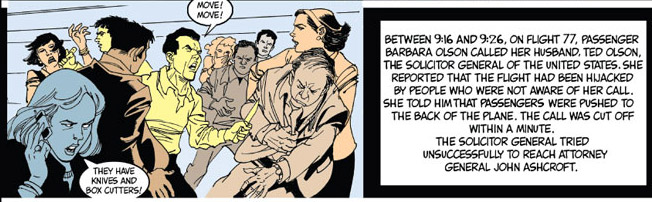
Slate is running an online version of “The 9/11 Report: A Graphic Adaptation.” Ever since I came across Art Spiegelman’s “Maus” — one of the best and most chilling Holocast narratives I’ve ever seen — I’ve been a big fan of the graphic novel format as a method for relating history (another, much quirkier example: “The Fatal Bullet,” a retelling of the James A. Garfield assassination). I don’t think such treatments are replacements for deeper reading, but they can make complex historical subjects more accessible to a wide audience.

In the case of the new 9/11 comic book, you won’t learn anything new if you paid attention to the original report and other accounts. But seeing the events in pictorial form has a way of bringing them freshly to mind. Whether a lot of people want to have that day put in front of them is another matter; I tend to think the day is worth contemplating and contemplating again. (The Washington Post, which I believe owns Slate, ran a story on the book last month. Among other things, the piece mentions that the authors’ previous credits include un-revolutionary stand-bys like “Richie Rich” and “Caspar” — you know, the friendly ghost).

Knivesboxcutters

Technorati Tags: ,

So Long, Evildoer; Hello, Fascist

The Associated Press is leading its story on Bush’s reaction to the newly reported terror plot with an emphasis on the president’s use of the phrase “Islamic fascists.” The Times’s website editors follow suit by headlining the story “Bush Focuses on ‘Islamic Fascists.’ ” The implication is that this is a new coinage to describe what in a simpler time we could shove into the general Evildoer file.

This might all be just academic, but the president and his people began using a close variant of this idea last fall, when Bush gave several speeches — including one at Elmendorf Air Force Base in Anchorage — where he described “Islamo-fascism:”

“… The tragic images of innocent victims can make it seem like these terrorist attacks are random and isolated acts of madness. While these killers choose their victims indiscriminately, their attacks flow from an ideology and a terrifying vision for the world. Their acts are evil, but they’re not insane. Some call this evil Islamic radicalism; others, militant jihadism; still others, Islamo-fascism. Whatever we choose to call this enemy, we must recognize that this ideology is very different from the tenets of the great religion of Islam. This form of radicalism exploits Islam to serve a violent, political vision: the establishment — by terrorism, subversion, and insurgency — of a totalitarian empire that denies all political and religious freedom. …”

The New York Times Magazine on Sunday carried a long essay on the Israeli-Hezbollah war by the French philosopher Bernard-Henri Levi. The piece not only offers unqualified support for Israel’s military strategy to date, it declares the conflict inevitable and part of a new global struggle against yes, fascism:

“When I arrived in Israel, it was the anniversary of the day the Spanish Civil War began. It was 70 years ago that the Spanish generals set off the war — civil, ideological and international — that the fascist governments of the time wanted. And I could not help thinking about this as I landed in Tel Aviv. Syria in the wings . . . Ahmadinejad’s Iran maneuvering . . . Hezbollah, which everyone knows is a little Iran, or a little tyrant, taking Lebanon and its people hostage. . . . And behind the scenes, a fascism with an Islamist face, a third fascism, which is to our generation what the other fascism, and then communist totalitarianism, were to our elders’.

Given the history of the past century, one dare not simply dismiss the suggestion we’re up against a new breed of fascism. But now that the suggestion is made, you have to wonder if this — Iraq, Lebanon, resort to blind military might employed with no plan about a future, no parallel attempt to understand or come to grips with the rage fueling support for our enemies — is the best we can do in response to such a threat.

Le Quiz sur le Dopage

This is where sports is headed: The World Anti-Doping Agency, a Big Brotherish creation of the International Olympic Committee set up in 1999 to ensure that athletes don’t use illegal steroids and the like. The agency’s motto: Play True. The unspoken part: Or Else.

Of course, the aim is noble. “Play true” is a wonderful sentiment, and one that every competitor and fan would embrace. The “or else” part is troublesome, though. You have to wonder whether it’s any more possible to create an absolutely clean, level playing field in sports than it is to keep drugs off the streets. How far do you go, how intrusive do you get, in pursuit of that goal? Do you throw out the notion of due process or the presumption of innocence — quaint notions, those — in the hunt for bad actors?

While you ponder that, test your anti-doping IQ at the WADA site. Sample question and answer:

True or False? If a Doping Control Officer comes to your home to conduct an out of competition test, it is okay for you to leave the room alone to make a cup of tea or run an errand.

False. It is important that you protect the integrity of your sample by staying in full view of the Doping Control Officer at all times until the test is complete. If you need to leave the room, tell the Doping Control Officer who will go with you.

Technorati Tags:

Denial, Act 2

Floyd Landis has, for the moment, a Tour de France title and two blood samples that tested positive for testosterone samples. He won’t get to keep the title if the test results stand, though; cycling officials are ready to strip him of the championship, and the Tour runner-up Oscar Pereiro is saying he wants a yellow-jersey presentation so that he feels like he’s really the Tour winner. So Landis is doing the only thing he can until his lawyers figure out who to sue: launching a media blitz to tell his story, which boils down to “I’m an honest, hard-working guy and I’m telling you I didn’t do anything wrong.” The truth is that there’s really nothing he can say that will get him off the hook. The best case, for everyone, would be the appearance of some incontrovertible evidence that he shot himself up with something, that someone tampered with his samples, or that the test was simply wrong and invalid. Landis could confess. Some lab technician could come forward and say, “I did it.” Or cycling officials could say the test is untrustworthy. Don’t hold your breath.

Instead, speculate about what might explain the positive test result that came back after Landis’s heroic win on Stage 17:

Landis needed a pick-me-up after getting thrashed in Stage 16 and knowingly took something he shouldn’t have. As I’ve said before, I doubt this because the consequences of being found out were so predictably devastating.

Landis was doping all along and just happened to get caught after Stage 17. Landis and his supporters make much of the fact he was tested eight times during the Tour and that just one of the results came back positive (in fact, the head of the International Cycling Union says only one of 300 tests administered during the Tour — Landis’s, after Stage 17 — came back positive). But what if he was taking something all through the Tour that went undetected, for whatever reason, until his incredible physical effort in the 17th stage? I suppose you could call this the BALCO scenario, after the Bay Area sports-nutrition lab that distributed performance-enhancing substances that anti-doping tests couldn’t detect. ESPN cycling correspondent Andrew Hood notes that Landis was seldom tested in past years, and also discusses known ways of defeating the current testing protocols.

Landis doped unknowingly. Maybe a well-meaning trainer gave him a little something extra in his daily dose of vitamins and supplements (not a credible possibility; the probability of detection, and the consequences from it, are just too high); or some enemy managed to slip him something (I shy away from most gunman-on-the-grassy-knoll theories, so I can’t swallow this one).

Alcohol or cortisone or something else threw off the test results. A real possibility, according to some serious sports-nutrition types, though probably very hard to prove.

Landis’s samples were deliberately contaminated. By whom? Why? It’s the gunman on the grassy knoll again. Tough sale.

Landis’ normal testosterone levels are naturally high, leading to a false positive result. If this is true, it ought to be a matter of producing the medical records that demonstrate it.

Take your pick, or come up with your own explanation. I’m still sticking with my instinct that a guy who’s been around the highest level of cycling for so long, who had apparently gotten to the elite level without doping, wouldn’t have done something as suicidal from a career perspective as drug himself with the whole world watching.

Technorati Tags: , , ,

Today’s Best Names

Typhoon Prapiroon. About to hit the island of Hainan, off China’s southwestern coast. Prapiroon is reported to be the Thai god of rain. When the storm hit the Philippines a couple days ago, it went by the name Henry.

David Tarwater. U.S. and University of Michigan swimmer and training partner of Michael Phelps. Tarwater? Sounds viscous.

Denial

First, is there a more unfortunate name in the entire world of sports than Dick Pound? He’s the head of the Orwellian-sounding World Anti-Doping Agency (known also by its goofier acronym, WADA). I only mention him because he’s always come across as a supercop-type zealot, and his comments on the current unpleasantness involving the formerly unbesmirched Tour de France champ Floyd Landis remind you of a narc who’s just caught a kid swigging Robitussin. Pound calls the Landis’s situation — it doesn’t really merit the label, yet, of "charges" or "accusations" — "a stunning indictment" of professional cycling. But the sport is in denial, he says:

“They have a huge problem, a
really serious problem, but first they have to recognize it. It’s like
an alcoholic. Unless you acknowledge you have a problem, it’s very hard
to move toward a solution.”

Huh. This is the sport that banned a whole team from the Tour a few years back because doping paraphernalia was found in a team car. It stopped two stars from riding in this year’s Tour because of allegations they were connected with a doping doctor. Many lesser but still prominent riders have been suspended from competition for years for violating doping rules. Now, the Tour winner’s team has outed its champion on the basis of a test result that looks like it’s open to interpretation. You wonder what sort of solution Pound thinks might be needed to correct this sort of denial. Capital punishment?

But back to Landis. Maybe it’s a mistake to apply plain, everyday, civilian logic, but the idea of anyone in his position deciding to shoot up (or whatever) at that stage in the race simply defies belief. The upside from doping would be uncertain at best. The downside would be clear: Disgrace and infamy — exactly what’s raining down on him now, denials and protests notwithstanding. Who would take that chance? Especially after having played by the rules up to that point?

Does it matter, really? Certainly not in the way that it matters when a nation’s leaders decide to gamble with the lives of others.  But even in the sports context, does it matter whether these guys are taking drugs or not? A friend and fellow cyclist in Berkeley, Steve, points to a pretty good essay by a former marathoner, triathlete and sports-doping enforcer who says maybe the most beneficial thing for athletes is to do away with all the drug rules and let the chips fall where they may. He argues that fair enforcement is impossible and that sports at the elite level require such extreme levels of physical punishment that they’re intrinsically unhealthy and that some banned substances could help competitors limit the damage. I’m not buying that — the example he uses aren’t convincing to me — but he challenges the gospel assumption that all sports doping is bad and that all attempts to stop it are good.

We’ll see about Floyd. If I were the betting sort, I’d put my money on him being exonerated. There will be a reasonable explanation for an anomalous test result. But the folks who say the damage is done are right. A few days ago, his story was about a heroic comeback. Now it’s about a desperate attempt to convince the world the heroism wasn’t fake. There’s no way you can make people put that aside and embrace the old story line. More’s the pity.

WWGWBD?

“Remember, this started, this crisis started when Hezbollah captured two Israeli soldiers. They were unprovoked — Hezbollah were unprovoked, and they then took hostages. Imagine how the United States would react if somebody provoked us with that kind of action. And secondly, started firing rockets. And it’s this provocation of Hezbollah that has created this crisis, and that’s the root cause of the problem.”

That was our president yesterday, with his pithy and morally certain summary of how Lebanon blew up. His third sentence got me: “Imagine how the United States would react if somebody provoked us with that kind of action.” The kind of action he’s talking about is the Hezbollah attack during which seven Israeli soldiers were killed and two taken captive.

We all know about Israel’s response: In a different time — maybe before Iraq, maybe before 9/11 — it’s hard to imagine that Israel’s orgy of destruction and killing would have been anything but shocking. Now the president is telling us not only that unrestrained violence is the way of the world, he is, in effect, endorsing it.

I’m not cayrring any water for Hezbollah or others who appear so willing to murder for their causes. The point is we’re supposed to represent the alternative.

Two Bucks

For tonight, at least, I declare the notion of currency is overrated. John, my brother, points out a good Nicholas von Hoffman piece in The Nation on the new United States “embassy” in Baghdad. Another development in plain sight but somehow virtually invisible from these shores:

“Among the many secrets the American government cannot keep, one of its biggest (104 acres) and most expensive ($592 million) is the American Embassy being built in Baghdad. Surrounded by fifteen-foot-thick walls, almost as large as the Vatican on a scale comparable to the Mall of America, to which it seems to have a certain spiritual affinity, this is no simple object to hide.

“So you think the Bush Administration is planning on leaving Iraq? Read on. …”

Yes, read on: Here. By the way, that $592 million price tag — which I’m sure we’ll be able to multiply by two or three or four by the time all is said and done — is two bucks a head for each and every American.

Technorati Tags:

July Fourth (II)

A New York Times tradition: Publishing an image of the original printed version of Declaration of Independence, complete with John Hancock and others’ signatures. Always inspiring to read when you need to have your civic idealism refreshed, though yesterday I didn’t read the declaration but found myself thinking about the non-PCness of one phrase: “merciless Indian savages” (from this passage: The king “has excited domestic insurrections amongst us, and has endeavoured to bring on the inhabitants of our frontiers, the merciless Indian Savages, whose known rule of warfare, is an undistinguished destruction of all ages, sexes and conditions”).

Later, or earlier — I can’t remember which — Kate pointed out the San Francisco Chronicle’s lead editorial for the day: “Patriots, awaken.” I don’t expect much these days from the mostly tired and uninspired Chron, but its little Fourth of July essay was very good. In part:

“…Perhaps it is the lingering shock effects of Sept. 11, 2001, or maybe it is the complacency of a half-century of growing affluence, but too many Americans seem all too willing to ignore Benjamin Franklin’s admonition about the danger of sacrificing essential liberties for temporary security. The Bush administration has been adroit at invoking the war on terrorism to justify policies that should be setting off alarms in this democracy.

“At what point will Americans draw the line at these intrusions on civil liberties and usurpations of power by the White House? Revelations that the National Security Agency eavesdropped on phone calls and e-mails without getting the required warrants didn’t do it. The disclosure that the government has compiled a vast database of Americans’ phone records didn’t do it. The hundreds of examples of President Bush’s unprecedented expansion of the number and scope of “signing statements” in which he gave himself the option to ignore parts of laws he objected to — such as torture — didn’t do it.

“Just last week, the U.S. Supreme Court struck down the Bush administration’s system for military tribunals at Guantanamo Bay that openly defied congressional law and international rules on the treatment of prisoners of war. So, what was the reaction in Congress? Regrettably, but not surprisingly in this era, there were immediate moves to give the president such authorization. ”