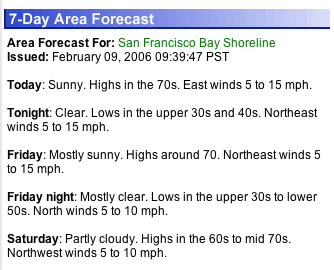
Never feel sorry for San Francisco Bay Area types who start whining about their wintry wet weather. Here’s why:
"You want it to be one way. But it's the other way."
Never feel sorry for San Francisco Bay Area types who start whining about their wintry wet weather. Here’s why:
The Chronicle is out today with a story about The Wrong Picture: The man whose mug was identified as that of San Francisco Police Department serial batterer John Haggett is actually a cab driver and part-time security guard named Jack Neeley. The Chron, proactive as ever, covered a press conference that Neeley’s lawyer called yesterday. Neeley said he’s both perplexed and disturbed at his sudden notoriety. He doesn’t recall the paper taking his picture (the photo credit names a staff photographer and says the image was taken in 2004). He says one friend approached him after the picture ran to ask why Neeley never disclosed that he was an undercover police officer. And, since his image has been identified with a man who has beaten up the locals and subjected them to all the favorite racial and ethnic slurs, Neeley is afraid he’ll wind up the target of some aggrieved citizen.
The Chron dutifully reports all that and mentions a couple times what a swell job it’s doing responding to Neeley’s concerns. But the paper offers no explanation for how the mistake happened. I’m sure there’s a debate going on there right now about what to do. The paper has a “readers’ representative” and he’s probably getting an earful from his audience.
The San Francisco Chronicle went to press Sunday with a big front-page series detailing the results of its years-long investigation into use of excessive force by some city police officers (the paper’s online site, SFGate.com, has created a special site for the stories). The paper says it took years to secure thousands of documents using the state’s Public Records Act . “The newspaper used these documents to do something the Police Department has never done,” the Chronicle says. “It created a computerized database capable of providing a profile of the use-of-force patterns of individual officers.” The paper reports it conducted hundreds of interviews with cops, city officials, abuse victims, and experts in police practices.
The findings are devastating: The Chron says San Francisco officers rack up more excessive-force complaints than those in Oakland, San Jose, San Diego, and Seattle combined. The Chron stories detail example after harrowing example of officers brutalizing citizens innocuously going about their day-to-day business. The articles suggest that in most cases, attempts to rein in the habitual batterers on the force are ineffectual at best and that some of the worst offenders have gotten promotions and assigned to train rookies.
The stories (today is day three of the series) look like they add up to an excellent piece of public-service journalism. There’s a Pulitzer Prize for that. But the Chron didn’t stop there.
In Sunday’s launch of the series, the paper published a 4,100-word profile of one of the department’s bad actors, a Sergeant John Haggett. Google him, and you’ll find that he’s got the special, if not unique, distinction of having been cited for brutality in a 1998 Human Rights Watch report that relies heavily on reporting by the local papers. The profile recounts Haggett’s history of unprovoked violence against suspects going back to the late 1980s, including shooting and killing an unarmed man after a chase through downtown traffic and two beatings that led to separate three-month suspensions.
Sergeant Haggett sounds like a lovely man, and two of the three reporters with bylines on the Sunday piece should know: Bill Wallace and Susan Sward wrote a 1,500-word piece on him in October 1996. That story is one of the sources for the Human Rights Watch report. Several of the incidents they recounted then were repeated nearly verbatim Sunday, supplemented by several more episodes of Haggett’s ugly behavior and the fair-and-balanced mention of facts that might temper the impression he’s a monster: He won a departmental award for valor in the line of duty and once released a teen hold-up suspect so he could attend his high school graduation.
Given the Chron’s history with Haggett and the seriousness of the charges it’s printing, then, it’s just short of incredible that the picture the paper ran to introduce this villain to the world — small on page one, splashed across six columns on an inside page — wasn’t of Haggett at all. It’s just an anonymous puffy guy in a jacket with a big collar; according to some, such as the head of the police union, the anonymous puffy guy bears little resemblance to Haggett.
The Chronicle’s response? Yes, we were wrong. The paper on Tuesday mentioned the mistake in its story on the chief’s reaction and runs a weak “we regret the error” correction. But it doesn’t explain how the picture of the unknown man wound up so prominently displayed on its pages.
Meantime, the paper is trying to fend off San Francisco’s mayor, Gavin Newsom, who is upset that the Chronicle reported he did not make himself available for interviews on the excessive-force issue. The paper’s response is that a reporter emailed nine interview requests over three weeks and that Newsom’s spokesman, while saying the mayor would be available, never nailed down a time for the talk to happen. The paper suggests without coming out and saying so that its efforts to get an interview were reasonable enough and that it did what any reasonable party might do in such a situation and published without the mayor’s comments.
What I’d suggest the Chron isn’t getting is that despite the years of reporting it says it has done, the sloppiness of its presentation has cost it the presumption of credibility. The police chief understands that and is trying to use the picture mistake to discredit the rest of the paper’s reporting.
All this is happening in a sort of crisis context for daily newspapers. They are less trusted than they have been — perhaps ever been — and a manifestly imperfect but still potent alternate news channel has appeared online, just waiting to pick apart mistakes like this. It’s no longer enough for the Chronicle and other papers to hunker down, issue an ephemeral acknowledgment of error and an empty statement of regret — like that’s a public service — and move on as if nothing happened.
Critical readers want and deserve to know how the papers’ internal processes work and why mistakes like the non-Haggett picture are made. In this case, the Chron needs to show that its error was exceptional and that its efforts to get high-level official comment were reasonable. That means a full explanation of the chain of events that led to the wrong picture being run, complete with an account of the key people who signed off on it and what they have to say about the process. The disagreement over the mayor’s interview might be clarified by publishing the whole email exchange between the paper and the mayor’s office so that readers can see who asked and who promised what. (For extra credit, the paper could make a version of its excessive-force database available online — it is based on public information, after all — so that readers could have a chance to explore the issue more deeply.)
At the end of having to explain itself, the paper might even learn something about itself that will save it from the same mistakes next time.
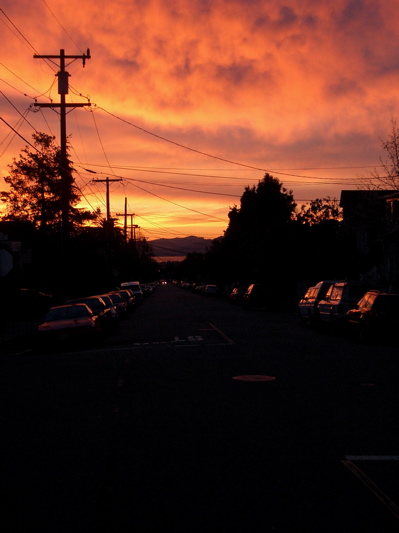
Looking west on Francisco Street, the bay, the Marin Headlands, the sky beyond. Courtesy of me.
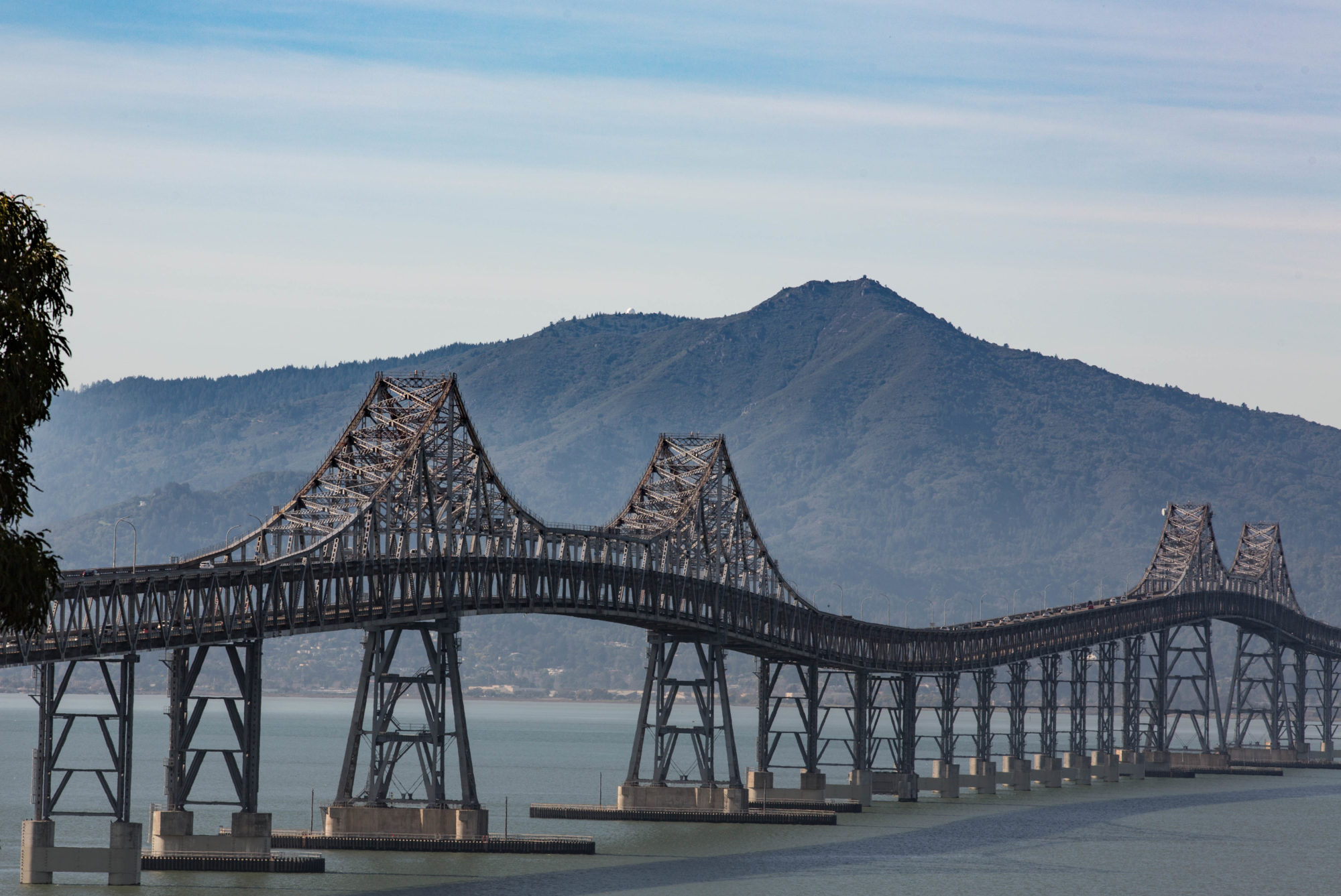
Someone had the idea to ride from here to Berkeley, go up and cross the newish bridge across the Carquinez Straits (about 27 winding road miles north of here), then make a big loop over to the Sacramento River to the easternmost Bay Area bridge, in Antioch. Then we’d catch a BART train and come home. The mileage for the total ride was advertised as 110 miles — definitely an all-day excursion.
Weather: Cool, clear, and breezy. It’s the area along the waterways that flow from the Central Valley out to San Francisco Bay is always windy. Usually it’s a westerly wind that starts to pick up at midday and howls in from the ocean to the inlands valleys. Today, the wind that made the air so clear the we could see the Sierra rising up more than 100 miles to the east was coming from the northeast — in our faces most of the day. The route turned out to be a bit longer than advertised — more like 120 miles. While the Super Bowl was happening, we were pushing our way down the highway next to the Sacramento, crossing the big bridge over the San Joaquin, and enjoying the post-industrial beauty of Pittsburg, without the h, that was named after the other one when U.S. Steel built a plant there many years ago.
Home in one piece. A little windburned. More than a little road-weary. I got to see the fourth quarter.
‘Night.
It occurred to me a month ago that it’s been 10 years since I left The Examiner — “The Examiner” being The Monarch of the Dailies, The San Francisco Examiner, William Randolph Hearst’s first newspaper.
Leaving the paper was much more than leaving a job: I was headed to an online startup — talk about a step into the unknown — from a world I had nearly always loved and almost never stopped complaining about. I was so excited about getting a chance to work at The Ex — I started as the midnight wire editor, a job no one there really wanted — that I remember honking and waving at one of the Ex delivery trucks on University Avenue in Berkeley the day after the news editor broke down and decided to give me a tryout. I liked The Ex going in, but my real passon was for news itself: being close to the flow of information and creating something from it that might help readers understand the world a little bit better.
I was there for 12 years. Since I walked out of the newsroom, just after midnight on January 2, 1996, I’ve been on the payroll of more than half a dozen other places. My longest run was three years and change in the newsroom at TechTV (a good job with a great group of people; the channel was killed by a bad new owner). I have spent all or part of several years free-lancing doing all kinds of different writing from investigative journalism to marketing hackery to academic grant-writing. I’ve made editors happy; I’ve made them unhappy — usually with my seeming disregard for deadlines; and they’ve done the same for me. I’ve found myself, several times, in the startup world. In short, they were 10 years I didn’t see coming. The only things I’d change about them would be to learn more from the mistakes I’ve made, to not spend so much time worrying about what’s going to happen next, and to make my deadlines.
But I’m really writing to look forward, not back. Since the first week in January, I’ve been back in the start-up world. I’m working with Ted Shelton, someone I crossed paths with at my very first startup, on a news project called The Personal Bee (www.personalbee.com; and yes, I have a new blog that goes along with the project, too). It’s an exploration of using RSS feeds — a method of syndicating the content on frequently updated sites like blogs and those maintained by newspapers — to create a new way of editing, packaging and reading the news. Ted’s strong preference is to call the current very early implementation of the service “an experiment” instead of “a beta.”
Will the experiment be the next big thing? Well, there’s lots of competition out there in what’s commonly called the Web 2.0 space. Obviously, I hope the project succeeds, that investors reap a big reward for taking a risk on a new idea, and that a decade from now people might know what the heck I’m talking about if I mention its name (unlike the site I went to work on 10 years ago, which is nothing more now than a bunch of good yarns to swap, unpleasant memories of repeated layoffs, and an empty URL).
In a personal sense, though, the Bee’s success would be just icing on the cake. I feel lucky to have a chance to work on something that allows me to put some of my old and new news knowledge to work — I’ll write more about that on the other blog. And for bonus points, I get to work with a friend I respect very highly and do it close to home (my commute is a 17-minute walk to downtown Berkeley).
By way of MK, who apparently is having some concern for the immortal soul of a West Coast friend: It’s the Seven Deadly Sins Quiz. Oh, and looky here—the quiz says I sin in moderation except when it comes to Wrath. There must be something to it.
| Greed: | Medium |
|
| Gluttony: | Medium |
|
| Wrath: | High |
|
| Sloth: | Medium |
|
| Envy: | Very Low |
|
| Lust: | Medium |
|
| Pride: | Medium |
|
By way of Pam:
The Californian’s Conception of the Continental United States:
“Despite my public complaints, California is a wonderful place. Its topography is among the most varied in the country, the weather in most of California is by most folks’ standards absolutely perfect, and it’s the birthplace of many global cultural and economic trends, a fact which may not make the state wonderful but does certainly make it both dynamic and important. So, despite my protestations about living here, I wholeheartedly admit that as places on the planet go, California ain’t so bad.
“The people though, fall victim to a kind of provincial snobbery unsurpassed by pretty much everyone except the French. When I tell people in California I’m from Chicago, they look at me with pity. When I tell my Californian students to travel around the U.S. after they graduate, they look at me as if I’m insane. I once was complaining about how poorly many Californians drive in the snow and my soon-to-be father-in-law responded “why on earth would anyone want to live in a place where you have to learn to drive in the snow”. This from a man who spent most of his life on the volcanic, lava-spewing island of Hawaii and from a man who currently lives only a few dozen miles from the San Andreas fault. All this to say that most people who call California home—red blooded Californians, or perhaps more precisely, almond-soy-triple-foam chai latte Californians—suffer from a more localized version of geographic ignorance than most Americans.”
Complete with map.
Technorati Tags: california election
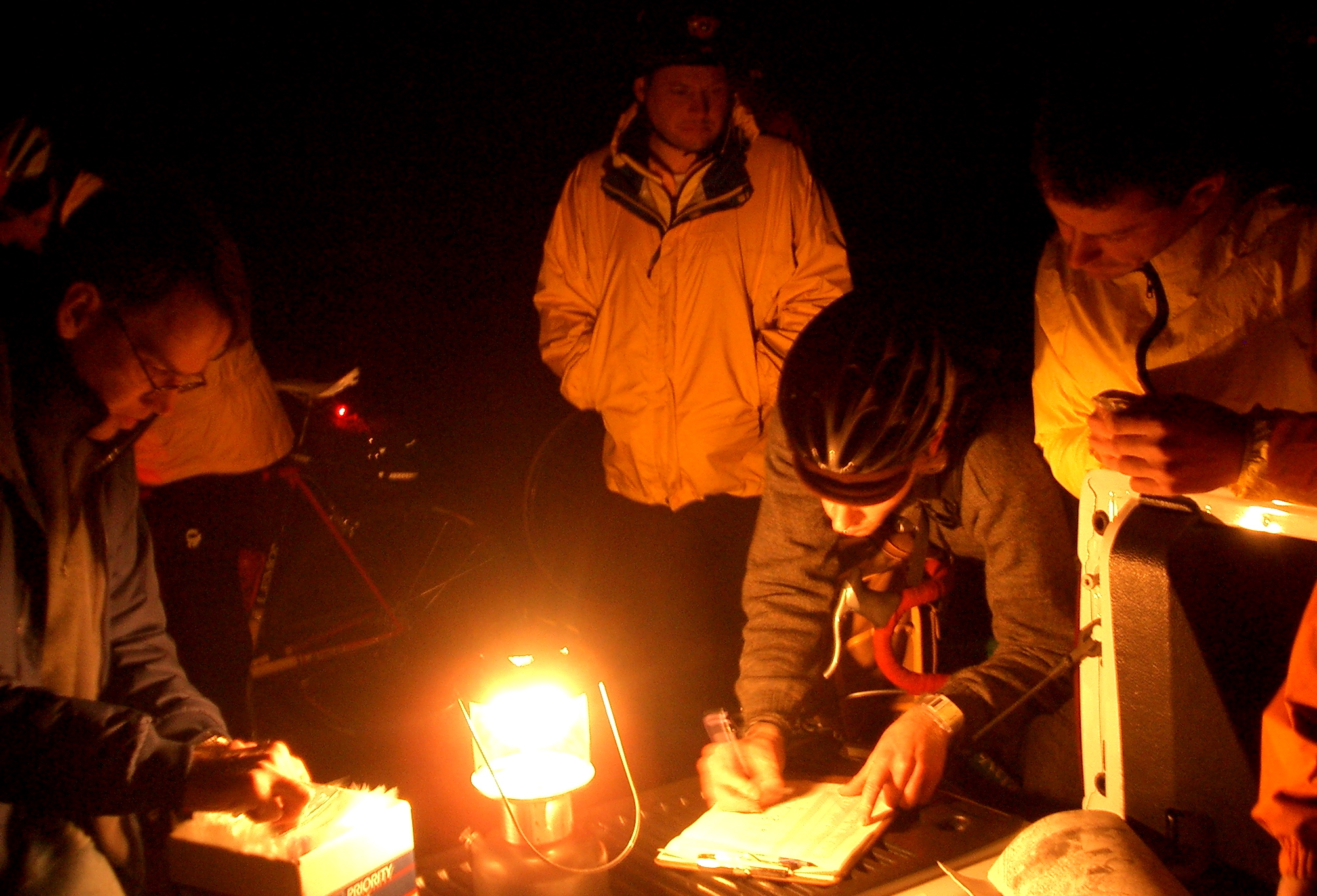
Three pictures from the ride yesterday.
The first is at the ride sign-in, about 6:30 a.m. Todd Teachout, the guy on the left, organized the ride for the San Francisco Randonneurs; in formal randonneuring parlance, he’s the Regional Brevet Administrator. He registers the riders, makes up their brevet cards and hands them out at the start and collects them at the end of the day, and more: He needs to make up maps and route sheets and ensure the course is the required distance, that the road is actually rideable (flooding and slides during the pre-New Year’s storms affected parts of the route) and that the control points — the places riders need to check in along the way — are in order. Todd’s habit at the start of the ride is to park his pickup in the free, dirt parking lot west of the bridge toll plaza, fold down the tailgate and use it as a desk.
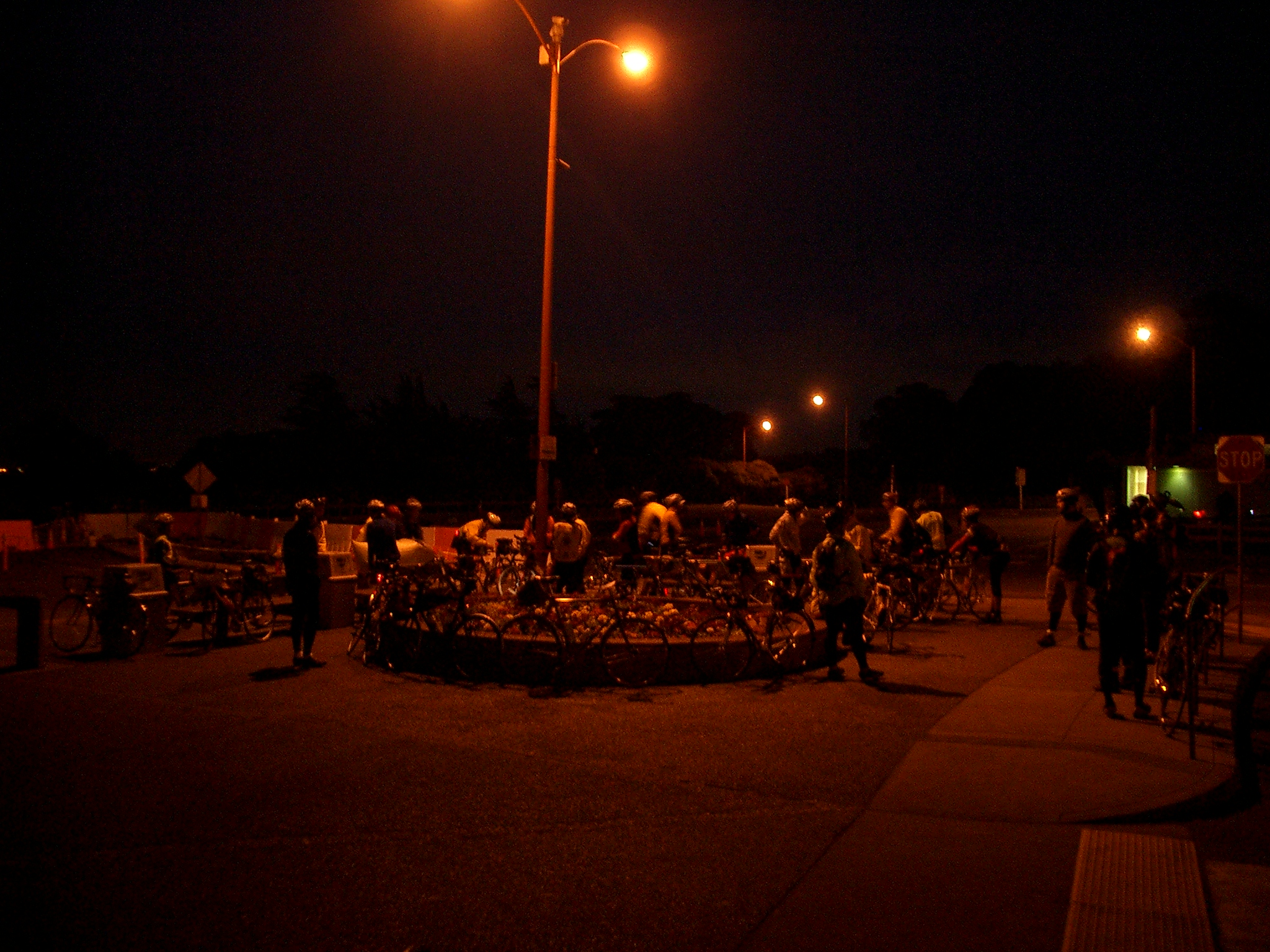
The middle shot is at the start, about 6:50 a.m., 10 minutes before the ride began. If you haven’t been to the Golden Gate Bridge, there’s a little plaza at the south end of the span and on the east side of U.S. 101. Among other objects of attention, there’s a gift shop and a statue of Joseph Strauss, putative genius behind the bridge. It’s a popular spot for cyclists to meet up early on weekend mornings. The little circular flower bed is the focal point for the pre-ride brevet gatherings: lots of milling around and greeting riding buddies and saying hi to folks you know from past brevets. As one of the guys I rode with in 2003 said, “What a bunch of recidivists.”
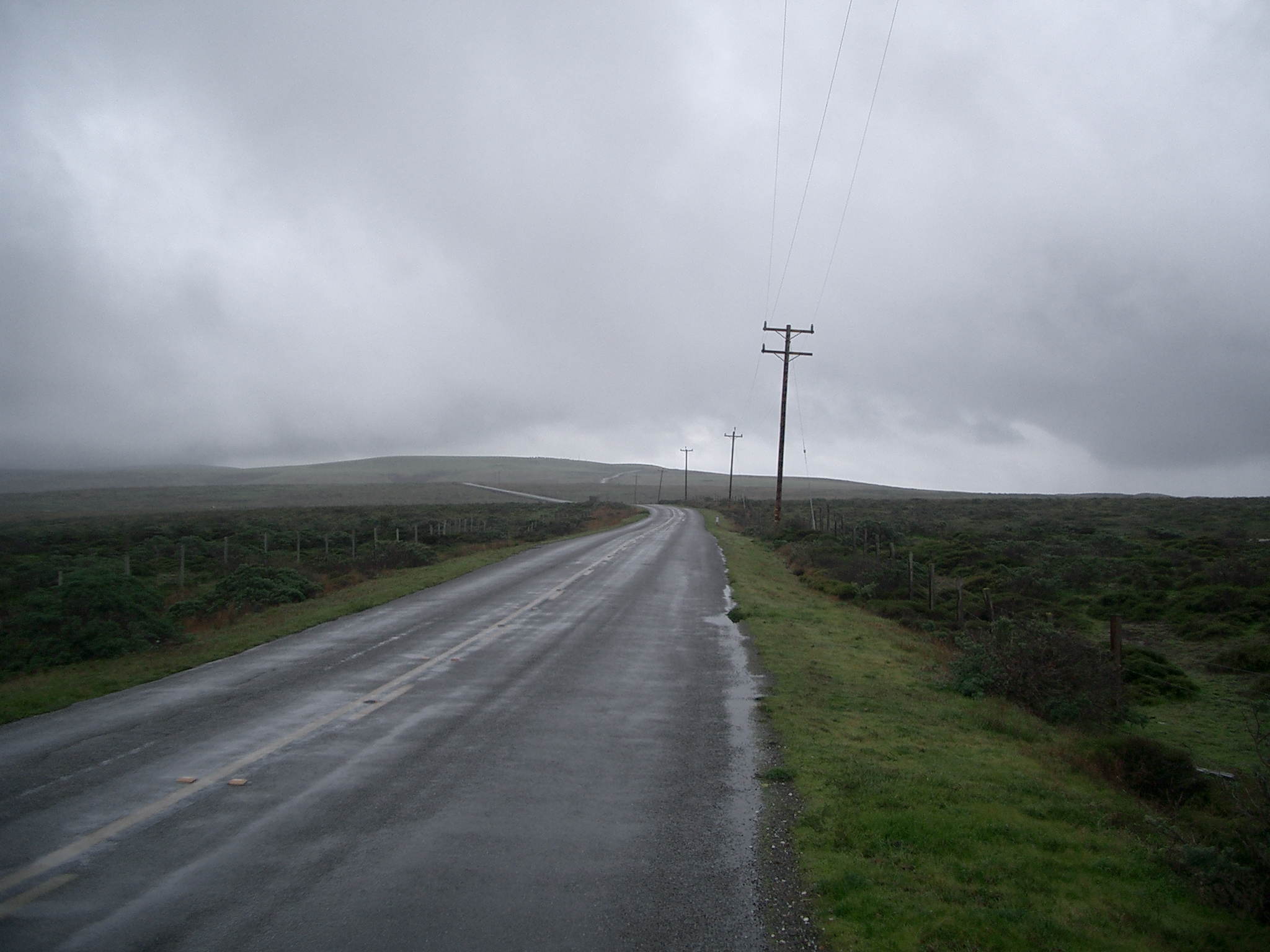
I stopped a couple times to take pictures along Sir Francis Drake Boulevard, a long road that begins just outside San Quentin — yes, that San Quentin — and runs west all the way to the end of Point Reyes, about 42 road miles west. The storm was coming in squally showers, with short breaks between gusty bursts of rain. I took the third shot during one of the breaks. Didn’t take any more shots after this; it was too wet, for one thing, and after a certain point I didn’t feel much like stopping.
Two hundred kilometers in the rain. It was even wetter than it sounds. Windy, too: Coming back across the Golden Gate Bridge just before dark, the towers were funneling wind downward; the turbulence was strong enough to nearly knock me down when I rode the little semicircle around the tower bases. The rain at that point was cold and driven nearly horizontally in off the ocean; it stung like sleet.
More later. I’d do it again. Just don’t ask me to saddle up tomorrow.