This American Gripe

One thing I’ve made myself get used to is that there’s nothing I can do about the way my fellow humans drive. For years and years and years, I’ve gotten steamed about people blowing through stop signs or speeding up and down residential streets and generally acting like idiots behind the wheel. (No doubt I’ve given people to get steamed, too).

I had a moment of enlightenment last fall when I was walking the dog and a car came screaming up the street behind us and went through a stop sign. For some reason, it hit me that it was just a coincidence I happened to be there to see it happen, and it would have happened whether I had witnessed it or not. And if I hadn’t been there–if I had been at a movie or sitting at home reading a book–the guy would have raced through the stop sign and I would have been none the wiser. I would not have gotten upset or started thinking about what an idiot the guy way or gone through any of the usual mental and emotional gymnastics. What the guy did had nothing to do with me, and getting exercised is a waste of energy and attention.

That insight, if that’s what it was, has helped me to stay unengaged on the street. I’m less upset more of the time, and that’s a good thing.

Since last fall, three people have been run down and killed in North Berkeley crosswalks. Two of the deaths occurred at the same corner, the third a block away. It’s not clear to me that anyone was ever charged in the incidents. Unless a driver is drunk or drug-addled or exhibiting some recklessly outrageous behavior, killing someone with your car seems to be regarded as just one of those things that happens.

We live on a street that has two relatively busy thoroughfares at either end. Both of those bigger streets have stop signs close to our street. And over the 20 years we’ve lived here, we’ve become used to the fact that most of the drivers who do slow to what passes for a stop here in Berkeley do so only grudgingly. The implicit impatience–for instance, the cars that continue rolling through the intersection as you cross, the cars that avoid stopping at all so as to get through the intersection before you can step off the curb–is obvious and constant. And I’m not one to stroll ostentatiously across the street, either–since I’m a driver in my other life, I know driver-kind is anxious to get a move on.

So right there is one time that my little mental trick–hey, that guy swerving across the double-yellow line and ignoring the oncoming traffic: as far as I’m concerned, he’s not really there–doesn’t work so well. When you’re actually in the crosswalk and have to interact, however indirectly, with the driver who is worried about not making the next traffic light a block away, that driver really is there.

Late this afternoon: It was a beautiful day here in Berkeley. We were crossing the street over to the school where we sometimes let the dog run. A couple weeks ago, an acquaintance was crossing at this same corner–there’s a stop sign and a crosswalk, all installed to make it safer to get to the school. A driver rolled through the stop sign and hit her dog, who somehow was not seriously injured.

So there we were. We started to cross. There was a car to our left. The driver didn’t stop; instead, he steered around us as he continued on. There was a car to our right. That driver didn’t stop, either. He continued to roll.

I won’t go into detail about what objects or epithets may have flown through the air during this intersection encounter. It’s not an episode that reflects well on me. I can repeat that one of the drivers explained, somewhere amid a bouquet of f-words, that “I didn’t come anywhere close to you” as he rolled through the stop sign into the crosswalk. In other words: Buddy, you’re not under my car. What are you complaining about?

Eventually, I calmed down and though about all this. It’s true there’s nothing I can do to change driver behavior, and nothing is less effective than getting angry with them. Still, what gets to me is what I think I see in these incidents: the basic lack of awareness or care when drivers get behind the wheel that other people are out there in the world and that yes, it’s necessary to grant them a shred of attention every once in a while. What a way to live.

Technorati Tags:

Today’s Best Expression

“As mad as a hatter.” That’s a tried and true formulation, though maybe a little archaic. One of Kate’s colleague’s has supercharged it and and updated it a little. In reference to someone who might be a little off-center, she’s fond of saying, “He’s as crazy as a f—ing mad hatter.”

So there, Charles Dodgson.

Hey, Where’d Everybody Go?

I would be embarrassed to admit the attention I pay to how many people land on this site. For the last three years or so, the number has been in the low hundreds every day; it has spiked briefly several tiimes, but I don’t think it has once hit 1,000. I’ve also found that in the past couple of years, more and more people arrive on the sprawling Infospigot web property not to partake of the brilliant bons mot but in search of pictures of Mount Shasta or the Haymarket memorials in Chicago. That’s fine–glad to be of service.

But in the last ten days, something odd has happened. That steady volume of visitors has shrunk suddenly and rather sharply, to just a few dozen a day. I can’t think of any reason this might have happened so quickly. Maybe Google has weeded out a lot of the redundant references to the site. Maybe something else has happened. Hope it wasn’t something I said.

This American Gripe

The world is, per custom, full of more serious issues and worthier subjects in my life and others, but sometimes you just have to put all that aside and complain. Listening to one of my several daily fulminations on diverse subjects, Kate said, “You should have your own show–‘This American Gripe.’ ” I like the idea well enough, but so far it hasn’t gone further than that (although I will note that as of this writing the exact phrase “this American gripe” appears exactly once in Google’s database and that thisamericangripe.com is still available).

So, This American Gripe. Here’s one:

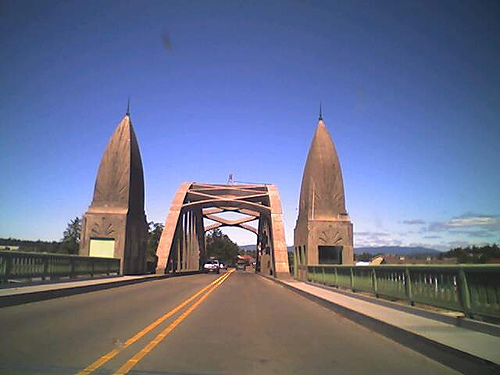
I mentioned recently that I got a call from someone in Oregon who wanted to use a picture that I took last year. Kate and I, with dog in tow, drove up to Eugene over Memorial Day weekend, picked up Thom and drove over to Florence, on the coast. A beautiful arched lift bridge carries U.S. 101 over the Siuslaw River there, and I took some pictures of it.

OK, then. I got a phone call about 10 days ago from a woman named Nancy who works for the Harley-Davidson dealership in Coos Bay, well down the coast from Florence. The town has a rhododendron festival, and the Harley place is making up a special T-shirt for the occasion. Nancy said they liked one of the pictured I took and wanted to use it as part of the T-shirt design. I was flattered. Naturally, I said they were welcome to do so; I just asked for a couple of the T-shirts in return for sending them the highest resolution version of the picture I had.

Since I had taken several bridge pictures that I put online, I asked Nancy to describe the one she wanted: It was an image that was obviously taken in the middle of the roadway with one of the bridge arches in the foreground and a car visible far down the road. From the group of shots I had taken, only one fit that description and I emailed the original to Nancy. I remarked that it looked a little darker than the online version of the shot; she agreed and asked whether I had a brighter version; I adjusted the brightness and contrast and color qualities of the picture and sent two more versions for Nancy to compare.

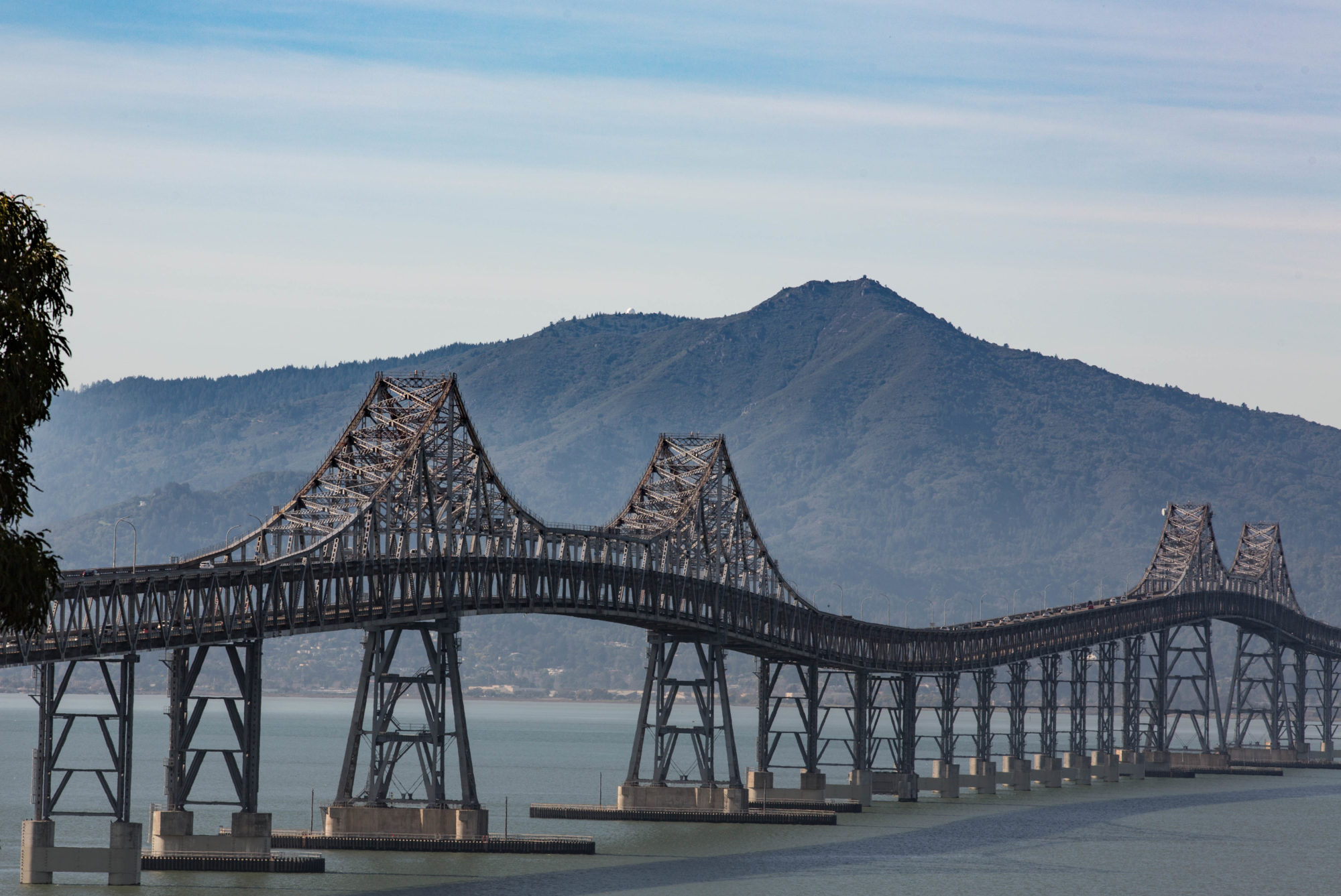
Then she said that the shot I sent her seemed to have been cropped–that the one she was looking at appeared to have been taken a little farther out from the bridge structure than the version I’d sent. I checked to see whether I had cropped the original. Nope. But at this point I suspected that we were not talking about the same picture at all and asked her to send me a copy. She did, and here it is (left–hers) side by side with the original (right–mine).

224198743 3B7Af6F800521918976 14Ec494Ecf O

Well, they are pictures of the same bridge. But if you asked for a copy of the one on the right, and someone sent you the other one, would you think for even a moment that they were the same picture? No, you wouldn’t. For her part, Nancy seemed reluctant to believe that the picture she had wasn’t my work, even after I told her it wasn’t.

Next time, I suppose the smart thing to do would be to ask for a copy of the picture in question before I start trying to hunt for something I don’t have.

Technorati Tags:

Rewrite: An Editing Tale

It’s like this: a trusted reader went over that bike piece and pointed out a few things about it. I was reluctant to acknowledge the reader’s points, but eventually saw their merit. The new version of the piece has a lot in common with the first, but has jettisoned a lot of what I’ll call random rhapsodizing. I liked the rhapsodizing. I just found it didn’t work the way I thought it did. The rewrite: It’s after the jump.

Technorati Tags: , , ,

Continue reading “Rewrite: An Editing Tale”

Pictobrowser: A Test

This is a post testing a Flickr app called Pictobrowser. It’s supposed to create a nifty little in-blog gallery. For the occasion, I’ve chosen my most recent Flickr set, which recorded the Code Pink-Marines foofaraw in downtown Berkeley a couple months back. Here goes:

Mark of Distinction

I got a phone call Tuesday from someone in Oregon who wants to use a picture I took last year. I’ll post more details if it happens, but I was tickled that anyone asked. It’s a nice compliment, is what it boils down to.

Actually, that picture call was the second call of the day I got from Oregon. The first was from my friend Pete, an old compatriot from newspapering and online news who, through his love of wine and winemaking, wound up working in that industry. He now is a rather senior-level marketing guy for a Chicagoland-based company called Terlato. Knowing that I’ve developed a fanatical international following–well, someone from Myanmar once came to this site after googling “blog” and “sex”–Pete had a favor to ask: Would I be willing to link to an announcement that one of Terlato’s wineries was making?

OK, so here’s the announcement, and it’s actually a pretty interesting possibility for anyone involved in a school or community or church group: Markham Vineyards, up in the Napa Valley, is offering two $25,000 grants to fund “tangible” projects that make a “visible, positive impact” on communities: a makeover for a section of inner-city schoolyard, for instance, or a community garden. Proposals will be accepted through June 14, and they need to be accompanied by a brief budget that shows how the cash would be put to work. Details for the Markham Mark of Distinction Community Grant Program, are available at http://www.markhammarkofdistinction.com.

Technorati Tags:

Memorial

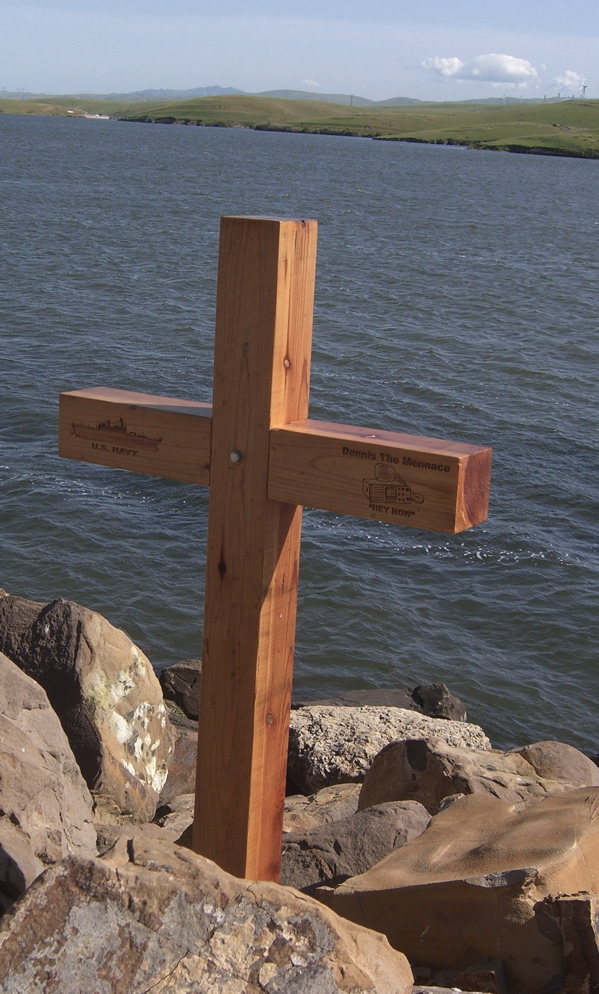
Bethanycross040508

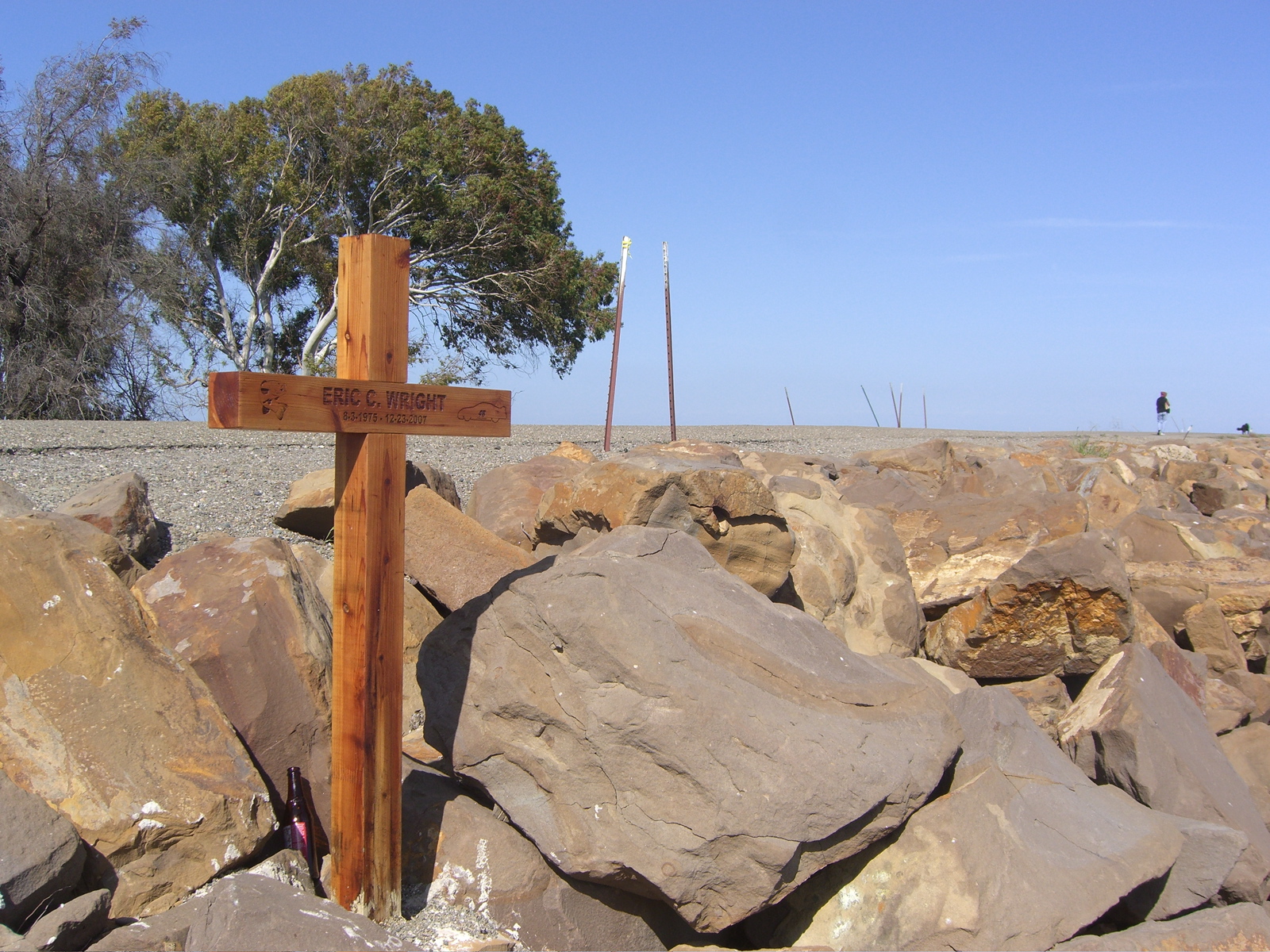
On Saturday, Kate and The Dog and I went out on a little exploration of the area just south of the Sacramento-San Joaquin Delta. The goal was to try to see some of the pumping facilities that the state and federal water projects use to, in essence, reroute the bulk of the Sacramento River into the San Joaquin Valley and beyond. We wound up at Bethany Reservoir, which in a sense is the headwaters of the California Aqueduct, which carries water all the way to Los Angeles. While we were walking on the reservoir’s northern rim, we found a brand new cross. On the side facing away from the lake, it bore some images with the legends “U.S. Navy” and “Dennis the Menace.” On the side facing the water, it bore the name Eric C. Wright; there was a birth date from 1975 and a death date, too, from two days before last Christmas. The story is here and here.

Bethanycross040508A

Undergraduate Notes

In my return to college, one thing I’ve wondered is whether the undergraduate population is as out of it, history and civics-wise, as the periodic headline-grabbing “our kids can’t find Washington, D.C., on a map” studies suggest. Honestly, I haven’t talked enough with my classmates to come to any opinion. As I’ve noted before, the only thing that has really caught my attention is the distractions people readily indulge in class, especially the online kind. In class last week, I was sitting behind a guy who was reading a graphic novel on his laptop while sporadically taking notes on the lecture. Across the aisle, a woman worked on her email most of the hour. No, it wasn’t a great lecture.

Actually, I’ve been noticing something else, too. I’m taking just two classes, so what I see is hardly a basis for sweeping conclusions. But, after 10 weeks I’m pretty sure about this one: most students don’t want to speak in class, period. In both my classes, I have instructors who are given to asking questions of the assembled multitude, then glancing around the room expectantly. Sometimes the questions are obvious, sometimes they’re obscure. It makes no difference: most of the times, these expectant queries meet with silence. No: an uncomfortable silence. Maybe that’s just me: I want to talk, and I love to answer questions (to the point of being a pain in the ass about it, I sometimes think). But in one class of about 150 people, the same three or four or five people seem to do about 75 percent of the student talking; in a discussion section for the same class, it’s the same three out of 15 who speak the most week in and week out. In my Irish history class, the professor designated one full class session to questions about an upcoming paper; when he threw the floor open at the beginning of the hour, the 30 people in the room just stared at him. He said he’d just as soon return to his lecture notes if that’s how we were going to be. A couple of kids finally cracked and said something. (In this case, the professor showed that his idea of a question-and-answer session was a 15- or 20-minute answer to a single question. That left room for about three questions for our 50 minutes together.)

I had to make an appearance in the history department office last week; the advisor, who got her B.A. in her late 30s or early 40s, I think, is pretty talkative. She asked me how things were going. I told her that things are swell–only a minor exaggeration—but that I was puzzled by the reluctance of so many people to participate in class discussions. “They don’t want to look stupid,” she said, and added that she had observed the same thing when she was in class a few years back. It makes sense to me. There are few things worse than looking dumb and uncool in front of your peers. I hate it. Still: to get to Berkeley, you have to be one of those students who does very, very well in high school. Thinking back to high school, many though by no means all of the brightest kids were pretty personable and willing to speak up. I don’t know whether something has happened since then–the competitive grind to get the grades, test scores and extracurricular laurels you need to get to the right school, perhaps–but I feel like something has changed.

And in conclusion: Earlier today I came across a column that touches on this subject (maybe tangentially) by a college journalism professor at Case Western Reserve. My impression is that you have to be pretty sharp to get in there. Anyway, the teacher, Ted Gup, a former investigative reporter, has some harsh things to say about the kids who show up in his class. He starts with an anecdote: how none of the students in his seminar on government secrecy knew what rendition (the CIA kind) means. He continued:

“That instance was no aberration. In recent years I have administered a dumbed-down quiz on current events and history early in each semester to get a sense of what my students know and don’t know. Initially I worried that its simplicity would insult them, but my fears were unfounded. The results have been, well, horrifying.

“Nearly half of a recent class could not name a single country that bordered” Israel. In an introductory journalism class, 11 of 18 students could not name what country Kabul was in, although we have been at war there for half a decade. Last fall only one in 21 students could name the U.S. secretary of defense. Given a list of four countries — China, Cuba, India, and Japan — not one of those same 21 students could identify India and Japan as democracies. Their grasp of history was little better. The question of when the Civil War was fought invited an array of responses — half a dozen were off by a decade or more. Some students thought that Islam was the principal religion of South America, that Roe v. Wade was about slavery, that 50 justices sit on the U.S. Supreme Court, that the atom bomb was dropped on Hiroshima in 1975. You get the picture, and it isn’t pretty.”

But Gup spends most of the column trying to find a prescription for what ails a society that excels in this paradox: It turns out bright kids, many of whom are perfectly ignorant of the world around them. Here’s the link again: “So Much for the Information Age.”

Technorati Tags: ,

The Travel Writer

When the travel writer comes to your town, one thing’s inevitable: They’ll get it wrong; or wrong, at least, from the way you, the “native,” has come to see things. Every week, The New York Times does a little Friday travel feature called “36 Hours.” It purports to give you a quick but thorough tour of a city destination. This week was Berkeley’s turn.

The writer starts out this way: “Anyone who thinks that Berkeley is just a hotbed of political radicalism is in for a surprise.” Oh, really? Let’s send this guy to Berlin: “Anyone who thinks the German capital is all about goose-stepping and burning books is in for a surprise.” Not that the radicalism cliche is so entirely out of date; we have our collection of ultra-shrills parading around downtown these days, apparently convinced that they can strike a decisive blow against the war machine if they can manage to get the Marine recruiting office to close.

The second sentence reads as if the writer spent 36 minutes here, not 36 hours: “College Avenue, the town’s main drag, is packed with more hipsters with BlackBerrys than hippies with beards.” I love the juxtaposition of hipster/BlackBerry and hippie/beard. That’s a sensitive observer at work. But the problem is, if you asked 100 people all across Berkeley what the town’s “main drag” is–main drag is another colorful touch–I’d guess about eight of them might say College Avenue. Yes, it’s the main street of a popular commercial district in the city’s Elmwood neighborhood, but no way would it be considered the town’s main street (the other 92 of my 100 people would split, with most naming University Avenue or Shattuck Avenue and a handful might say Telegraph Avenue or Solano Avenue).

For the rest of the piece: Yes, the destinations the writer names are interesting. It would have taken about two or three hours, tops, to clip them out of guidebooks. And the absurd “street scene” observations scattered throughout the article make you wonder if that’s what happened here. For instance, a recommendation for a Saturday morning walk says, “This is California, so you’ll need to get up early to have prime walking paths to yourself. Wander through the main U.C. Berkeley campus, quiet at this time, and into the lush Berkeley hills overlooking the university. You’ll pass sprawling mansions that resemble Mexican estates, families walking tiny, manicured poodles, and students running off hangovers along the steep hills.”

All I can say is — not having ever encountered a crowded path during any walk I’ve ever done in the hills at any time of day, not having been aware of seeing a single student ever running off a hangover on the steep hills (don’t the really drunk ones sleep late, by the way?), and not having witnessed a profusion of haciendas hereabouts — there are a few stunning Spanish colonial homes if you know where to look, but the notable local architecture is distinctly un-Mexican — I’d love to see the reporter’s notebook in which these details are recorded.

If you’ve got 36 hours to spend in Berkeley, call a friend. Or me–I’ll be glad to show you around.

Technorati Tags: