The Lint Giver

Kate, upon inspecting some nice black slacks of hers that I had helpfully jammed into the washing machine with a bunch of other stuff, exclaimed, “What’s this?” She was referring to the profusion of white lint on the black slacks. It was clear that I had committed a laundry misdemeanor (laundry felonies almost always involve bleach or melting things in the dryer; or pens), and she set out to solve it. She sorted through the damp clothes until she came to her white fleece pullover.

“Here — this is what did it,” she said. “This is a lint giver. You can’t put lint givers and lint takers in the same load.”

Say again? This is someone I’ve known for more than 20 years. Thousands of baskets of dirty laundry have churned, spun, and tumbled through their cycles since we first commingled loads. We’ve used inscrutable top-loaders and mesmerizing front-loaders, both. Liquid and powder. Cold, warm and hot. Normal and delicate. A lot has come out in the wash. But this is the first I’ve heard of a guideline, rule, ordinance, statute or proposed physical law concerning “lint givers” and “lint takers.”

“Look it up online. I’m sure you’ll find something about it,” Kate said as she deployed a lint roller to defuzz the damp slacks. (She’s living right. It worked.)

Sure enough: A site called “How to Clean Stuff” features a graduate-level discourse on various lint topics, including lint givers and lint takers.

Updated July 2018.

Slainte, Brian/Flann/Myles

A day late and almost moreso, let me say "happy birthday" to one of the billions of our fellow earthlings who can no longer appreciate it. But unlike nearly all of those, this one — Brian O’Nolan/Flann O’Brien/Myles na gCopaleen (note to judy b: that gC combo is, for once, not a typo) — has occasioned uncounted hours of literary fun and amazement to uncounted masses, but most importantly to me and my friends.

He — Brian O’Nolan, who later became those other fellows — was born 94 years ago yesterday in Ireland somewhere. Through the usual peculiar circumstances of genius and screwed-up upbringing and abusive strait-laced education, he produced many thousands, or hundreds of thousands of pleasing words. In his mid-20s, he produced a novel that was a send-up of Joyce, modernist fiction and literary experimentation, Irish mythology and classic poetry, and, probably, people like me. The novel is called "At Swim-Two-Birds," and has gained enough currency that, well, it’s still in print. His second novel, "The Third Policeman," has built enough of a reputation that no less than the University of California at Berkeley, my current and no doubt temporary paycheck provider, has placed it more than once on its unofficial summer reading list. (For O’Nolan/O’Brien’s part, he reportedly became so upset by early rejection of this manuscript that, in reflecting on the nature of his story, he attempted to destroy it as sacrilegious).

There will be a centennial in six years’ time, with many tributes to one of the half- (or two-thirds-) recognized geniuses of 20th century letters. Until then, you might entertain yourself with — with what? With this short passage from "At Swim-Two-Birds":

"… The stout was of superior quality, soft against the tongue but sharp upon the orifice of the throat, softly efficient in its magical circulation through the conduits of the body. Half to myself, I said:

Do not let us forget that I have to buy “Die Harzreise.” Do not let us forget that.

“Harzreise,” said Brinsley. There is a house in Dalkey called Heartrise.

Brinsley then put his dark chin on the cup of a palm and leaned in thought on the counter, overlooking his drink, gazing beyond the frontier of the world.

What about another jar? said Kelly.

Ah, Lesbia, said Brinsley. The finest thing I ever wrote, How many kisses, Lesbia, you ask would serve to sate this hungry love of mine?–As many as the Libyan sands that bask along Cyrene’s shore where pine-trees wave, where burning Jupiter’s untended shrine lies near to old King Battus’ sacred grave:

Three stouts, called Kelly.

Let them be endless as the stars at night, that stare upon the lovers in a ditch–so often would love-crazed Catullus bite your burning lips, that prying eyes should not have power to count, nor evil tongues bewitch, the frenzied kisses that you gave and got.

Before we die of thirst, called Kelly, will you bring us three more stouts. God, he said to me, it’s in the desert you’d think we were.

That’s good stuff, you know, I said to Brinsley. A picture came before my mind of the lovers at their hedge-pleasure in the pale starlight, no sound from them, his fierce mouth burying into hers.

Bloody good stuff, I said.

Kelly, invisible to my left, made a slapping noise.

The best I ever drank, he said.

As I exchanged an eye-message with Brinsley, a wheezing beggar inserted his person at my side and said:

Buy a scapular or a stud, Sir.

This interruption I did not understand. Afterwards, near Lad Lane police station a small man in black fell in with us and tapping me often about the chest, talked to me earnestly on the subject of Rousseau, a member of the French nation. He was animated, his pale features striking in the starlight and his voice going up and falling in the lilt of his argumentum. I did not understand his talk and was personally unacquainted with him. But Kelly was taking in all he said, for he stood near him, his taller head inclined in an attitude of close attention. Kelly then made a low noise and opened his mouth and covered the small man from shoulder to knee with a coating of unpleasant buff-colored puke. Many other things happened on that night now imperfectly recorded in my memory but that incident is still very clear to me in my mind. Afterwards the small man was some distance from us in the lane, shaking his divested coat and rubbing it along the wall. He is a little man that the name of Rousseau will always recall to me. …"

Death of an Army Blogger

One of the latest U.S. casualties in Iraq: Army Specialist Michael J. Smith of Media, Pennsylvania, was killed in action last Tuesday. He was 24. (And he was not the first Michael J. Smith to die in Iraq.)

The Defense Department issued the usual antiseptic press release. The news has created a little more buzz online, because Specialist Smith maintained an infrequently updated blog that hinted at how he felt about some of his experiences (“so i think i might have made a mistake,” a November post started; it concluded “this place sucks”) without elaborating). The blog itself is simple to the point of poignancy. Smith’s last post, titled “regrets, i’ve had a few,” is dated eight days before his death:

“so i’ve been thinking a lot lately.

that time at the college… nope…

those countless times in the car… nope…

the party? you guessed it… NOPE

i know i’ve always said i don’t regret anything i’ve done in my life, but i think i found one.

——————————————–

it’s time to call my dad. it’s his birthday today

——————————————–

beauty and the beast is such a great movie

——————————————–

i need a day off

that is all…

missing you

and all of you too

-Mike”

Some of Smith’s fellow LiveJournal bloggers have posted about his death (here and here, for instance). Several papers in eastern Pennsylvania and his hometown paper, the Daily Times in Delaware County, ran a feature on him last week:

“James Smith, who lives in Coatesville, Chester County, learned of his son’s death Tuesday night. Smith said the officers who delivered the news were professional and supportive.

” ‘I don’t know that I could do that job,’ he said.

“Smith said his son did not show any interest in the military as a child.

” ‘It was a couple of years ago he came to me and said, ‘Dad, I’m going to join the Army.’

“Smith said the terrorist attacks of 9/11 probably influenced his son’s decision to join the Army in November 2002. Whatever the reason, it was supported by the family.

” ‘He believed in the liberation of Iraq, and so do I,’ Smith said. ‘He died doing what he believed.’ ”

Stories along the same lines appeared in the Philadelphia Inquirer and Philadelphia Daily News.

Road Blog: Tolono 09.11.04

Dad and I headed south from Chicago, leaving the North Side about 9:30 a.m., going down Lake Shore Drive and the Dan Ryan before peeling off to the southwest on Interstate 57 with a destination of Cairo, all the way at the southern tip of the state. We stayed on that all the way down to Tolono, a small town that’s the subject of a railroad song by Utah Phillips (I wrote briefly about the song earlier this year).

The old Illinois Central (now Illinois Central Gulf) and Wabash (now Norfolk Southern) lines come together in town. In his song, Phillips describes the place as a flag stop — a place too small to have regular service. That looks like it was probably true, though there are so few passenger trains now that I’m sure it’s been decades since even a flag stop was made.

We got off the interstate just northwest of Tolono and drove into town on U.S. 45. I noticed while we were heading through that there was a sign for a historical marker. But as we passed the spot indicated — the entrance to a gas station — I didn’t see a marker. We drove out the south end of town, turned around, and tried again. We turned in at the gravel entrance to the gas station, but still didn’t see anything historic looking. But we did see a local constable parked in his Tolono squad car, apparently waiting for speeders . He lowered his passenger-side window as we rolled up.

“We were looking for that historical marker,” I said.

“What?” he answered.

“Do you know anything about the historical marker that’s supposed to be here?”

“A drunk took it down last winter. State still hasn’t put it back up.”

“Do you know what it was for? What the marker was for?

“I don’t know. State’s supposed to put it back up again.”

I had my camera out, but I couldn’t bring myself to ask whether I could take the officer’s picture. I also didn’t ask how long he’d been living in the area that he had no idea what this marker was about. Inquiries like that could be a threat to homeland security and speed-zone enforcement. Instead, Dad and I drove off to see Tolono; I was hoping there’d been an old station or stop of some kind I could photograph so I can send a shot to my old friend Gerry, who used to play the song so well. But there’s not a whole lot happening in town, certainly no evidence of a rail-passenger platform anywhere. I shot a couple scenes along the Norfolk tracks anyway. Then we headed back to U.S. 45 to go south for a few miles and get back on I-57.

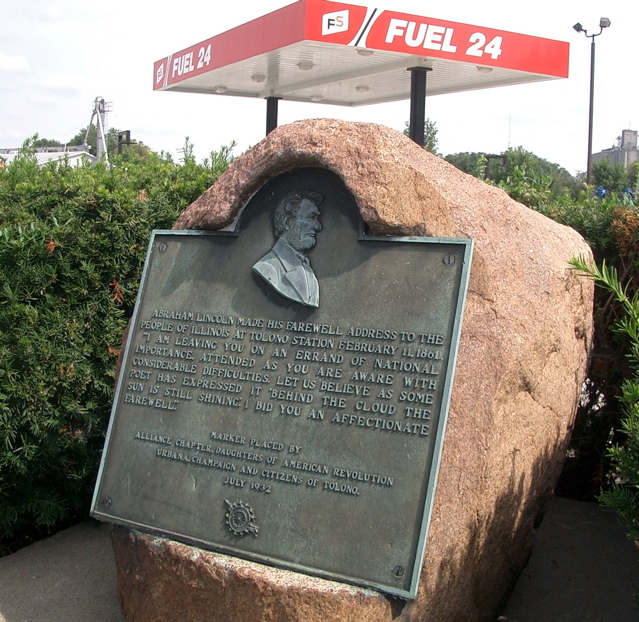
We passed the historical marker sign again, and going by the gas station I finally saw the monument. It was a tablet set into a boulder in among some sort of ever-greenery. The bushes kind of looked like landscaping for the gas station, and the boulder hadn’t been visible when we were consulting local law enforcement about markers of historical significance. The police officer had been parked no more than 100 feet from the spot.

We halted again, and it turned out to be worth it this time. The marker commemorates what is said to be Lincoln’s last speech in Illinois, on February 11, 1861, during a brief stop on his journey east to be inaugurated. One site notes that Lincoln stopped further east, too, in Danville, and spoke to a crowd there. A railroad-centric account of the journey mentions Tolono, but not Danville.)

Lincoln’s brief Tolono speech is on the marker:

“I am leaving you on an errand of national importance, attended as you are aware with considerable difficulties. Let us believe as some poet has expressed it, ‘Behind the cloud the sun is still shining.’ I bid you an affectionate farewell.”

Monument commemorating Lincoln’s stop in Tolono, Illinois, (just south of Champaign) in February 1861.

Don’t Talk About the Weather

earthtemperature.jpgThe New York Times reports that NASA headquarters ordered its scientists to keep their mouths shut about questions arising from the upcoming climate-change blockbuster "The Day After Tomorrow" (with someone named Claude Laforce playing "UN Norwegian diplomat").

"No one from NASA is to do interviews or otherwise comment on anything having to do with" the film, said the April 1 message, which was sent by Goddard’s top press officer. "Any news media wanting to discuss science fiction vs. science fact about climate change will need to seek comment from individuals or organizations not associated with NASA."

The Times also reports that the space agency has called off the dogs and will now let its experts talk about climate stuff. Maybe that has something to do with some research results published last week on NASA’s own site, "Satellite Thermometers Show Earth Has a Fever." Keep it cute like that, so no one will get the idea that increased temperatures have anything to do with well, anything.

View from the Ferry

FerrybuildingCaught the 6:25 ferry back to Oakland after work. Sitting on the top deck, noticed the sun was blocked behind  One Embarcadero Center (that tall building in the middle). Decided to try to shoot it with my camera phone, using my sunglasses as a filter. The building in the center-right with the flag on top is the Ferry Building; that little tiny nub to the far right is Coit Tower, I think. I’m surprised both at the ability to shoot anything with the phone and also at how modest the resolution really is.

In the Mail

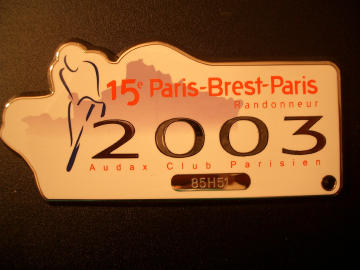
My medal for finishing the 2003 Paris-Brest-Paris randonee.
So, just about eight months to the day after I finished PBP, look what came in the mail. In reading the lore of the ride over the years, I’d seen reports of the medal, complete with your own individual
time on it. For some reason, I thought it might show up by the end of  last year. But it never came, and lots of other stuff came up, and I never really thought too much about it. I just figured that maybe I was the one rider who didn’t get one; or that my ride had been declared invalid for some unworthiness that the organizers had detected in me; or that I had managed to ride the one year when no medals were awarded. Just my luck.

Then I started to see accounts on some cycling email lists a month or so ago that none of the American riders had gotten their medals yet. But they were coming. By sea mail, maybe.

Yesterday, a big brown envelope with my self-addressed sticker was in the mailbox. Heavy. The medal was inside, along with my brevet card, with the stamps from all the controls along the way, and the English-language program for the event, with the finish times for all the participants, including No. 4417, Dan Brekke: 85H51.

Un Pez sin Agua

Sinagua“I feel like a fish without water.” The small type under “sin agua” says “Francisco, 5 años, descridiendo el asma.” It’s a billboard at the corner of 7th and Brannan streets in San Francisco. Kate says she’s seen English versions of it. It struck me just because of my (nearly lifelong) problems with asthma; and also because of the fact the disease seems to have become so prevalent among city kids now; the why of that still seems largely unknown, but one has to think it has got be due to basic environmental causes.

A Totally Whack New World

Opportunity012504The second Mars rover, Opportunity, plunged and bounced and rolled safely to rest last night/this morning. The NASA scientists running the Martian campout are agog at images of the landing site (“it’s a bizarre, alien landscape,” quoth one).

In other news, engineers think the other rover, Spirit, marooned in a less bizarre, less alien landscape, might not be totally brain dead.

[Image credit: NASA/JPL/Cornell]

Molly Kelly

RabbitproofThe lead paragraph from the AP obit in Friday’s New York Times:


SYDNEY, Australia, Jan. 15 — Molly Kelly, whose childhood trek across 1,000 miles of the Australian desert to return to her Aboriginal mother inspired the 2002 movie “Rabbit-Proof Fence,” died on Tuesday at her home in Jigalong in Western Australia, her family said. She was thought to be 87.

The movie is great.