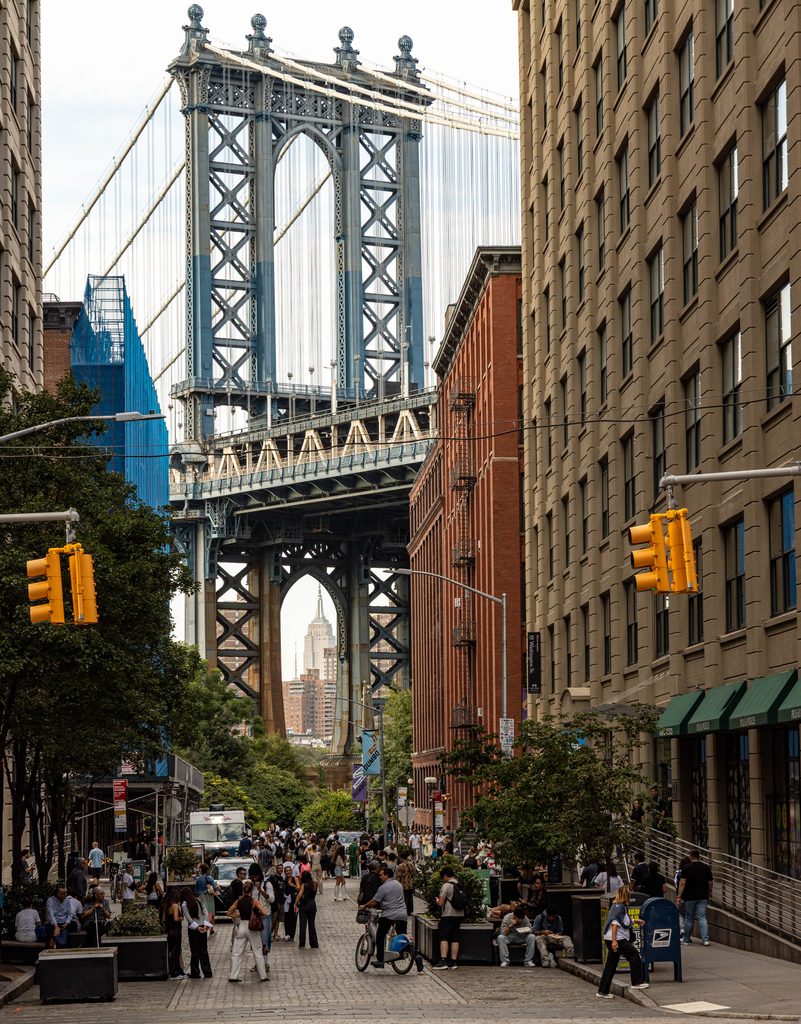
Washington and Water streets in Brooklyn’s DUMBO district is a favorite destination for social media shooters capturing the view of the Empire State Building between the legs of the Manhattan Bridge.
A friend of mine commented recently that this area, now so popular with tourists, was not so long ago the kind of neighborhood where bodies might be dumped. I’m not sure that’s true, but he did prompt me to go back and look at when DUMBO became a thing.
The official story — yes, official, promulgated by the Dumbo Business Improvement District — is that local residents came up with the name in 1978. Some accounts say that the name was meant to be off-putting to real-estate developers who might seek to gentrify the area.
The earliest media mention I can readily find appeared as an item in the Dec. 13, 1981, edition of the New York Daily News:
“First there was SoHo, which stood for South of Houston. Then Tribeca, for Triangle Below Canal. Now an area of lofts and small businesses near Brooklyn Heights that is beginning to attract artist has been unofficially christened the District Underneath the Manhattan Bridge Overpass.”
Note the variation: “District Underneath” rather than “Down Under.” The original name may well have been “district” given the fact residents reportedly considered an alternate name: “District Around the Navy Yard Annex,” or DANYA.
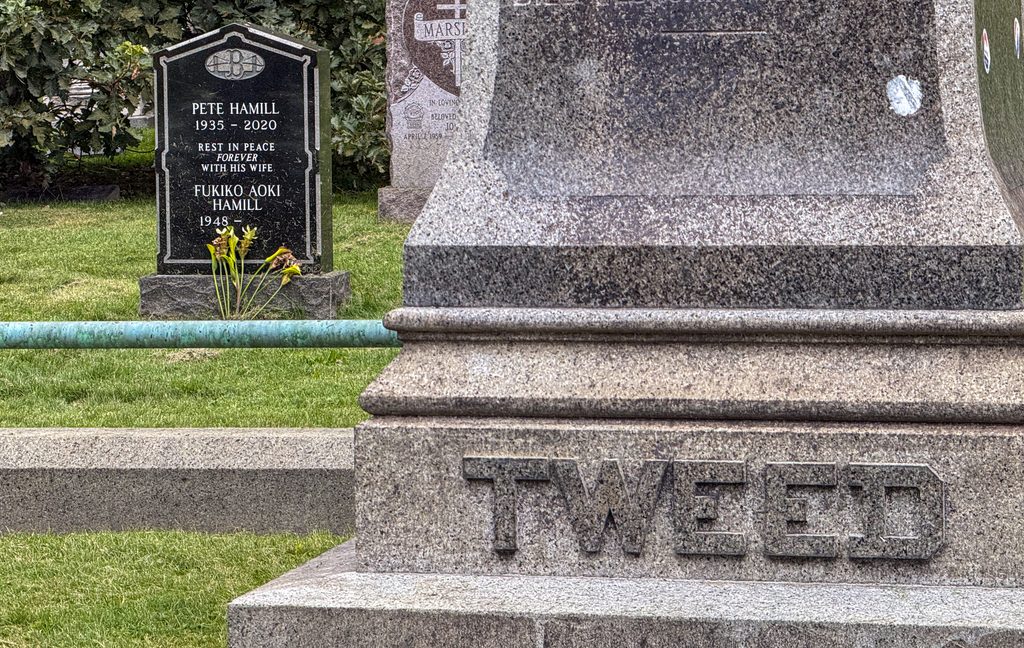
The final resting place of the spectacularly corrupt Boss Tweed, right, and the headstone for New York journalist Pete Hamill, left.
I was in Brooklyn recently and spent most of one afternoon walking around Green-Wood Cemetery. I knew that among the luminaries, scoundrels and common people of New York resting there is William Magear Tweed, better known as Boss Tweed for his corrupt reign as head of Tammany Hall political machine in the 1860s and early ’70s. Tweed’s resting place is marked on a handout map I picked up at the cemetery gate, and after tracking down Leonard Bernstein, DeWitt Clinton and a varriety of lesser mortals, I set out to find him.
Many, many Green-Wood graves declare the importance of the interred with monumental columns and all manner of statuary. Tweed’s is substantial but less than imposing. Standing there taking in the scene, my eye was drawn to another headstone, one just behind and to the left of Tweed’s. It belongs to Pete Hamill, a Brooklyn-born journalist, novelist, raconteur and adviser to Robert F. Kennedy during the 1968 presidential campaign.
What’s the story there? Why is Hamill hanging out with Tweed?
Hamill had a lifelong attachment to Green-Wood — he grew up nearby and played there as a kid — and had often expressed a kind of admiration for Tweed, especially his political skills and attention to what politicos now call “constituent services.”
In reviewing a 2005 Tweed biography for The New York Times, Hamill wrote: “Give me Tweed before any crusader for earthly utopias: religious, Marxist, fascist or neocon. Save me from tinhorn messiahs, and from almost every Republican or Democrat now holding public office. In this era of true believers and invincible mediocrity, give me Tweed.”
Sometime around 2010, Hamill asked Green-Wood’s president, Rich Moylan, for a tour.
“Pete said, ‘Rich, I really need to buy a plot in the Green-Wood,’ as he always called it,” Moylan recalled in a 2024 interview. “And I said, ‘Pete, if we drive around, you see a spot you like, let me know, and we’ll try to find something for you there.’ We got to Boss Tweed’s plot, and he said, ‘Rich, stop. There. Can you find me something there?’ I said, ‘We’ll try.’ Called him back a few weeks later, we found him a spot.”
Hamill certainly recognized Tweed’s flaws. His 2005 book review noted Tweed “remains the epitome of big-city corruption.”
But he adds: “Tweed is a wonderfully vivid subject, a man of gigantic, Rabelaisian hungers. He seems always to have wanted more. More food. More money. More power. Unfortunately, for a long time he got what he wanted.”
I don’t think Hamill the crusading journalist wanted a spot near Boss Tweed with the idea of keeping an eye on a larger-than-life ne’er-do-well. Instead, I’m guessing he figured that if there is some sort of bardo-like afterlife, he wanted the most entertaining company possible.
I’ve been in New York for the past couple of days on a work assignment–attending a conference on transportation reporting sponsored by WNYC. One of the best parts of being in the city is walking; in particular, walking from my brother John’s place at the Brooklyn landing of the Brooklyn Bridge into Manhattan. I went over and back yesterday. And today, I walked over to WNYC, in what I think is West Greenwich Village, and then back to John’s by way of the Manhattan Bridge.
The Manhattan Bridge crosses the East River just to the north of the Brooklyn Bridge. It’s striking in its own way, but rougher, less venerable feeling, more industrial, without the cathedral air of the Brooklyn Bridge. It’s also far less frequented by pedestrians. After dark this evening, it was almost lonely up there after the crowds I’ve seen on the other span. A good place from which to watch the crescent moon set.
David Byrne is an installation artist, author, blogger, recording
executive, photographer, film director and PowerPoint enthusiast. He’s
even been known to dabble in music. But in certain New York
neighborhoods he may be most visible as a bicycle rider, a lanky figure
pedaling around the Lower East Side, or from Bay Ridge out to Coney
Island in Brooklyn or up to the Bronx Museum of the Arts.
In recent years his interest
in bicycles has expanded from riding them to thinking seriously about
the role they play in urban life, as he has started making connections
with politicians and international design consultants keen to keep cars
from taking over the city. So when the Department of Transportation
asked him to help judge a design competition for the city’s new bike
racks, he eagerly agreed — so eagerly, in fact, that he sent in his own
designs as well.
They were simple shapes to define different
neighborhoods around the city: a dollar sign for Wall Street; an
electric guitar for Williamsburg, Brooklyn; a car — “The Jersey” — for
the area near the Lincoln Tunnel. “I said, ‘Well, this disqualifies me
as a judge,’ ” he recalled, “but I just doodled them out and sent them
in.” He figured maybe they’d be used to decorate the contest Web site, nycityracks.wordpress.com.