A friend sent me a link to the movie trailer below — for “The Colossus of Rhodes.” It was made in 1961 and is listed as the directorial debut of Sergio Leone, who found his niche a few years later remaking Akira Kurosawa’s “Yojimbo.”
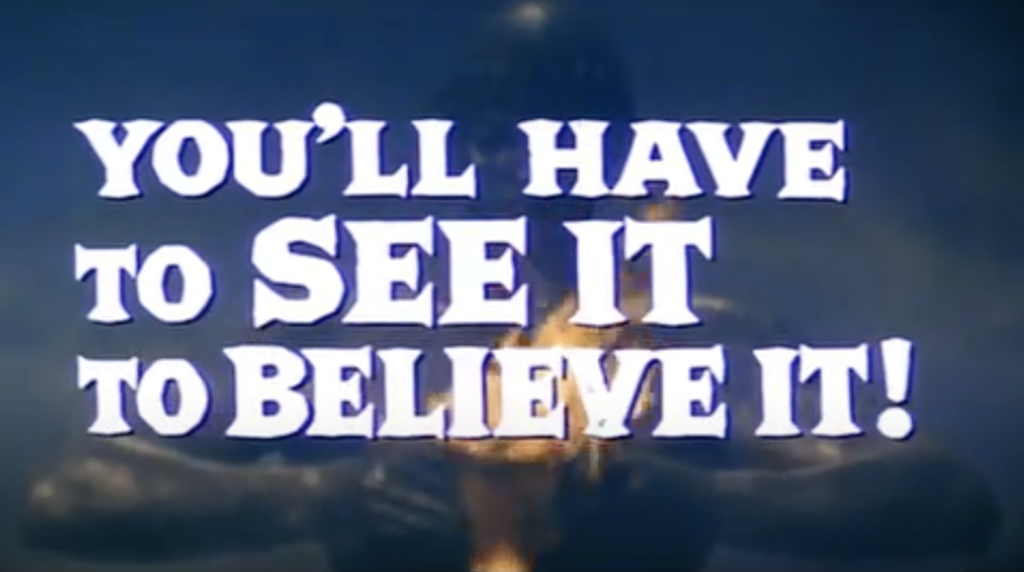
After seeing this preview, I don’t think you need to see the movie. The script for the trailer: a tour de force of overheated verbiage. The delivery: Bombastic and utterly credulous.
Over the course of two and a half action-packed minutes, you’ll encounter a pagan fortress, a city of sin, cruel warriors, devil worshippers, a raging fury of ecstasy and terror, a fiendish torture chamber, Dario the Daring, a beautiful princess, desire, treachery, a thousand towering thrills, the hall of the living dead, the infamous chamber of orgies, a cave of wild beasts, sinister barbarians, a slave revolt, a mob gone mad, depravity, and an awesome holocaust. (The film itself is two hours long and earns a surprisingly positive 56 percent Tomatometer rating at Rotten Tomatoes.)
Summary: “Colossus of Rhodes” is one motion picture that for bigness and excitement has the right to be called “colossal.”
The full script:
The fabulous Colossus astride the harbor of Rhodes, City of Sin, a pagan fortress with an evil purpose.
Behind its eyes, cruel warriors watch the devastation they have wrought within its walls.
The temple of the devil worshippers, as the great god Moloch incited followers into a raging fury of ecstasy and terror.
And behind the wicked heart of the Colossus, the fiendish torture chamber.
Yet fighting back against terror like this was almost sure death. But one man gambled his fantastic strength and power: Dario the Daring, portrayed by Rory Calhoun, star of “The Texan,” racing at the head of a band of reckless horsemen.
Defying the treachery of a beautiful princess: *(Princess:) “Don’t you have the sense to realize you’re in danger?” (Dario:) “Who would look for me here at this time of night?”
Sworn enemies, these two, but still drawn together by their desire for each other.
“Colossus of Rhodes” is one motion picture that for bigness and excitement has the right to be called “colossal,” with its thousand towering thrills:
The Devil’s Cauldron, where slaves were forced to labor in the bowels of the earth.
The hall of the living dead, where a kiss sprung the trap that led to the Cave of the Wild Beasts.
The infamous Chamber of Orgies.
The Arena — terrifying coliseum where sinister barbarians made sport of human agony and human sacrifice evoked the cheers of the crowds.
And as the crescendo of terror rose to a frenzy, a voice: “People of Rhodes! The Colossus you built is now a nest for the traitors!”
The slaves revolt. The people rise to join them. A mob gone mad with the realization of where their depravity has taken them until nature itself looses its fury — an awesome holocaust to destroy the evil all around.”