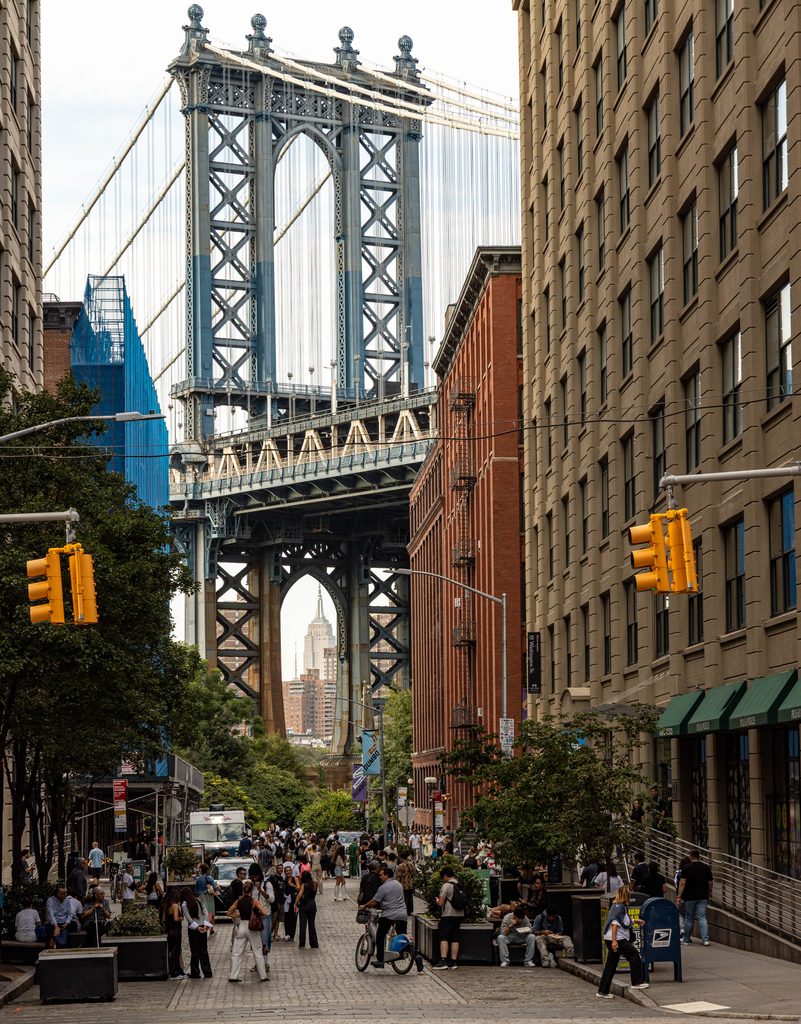
Washington and Water streets in Brooklyn’s DUMBO district is a favorite destination for social media shooters capturing the view of the Empire State Building between the legs of the Manhattan Bridge.
A friend of mine commented recently that this area, now so popular with tourists, was not so long ago the kind of neighborhood where bodies might be dumped. I’m not sure that’s true, but he did prompt me to go back and look at when DUMBO became a thing.
The official story — yes, official, promulgated by the Dumbo Business Improvement District — is that local residents came up with the name in 1978. Some accounts say that the name was meant to be off-putting to real-estate developers who might seek to gentrify the area.
The earliest media mention I can readily find appeared as an item in the Dec. 13, 1981, edition of the New York Daily News:
“First there was SoHo, which stood for South of Houston. Then Tribeca, for Triangle Below Canal. Now an area of lofts and small businesses near Brooklyn Heights that is beginning to attract artist has been unofficially christened the District Underneath the Manhattan Bridge Overpass.”
Note the variation: “District Underneath” rather than “Down Under.” The original name may well have been “district” given the fact residents reportedly considered an alternate name: “District Around the Navy Yard Annex,” or DANYA.
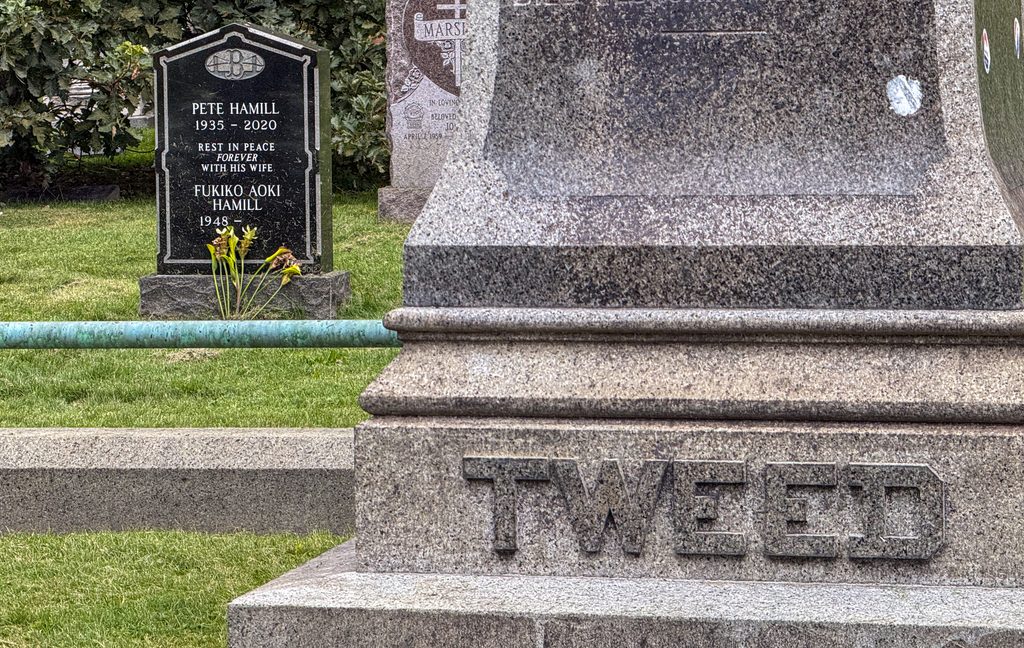
The final resting place of the spectacularly corrupt Boss Tweed, right, and the headstone for New York journalist Pete Hamill, left.
I was in Brooklyn recently and spent most of one afternoon walking around Green-Wood Cemetery. I knew that among the luminaries, scoundrels and common people of New York resting there is William Magear Tweed, better known as Boss Tweed for his corrupt reign as head of Tammany Hall political machine in the 1860s and early ’70s. Tweed’s resting place is marked on a handout map I picked up at the cemetery gate, and after tracking down Leonard Bernstein, DeWitt Clinton and a varriety of lesser mortals, I set out to find him.
Many, many Green-Wood graves declare the importance of the interred with monumental columns and all manner of statuary. Tweed’s is substantial but less than imposing. Standing there taking in the scene, my eye was drawn to another headstone, one just behind and to the left of Tweed’s. It belongs to Pete Hamill, a Brooklyn-born journalist, novelist, raconteur and adviser to Robert F. Kennedy during the 1968 presidential campaign.
What’s the story there? Why is Hamill hanging out with Tweed?
Hamill had a lifelong attachment to Green-Wood — he grew up nearby and played there as a kid — and had often expressed a kind of admiration for Tweed, especially his political skills and attention to what politicos now call “constituent services.”
In reviewing a 2005 Tweed biography for The New York Times, Hamill wrote: “Give me Tweed before any crusader for earthly utopias: religious, Marxist, fascist or neocon. Save me from tinhorn messiahs, and from almost every Republican or Democrat now holding public office. In this era of true believers and invincible mediocrity, give me Tweed.”
Sometime around 2010, Hamill asked Green-Wood’s president, Rich Moylan, for a tour.
“Pete said, ‘Rich, I really need to buy a plot in the Green-Wood,’ as he always called it,” Moylan recalled in a 2024 interview. “And I said, ‘Pete, if we drive around, you see a spot you like, let me know, and we’ll try to find something for you there.’ We got to Boss Tweed’s plot, and he said, ‘Rich, stop. There. Can you find me something there?’ I said, ‘We’ll try.’ Called him back a few weeks later, we found him a spot.”
Hamill certainly recognized Tweed’s flaws. His 2005 book review noted Tweed “remains the epitome of big-city corruption.”
But he adds: “Tweed is a wonderfully vivid subject, a man of gigantic, Rabelaisian hungers. He seems always to have wanted more. More food. More money. More power. Unfortunately, for a long time he got what he wanted.”
I don’t think Hamill the crusading journalist wanted a spot near Boss Tweed with the idea of keeping an eye on a larger-than-life ne’er-do-well. Instead, I’m guessing he figured that if there is some sort of bardo-like afterlife, he wanted the most entertaining company possible.
We got up early this morning in Brooklyn Heights to play a pursue a favorite neighborhood pastime: moving the car from one temporarily illegal parking spot (it’s a street-sweeping day) to a spot that will be temporarily illegal tomorrow (or maybe not, since it’s a holiday). We found a gorgeous new parking space on the north/east end of the Brooklyn Heights promenade. The view across the East River where it opens out into New York Harbor was dazzling. As I started to climb out of the car, I saw a procession of people walking up the promenade. Scores of them, all in business attire. My surmise: They were all headed to the Jehovah’s Witness headquarters, just down the street. The church is a major landowner in the neighborhood where the Brooklyn and Manhattan bridges touch down on the east side of the river, with several large buildings bearing the legend “Watchtower”–the name of the church’s publication.
We stayed and took in the view, watched the parade to The Watchtower, then walked through the stream of parents and kids and commuters to get our first coffee of the morning.
A random Sunday morning find in my 2011 photos–an August street scene in Brooklyn. This was at 5th and Baltic, as Kate and I walked from Court and Warren streets down to Grand Army Plaza to meet our friends Jan and Christian at the Brooklyn Public Library.
We flew out to New York from the Bay Area on Sunday. It may be the last 6 a.m. flight I ever take, because I have so poorly mastered the logistics of an early morning departure that I wind up getting almost no sleep the night before I leave. In the current instance, I wasted much of the eve of the trip screwing around with entirely gratuitous family history stuff; task avoidance if I’ve ever seen it, and believe me I have. The net effect was I was up until after two in the morning doing all manner of stuff I had planned on doing earlier and which I was convinced had to be done. I got about an hour of real sleep (Kate got a bit less), then got up for our cab ride to the airport. We did manage to sleep some on the plane.
Then we landed at Newark. Eamon and Sakura drove bravely through the rain from Brooklyn to pick us up and take us back to their place in Brooklyn (Cobble Hill, just down Court Street from the Borough Hall). We walked out into the storm to eat at a place on Atlantic Avenue, splashed back to the apartment, where I napped for an hour. Then, since the rain was still pounding down, we all took the subway to my brother John’s new place next to the Brooklyn Bridge. He and his wife, Dawn, had lived in the same apartment in the Carroll Gardens neighborhood for 20 years but just this past year landed a spot in a big co-op-type apartment building. We all hung out for a couple hours and checked out the new digs. Outside it had finally stopped raining. the Cobble Hill contingent walked home.
Next morning: No rain. We met John and his kids (Sean and Leah) for coffee and a post-breakfast bagel, then walked to the Brooklyn Heights Promenade and up to the new park at the foot of the Brooklyn Bridge. Kate and I later cleared out and came down to visit her family in friends in what I describe as the northern Jersey shore area–Holmdel and Hazlet townships in Monmouth County. But let’s stay in New York for a minute: The strangest thing for me about our arrival wasn’t the sleepless haze that enveloped parts of the first day but the feeling that I’m visiting a place where my family, through John and Eamon, has put down roots. It feels like home territory, though my zip code still begins with a 9.
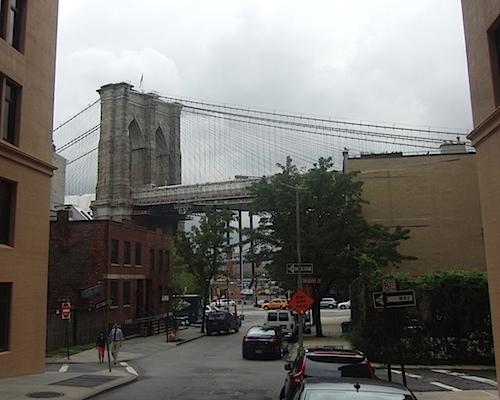
(Photo: east tower of the Brooklyn Bridge, shot from Evert Street outside the headquarters of the Watchtower Society (a.k.a. Jehovah’s Witnesses.) You think of the Witnesses as quaint fringe Bible thumpers? You probably won’t after reading about their immense and hugely valuable Brooklyn real-estate holdings and the part they’re playing in local property wheeling and dealing (involving that same new park I mentioned above.))
I haven’t had to live through a Chicago-type winter in ages. So sights like the alley behind my sister Ann’s house on the North Side of Chicago have a certain appeal: The light on the snow, the tire tracks. Very atmospheric. Of course, I’ll be back in the warm zone in a few days. The atmosphere might be lost on those stay behind, judging by this comment from Ann: “By this point, every time I see it snow, I go, ‘Oh, Jesus.’ “
Of course, there’s snow, and then there’s snow. Below is a shot from my brother John, in Brooklyn, where they had their second foot-plus snowfall in a month yesterday. Atmospheric in a whole different way.
The last day of July, the first of August, it’s supposed to be hot. Today, it’s an unremarkable 90 or so here in Brooklyn. I’m sitting in my brother and sister-in-law’s unairconditioned kitchen about a mile south and east of the Brooklyn Bridge. Not suffering. But tomorrow we’ll be getting what folks to the west have been dealing with for the last couple of days (112 in Bismarck?!). The National Weather Service is warning it will get up to about 100 Tuesday and Wednesday, that it will be plenty humid, and that we’ll have high ozone levels as the air in the region stagnates. (Add rum and guns, then stir for a swell party!)
The last few days, Kate and I have been staying in a friend’s house near the northern New Jersey shore. It’s got central air conditioning, and the system has been running ever since we arrived there last Thursday. It struck me this morning as I walked outside for the first time and shut the sliding glass door behind me that around here, the ability to cool the air in homes and cars and public places of all kinds is just as vital as the ability to heat it in the winter. In the suburbs, anyway, you don’t see homes open to the elements on a hot day any more than you’d see a place with its windows flung open when it’s zero outside. Yet, the weather’s the weather. It may be incrementally hotter on average than it was a generation or two or three ago, but everyone here endured long, stifling stretches of heat then without refrigerating every living space, just as most of the world’s people do today. (We went to France in August 2003 at the tail end of the country’s extended heat wave; I knew air conditioning was uncommon there, but I hoped against hope that somehow our little hotel would be an exception; instead, when we got to our room, we found that the windows hadn’t been opened for days and the place was like an oven — and what was worse was that for several days afterward, there wasn’t enough of a breeze to cool anything off.)
I’m not arguing for some kind of sweaty, hair-shirt virtue in living without air conditioning. Just makes me wonder sometimes what would happen if we all suddenly had to do without (which ties into my fear for the next couple of days; I’m concerned that the power demand here will cause a blackout and shut down the air-traffic-control system and keep us from flying back Wednesday to our effete little climate back in Berkeley). I do remember that before we had our first air conditioners, in 1966, the remedy for hot nights was staying up late watching movies with our mom and taking cool showers before we headed off to bed. Somehow, we slept.
(Picture: Hamilton Avenue and West 9th Street, Brooklyn. It wasn’t really 99 degrees.)