
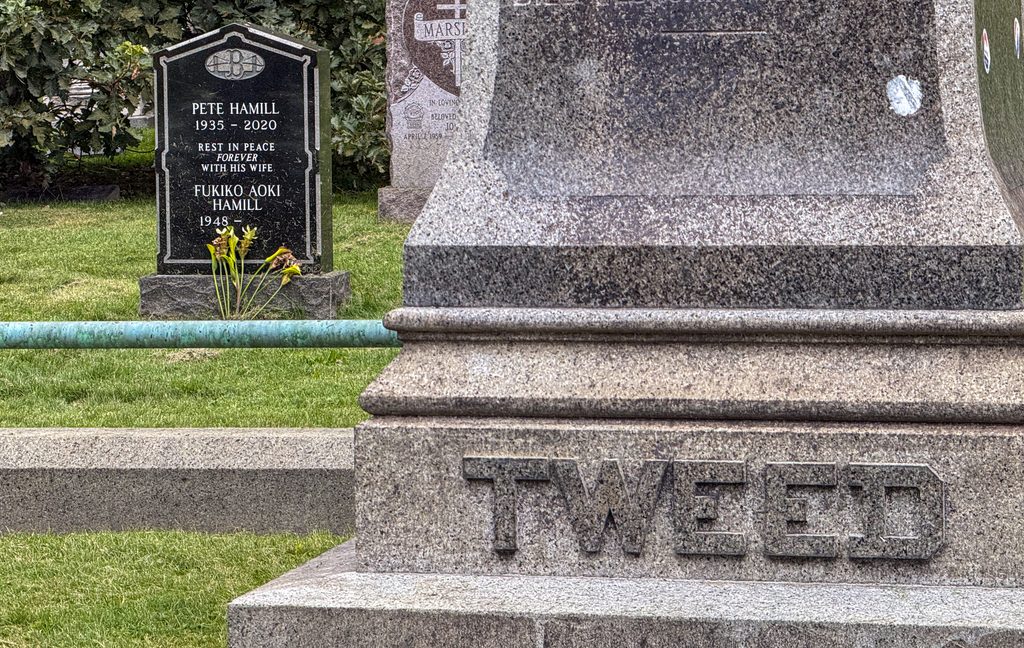
I was in Brooklyn recently and spent most of one afternoon walking around Green-Wood Cemetery. I knew that among the luminaries, scoundrels and common people of New York resting there is William Magear Tweed, better known as Boss Tweed for his corrupt reign as head of Tammany Hall political machine in the 1860s and early ’70s. Tweed’s resting place is marked on a handout map I picked up at the cemetery gate, and after tracking down Leonard Bernstein, DeWitt Clinton and a varriety of lesser mortals, I set out to find him.
Many, many Green-Wood graves declare the importance of the interred with monumental columns and all manner of statuary. Tweed’s is substantial but less than imposing. Standing there taking in the scene, my eye was drawn to another headstone, one just behind and to the left of Tweed’s. It belongs to Pete Hamill, a Brooklyn-born journalist, novelist, raconteur and adviser to Robert F. Kennedy during the 1968 presidential campaign.
What’s the story there? Why is Hamill hanging out with Tweed?
Hamill had a lifelong attachment to Green-Wood — he grew up nearby and played there as a kid — and had often expressed a kind of admiration for Tweed, especially his political skills and attention to what politicos now call “constituent services.”
In reviewing a 2005 Tweed biography for The New York Times, Hamill wrote: “Give me Tweed before any crusader for earthly utopias: religious, Marxist, fascist or neocon. Save me from tinhorn messiahs, and from almost every Republican or Democrat now holding public office. In this era of true believers and invincible mediocrity, give me Tweed.”
Sometime around 2010, Hamill asked Green-Wood’s president, Rich Moylan, for a tour.
“Pete said, ‘Rich, I really need to buy a plot in the Green-Wood,’ as he always called it,” Moylan recalled in a 2024 interview. “And I said, ‘Pete, if we drive around, you see a spot you like, let me know, and we’ll try to find something for you there.’ We got to Boss Tweed’s plot, and he said, ‘Rich, stop. There. Can you find me something there?’ I said, ‘We’ll try.’ Called him back a few weeks later, we found him a spot.”
Hamill certainly recognized Tweed’s flaws. His 2005 book review noted Tweed “remains the epitome of big-city corruption.”
But he adds: “Tweed is a wonderfully vivid subject, a man of gigantic, Rabelaisian hungers. He seems always to have wanted more. More food. More money. More power. Unfortunately, for a long time he got what he wanted.”
I don’t think Hamill the crusading journalist wanted a spot near Boss Tweed with the idea of keeping an eye on a larger-than-life ne’er-do-well. Instead, I’m guessing he figured that if there is some sort of bardo-like afterlife, he wanted the most entertaining company possible.